
Benzopyran Family at a Glance: From the Core Scaffold to Three High-Frequency Applications (Photochromism / Drug Scaffolds / Fluorescence) — with Product Selection Logic and Product Tables (Tables 1–3)
Benzopyran Family at a Glance: From the Core Scaffold to Three High-Frequency Applications (Photochromism / Drug Scaffolds / Fluorescence) — with Product Selection Logic and Product Tables (Tables 1–3)
1.Basic Definition and Nomenclature
Benzopyran refers broadly to a bicyclic parent framework formed by fusion of a benzene ring with a pyran-type oxygen-containing six-membered ring. Depending on the position of the oxygen atom within the fused-ring numbering (i.e., at position 1 or 2), it can be classified into 1-benzopyran (the chromene family) and 2-benzopyran (the isochromene family).
Taking the common parent nucleus 2H-1-benzopyran as an example, it is also known as 2H-chromene. Here, “2H” is the IUPAC indicated hydrogen notation, used to specify which position in the fused system is the saturated site. For 2H-chromene, this means that C-2 is saturated (typically appearing as a –CH₂– unit), which distinguishes it from other hydrogen-location isomers such as 4H-chromene (4H-1-benzopyran) (for instance, in 2H-chromene the double bond is located between C-3 and C-4).
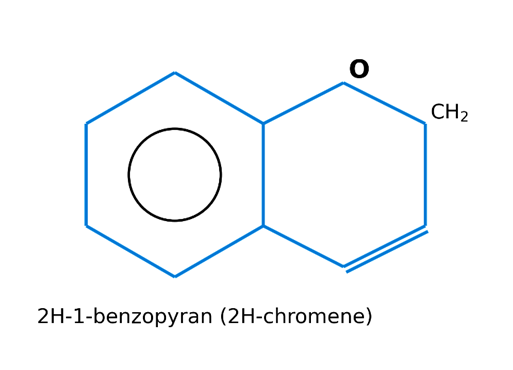
2.Research Background: Why It Is Repeatedly Used as a “Heterocyclic Building Block”
Benzopyrans appear with high frequency because, as a reusable parent scaffold, they satisfy three structural advantages at once:
1. An oxygen site enables controllable polarity and interaction modes:
The oxygen atom provides a stable hydrogen-bond acceptor and a dipole source, making physicochemical properties (solubility, polarity, coordination/binding patterns) easier to tune systematically.
2. A fused bicyclic framework offers rigidity and predictability:
When performing substituent scanning on the same core, conformational changes are more controllable, which is advantageous for building clear structure–property relationships.
3. Multiple key sub-scaffolds can be derived from the same parent core:
By modulating saturation/oxidation state, whether a carbonyl is introduced, and whether the fused system is further extended, the same parent scaffold can be directed toward drug-like scaffolds, fluorescent chromophores, or photochromic switches.
3.Structural Features: Three “Structure Knobs” Determine Three Property Trajectories
Structure knob (tunable variable) | Typical structural forms | Properties changed most directly | Most common application direction |
A. Saturation / oxidation state | Chromene (unsaturated) ↔ Chroman(e) (more saturated) | Degree of conjugation, planarity, reactivity, and stability | Switching from a “reactive platform” to a “more stable scaffold” |
B. Carbonyl introduction | Coumarin (chromen-2-one), Chromone (4H-chromen-4-one) | Stronger electron-accepting character; more controllable photophysics and binding modes | Fluorescent probes/chromophores; drug discovery scaffolds |
C. Fused-ring extension + reversible ring-opening pathway | Extended systems such as naphthopyrans | Longer π-conjugation + a typical reversible “ring-open ↔ ring-closed” pathway | Photochromic lenses; molecular switches |
4.How to Classify the Benzopyran Family: Six Common Scaffolds and Their Typical Uses
Common scaffold types seen in catalogs | Structural features | Properties determined most directly | Common uses / scenarios |
2H-Chromene (2H-chromene / 2H-1-benzopyran) | Benzopyran core; pyran ring contains a double bond (unsaturated) | Conjugation and electronic effects are more “tunable,” facilitating substituent scanning | Lead-like scaffold / synthetic starting block: often used for further functionalization and building series of derivatives |
Chroman(e) (chroman / chromane) | Benzopyran core; pyran ring more saturated (more “scaffold-like”) | Higher stability; more controllable conformations | Stable core scaffold: natural-product analogs, drug-like scaffold comparisons, etc. |
Coumarin (coumarin / chromen-2-one) | Benzopyran incorporating a lactone carbonyl (C-2 carbonyl) | More prominent chromophore/fluorescence behavior; strong photophysical tunability | Fluorescence and probes: imaging/labeling, fluorescent substrates, luminescent-material contexts |
Chromone (chromone / 4H-chromen-4-one) | Benzopyran with a C-4 carbonyl (often with enone character) | Clear planarity and acceptor site; structure–activity relationships (SAR) are relatively straightforward to map | High-frequency drug-discovery scaffold: used for optimization of activity and property tuning |
Chromanone (chromanone / chroman-4-one, etc.) | “Partially saturated + carbonyl” (one fewer double bond than chromone) | Combines rigidity with synthetic handles; rich derivatization pathways | Drug scaffold + synthetic intermediate: often further modified into diverse derivatives |
Naphthopyran (naphthopyran) | Fused-ring extension (larger π-system); typical reversible ring-open/closed pathway | Strong reversible color switching; hue and fading rate tunable via substituents | Photochromism and molecular switches: photochromic lenses, light-responsive materials |
5.Structure Determines Use: Three Most Common Use-Cases of Benzopyrans (Photochromism / Drug Scaffolds / Fluorescence)
5.1 Comparison Table: Scaffold Types vs. Common Use Directions
Common use direction | Representative scaffold(s) | Most critical structural “determinant” | Key evaluation metrics |
Photochromism / molecular switches | Naphthopyran | A reversible “ring-open ↔ ring-closed” pathway; ring-opening markedly extends conjugation to form a colored species | Coloration depth and hue, fading rate, cycling durability |
High-frequency drug-discovery scaffolds | Chromone / Chromanone | “Carbonyl + fused-ring rigidity” provides a defined acceptor site and controllable conformations, enabling iterative SAR optimization | Trends in activity/selectivity, physicochemical properties (solubility/polarity), metabolic stability, etc. |
Fluorescent chromophores and probes | Coumarin | Lactone carbonyl + conjugation forms the chromophore; however, most “directly strong-fluorescence platforms” are substituted coumarins (e.g., 7-OH / 7-NR₂ / 4-substituted). Unsubstituted coumarin more often serves as a chromophore/synthetic starting point and reference. | Excitation/emission maxima, brightness, environmental sensitivity, solubility, and background interference |
5.2 Photochromism and Molecular Switching: Why Naphthopyrans “Change Color—and Switch Back”
Upon light irradiation (commonly UV), naphthopyrans can undergo ring opening to form a strongly absorbing colored species (often described as a merocyanine-type colored form). When irradiation stops, the colored form can typically thermally revert to the ring-closed, colorless state, thus behaving as a reversible “switch.”
From an engineering perspective, three points are usually prioritized:
1. Hue and coloration depth:
Substituents and the π-system influence the absorption characteristics of the colored form and its formation fraction, thereby determining the color tone and intensity.
2. Fading rate:
Structural differences lead to different lifetimes of the colored form, which dictates how quickly the system returns to transparency.
3. Durability (cycling fatigue / photodegradation resistance):
Whether performance decays after repeated switching determines the usable lifetime.
5.3 High-Frequency Scaffolds in Drug Discovery: Why Chromones / Chromanones “Enable Structure Optimization”
The advantages of chromones and chromanones can be summarized as follows: they are relatively rigid, have clearly defined substitution positions, and contain interaction sites such as a carbonyl that can support reproducible interaction patterns. As a result, they are well suited for systematic structural comparisons and iterative optimization.
Common optimization handles include:
1. Substituent scanning for controlled comparisons:
On a fixed core, build a series by varying position, electronic effects, and steric bulk, then track trends in activity and selectivity.
2. Tuning polarity- and solubility-related properties:
Use substituents and polar functional groups to adjust “developability” metrics such as solubility, permeability, and metabolic stability.
3. Reducing uncertainty with a relatively rigid scaffold:
When conformational changes are more controllable, SAR often converges more readily (though it still depends on the target and binding mode).
5.4 Fluorescence and Probes: Why Coumarins Are Often Treated as “Tunable Chromophores”
The core logic of coumarins is that the conjugated lactone framework is a stable chromophore, and multiple positions are readily substituted, allowing the absorption/emission window and environmental responsiveness to be tuned systematically.
Two points are most commonly emphasized:
1. How to tune peak positions and brightness:
Substituents modulate electronic effects and conjugation strength, shifting absorption/emission maxima and changing intensity.
2. How to use—and measure—environmental sensitivity correctly:
Polarity, hydrogen bonding, and microviscosity can significantly affect emission. For responsive probes, use blanks and dilution controls to avoid artifacts (e.g., apparent “changes” caused by the inner-filter effect).
6.Product Navigation Table|Benzopyran-Related Chemicals: Quickly Choose the Right Table by Research Task (Tables 1–3)
Research / experimental need | Recommended table to consult first | Selection logic | Representative products in the table |
Photochromism / photochromic lenses / light-responsive coatings: need a typical “photochromic core” to evaluate materials, ring-opening/closing kinetics, and fatigue behavior | Table 3 (benzopyran / chromone / naphthopyran scaffold building blocks) | The core of many photochromic systems is typically a naphthopyran/chromene-type nucleus. Starting from canonical parent structures is the fastest way to establish a baseline for “photo-response → recovery → durability,” then move to substituent optimization. | 3,3-Diphenyl-3H-naphtho[2,1-b]pyran; 2H-benzopyran |
Fluorescence readout / probes / enzyme-activity assays (HTS): need an inherently bright fluorophore or a readily derivatizable scaffold | Table 1 (Coumarins) | Coumarins are classic fluorescence platforms; in particular, 4-MU, 7-hydroxycoumarin, and aminocoumarin dyes are common starting points that are “directly usable” and/or “substrate-ready.” | 4-Methylumbelliferone (4-MU); 7-hydroxycoumarin; 7-diethylamino-4-methylcoumarin |
Spectroscopy / photophysics mechanisms (microenvironment polarity/H-bond probes, ESIPT mechanism): need model compounds for controls and mechanistic validation | Table 2 (flavones / isoflavones / polyphenols) (for pure coumarin systems, switch to Table 1) | Flavones and flavonols include classic photophysical models (e.g., ESIPT-capable scaffolds), making it convenient to run structure-controlled comparisons within one scaffold family. If your target is specifically “coumarin-type probes,” Table 1 is preferred. | 3-hydroxyflavone; quercetin; (coumarins: 7-hydroxycoumarin / 4-MU) |
Medicinal-chemistry scaffold construction (improving 3D character / metabolic stability): need an oxygen-containing fused scaffold that is “assemblable and substitutable” as fragments/intermediates | Table 3 (benzopyran / chromone / naphthopyran scaffold building blocks) | This table concentrates on benzopyran/chromone/isochroman-type derivatizable scaffold building blocks, aligning better with the medicinal-chemistry “fragment → lead” workflow (clear functionalization sites and extensibility). | 3,4-Dihydro-2H-1-benzopyran; isochroman; chromone; chromone-3-carbaldehyde; 2H-benzopyran |
Flavone/isoflavone natural-product activity screening (antioxidant/anti-inflammatory/receptor pathways): need standards and structure–activity comparisons | Table 2 (flavones / isoflavones / polyphenols) | When the goal is flavone/isoflavone polyphenol activity and pathway effects, start from the “core + representative monomers,” then decide whether mixtures are needed to better reflect real samples. | Flavone; flavanone; naringenin; genistein; daidzein; quercetin |
Phytoestrogens / estrogen-receptor related studies (in vitro pathway / cell assays): need canonical isoflavone controls or mixtures closer to real samples | Table 2 (flavones / isoflavones / polyphenols) | Isoflavones are the most commonly used tool molecules for “phytoestrogen” studies. For “supplement/extract-like real systems,” mixtures better match application scenarios. | Genistein; daidzein; soy isoflavones (mixture) |
Anticoagulation mechanisms / vitamin K pathway (VKA) research: need classic reference drugs or cores for derivatization | Table 1 (Coumarins) | The core of VKA anticoagulants is the 4-hydroxycoumarin platform. This table covers the parent core, representative drugs, and dimer controls—ideal for mechanism/efficacy/methodology comparisons. | Warfarin; phenprocoumon; dicoumarol; 4-hydroxycoumarin |
Fragrance/flavor formulations: odor profile and photostability—need coumarin/dihydrocoumarin “aroma + stability” references | Table 1 (Coumarins) | Coumarin and its hydrogenated derivatives are common in fragrance systems, suitable for formulation stability and quality studies under light/oxidative conditions. | Coumarin; dihydrocoumarin |
Lipophilic antioxidant performance / stability of lipid systems (oils, membranes, formulations): need a canonical fat-soluble antioxidant benchmark | Table 3 (benzopyran / chromone / naphthopyran scaffold building blocks) | α-Tocopherol belongs to the chromanol (benzopyran) platform and serves as a benchmark for lipid-phase antioxidant performance; it is often used to establish a baseline before comparing other antioxidants. | (+)-α-Tocopherol |
Table 1|Coumarins (including 4-hydroxycoumarins / fluorescent coumarins / natural coumarins)
Category | CAS No. | Aladdin Cat. No. | Name | Specification / Purity | Product features & applications |
Coumarin|parent fragrance component / UV-absorbing chromophore | 91-64-5 | Coumarin | AR, ≥98% | Parent coumarin: a classic fragrance ingredient and chromophore. Used in fragrance & flavor studies, UV-absorption and photostability evaluation of materials/formulations; also widely used as a starting material for coumarin-derivative synthesis and as a spectroscopic reference. | |
Coumarin|polyphenolic natural product / antioxidant (Esculetin-type) | 305-01-1 | 6,7-Dihydroxycoumarin | Moligand™, ≥98% | A typical catechol-type coumarin: often used in ROS/free-radical related bioactivity studies, metal-ion chelation and antioxidant benchmarking; also serves as a structural control for how the number/position of phenolic OH groups impacts spectra and reactivity. | |
Isocoumarin|structural control (Coumarin vs Isocoumarin) | 491-31-6 | Isofraxidin | ≥97% | Isocoumarin (1H-2-benzopyran-1-one) core: a constitutional isomer of coumarin, enabling comparisons of how differences in lactone fusion mode affect spectra, reactivity, and binding patterns; also useful as a heterocyclic building block for derivatization and SAR comparison. | |
Coumarin|fluorescent parent (Umbelliferone) / UV probe | 93-35-6 | 7-Hydroxycoumarin | ≥99% | Umbelliferone: a classic UV-absorbing and visible/near-UV fluorescent scaffold. Commonly used in spectroscopy, studies of pH/ionic-environment effects, and as a structural starting point for fluorescent labeling or substrate-release probes. | |
Coumarin|hydrogenated derivative / fragrance & process control | 119-84-6 | Dihydrocoumarin | ≥99% | Hydrogenation reduces conjugation and changes odor profile and reactivity: widely used in fragrances; also used in research as a control for how conjugation/planarity affects spectra and biomolecular interactions, and as a synthetic intermediate. | |
Coumarin|fluorogenic substrate platform (4-MU) | 90-33-5 | 4-Methylumbelliferone (4-MU) | ≥98% | A classic fluorescent reporter: many 4-MU glycosides/esters serve as substrates for enzyme assays (glycosidases, esterases, etc.). Upon enzymatic release, 4-MU produces strong fluorescence; widely used for high-throughput screening and methodological benchmarking. | |
4-Hydroxycoumarin platform|anticoagulant core / derivatization starting point | 1076-38-6 | 4-Hydroxycoumarin | ≥98% | A key core scaffold for VKA-class anticoagulants: commonly used to synthesize derivatives such as warfarin/dicoumarol, and to study how the 4-hydroxy/enolizable acidic site influences binding and activity; also a frequent starting point for medicinal-chemistry scaffold expansion. | |
4-Hydroxycoumarin class|anticoagulant (vitamin K antagonist, VKA) | 152-72-7 | Acenocoumarol | Moligand™, ≥98% (HPLC) | Representative 4-hydroxycoumarin VKA: used in VKA mechanism studies, coagulation/vitamin K pathway controls, and analytical-method validation. As a potent pharmacological reference, store/handle/weigh and control exposure according to appropriate laboratory practices (research use only). | |
4-Hydroxycoumarin class|anticoagulant (vitamin K antagonist, VKA) | 81-81-2 | Warfarin | Moligand™, ≥98% | A classic 4-hydroxycoumarin anticoagulant. Commonly used as a VKA control and as a reference standard in studies of coagulation pathways and the vitamin K cycle (high pharmacological activity—handle under proper controls). | |
4-Hydroxycoumarin class|anticoagulation / inhibitor control (dimer) | 66-76-2 | Dicoumarol | Moligand™, ≥98% | A representative coumarin dimer: used historically in anticoagulation studies and also as a small-molecule inhibitor/tool compound in redox/stress-related pathway research (may have multi-target effects—use appropriate controls/validation). | |
4-Hydroxycoumarin class|anticoagulant (VKA) | 435-97-2 | Phenprocoumon | Moligand™, ≥97% | A typical 4-hydroxycoumarin anticoagulant (member of the VKA family): used for anticoagulation mechanism/pharmacodynamics comparisons and analytical-method validation; also serves as a representative case of the “drugability” of the 4-hydroxycoumarin platform. | |
Coumarin dyes|strong fluorescence / laser-dye scaffold | 91-44-1 | 7-(Diethylamino)-4-methylcoumarin | ≥98% | A typical aminocoumarin fluorescent dye: strong visible absorption/emission; used for fluorescent labeling, photophysics studies, laser dyes, and as a sensitizing scaffold in photosensitization/energy-transfer systems (sensitive to solvent and microenvironment—well suited as a probe scaffold). | |
Coumarin|natural product (Scopoletin) / bioactivity standard | 92-61-5 | Scopoletin | ≥98% | Scopoletin is a representative natural coumarin: commonly used in plant secondary-metabolism studies, anti-inflammatory/antioxidant bioactivity research, and as an analytical reference standard. It also retains the coumarin chromophore, facilitating spectroscopic and quantitative comparisons. |
Table 2|Flavonoids & Isoflavones / Polyphenols
Category | CAS No. | Aladdin Cat. No. | Name | Specification / Purity | Product features & applications |
Flavonoids|flavanone core (Flavanone) | 487-26-3 | Flavanone | Moligand™, ≥98% (HPLC) | A key benzopyranone scaffold reference within the flavonoid family. Commonly used in natural product/metabolite studies, preliminary screening of antioxidant and enzyme/receptor interactions, and as a structural starting point/control for synthesizing flavone/chalcone derivatives. | |
Flavonoids|flavone parent core (Flavone) | 525-82-6 | Flavone | Moligand™, ≥98% | A reference parent flavone compound: used to establish SAR (effects of substitution/hydroxylation/methoxylation on activity and solubility) and as a foundational scaffold control for synthesis and pharmacophore studies. | |
Flavonoids|flavonol antioxidant control | 117-39-5 | Quercetin | Moligand™, ≥95% | A representative polyphenolic flavonol: widely used in antioxidant/metal-chelation and membrane/protein-interaction studies; also a high-frequency standard in polyphenol analysis and quality control (note formulation/controls due to limited solubility and propensity for auto-oxidation). | |
Flavonoids|photophysics probe (3-hydroxyflavone, ESIPT) | 577-85-5 | 3-Hydroxyflavone | ≥98% (HPLC) (T) | A classic ESIPT (excited-state intramolecular proton transfer) fluorescent scaffold: used as a probe for microenvironment polarity/H-bonding ability, studies of binding-site microenvironments in membranes/proteins, and as a model compound in materials photophysics. | |
Flavonoids|citrus polyphenol (Naringenin) | 480-41-1 | Naringenin | ≥97% | A representative citrus flavanone: commonly used in studies of metabolism/transporters/enzyme regulation and as an antioxidant control; also a frequent standard in food/natural-product analytics for quantitation and linking activity to component profiles. | |
Isoflavones|phytoestrogen / signaling regulation | 486-66-8 | Daidzein | Moligand™, ≥98% | A representative soy isoflavone (benzopyranone scaffold): used in phytoestrogen/receptor-pathway studies and inflammation/metabolism signaling research; also used as an HPLC/LC–MS quantitative standard and for analytical-method development. | |
Isoflavones|phytoestrogen / kinase-pathway tool compound | 446-72-0 | Genistein | Moligand™, ≥97% | A representative isoflavone: widely used in estrogen-receptor related effects, cell signaling (including kinase pathways), and metabolism studies; also commonly used as a standard for natural-product activity screening and content determination. | |
Isoflavones|mixture (soy extract) | 574-12-9 | Soy Isoflavones | BioReagent, ≥40%, mixture | A mixed isoflavone formulation closer to real samples/supplement systems. Commonly used for method development (fingerprinting/quantitation), preliminary in vitro screening, and “mixture vs single-component” effect comparisons (composition ratios affect outcomes—retain/characterize batches for reproducibility). |
Table 3|Scaffold Building Blocks: Chromene / Chromone / Naphthopyran (and related)
Category | CAS No. | Aladdin Cat. No. | Name | Specification / Purity | Product features & applications |
Chromanol / Vitamin E|lipophilic antioxidant platform | 59-02-9 | (+)-α-Tocopherol | From type-V vegetable oil, ~1000 IU/g | A classic scaffold combining benzopyran (chromanol) with a long alkyl side chain. A lipid-phase radical scavenger used in antioxidant studies for oils/lipid systems, nutrition and membrane oxidative-stress research, and formulation/stability evaluation (often used as a vitamin E standard/control). | |
Chromone|benzopyranone core building block | 491-38-3 | Chromone | ≥99% | Chromone is a key benzopyranone parent core: used to construct flavone/chromone natural-product and drug-like scaffolds; also a fundamental reference for studying UV absorption, electrophilic/nucleophilic reaction sites, and substituent effects within this scaffold class. | |
Chromone|functionalized building block (aldehyde) | 17422-74-1 | Chromone-3-carbaldehyde | ≥98% (GC) | An aldehyde-functionalized chromone building block enabling condensations, reductive amination, Knoevenagel reactions, and other derivatizations; commonly used for rapid library construction of chromone/flavone analogs, medicinal-chemistry scaffold expansion, and SAR exploration. | |
Chroman|saturated scaffold building block (3,4-dihydro) | 493-08-3 | 3,4-Dihydro-2H-1-benzopyran | ≥98% | A saturated chroman (chromanol-like) benzopyran scaffold: used in medicinal chemistry to increase 3D character and tune lipophilicity/metabolic stability; also a synthetic starting fragment for vitamin E/chromanol analogs and many natural-product motifs. | |
Chromene|2H-benzopyran parent core / reactive & materials scaffold | 254-04-6 | 2H-Benzopyran | ≥95% | One of the most fundamental benzopyran (chromene) parent nuclei: widely used for medicinal-chemistry scaffold construction and for building substituted chromenes (oxygen heterocycles). Also relevant to photoresponsive/chromophore systems in certain chromene/pyran chemistries, serving as a starting building block for structural modification and mechanistic studies. | |
Isochroman|constitutional-isomer scaffold building block | 493-05-0 | Isochroman | ≥98% | A common oxygen-fused scaffold broadly found in natural products and drug-like structures. Used for medicinal-chemistry scaffold insertion (increasing 3D character and tuning properties), fragment-library construction, and synthetic-methodology development. | |
Naphthopyran|photochromic materials (photochromic lens systems) | 4222-20-2 | 3,3-Diphenyl-3H-naphtho[2,1-b]pyran | ≥98% (HPLC) | A representative naphthopyran photochromic scaffold: UV-triggered ring opening/coloration with reversible recovery. Used for photochromic materials, evaluation of lens/coating systems, and benchmarking “photoresponse–durability–fatigue” performance. |
Note: The above are representative Aladdin products. For additional specifications, please refer to the product list at the end of the document, or search the Aladdin website using the product name / CAS / catalog number.
For more related articles, please see below:
Fluorescent probes – brightening the horizon of biomedical research
Application and Channel Selection of Super Fluor Fluorescent Dyes in Multicolor Antibody Labeling