
High-Refractive-Index vs Low-Refractive-Index Coating Materials: From AR/Waveguide Principles to a Formulation & Material-Selection Map (Including Product Category Tables A/B/C)
High-Refractive-Index vs Low-Refractive-Index Coating Materials: From AR/Waveguide Principles to a Formulation & Material-Selection Map (Including Product Category Tables A/B/C)
What role does the refractive index n play in coatings?
The refractive index (refractive index, n) can be understood as “how slow light travels inside a material.” The higher the n, the stronger the material’s “bending ability/optical density” for light. In coatings, tuning n most commonly serves three purposes:
· Anti-reflection (AR) / enhanced transmission: reduce interfacial reflection to increase transmittance and contrast (displays, lenses, solar module cover glass, etc.).
· Waveguides / optical fibers / photonic devices: require a high-n core + low-n cladding to “confine” light inside the waveguide.
· Light management: e.g., OLED light extraction, display glare control, graded-index (GRIN) structures—using multilayers/gradient n to control reflection and optical paths.
Reminder: n is not a fixed constant—it varies with wavelength (dispersion) and temperature. Thin films may also exhibit anisotropy/birefringence. Therefore, literature often reports n_D (589 nm, sodium D line) or explicitly specifies the measurement wavelength and temperature.
Why do “interfaces” reflect light?
In the simplest case (normal incidence, non-absorbing approximation), the interfacial reflectance is given by the Fresnel relation:
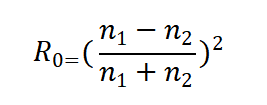
This means: when light goes from air (n≈1.00) to a common transparent substrate (e.g., PET, n≈1.57), the reflectance of a single interface is on the order of a few percent (about 4–7%, depending on n). This is one of the roots of the “first-surface reflection” seen on displays and lenses.
Note: real materials require the complex refractive index, and once incidence is oblique, reflection splits into s/p polarizations, so the optimum conditions change.
Why are AR coatings often designed as “single-layer / multilayer / graded-n”?
The core objective of anti-reflection (AR) is one sentence: make the reflected light as small as possible. Two main mechanisms are used:
1. Destructive interference (make reflected beams cancel each other), and
2. Refractive-index matching (make changes in n smoother across the interface).
1. Single-layer quarter-wave AR: the most classic and fundamental approach
After coating a transparent thin film between “air–substrate,” two main reflected beams arise:
Reflection ①: reflection at the air/film interface
Reflection ②: light enters the film, reflects at the film/substrate interface, and returns to the air side
If these two reflected beams satisfy:
1. a 180° phase difference (one beam is effectively “flipped”), and
2. similar amplitudes (good magnitude matching),
they can destructively interfere on the air side, significantly reducing reflection.
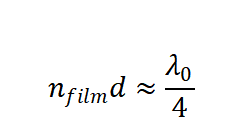
Therefore, single-layer AR often uses two “design conditions”:
1. Thickness condition (phase): optical thickness is approximately one quarter wavelength
2. Refractive-index condition (amplitude matching): film index approximates the geometric mean
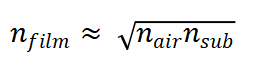
For example, if the substrate has and air has
, the ideal single-layer film requires
.
Why is a single layer often insufficient in practice?
Because it is hard to find a transparent, stable dense material with n≈1.22 (SiO₂≈1.46; MgF₂≈1.38; most commonly processable fluorinated (meth)acrylates/fluoropolymers are typically ~1.35–1.42; some fully fluorinated polymers can go further down to ~1.29–1.34, depending on the system and wavelength.) In addition, a single layer typically performs best only at one design wavelength and near normal incidence (performance degrades when wavelength or angle deviates).
Note: SiO₂ has n≈1.46 in the visible and is a commonly used “low-n layer” in multilayer stacks. However, to approach the ideal single-layer AR target of n≈1.22, porosity/nanostructuring is usually still required.
2. Multilayers and graded-n: for “broader bandwidth and better angular tolerance”
When applications require low reflectance across a broader visible range and/or at larger incident angles (displays, photovoltaics, lenses), engineers often use:
1. Multilayer stacks (high n → medium n → low n): split the refractive-index transition from substrate to air into multiple steps to reduce “abrupt” interfaces, extending low-reflection performance across wavelength/angle.
2. Graded-index (GRIN): make n vary continuously through the thickness (a smoother transition), often achieving “broadband/angle-robust” performance more naturally than discrete layers.
When the target is n≈1.22 or even lower, engineering commonly introduces nanoporosity/nanostructures (mixing “air, n=1” into the material to form an effective medium) to pull n down, and such structures can also be designed as graded layers.
How to make n higher? Three main routes (and their trade-offs)
Route | Typical n range | Representative materials / examples | Advantages | Main trade-offs | Best suited for |
A. Inorganic high-n thin films (classic optical coatings) | ~1.9–2.7+ (material/process-dependent) | TiO₂ is commonly ~2.3–2.7 (depending on phase and process), and k must also be considered (visible “tail absorption” from absorption/defects); Ta₂O₅, Nb₂O₅, HfO₂, ZrO₂ | High n; excellent weather/thermal stability | Higher process barrier (evaporation/sputtering/ALD); stress/cracking; thermal compatibility with plastics; must also manage k (absorption) | High-performance optical stacks; durability-first applications |
B. High-n organics/polymers (heavy atoms/high polarizability) | ~1.60–1.71 (common practical upper limit) | Highly brominated aromatic polymer: n_{20/D}=1.710 (poly(pentabromophenyl methacrylate)) | Solution processable; UV crosslinking/patterning possible | Yellowing/UV absorption risk; balance durability vs processability; solvent and stress control | Photonic devices, waveguides; processable polymer systems |
C. Composites: polymer + high-n nanoparticles | Depends on filler loading (can increase significantly) | TiO₂/ZrO₂/HfO₂ nanoparticles + UV-curable resin | Wide tunability of n; can also improve hardness | The core contradiction “transparency vs high n”: particle size/agglomeration → scattering/haze; dispersion/interface/viscosity are challenging | Coatings requiring “tunable n + engineering performance” |
Note: For Route C, to remain transparent, the characteristic scale of refractive-index fluctuations/particles/pores should ideally be far smaller than visible wavelengths (empirically, < λ/10 is safer). Otherwise, you may shift from “tuning n” to “making a scattering layer.”
How to make n lower? Two main routes + the key to ultra-low n
Route | Typical n range | Representative materials / examples | Advantages | Main trade-offs | Best suited for |
A. Fluorinated polymers/monomers (the main low-n workhorse) | ~1.37–1.42 (common), structure-dependent | Sigma/Merck low-n list: ~1.375–1.418; e.g., poly(HFIPMA) n≈1.390; also available in photo-crosslinkable versions | Wet processing friendly; compatible with patterning/multilayer devices | Low surface energy → poor adhesion; phase separation/crystallization → brittleness or haze; requires primers/coploymerization/interface design | Low-n claddings; AR top layers; polymer-processable systems |
B. Inorganic low-n (dense films) | SiO₂ ~1.46; MgF₂ ~1.38 | SiO₂ (fused silica databases); MgF₂ (databases/instrument libraries) | Transparent; good durability (MgF₂ is commonly used for AR/protection) | n still not low enough for the “ideal single-layer AR” target; process/stress/adhesion still need engineering | Classic optical coating systems |
The secret of ultra-low n (<1.30): porosity/nanostructures | Down to ~1.22 (even lower) | Porous SiO₂ AR: n tunable 1.22–1.44 (via porosity control) | Can approach the ideal single-layer AR target n≈1.22 | Higher porosity → poorer wear resistance; more sensitive to scattering; requires structural/surface reinforcement | Maximum transmission gain; broadband AR (often combined with multilayers/GRIN) |
Note: Highly porous materials are sensitive to water uptake/organic contamination. Once “something enters the pores,” the effective refractive index increases and AR performance degrades. Therefore, end-capping/hydrophobization and structural reinforcement are often necessary.
Typical application scenarios
Application scenario | What is the goal? | “Which n range to match” | Common material routes |
Display/cover glass AR (specular reflection) & high contrast | Reduce specular reflection; increase contrast (optionally add AG for glare reduction) | Make n transition stepwise or continuously from substrate (~1.5–1.6) to air (1.0) to reduce abrupt interfaces | Interference multilayers (high/low n stacks); graded n (co-sputtering/mixed materials); porous/nanostructures (“moth-eye”) as an effective graded-index transition |
Polymer waveguides / optical interconnects (core/cladding) (recommended wording) | Optical confinement; low loss; manufacturability | core n > cladding n; Δn set by coupling/bend radius/mode requirements (commonly 0.05, 0.03, or even lower) | High-n core (aromatic/sulfur-containing/brominated/hybrid) + fluorinated low-n cladding; tune n via formulation/copolymerization while controlling 1550-nm absorption (avoid O–H/N–H) |
Lens/ophthalmic device coatings | Enhanced transmission + wear resistance + weatherability/easy cleaning | Need optical matching (low reflection) plus hardness/adhesion/sweat resistance/abrasion resistance | Hardcoat (resin/hybrid) + inorganic multilayer AR (TiO₂/SiO₂/MgF₂, etc.) + hydrophobic/anti-smudge top layer |
Solar cells | Broadband AR + outdoor durability (crystalline Si also needs surface passivation) | For high-n substrates such as Si, the optimal single-layer AR index is often ~1.9; engineering focuses on “broadband + angle” and “passivation” together | SiNx:H (passivation + AR in one; tunable n); double-layer SiO₂/SiNx; surface texturing/micro-nano structures for anti-reflection |
Common issues and troubleshooting
Symptom | Most common causes | First checks / fixes |
Low transmittance / “gray” appearance, high haze | Agglomeration/phase separation/over-large pores → n nonuniformity → scattering; high surface roughness | Compare dispersion systems (solvent/surface treatment/ultrasonication/filtration); reduce agglomeration and feature scale; control pore structure and drying/curing rate |
Poor adhesion of low-n layers; delamination | Fluorinated systems have low surface energy → poor wetting; insufficient reactive/interpenetrating network at the interface | Use primers/coupling (e.g., silanes); introduce reactive groups (epoxy/hydroxyl/(meth)acrylate, etc.); plasma/UV-O₃ (subject to substrate feasibility) |
Yellowing / poor weatherability of high-n layers | Aromatic/halogenated structures absorb more and undergo photo-oxidation; initiator/residual impurities cause yellowing | Choose more UV-stable structures or shift to inorganic/hybrid routes; switch to low-yellowing initiators; add stabilizers (UV absorbers/antioxidants) and run aging controls |
n does not reach the design value | Formulation errors; insufficient conversion/densification; residual solvent or water uptake; “false n” from measurement model/thickness errors | Re-calibrate with ellipsometry/prism coupling and verify thickness; run a curing-energy/time matrix; compare “dense vs porous” routes; control residual solvent and moisture content |
Aladdin Optical Thin-Film & Optical Coating Refractive-Index Selection Guide: Material Classification Map + Master Table of Representative Products
Product Classification Map — How the Three Sub-Tables Correspond
· A = Low-refractive-index materials (low-n inorganics + fluorinated low-n organics + low-n topcoats)
· B = High-refractive-index materials (high-n inorganics + high-n organics/functional layers)
· C = Others (precursors/deposition sources/surface modification & coupling/process aids)
Material Map (by “what you’re trying to achieve”)
Main Category | Subcategory | Typical use / Why it is its own category | Representative examples | Where to find |
Low n (lower refractive index / low-n end for AR) | Inorganic fluorides / fluoride salts | Classic low-n material family; used as AR top layers/low-n layers/windows, or as low-n fillers | MgF₂, CaF₂, LiF, AlF₃, BaF₂, SrF₂, LaF₃, YF₃, cryolite | Table A |
Low n (lower refractive index / low-n end for AR) | SiO₂ family (dense / nano / mesoporous / microspheres) | SiO₂ is the baseline low-n material; mesoporous/high-porosity forms enable lower “effective n”; nanoparticles are more favorable for transparent composites | 2 µm SiO₂, 30 nm nano-SiO₂, SBA-15 mesoporous SiO₂, magnetic SiO₂ microspheres | Table A |
Low n (lower refractive index / low-n end for AR) | Low-n fluoropolymers | Ultra-low n plus chemical/thermal resistance; commonly used as waveguide claddings/low-n buffer layers | Fluoropolymer (the Tg ~240 °C one) | Table A |
Low n (lower refractive index / low-n end for AR) | Fluorinated (meth)acrylate monomers (tuning low-n resins) | Use “fluorinated side chains” to reduce n and increase hydrophobicity/low surface energy; used in UV/thermal-curing coatings and adhesive formulations | Trifluoro / pentafluoro / hexafluoro / heptafluoro series acrylates and methacrylates (multiple entries) | Table A |
Low n (lower refractive index / low-n end for AR) | Low-n topcoats / anti-fouling surfaces (fluorosilanes) | As the outermost layer: hydrophobic/anti-smudge; reduces water uptake–induced n drift; often used as top layers on glass/SiO₂ surfaces | Perfluorodecyl triethoxysilane, perfluorodecyl trichlorosilane, tridecafluorooctyl triethoxysilane | Table A |
High n (increase refractive index / high-n end for AR / waveguide core) | High-n oxides (thin film / particles / target forms) | The workhorse “high-n layers” for multilayer dielectric stacks; can be used for filters/HR/waveguides/high-n composites | TiO₂, ZrO₂, HfO₂, Ta₂O₅, Nb₂O₅ (Nb family in the table) | Table B |
High n (increase refractive index / high-n end for AR / waveguide core) | High-n nitrides | Common in waveguide ecosystems (high n; low-loss routes are typically deposited); powders are more for composites/ceramics | Si₃N₄, AlN | Table B |
High n (increase refractive index / high-n end for AR / waveguide core) | Functional oxides (mid–high n + functionality) | Beyond refractive index, also provide functions (polishing, electrochromism, etc.); used as references or functional layers | CeO₂, WO₃ | Table B |
High n (increase refractive index / high-n end for AR / waveguide core) | Transparent conductive / optoelectronic functional layers (TCO) | Participate in optical interference (n/k) while also providing electrical functionality; commonly used in devices | In₂O₃, ITO | Table B |
High n (increase refractive index / high-n end for AR / waveguide core) | High-n organic monomers (heavy-halogen / fused-ring aromatics / halogenated aromatics) | Increase n via “high-polarizability structures”; often used for index-matching adhesives or high-n UV coatings | Pentabromobenzyl/pentabromophenyl (meth)acrylates, naphthyl methacrylate, N-vinylphthalimide, chlorostyrene, etc. | Table B |
Others (make the materials “work”: precursors/deposition/surface & process) | Sol–gel silicon sources (for SiO₂) | Key feedstocks for low-n SiO₂ films/porous films; define process window and film quality | TEOS, TMOS | Table C |
Others (make the materials “work”: precursors/deposition/surface & process) | Sol–gel metal alkoxide precursors (for high-n oxides) | Used to prepare networks and films such as TiO₂, ZrO₂, Al₂O₃ via coating/sol–gel routes | Titanium isopropoxide, tetrabutyl titanate, zirconium propoxide, aluminum isopropoxide | Table C |
Others (make the materials “work”: precursors/deposition/surface & process) | Vapor-phase deposition sources (halides: CVD/ALD routes) | Common routes for high-quality films (especially waveguides/dielectric stacks); emphasizes anhydrous handling and safety | SiCl₄, TiCl₄, ZrCl₄ (“zirconium chloride” in the table), HfCl₄ | Table C |
Others (make the materials “work”: precursors/deposition/surface & process) | Medium-n vacuum evaporation materials | Classic evaporated dielectric layers (often used as matching/enhancement layers) | Silicon monoxide (SiO) | Table C |
Others (make the materials “work”: precursors/deposition/surface & process) | Surface end-capping / hydrophobization (reduce water uptake & haze) | Solves “water uptake → n drift / haze increase”; also improves particle dispersion | HMDS, trimethylchlorosilane (TMCS) | Table C |
Others (make the materials “work”: precursors/deposition/surface & process) | Coupling agents / interfacial reinforcement (reduce scattering / improve adhesion) | Key to transparent nanoparticle composites: reduce agglomeration, improve adhesion and damp-heat resistance | APTES, GPTMS, VTMS, MTMS/MTES, phenyltrimethoxysilane, (the MPTS entry) | Table C |
Others (make the materials “work”: precursors/deposition/surface & process) | Process aids (moisture control / drying) | Precursors/sol–gel systems are highly water-sensitive; moisture control improves reproducibility and stability | Activated alumina balls | Table C |
Quick Decision Tree
What problem are you trying to solve?
Want to reduce n / build the low-n end for AR?
Make an inorganic low-n film/layer → choose “fluorides / SiO₂ family” → see Table A
Achieve even lower effective n (porous) → choose “mesoporous SiO₂ / porous SiO₂ approach” → see Table A
Make an organic low-n coating/adhesive → choose “fluorinated (meth)acrylates / fluoropolymers” → see Table A
Need an anti-fouling hydrophobic topcoat → choose “fluorosilanes” → see Table A
Want to increase n / build the high-n end for AR / waveguide core?
Workhorse high-n dielectric films → TiO₂/ZrO₂/HfO₂/Ta₂O₅/Nb₂O₅ → see Table B
Waveguide ecosystem / low-loss route → Si₃N₄/AlN (mostly deposited processes) → see Table B
High-n optical adhesive / UV coating → “heavy-halogen / fused-ring aromatic monomers” → see Table B
Device functional layer (transparent conductor) → In₂O₃/ITO → see Table B
The base material is selected, but films are hard to make / haze is high / adhesion is poor / process is unstable?
Sol–gel / coating route → TEOS/TMOS/metal alkoxide precursors → see Table C
CVD/ALD route → TiCl₄/SiCl₄/ZrCl₄/HfCl₄ → see Table C
Transparency/dispersion/adhesion issues → coupling agents/end-capping (APTES/GPTMS/HMDS/TMCS, etc.) → see Table C
System is moisture-sensitive, poor reproducibility → desiccant (activated alumina balls) → see Table C
Table A. Low-Refractive-Index Materials (Low-n Inorganics + Fluorinated Low-n Organics + Low-n Surface Topcoats)
Category | CAS No. | Aladdin Cat. No. | Name | Specification or Purity | Key features or typical refractive-index-related applications |
Fluorides / fluoride salts (low–medium n, strongly wavelength-dependent; often used as the low-n end or for UV/IR systems) (AR/cladding) | 7784-18-1 | Aluminum fluoride | Anhydrous grade, ≥99.9% metals basis | A member on the low-n fluoride end; used for low-n layers/protective layers/fillers (note moisture sensitivity and processing route). | |
Low-n inorganic fluoride (classic AR top layer) | 7783-40-6 | Magnesium fluoride | PrimorTrace™, ≥99.99% metals basis | Classic low-n material for AR top layers; high purity helps reduce absorption and improve stability. | |
Low-n inorganic fluoride (classic AR) | 7789-75-5 | Calcium fluoride | PrimorTrace™, ≥99.99% metals basis | Low n with a wide transmission window; often used for low-n layers/windows/coating systems. | |
Low-n inorganic fluoride (UV/special windows) | 7789-24-4 | Lithium fluoride | ≥99.995% metals basis, lumps, 10 mm max. lump size, weight 10 g | Low-n fluoride; high-purity lump form is better for impurity-sensitive optical/vacuum-related uses. | |
Low-n inorganic fluoride (general grade) | 7789-24-4 | Lithium fluoride | AR, ≥99% | General low-n fluoride; for low-loss films, pay more attention to impurities and moisture uptake. | |
Low-n inorganic fluoride salt (filler/porosity tuning) | 15096-52-3 | C477345 | Cryolite | Synthetic, ≥97% | Can reduce the effective n in composite systems (control particle size/dispersion to avoid scattering); also common in non-optical industrial uses. |
Low-n inorganic fluoride (commonly used in optical coating systems) | 13709-49-4 | Y106115 | Yttrium fluoride | Anhydrous grade, ≥99.9% metals basis | Common material in fluoride coating systems; anhydrous high purity supports low absorption and process stability. |
Low-n inorganic fluoride (commonly used in optical coating systems) | 13709-38-1 | L102204 | Lanthanum fluoride | PrimorTrace™, anhydrous grade, ≥99.99% metals basis | Common in fluoride systems; suitable as a low-n end/reference material. |
Low-n inorganic fluoride (windows/coatings) | 7787-32-8 | Barium fluoride | PrimorTrace™, ultrapure, ≥99.99% metals basis | BaF₂ is often used in optical windows/coating systems; ultrapure grade helps reduce absorption and impurity effects. | |
Low-n inorganic fluoride (windows/coatings) | 7783-48-4 | Strontium fluoride | PrimorTrace™, ≥99.99% metals basis | A complementary fluoride-family material; often used as a window/coating reference. | |
Low-n SiO₂ powder/particles (baseline low n) | 7631-86-9 | Silicon dioxide | PrimorTrace™, ≥99.99% metals basis, particle size: 2 µm | Baseline low-n material; 2 µm can easily introduce visible scattering—use with caution for transparent films. | |
Low-n porous SiO₂ (lower effective n) | 7631-86-9 | Mesoporous silicon dioxide | ≥99% metals basis, SBA-15 | Porosity → lower effective n; suitable for low-n porous layers/AR structures; note water uptake and mechanical fragility. | |
Low-n nano-SiO₂ (more favorable for transparent composites) | 7631-86-9 | Nano silicon dioxide | ≥99% metals basis, 30 nm | 30 nm is more favorable for transparent composites (“lower n + increase hardness”); dispersion and surface treatment are key. | |
Ultra-low-n fluoropolymer (cladding/low-n buffer) | 37626-13-4 | Poly[4,5-difluoro-2,2-bis(trifluoromethyl)-1,3-dioxole-co-tetrafluoroethylene] | Tg ~240 °C | A representative ultra-low-n, transparent fluoropolymer; commonly used for waveguide claddings, low-n buffer layers, and low-n protective coatings. | |
Low-n fluorinated monomer (low-n resin) | 352-87-4 | 2,2,2-Trifluoroethyl methacrylate | PrimorTrace™ Ultra, electronic grade, ≥99.9999% metals basis | Fluorinated side chain lowers n and increases hydrophobicity/low surface energy; used to tune n in formulations. | |
Low-n fluorinated monomer (low-n resin) | 356-86-5 | 2,2,3,3,3-Pentafluoropropyl acrylate (with TBC inhibitor) | ≥98% (GC) | Low n + hydrophobic; used for low-n topcoats/coating formulations. | |
Low-n fluorinated monomer (low-n resin) | 2160-89-6 | 1,1,1,3,3,3-Hexafluoroisopropyl acrylate (with inhibitor) | ≥98% (GC) | Stronger fluorination → trend toward lower n; note compatibility and volatility. | |
Low-n fluorinated monomer (low-n resin) | 407-47-6 | 2,2,2-Trifluoroethyl acrylate (with MEHQ inhibitor) | ≥98% (GC) | Low-n acrylate; used for low-n UV adhesives/topcoats. | |
Low-n fluorinated monomer (low-n resin) | 3063-94-3 | 1,1,1,3,3,3-Hexafluoroisopropyl methacrylate (with MEHQ inhibitor) | ≥98% (GC) | Low-n methacrylate; generally more favorable for durability/stability. | |
Low-n fluorinated monomer (low-n resin) | 45115-53-5 | 2,2,3,3,3-Pentafluoropropyl methacrylate (with TBC inhibitor) | ≥98% (GC) | Low n + low surface energy; commonly used for organic low-n layers in AR topcoats. | |
Low-n fluorinated monomer (low-n resin) | 45102-52-1 | 2,2,3,3-Tetrafluoropropyl methacrylate | ≥97%, with 50 ppm BHT inhibitor | Low-n blending monomer; used for low-n hardcoats/topcoats. | |
Low-n fluorinated monomer (low-n resin) | 424-64-6 | 2,2,3,3,4,4,4-Heptafluorobutyl acrylate | ≥97% | Longer fluorinated chain → lower n/lower surface energy; common for low-n top layers. | |
Low-n fluorinated monomer (low-n resin) | 13695-31-3 | 2,2,3,3,4,4,4-Heptafluorobutyl methacrylate (with MEHQ inhibitor) | ≥97% | Low n + improved hydrolysis resistance; used in low-n hardcoats/hydrophobic layers. | |
Low-n fluorinated monomer (low-n resin) | 36405-47-7 | 2,2,3,4,4,4-Hexafluorobutyl methacrylate | ≥96%, with MEHQ inhibitor | Low-n blending monomer; balances n/mechanics/compatibility. | |
Low-n fluorinated monomer (low-n resin) | 54052-90-3 | 2,2,3,4,4,4-Hexafluorobutyl acrylate (with MEHQ inhibitor) | ≥95% (GC) | Low-n acrylate; higher reactivity makes the formulation window more sensitive. | |
Low-n top-layer surface modification (fluorosilane) | 51851-37-7 | Triethoxy-1H,1H,2H,2H-tridecafluoro-n-octylsilane | ≥97% (GC) | Fluorosilane topcoat: low surface energy/hydrophobic/anti-smudge; often used as a low-n top layer and for damp-heat comparisons. | |
Low-n top-layer surface modification (fluorosilane) | 101947-16-4 | 1H,1H,2H,2H-Perfluorodecyl triethoxysilane | ≥96% | Stronger hydrophobic/anti-smudge performance; used for top-layer modification and damp-heat comparisons. | |
Low-n top-layer surface modification (fluorosilane, SAM) | 78560-44-8 | 1H,1H,2H,2H-Perfluorodecyl trichlorosilane | ≥96% | Trichlorosilane is “more aggressive”; suitable for dense SAM/top-layer modification to enhance hydrophobic and anti-smudge properties. |
Note: In the visible range, MgF₂/LiF/AlF₃ are more “low-n,” while LaF₃/YF₃ are more “medium-n.” However, in specific wavelength ranges/systems, they can still serve as low-n-end materials.
Table B. High-Refractive-Index Materials (High-n Inorganic Oxides/Nitrides + High-n Organic Monomers)
Category | CAS No. | Aladdin Cat. No. | Name | Specification or Purity | Key features or typical refractive-index-related applications |
High-n oxide (coating/composites) | 1314-23-4 | Zirconium(IV) oxide | Nanoparticles, dispersion, <100 nm (BET), 5 wt.% in H₂O | High-n dispersion for coatings/composites to raise n and hardness; watch for agglomeration → scattering/haze. | |
High-n nitride (composites/ceramics) | 24304-00-5 | Aluminum nitride | Nanopowder, ≤100 nm | High n + high thermal conductivity; more oriented to composites/ceramics; transparent systems require strict particle-size control and dispersion. | |
High-n oxide (vacuum/evaporation feedstock form) | 12055-23-1 | Hafnium(IV) oxide | Pellets, diameter × thickness 13 mm × 5 mm | High-n HfO₂ often used in high-n film stacks; this form is more like an evaporation/target feedstock. | |
High-n oxide (electronic grade) | 1313-96-8 | Niobium(V) oxide (monolithic) | Electronic grade, ≥99.98% metals basis | Nb₂O₅-type high-n material for filters/waveguides/dielectric layers; electronic grade helps minimize absorption. | |
High-n oxide (spectroscopic grade) | 1314-61-0 | Tantalum(V) oxide | PureSpectra™, spectroscopic grade | Ta₂O₅ high-n optical layer; commonly used in multilayer filters/HR/AR stacks. | |
High-n oxide (nanostructure; scattering vs composites) | 13463-67-7 | Titanium dioxide | Nanotubes, average diameter 25 nm, powder | High-n TiO₂ nanostructures can readily enhance scattering; to remain transparent, tightly control size and dispersion. | |
High-n oxide (high-purity films / low loss) | 13463-67-7 | Titanium dioxide | PrimorTrace™, ≥99.99% metals basis | TiO₂ is a mainstay high-n material for multilayer dielectric films. | |
High-n nitride (waveguide ecosystem) | 12033-89-5 | Silicon nitride | ≥98.5% metals basis, nanopowder, <50 nm particle size (spherical) | Si₃N₄ is widely used for high-n, low-loss waveguides (films are usually deposited); powders are more for composite/ceramic references. | |
Mid–high-n functional oxide | 1306-38-3 | C103988 | Cerium oxide | PrimorTrace™, ≥99.99% metals basis | CeO₂: mid–high n plus functional properties; for transparent uses, monitor absorption and particle size. |
Mid–high-n functional oxide (nano) | 1306-38-3 | C103981 | Nano cerium oxide | ≥99.5% metals basis, 20–50 nm | Nano CeO₂ is more favorable for transparent composites (dispersion remains key). |
Optical + electrical functional layer (TCO) | 1312-43-2 | Nano indium oxide | PrimorTrace™, ≥99.99% metals basis, <50 nm (TEM) | In₂O₃: TCO/optoelectronic functional material; powders used for slurries/composites/target pre-processing, etc. | |
Optical + electrical functional layer (TCO) | 50926-11-9 | Indium tin oxide | Nanopowder <50 nm | ITO: widely used transparent conductive layer; more often serves as a device functional layer participating in reflection/interference design. | |
Functional high n (may have visible absorption) | 1314-35-8 | Tungsten trioxide | For elemental analysis, 0.85–1.7 mm | WO₃ functional layer (electrochromism/optical modulation); for “purely transparent high-n dielectrics,” evaluate absorption/color. | |
High-n organic monomer (aromatic/imide) | 3485-84-5 | N-Vinylphthalimide | ≥98% (GC) | Raises n and Tg; used in high-n, heat-resistant polymer/copolymer systems. | |
High-n organic intermediate (aromatic halogenated) | 873-32-5 | 2-Chlorobenzonitrile | ≥98% | Aromatic + halogenation → higher polarizability; more of a synthetic intermediate (for building high-n structures). | |
High-n polymerizable monomer (heavy halogen for high n) | 59447-55-1 | Pentabromobenzyl acrylate | ≥98% | Heavy bromine significantly increases n; used for index-matching adhesives/high-n coatings; watch for yellowing/absorption risk. | |
High-n polymerizable monomer (heavy halogen for high n) | 52660-82-9 | Pentabromophenyl acrylate | ≥98% | Strong n-boosting monomer for high-n formulations; also watch color/absorption and compatibility. | |
High-n polymerizable monomer (aromatic halogenated) | 2039-87-4 | 2-Chlorostyrene | ≥97%, with 100 ppm 4-tert-butylcatechol inhibitor | Aromatic + halogenation increases n; used for copolymer tuning of n (note inhibitor). | |
High-n polymerizable monomer (fused-ring aromatic) | 19102-44-4 | 1-Naphthyl methacrylate | ≥97% (GC), with <500 ppm MEHQ inhibitor | Fused-ring aromatics → stronger n enhancement; commonly used for high-n transparent polymers/index-matching adhesives. | |
High-n polymerizable monomer (aromatic alkene) | 766-90-5 | cis-β-Methylstyrene (with TBC inhibitor) | ≥98% | Aromatic structure increases n; isomer ratio may affect polymerization and properties—verify on the product page. | |
High-n polymerizable monomer (heavy halogen for high n) | 60631-75-6 | Pentabromobenzyl methacrylate | ≥95% | Heavy-brominated methacrylate monomer for high-n adhesives/coating formulations. |
Table C. Others (Precursors / Deposition Sources / Surface Modification & Coupling / Process Aids)
Category | CAS No. | Aladdin Cat. No. | Name | Specification or Purity | Key features or typical refractive-index-related applications |
Sol–gel silicon source (for low-n SiO₂ layers) | 78-10-4 | Tetraethyl orthosilicate (TEOS) | Reagent grade, ≥98% | TEOS: used to make SiO₂ (low n) and porous SiO₂ (lower effective n); for sol–gel/coating routes. | |
Sol–gel silicon source (faster hydrolysis) | 681-84-5 | T110592 | Tetramethyl orthosilicate (TMOS) | ≥98% | TMOS is more reactive; useful for comparing process windows for dense/porous SiO₂. |
High-n precursor (sol–gel TiO₂) | 546-68-9 | Titanium isopropoxide | Packed for deposition systems | High-n TiO₂ precursor; highly moisture-sensitive and hydrolyzes easily—requires anhydrous handling and stabilized formulations. | |
High-n precursor (sol–gel TiO₂) | 5593-70-4 | Tetrabutyl titanate (TBOT) | Chemically pure (CP), ≥98% | TBOT: common for TiO₂ sol–gel; used for high-n films/hybrid networks. | |
High-n precursor (sol–gel ZrO₂) | 23519-77-9 | Zirconium n-propoxide | 70 wt.% in n-propanol | High-n ZrO₂ precursor; control water and use chelation/stabilization to avoid aggregation. | |
Medium-n/hardcoat precursor (Al₂O₃/hybrids) | 555-31-7 | Aluminum isopropoxide | Suitable for synthesis | Forms Al₂O₃ or Al–O–Si networks; often used for medium-n protective/hardcoat layers. | |
Deposition source (SiCl₄, vapor phase) | 10026-04-7 | Silicon tetrachloride | Packed for deposition systems | CVD-related vapor source; strongly moisture-reactive and releases HCl—strict anhydrous handling and safety required. | |
Deposition source (TiCl₄, vapor phase) | 7550-45-0 | T118447 | Titanium tetrachloride | PrimorTrace™, ≥99.99% metals basis | Common deposition source for TiO₂ and related films; highly corrosive and strongly moisture-reactive. |
Deposition source (ZrCl₄, vapor phase) | 10026-11-6 | Zirconium chloride | ≥99.9% metals basis | Used for ZrO₂ high-n thin-film routes. | |
Deposition source (HfCl₄, vapor phase) | 13499-05-3 | Hafnium tetrachloride | Sublimed grade, ≥99.9% metals basis | Sublimed grade suits vapor transport; used for HfO₂ high-n thin-film routes. | |
Vacuum evaporation dielectric (medium-n layers) | 10097-28-6 | Silicon monoxide (SiO) | PureSpectra™, spectroscopic grade, ≥99.8% metals basis | SiO: classic vacuum-evaporated medium-n dielectric (matching/enhancement/multilayers). | |
Surface end-capping / hydrophobization (reduce water uptake & haze) | 75-77-4 | Trimethylchlorosilane (TMCS) | For GC derivatization, ≥99% (GC) | End-caps surface –OH groups to improve hydrophobicity/dispersion; reduces n drift caused by water uptake. | |
Surface end-capping / hydrophobization (reduce water uptake & haze) | 999-97-3 | Hexamethyldisilazane (HMDS) | For GC derivatization, ≥99% (GC) | Milder silylation reagent; often used to hydrophobize and “clarify” SiO₂ surfaces. | |
Coupling agent (interfacial reinforcement; reduce scattering) | 919-30-2 | 3-Aminopropyltriethoxysilane (APTS) | ≥99% | APTES: improves inorganic filler dispersion/adhesion; enhances transparency and stability. | |
Coupling agent (epoxy; adhesion/damp-heat resistance) | 2530-83-8 | 3-Glycidyloxypropyltrimethoxysilane | ≥97% | GPTMS: highly reactive interface chemistry; commonly used to improve bonding and damp-heat resistance. | |
ORMOSIL silane building block (low water uptake / tunable n) | 2031-67-6 | Methyltriethoxysilane (MTES) | ≥98% | Builds organically modified Si–O networks (tends toward lower n; more hydrophobic). | |
ORMOSIL silane building block (low water uptake / tunable n) | 1185-55-3 | Methyltrimethoxysilane (MTMS) | ≥98% | Faster hydrolysis/condensation; commonly used for process comparison. | |
ORMOSIL silane building block (higher polarizability → higher n) | 2996-92-1 | Phenyltrimethoxysilane | ≥98% (GC) | Used to shift Si–O networks toward higher n. | |
ORMOSIL / crosslinkable silane | 2768-02-7 | Vinyltrimethoxysilane | ≥98% (GC) | Vinyl group can participate in crosslinking/copolymerization; used for network building and surface grafting. | |
Polymerizable coupling agent (bring particles into the network; reduce haze) | 2530-85-0 | 3-(Methacryloyloxy)propyltrimethoxysilane | ≥97%, with 100 ppm BHT inhibitor | Helps particles participate in curing networks, improving transparency and stability. | |
Process aid: moisture control / drying | 1344-28-1 | Activated alumina balls | Adsorbent, general-purpose | Sol–gel/halide-precursor systems are moisture-sensitive; moisture control reduces n drift and defects. |
Note: The above are only representative Aladdin catalog items. For more specifications, please refer to the full product list at the end of the document or search the Aladdin website by product name/CAS number.
Aladdin: https://www.aladdinsci.com/