
Pyran and the “Pyran Family” Research Selection Guide: Key Structural Points, a Classification Roadmap, and Experimental Selection Navigation
Pyran and the “Pyran Family” Research Selection Guide: Key Structural Points, a Classification Roadmap, and Experimental Selection Navigation
1.Why do so many fields “run into” pyrans?
In organic chemistry and the life sciences, oxygen-containing heterocycles are among the most frequently encountered structural motifs. Pyran (pyran) is worth learning as a standalone concept mainly for three reasons:
1. “Its traces are everywhere” in biological systems: Many monosaccharides commonly exist in a six-membered ring form. That six-membered oxygen heterocycle framework is what “pyranose” refers to (essentially a tetrahydropyran ring framework).
2. Very common in natural products and lead compounds: A large number of natural products and secondary metabolites (e.g., from marine fungi) contain benzopyran (benzopyran; common specific frameworks include chromene and chroman, among others) and related motifs. Because these structures often come with diverse biological activities, they are frequently treated in medicinal chemistry as scaffolds that can be optimized.
3. Highly practical in synthetic chemistry: Pyran-related reagents (e.g., 3,4-dihydro-2H-pyran, DHP) can, under acid catalysis, convert alcohols into tetrahydropyranyl ether protecting groups (THP protection). Here, THP refers to the tetrahydropyranyl (Thp) protecting group, not the tetrahydropyran ring itself, and it is widely used for hydroxyl protection in multistep synthesis and subsequent acid-mediated deprotection.
2.What is pyran? How is it related to “pyranose/tetrahydropyran”?
Pyran (pyran) is a six-membered oxygen-containing heterocycle: a ring with one oxygen atom + five carbon atoms, containing two double bonds, with the molecular formula C₅H₆O.
It has two positional isomers, distinguished by the position of the labeled hydrogen (H):
①. 2H-pyran (2H-pyran)
②. 4H-pyran (4H-pyran)
③. 2H-pyran and 4H-pyran are tautomeric forms (tautomerism). In the literature, the 2H/4H notation is commonly used to specify the double-bond distribution and the position of the saturated carbon in the ring.
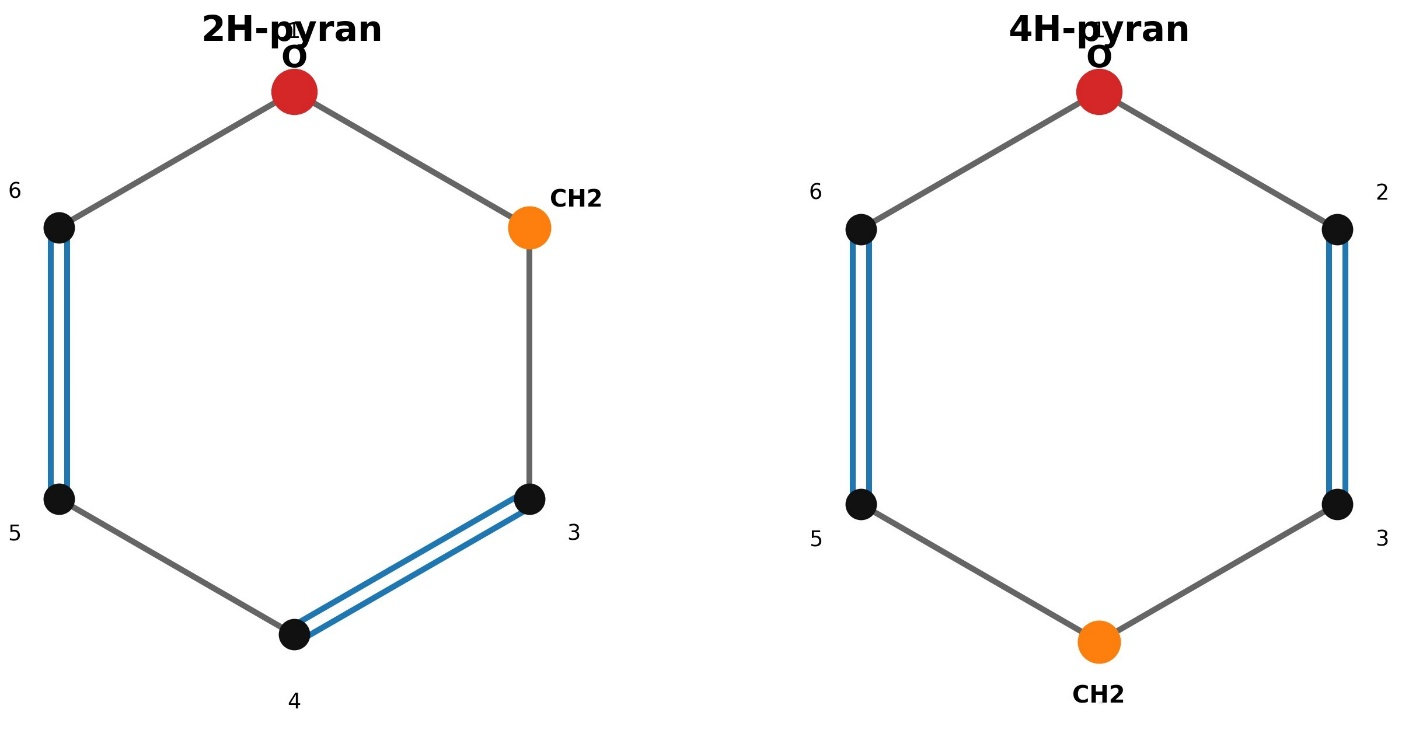
In practical experimental selection and in commercial catalogs, what you encounter more often is not the “parent pyran” itself, but rather its hydrogenated derivatives and fused/functionalized derivative systems, for example:
1. Tetrahydropyran (tetrahydropyran; also called oxane): the fully hydrogenated, saturated six-membered oxygen heterocycle derived from pyran; the “pyranose” form of sugars is based on this ring framework.
2. Pyranose (pyranose): The IUPAC definition of “pyranose” explicitly refers to the cyclic hemiacetal form of a monosaccharide in a six-membered ring (a tetrahydropyran ring framework).
3.Key structural features brought by a single oxygen atom
The structural characteristics of pyran and its derivatives can be summarized in three points:
1. Not a “standard aromatic ring”: The parent pyrans (2H-/4H-pyran) are non-aromatic six-membered oxygen heterocycles. Because the ring contains a saturated carbon position, it is not a fully conjugated aromatic system. As a result, its reactivity is often closer to that of oxygen-containing dienes/enol ethers, rather than typical aromatic heterocycles.
2. The 2H/4H difference comes from double-bond placement: Shifts in double-bond positions change electron distribution, stability, and downstream reaction pathways. Therefore, when designing synthetic routes or selecting building blocks, it is important to distinguish between them.
3. The “pyran family” is readily functionalized and expanded via fusion: For example, fusion with a benzene ring forms benzopyrans (chromene/benzopyran), or introduction of a carbonyl group forms pyranones (pyranone). These expanded motifs are more commonly found in natural products, pharmaceuticals, and functional materials. Among them, 2-pyrone is more often used as a cycloaddition synthon, whereas 4-pyrone more often appears as a conjugated oxygen-containing framework in natural products and in coordination/functional-molecule contexts.
4.Two scenarios that highlight the importance of pyrans
Scenario A: Cyclic forms of sugars (a core concept in life sciences)
Many monosaccharides exist in water as cyclic forms; the six-membered ring form is called a pyranose, and its ring framework is essentially tetrahydropyran.
Scenario B: Medicinal chemistry and natural products (high-frequency scaffolds)
Benzopyrans are an important class of fused oxygen-containing six-membered heterocyclic systems in natural products. Related reviews note that they have broad origins, diverse structures, and connections to many bioactivity studies.
5.Common ways to classify pyran-related structures (by degree of unsaturation / functionalization / fusion mode)
Category | Representative structure | Where you typically see it |
Parent pyran | A six-membered oxygen heterocycle containing two double bonds (2H-/4H-pyran) | Core concepts in heterocyclic chemistry; reaction-mechanism discussions |
Dihydropyran (DHP) | Partially hydrogenated pyran (most commonly 3,4-dihydro-2H-pyran) | Hydroxyl protection (THP protecting group) and multistep synthesis |
Tetrahydropyran (THP/oxane) | A fully saturated six-membered oxygen heterocycle; one of the core ring frameworks in sugars | Carbohydrate chemistry; natural-product fragments; protecting-group chemistry |
Pyranone (e.g., pyranone) | Introduction of a carbonyl on the pyran ring (e.g., 2H-pyran-2-one, etc.) | 2-pyrone: often used as a diene for rapid ring construction via Diels–Alder ([4+2]); 4-pyrone: more often serves as a conjugated oxygen-containing framework (natural products / functional molecules) |
Benzopyran (chromene/benzopyran) | A fused system of a benzene ring + a six-membered oxygen ring | Natural products; medicinal-chemistry lead scaffolds; structure optimization |
Spiropyran / spirobenzopyran | Pyran connected to another ring system through a spiro junction; often associated with photochromism | Photoresponsive materials; molecular switches; sensing and imaging research |
6.Common pyran-related reagents/building blocks: what problems do they solve?
Research task | Pyran-related category you may use | Why it is “useful” |
Protect alcohol hydroxyl groups in multistep synthesis | Dihydropyran (DHP) → THP protecting group | Easy to introduce; relatively stable under many non-acidic conditions; removable under acidic conditions |
Quickly obtain an oxygen-containing six-membered ring fragment (increase 3D character and introduce oxygen features) | Tetrahydropyran / substituted tetrahydropyran fragments | The six-membered ring provides conformational control and steric occupation; often used in fragment-based design |
Build fused-ring or aromatized fragments | Pyranones as cycloaddition substrates | Can act as a diene or dienophile in Diels–Alder and related reactions |
Explore lead scaffolds in medicinal chemistry | Benzopyran (chromene/benzopyran) and derivatives | High-frequency natural-product scaffold; facilitates substitution optimization and SAR studies |
Photoresponsive / reversible switch materials | Spiropyran / spirobenzopyran (spiropyran/spirobenzopyran) | Undergoes light-induced structural switching; suited for molecular switches and functional-material design |
7.Product navigation table|Quickly locate pyran-related sugars, parent pyran cores, and benzopyran building blocks by research task/experimental need (corresponding to Tables 1–3)
Research task / experimental need | Key structural/property cues you need | Recommended product table to check first | What you can find in the table |
Carbon-source supplementation in cell culture / altering culture conditions (control carbon source, alternative carbon source, osmolality control) | Need carbohydrate carbon sources, often in pyranose conformations; focus on cell-culture grade purity, osmolality, and lot-to-lot consistency | Table 1: Sugars and sugar derivatives | Glucose/galactose/fructose/mannose/xylose/arabinose, etc. (commonly used for cell culture and metabolic controls); sucrose/lactose for osmolality and formulations; maltose syrup for biology-grade systems |
Pathway studies, metabolic flux, and energy-dependence experiments (glycolysis, PPP, fructose/galactose metabolism, mitochondria-dependent culture) | Need monosaccharides that selectively bias pathways: e.g., galactose (enhances mitochondrial dependence), fructose (bypass metabolism), glucose (baseline control) | Table 1: Sugars and sugar derivatives | Core monosaccharides for metabolic controls plus related sugar acids/amino sugars; convenient for isotope tracing, media formulation, and control design |
Glycosylation / glycan analysis and receptor-recognition assays (N-glycosylation, lectin/receptor binding, antibody glycoforms) | Need specific monosaccharides/deoxy sugars/sugar acids/amino sugars as substrates, feeds, or controls: GlcNAc, glucuronic acid, fucose, rhamnose, etc. | Table 1: Sugars and sugar derivatives | GlcNAc; glucosamine / glucosamine HCl (hexosamine pathway & O-GlcNAc); glucuronic acid (UGT detoxification & GAGs); fucose/rhamnose (terminal modifications & microbial glycans) |
Cellulose/hemicellulose degradation and related enzyme assays (β-glucosidase, cellulase activity) | Need disaccharide standard substrates with well-defined linkages (e.g., β-1→4) | Table 1: Sugars and sugar derivatives | Cellobiose as a typical enzymatic substrate/analytical standard; xylose/arabinose as controls related to hemicellulose systems |
Molecular biology expression systems and protein purification (induction / affinity elution) | Need functional sugars: L-arabinose for PBAD/araC induction; maltose for elution in MBP systems | Table 1: Sugars and sugar derivatives | L-arabinose (commonly used for induction); maltose syrup (biology grade; compatible with MBP affinity purification elution / carbon source use) |
Organic synthesis: hydroxyl-protection strategy (THP protection) (common in multistep synthesis) | Need 3,4-dihydro-2H-pyran (DHP) as the THP-protection reagent; consider anhydrous handling and acid-catalyzed compatibility | Table 2: Non-fused pyran cores and pyranone systems | 3,4-dihydro-2H-pyran (DHP) for THP protection of alcohols; other pyrans/pyranones in the same table as oxygen-heterocycle building blocks |
Organic synthesis: build tetrahydropyran / pyranone fragments (natural-product / drug scaffold construction) | Need saturated pyran rings / cyclic ketones / pyranone cores suitable for reductive amination, addition, substitution, and other derivatizations | Table 2: Non-fused pyran cores and pyranone systems | Key parent cores and platform molecules such as tetrahydropyran, tetrahydropyranone, 4H-pyran-4-one, 2H-pyran-2-one |
Cycloadditions and strategic rapid ring construction (Diels–Alder; building aromatic/cyclic frameworks) | Need synthons such as 2-pyrone (2H-pyran-2-one) that can serve as a diene/acceptor | Table 2: Non-fused pyran cores and pyranone systems | Core starting materials for cycloaddition (e.g., 2H-pyran-2-one), suitable for rapid scaffold construction and methodology development |
Metal chelation/coordination chemistry and spectroscopic characterization (Fe³⁺/Cu²⁺ complexes; coordination models) | Need pyranone / dicarboxylic-acid motifs: maltol, ethyl maltol, kojic acid, chelidonic acid, meconic acid, etc. | Table 2: Non-fused pyran cores and pyranone systems | Typical pyranone ligands and dicarboxylic-acid systems for complex preparation, spectroscopy/stability-constant comparisons, and colorimetric/identification models for metal ions |
Natural products / medicinal chemistry: build benzopyran scaffold libraries and SAR (flavones/coumarins/chromones/chromans) | Need benzopyran / fused oxygen-heterocycle parent cores: chromone, chromanone, chromene, chroman, flavone/flavanone, etc. | Table 3: Benzopyrans and related fused oxygen heterocycles | Flavones/flavanones; chromones/dihydrochromones; 2H-benzopyran; 3,4-dihydro-2H-1-benzopyran, etc.—useful for scaffold expansion and starting-material selection in medicinal chemistry |
Fluorescent probes / analytical method development (coumarin fluorophore core; dye scaffolds) | Need high-frequency fluorescent cores: coumarins and hydroxy derivatives; xanthene as a dye framework | Table 3: Benzopyrans and related fused oxygen heterocycles | Coumarin, 7-hydroxycoumarin, 6,7-dihydroxycoumarin, scopoletin, etc. for fluorescent substrates/probes; xanthene for fluorophore dye-core construction |
Coagulation/anticoagulation studies or synthetic precursors (warfarin-type cores) | Need 4-hydroxycoumarin as a key core/precursor; focus on purity and downstream derivatization | Table 3: Benzopyrans and related fused oxygen heterocycles | 4-hydroxycoumarin and related coumarin derivatives, suitable for coagulation-pathway research, drug synthesis, and reference standards |
Plant metabolites / polyphenol bioactivity studies (antioxidant, anti-inflammatory, enzyme inhibition) | Need polyphenol systems such as flavones/isoflavones/coumarins as reference standards or mixtures for bioassays and quantification | Table 3: Benzopyrans and related fused oxygen heterocycles | Flavones, flavanones, soybean isoflavones, coumarins and derivatives—suitable for activity screening, mechanistic studies, and analytical controls |
Table 1|Sugars and Sugar Derivatives (predominantly pyranose conformations: monosaccharides / deoxy sugars / sugar acids / amino sugars / disaccharides)
Category | CAS No. | Aladdin Cat. No. | Name | Grade / Purity | Key features & applications |
Monosaccharide (pyranose; general carbon source for cell culture) | 50-99-7 | D432810 | D-(+)-Glucose | Anhydrous grade, PharmPure™, USP, BP, European Pharmacopoeia (Ph. Eur.), ACS | Glucose exists mainly as glucopyranose; the most commonly used carbon source for cell culture and metabolic experiments, including glycolysis/PPP, metabolic flux analysis (often paired with isotope tracing), and control of osmolality and nutrient conditions. |
Monosaccharide (carbon source characterized by pyranose/furanose interconversion) | 57-48-7 | D-Fructose | For cell culture, ≥99% | Fructose shows a pyranose/furanose conformational equilibrium in solution; used in studies of sugar metabolism, fructose uptake, and glycolytic bypass routes (e.g., fructose-1-phosphate–related pathways), and also as a carbon source for fermentation/microorganisms. | |
Monosaccharide (predominantly pyranose; carbon-source/control standard) | 59-23-4 | D-(+)-Galactose | For cell culture; for insect cell culture; ≥99% | A classic monosaccharide carbon source with a pyranose ring; used in cellular energy metabolism and carbohydrate-pathway studies (e.g., galactose metabolism; culture conditions that increase mitochondrial dependence), and commonly used as a reference in glycosylation and glycan analysis. | |
Monosaccharide (pyranose; glycosylation and receptor-recognition studies) | 3458-28-4 | D-(+)-Mannose | Moligand™, for cell culture, ≥99% | Predominantly pyranose in solution; used in N-glycosylation studies and mannose receptor/lectin recognition, as well as microbial adhesion studies, glycan-composition controls, and carbon-source substitution in media. | |
Monosaccharide (pyranose/furanose equilibrium; fermentation and metabolic control) | 58-86-6 | D-(+)-Xylose | Moligand™, ≥99% | Xylose can adopt pyranose/furanose forms in solution; used in xylose metabolism and hemicellulose-degradation research, and often as a carbon source for microbes/yeast and as a substrate/inducer in certain xylose-inducible expression systems. | |
Monosaccharide (pyranose; commonly used for inducible expression / sugar metabolism studies) | 5328-37-0 | L-(+)-Arabinose | Natural | Often exists as a pyranose; widely used in molecular biology as an inducer for the PBAD/araC system (tunable expression), and also in studies of microbial sugar metabolism and polysaccharide side chains (arabinans). | |
Monosaccharide (pyranose; control / metabolic studies) | 10323-20-3 | D-(-)-Arabinose | ≥98% | Pyranose forms are common; used as a control in carbohydrate metabolism and glycan studies, and also as an analytical standard related to microbial carbon sources and polysaccharide side chains (arabinose components). | |
Deoxy sugar (pyranose; terminal glycan modification and immune recognition) | 2438-80-4 | L-(-)-Fucose | Moligand™, ≥98% | Commonly in pyranose form; used in fucosylation, terminal glycan modifications (e.g., antibody Fc glycoforms), and lectin recognition studies; also used as a reference standard for glycan analysis/MS quantification. | |
Deoxy sugar (pyranose; microbial glycans / surface antigens) | 10030-85-0 | L-Rhamnose monohydrate | ≥99% | Commonly pyranose; used in studies of bacterial cell walls/LPS, as a glycosyl donor/control in glycoside and natural-product synthesis, and as a carbon source in fermentation systems; also for glycan quantification standards. | |
Sugar acid (pyranose framework; glucuronidation / detox metabolism) | 6556-12-3 | D-Glucuronic acid | Moligand™, ≥98% | Predominantly pyranose; used in studies of glucuronidation (UGT), models of drug metabolism and detoxification pathways, and synthesis/quantitative controls for glycosaminoglycans and hyaluronic acid–related work. | |
Amino sugar / glycosamine (pyranose framework; GAGs and the hexosamine pathway) | 66-84-2 | D(+)-Glucosamine hydrochloride | For cell culture, ≥99% | An amino-sugar salt based on a pyranose framework; used in the hexosamine biosynthetic pathway (HBP) and in GAG/hyaluronic-acid research; commonly used to modulate protein O-GlcNAc levels and ECM-related experiments. | |
Amino sugar / glycosamine (pyranose framework; metabolism and biomaterials) | 3416-24-8 | Glucosamine | Isomer mixture, ≥95% | A mixed amino sugar based on a pyranose framework; used in amino-sugar metabolism, precursor supplementation for glycosylation, ECM/cartilage-related studies; also a starting material for synthesizing nitrogen-containing sugars and glycomimetics. | |
Amino sugar derivative (GlcNAc; pyranose framework; O-GlcNAc/glycan unit) | 7512-17-6 | N-Acetyl-D-glucosamine | For cell culture, ≥98% | A typical GlcNAc unit (predominantly pyranose); used in O-GlcNAc modification studies, enzymatic substrate/inhibitor studies for N-glycans and chitin-related enzymes, and as a glycan calibration/control standard. | |
Disaccharide (contains a pyranose ring; osmolality/gradients/media additive) | 57-50-1 | Sucrose | PharmPure™, JP, BP, European Pharmacopoeia (Ph. Eur.), NF | Composed of glucopyranose and fructose (often furanose), still containing a pyranose ring; used as a carbon source for plant tissue culture, for osmolality buffering, for density-gradient centrifugation (organelle/virus particle separation), and as a stabilizer. | |
Disaccharide (two pyranose units; lactose metabolism/induction) | 63-42-3 | Lactosum, anhydrous | PharmPure™, USP, JP, European Pharmacopoeia (Ph. Eur.), NF | Composed of galactopyranose + glucopyranose; used in lactose metabolism studies, and in lac-system experiments (can serve as an inducer/substrate under specific conditions), and commonly used as a formulation excipient and stabilizer. | |
Disaccharide (two pyranose units; cellulose degradation and enzymatic substrate) | 528-50-7 | D-(+)-Cellobiose | Analytical standard | Two glucopyranose units linked by β(1→4); used for cellulase/β-glucosidase activity assays, cellulose-degradation pathway studies, and as an analytical standard. | |
Disaccharide solution (two pyranose units; MBP system/carbon source) | 69-79-4 | Maltose solution | BioReagent, molecular biology grade, ~20% in H₂O | Maltose consists of two glucopyranose units; commonly used in molecular biology for MBP (maltose-binding protein) affinity purification (maltose elution from amylose resin), and also as a microbial culture carbon source. |
Table 2|Non-fused pyran cores and pyranone systems (THP/DHP/pyranones/dicarboxylic acids, etc.)
Category | CAS No. | Aladdin Cat. No. | Name | Grade / Purity | Key features & applications |
Saturated pyran core (tetrahydropyran; solvent / scaffold intermediate) | 142-68-7 | Tetrahydropyran | Anhydrous grade, ≥99% | A typical saturated six-membered oxygen heterocycle (hydrogenated pyran); used to build natural-product/drug molecules containing tetrahydropyran fragments; also usable as an aprotic solvent/reaction medium (more compatible with moisture-sensitive systems). | |
Unsaturated pyran core (DHP; THP protecting-group reagent) | 110-87-2 | 3,4-Dihydro-2H-pyran | ≥98% | Classic reagent for THP ether protection: under acid catalysis, reacts with alcohols to form THP ethers; widely used for selective hydroxyl protection/deprotection strategies in multistep synthesis. | |
Saturated pyranone (tetrahydropyranone; cyclic ketone intermediate) | 29943-42-8 | Tetrahydro-4H-pyran-4-one | ≥97% | A six-membered oxygen-containing cyclic ketone intermediate; used to build substituted tetrahydropyran fragments via reductive amination/Grignard reactions/enolization, commonly appearing in synthetic routes for pharmaceuticals and fragrance molecules. | |
Pyranone core (4-pyrone; “γ-pyrone” core structure) | 108-97-4 | 4H-Pyran-4-one | ≥95% (GC) | The most basic 4-pyrone core; often used to study/synthesize substituted 4-pyrones (e.g., maltol, kojic acid, and related derivatives), and as a reactivity model and synthetic intermediate for conjugated oxygen heterocycles. | |
Pyranone/lactone-type heterocycle (2-pyrone; Diels–Alder platform) | 504-31-4 | 2H-Pyran-2-one | ≥97% (GC) | 2-Pyrone is a key synthon in cycloaddition (Diels–Alder) chemistry, enabling efficient construction of substituted aromatic or cyclohexene frameworks; used in heterocycle synthesis and natural-product scaffold assembly. | |
Pyranone (γ-pyrone; coordination/synthetic parent core) | 1004-36-0 | 2,6-Dimethyl-γ-pyrone | ≥99% | Belongs to the γ-pyrone (4H-pyran-4-one) family; often used as a platform for heterocycle synthesis and substitution reactions, and can serve as an oxygen-containing ligand in metal coordination/catalysis model studies. | |
Pyrandione / pyranone (preservative / active-methylene chemistry) | 520-45-6 | Dehydroacetic acid | ≥98% | A 2H-pyran-2,4-dione system; beyond preservative applications, commonly used as a reaction platform in organic synthesis featuring an active methylene/conjugated system, for condensation, addition, and coordination-chemistry studies. | |
Maltol-type pyranone (commonly used ligand for coordination/metal-transport studies) | 118-71-8 | Maltol | ≥99% | 3-hydroxy-2-methyl-4H-pyran-4-one; widely used as a metal-chelating ligand (e.g., Fe³⁺ complexes for spectroscopy/coordination-behavior studies), and as a building block for pyranone derivatives and mechanistic studies. | |
Maltol-type pyranone (flavor / metal chelation / coordination model) | 4940-11-8 | Ethyl maltol | ≥99% | A member of the 3-hydroxy-4H-pyran-4-one family; besides flavor uses, commonly used in research for metal chelation and coordination chemistry, spectroscopic characterization of metal-ion complexation, and dissolution-model studies. | |
Pyranone derivative (kojic acid; chelation / enzyme inhibition) | 501-30-4 | Kojic acid | ≥99% | A hydroxyl-substituted pyranone; widely used in tyrosinase inhibition and browning-mechanism studies, as a metal-chelation model (especially with Fe³⁺/Cu²⁺), and as a precursor for synthesizing oxygen heterocycles and ligands. | |
Pyran dicarboxylic acid (4-pyrone dicarboxylic acid; strong coordination / organic-acid scaffold) | 99-32-1 | Chelidonic acid | ≥96% | A 4-oxo-4H-pyran-2,6-dicarboxylic acid system; commonly used in metal-ion coordination/complexation, organic-acid analytical controls, and synthesis involving pyranone dicarboxylate fragments. | |
Pyranone dicarboxylic acid (meconic acid; analytical identification / coordination) | 497-59-6 | Meconic acid | — | Contains a pyranone dicarboxylate framework; commonly used in metal-ion complexation/analytical chemistry (e.g., forming characteristic complexes with Fe³⁺ for identification/color development), and as a reference for organic-acid and coordination-chemistry studies. |
Table 3|Benzopyrans and related fused oxygen heterocycles (coumarins / chromones / flavonoids / xanthene systems, etc.)
Category | CAS No. | Aladdin Cat. No. | Name | Grade / Purity | Key features & applications |
Coumarin core (benzopyran-2-one; fluorescence/fragrance/scaffold) | 91-64-5 | Coumarin | AR, ≥98% | A classic coumarin scaffold used in fluorescent probe design (coumarin dyes), fragrances, and drug-scaffold research; also a parent core for probe substrates in enzyme activity/metabolic reactions (e.g., hydroxylation). | |
Coumarin (common fluorescent core; “umbelliferone”) | 93-35-6 | 7-Hydroxycoumarin | ≥99% | Also known as umbelliferone; a typical fluorescent coumarin used to build fluorogenic substrates/probes (esterases, glycosidases, etc.), and commonly used as a reference for natural products and metabolite analysis. | |
Coumarin (benzopyran-2-one; polyphenol/fluorescent-probe core) | 305-01-1 | 6,7-Dihydroxycoumarin | Moligand™, ≥98% | Also known as esculetin; a coumarin-core derivative used for antioxidant/enzyme-inhibition studies and as a quantitative reference in natural-product analysis; also used as a precursor for fluorescent coumarin probe development. | |
Coumarin derivative (anticoagulant-core precursor) | 1076-38-6 | 4-Hydroxycoumarin | ≥98% | A key core for multiple anticoagulants (e.g., warfarin-type agents); used in coagulation-pathway studies, drug-synthesis intermediates, and SAR scaffold construction. | |
Coumarin (scopoletin; plant metabolite/fluorescence) | 92-61-5 | Scopoletin | ≥98% | A typical coumarin derivative (with measurable fluorescence); used in plant stress-response/defense-metabolism studies, antioxidant and enzyme-regulation experiments, and as a reference for natural-product detection and quantification. | |
Chromone core (benzopyran-4-one) | 491-38-3 | Chromone | ≥99% | A typical chromone (benzopyran-4-one) core; used for synthesizing flavone/isoflavone derivatives, medicinal-chemistry scaffold expansion, and as a quantitative reference for natural products. | |
Saturated chromone (chromanone; benzopyranone derivative) | 491-37-2 | 4-Chromanone | ≥97% | Chromanone is an important intermediate in chromone/flavonoid chemistry; used to synthesize flavanones, chromanols, and related drug scaffolds, and often subjected to reduction, alkylation, condensation, and other derivatizations. | |
Benzopyran core (chromene; building block) | 254-04-6 | 2H-Chromene | ≥95% | Also called 2H-1-benzopyran (chromene); a key building block in medicinal chemistry and natural-product synthesis, enabling rapid expansion of benzopyran chemical space via epoxidation, addition, substitution, and related transformations. | |
Saturated benzopyran (chroman; vitamin E / chroman scaffold) | 493-08-3 | 3,4-Dihydro-2H-1-benzopyran | ≥98% | The chroman scaffold; structurally related to vitamin E (tocopherol) and antioxidant motifs, and commonly used as a key intermediate in medicinal chemistry and natural-product synthesis. | |
Natural-product scaffold related to benzopyrans (flavone; chromone system) | 525-82-6 | Flavone | Moligand™, ≥98% | Flavone (2-phenylchromen-4-one) belongs to the chromone/benzopyran-4-one system; commonly used as an HPLC reference for natural-product analysis, in antioxidant/anti-inflammatory studies, and as a starting scaffold for structural modification. | |
Natural-product scaffold related to benzopyrans (flavanone/flavone system) | 487-26-3 | Flavanone | Moligand™, ≥98% (HPLC) | A benzopyran-related scaffold (flavanone is a dihydroflavone); widely used as a scaffold building block in natural-product/medicinal chemistry for asymmetric synthesis, redox transformations, and activity-screening reference standards. | |
Isoflavone mixture (benzopyran-4-one system; phytoestrogens) | 574-12-9 | Soy isoflavone | BioReagent, ≥40%, mixture | Isoflavones belong to the benzopyran-4-one system; used in phytoestrogen/estrogen-receptor pathway studies and antioxidant/inflammation models, and commonly as a reference for food and natural-product analysis. | |
Tricyclic oxygen-hetero scaffold (xanthene; fluorophore dye core) | 92-83-1 | Xanthene | ≥98% | Xanthene is the core scaffold of many fluorophores (e.g., fluorescein, rhodamine); a key starting core for fluorescent probe/dye synthesis and photophysical studies. | |
Tricyclic oxygen-hetero scaffold (xanthone; dibenzo-pyranone system) | 90-47-1 | Xanthone | ≥98% (GC) | Xanthone belongs to the dibenzo-pyranone system; used in natural-product/medicinal-chemistry scaffold studies, photophysics and fluorescence evaluation, and as a starting point for structural modification and activity screening. |
Note: The above are representative Aladdin products. For additional specifications, please refer to the product list at the end of this document, or search the Aladdin website using the product name / CAS number / catalog number.
For more related articles, please see below:
Understanding n-Octyl-β-D-glucopyranoside: A Non-ionic Surfactant for Research and Biotechnology
Oxetane: Property-Window Optimization and a Building-Block Selection Guide (Tables 1–4)