
Determine the necessary mass, volume, or concentration for preparing a solution.
| Activity Type | Activity Value -log(M) | Mechanism of Action | Activity Reference | Publications (PubMed IDs) |
|---|
≥98% for sensitive chromatographic and analytical workflows requiring minimal baseline interference.
Store at -20°C Ships Ice chest + Ice pads Check lot-specific COA for exact specifications.
SDS, COA, datasheet, and spec sheet available for download. Lot-specific COA accessible via lot number lookup.
Cited in 0 peer-reviewed publications across chromatography, organic synthesis, and cross-coupling reactions.
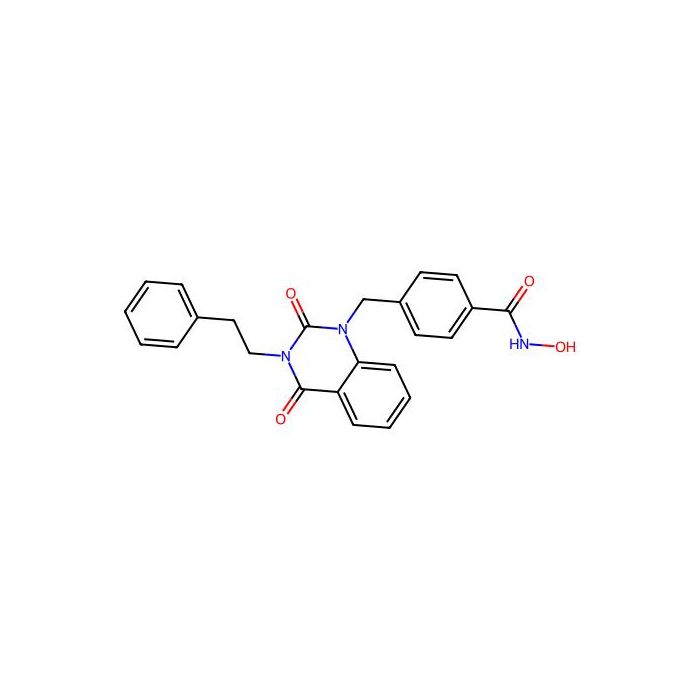
J22352 is a PROTAC (proteolysis-targeting chimeras)-like and highly selective HDAC6 inhibitor with an IC 50 value of 4.7 nM. J22352 promotes HDAC6 degradation and induces anticancer effects by inhibiting autophagy and eliciting the antitumor immune response in glioblastoma cancers, and leading to the restoration of host antitumor activity by reducing the immunosuppressive activity of PD-L1
In Vitro
J22352 (0.1-20 μM; 72 hours) decreases U87MG cell viability in a dose-dependent manner. J22352 (10 μM; 24 hours) shows a dose-dependent decrease in HDAC6 protein abundance. MCE has not independently confirmed the accuracy of these methods. They are for reference only. Cell Viability AssayCell Line: U87MG cells Concentration: 0.1 μM; 0.5 μM; 1μM; 2.5 μM; 5 μM; 10 μM; 20 μM Incubation Time: 72 hours Result: A dose-dependent decrease on U87MG cell proliferation. Western Blot AnalysisCell Line: U87MG cells Concentration: 10 μM Incubation Time: 24 hours Result: A dose-dependent decrease in aberrant overexpression of HDAC6 in glioblastoma.
In Vivo
J22352 (10 mg/kg; given i.p. per day for 14 days in male nude mice) results in a >80% tumor growth inhibition (TGI) rate. J22352 is well tolerated in mice . MCE has not independently confirmed the accuracy of these methods. They are for reference only. Animal Model: Male nude mice (BALB/cAnN.Cg-Foxnlnu/CrlNarl, 4-6 weeks old) Dosage: 10 mg/kg Administration: Given i.p.; per day for 14 days Result: Marked anti-tumor effects and well tolerated in mice.
Form:Solid
IC50& Target:HDAC6 4.7 nM (IC 50 )
| Sonrisas canónicas | C1=CC=C(C=C1)CCN2C(=O)C3=CC=CC=C3N(C2=O)CC4=CC=C(C=C4)C(=O)NO |
|---|---|
| IUPAC Name | 4-[[2,4-dioxo-3-(2-phenylethyl)quinazolin-1-yl]methyl]-N-hydroxybenzamide |
| InChIKey | JBJIKUXUKSADFV-UHFFFAOYSA-N |
| INCHI | 1S/C24H21N3O4/c28-22(25-31)19-12-10-18(11-13-19)16-27-21-9-5-4-8-20(21)23(29)26(24(27)30)15-14-17-6-2-1-3-7-17/h1-13,31H,14-16H2,(H,25,28) |
| Isómeros SMILES | C1=CC=C(C=C1)CCN2C(=O)C3=CC=CC=C3N(C2=O)CC4=CC=C(C=C4)C(=O)NO |
| PubChem CID | 138377601 |
| Peso molecular | 415.44 |
Comprehensive hazard, handling, storage, and regulatory compliance document.
Download SDS →Lot-specific quality data. Enter your lot number to retrieve the exact COA.
Look up COA →Full quality attributes and acceptance criteria for this grade.
View spec sheet →Taxonomy Tree
| Kingdom | Organic compounds |
|---|---|
| Superclass | Organoheterocyclic compounds |
| Clase | Diazanaphthalenes |
| Subclass | Benzodiazines |
| Intermediate Tree Nodes | Not available |
| Direct Parent | Quinazolines |
| Alternative Parents | Benzoic acids and derivatives Benzoyl derivatives Pyrimidones Vinylogous amides Heteroaromatic compounds Ureas Lactams Carboxylic acids and derivatives Azacyclic compounds Organopnictogen compounds Organooxygen compounds Organonitrogen compounds Organic oxides Hydrocarbon derivatives |
| Molecular Framework | Aromatic heteropolycyclic compounds |
| Substituents | Quinazoline - Benzoic acid or derivatives - Benzoyl - Pyrimidone - Benzenoid - Pyrimidine - Monocyclic benzene moiety - Heteroaromatic compound - Vinylogous amide - Urea - Carbonic acid derivative - Lactam - Azacycle - Carboxylic acid derivative - Organic nitrogen compound - Organic oxygen compound - Organopnictogen compound - Organic oxide - Hydrocarbon derivative - Organooxygen compound - Organonitrogen compound - Aromatic heteropolycyclic compound |
| Descripción | This compound belongs to the class of organic compounds known as quinazolines. These are compounds containing a quinazoline moiety, which is made up of two fused six-member aromatic rings, a benzene ring and a pyrimidine ring. |
| External Descriptors | Not available |
| Activity Type | Activity Value -log(M) | Mechanism of Action | Activity Reference | Publications (PubMed IDs) |
|---|
| Activity Type | Activity Value -log(M) | Mechanism of Action | Activity Reference | Publications (PubMed IDs) |
|---|
| Activity Type | Relation | Activity value | Units | Action Type | Journal | PubMed Id | doi | Assay Aladdin ID |
|---|
| Activity Type | Relation | Activity value | Units | Action Type | Journal | PubMed Id | doi | Assay Aladdin ID |
|---|
| Activity Type | Relation | Activity value | Units | Action Type | Journal | PubMed Id | doi | Assay Aladdin ID |
|---|
| Activity Type | Relation | Activity value | Units | Action Type | Journal | PubMed Id | doi | Assay Aladdin ID |
|---|
| Activity Type | Relation | Activity value | Units | Action Type | Journal | PubMed Id | doi | Assay Aladdin ID |
|---|
| Activity Type | Relation | Activity value | Units | Action Type | Journal | PubMed Id | doi | Assay Aladdin ID |
|---|
| Solubilidad | DMSO : 125 mg/mL (300.89 mM; Need ultrasonic) |
|---|