
Cellular Energy Metabolism Assay
Cellular Energy Metabolism Assay
Cellular energy metabolism, specifically cellular aerobic respiration and glycolysis, was measured using the seahorse instrument.
Principle
Aerobic respiration and glycolysis are the two main energy production pathways in the cell; the former can be measured as the rate of oxygen consumption for cellular respiration by the addition of different mitochondrial electron transport chain drugs, while the latter can be measured as the rate of cellular acid production by the addition of oligomycin to inhibit aerobic respiration.
Operation method
seahorse Detects cellular energy metabolism
Principle
Aerobic respiration and glycolysis are the two main energy production pathways in the cell; the former can be measured as the rate of oxygen consumption for cellular respiration by the addition of different mitochondrial electron transport chain drugs, while the latter can be measured as the rate of cellular acid production by the addition of oligomycin to inhibit aerobic respiration.
Materials and Instruments
Seahorse XFe96 Instrument; Seahorse XF Cellular Mitochondrial Stress Assay Kit Move The experimental operation of Seahorse cellular energy assay may vary in cell type (adherent or suspension), cell number, and drug dosage concentration, which need to be adjusted during the experimental process, the following is a mitochondrial stress test protocol for adherent cells: I. Preparation 1. Inoculation of adherent cells: Inoculate the cells on XF96 cell culture plate, 80 μL of medium per well, the cell number should be 5~20 k/well, and then add 70 μL of medium to each well after the cells have been cultured and fixed in the incubator for 1 h. Add 150 μL of medium to the background correction wells without cells, and then incubate the plate in a 37 ℃ CO2 cell culture incubator overnight. The cell culture plate was incubated in a 37 ℃ CO2 cell incubator overnight; 2. Hydration Probe Plate: Add 200 μL/well of sterile water into the Utility Plate, then put the probe plate and cover on it, and move it slightly to expel the air bubbles, and then put it into 37 ℃ CO2-free cell culture incubator overnight; meanwhile, take out at least 20 mL of the XF calibration solution and put it into centrifugal tube, and then put it into 37 ℃ CO2-free cell culture incubator overnight; Second, on-line testing 1. Seahorse Xfe96 system warm-up: Turn on the instrument, computer and software at least 5 hours in advance for warm-up. 2; 2. Hydrate the probe plate: Remove the probe plate device on the next day, discard the sterile water in the Utility Plate, add 200 μL of XF calibration solution to each well, put on the probe plate and cover, and then hydrate the plate for 45~60 min at 37℃ in a CO2-free cell culture incubator; 3. Configure the assay solution: the method of configuration should be carried out according to the instruction of the kit and adjusted according to the experimental requirements; in short, a plate should be configured with about 100 mL of assay solution (97 mL of 103575-100 kit with 1 mL of glucose (final concentration 10 mM), 1 mL of pyruvate (final concentration 1 mM), 1 mL of glutamine (final concentration 2 mM), 1 mL of pyruvate (final concentration 2 mM), 1 mL of pyruvate (final concentration 2 mM) and 1 mL of glutamine (final concentration 2 mM). (final concentration of 1 mM), 1 mL pyruvate (final concentration of 1 mM), 1 mL glutamine (final concentration of 2 mM)) in the cartridge, adjust the PH of the assay solution to 7.4, and then filter the solution through a 0.22 μm cell strainer and incubate at 37 ℃. 4; 4. Cell exchange: Discard the medium in the cell culture plate (leaving 20 μL covering the cells), add 200 μL of detection solution to wash for 2 times, remove the detection solution thoroughly, then add 180 μL of detection solution, and put the cells into a 37 ℃ CO2-free cell culture incubator for 60 min to wait for the machine; 5. Dispensing: take out a packet of drug from the kit and dilute it with the assay solution, as shown in the table below. Drug Resuspension volume Dilute the resuspension solution, the volume of resuspension added per 3 mL of working solution. Concentration of working solution Final Concentration Oligomycin 630 μL 450 μL 15 μM 1.5 μM FCCP 720 μL 300 μL 10 μM 1 μM Rot/AA 540 μL 300 μL 5 μM 0.5 μM Recommended final concentration for Oligomycin is 1.5 μM, Rot/AA is 0.5 μM, FCCP is 0~2 μM, 2~3 mL of working solution is loaded into the probe plate for 10x concentration, e.g., to get the final concentration of 1.5 μM of Olygomycin, you need to add 630 μL of assay solution to resuspend it, then mix it well and take out 450 μL and add 2,550 μL of assay solution to configure 3 mL of 15 μM working solution. For example, to obtain a final concentration of 1.5 μM Olygomycin, add 630 μL of assay solution to resuspend, mix well, and then take out 450 μL from the resuspension solution and add 2,550 μL of assay solution to make up 3 mL of 15 μM working solution;
6. Dosing: add 20 μL of the prepared drug into each well of the probe plate, keep the probe plate horizontal when adding the drug, the tip of the gun is slightly tilted to the probe plate, the tip of the gun is deep into the well but not into the liquid, and the drug should not hang on the wall; the order of adding the drug is as follows: (the cellular drug required for the experiment) - Oligomycin - FCCP - Rot/AA.
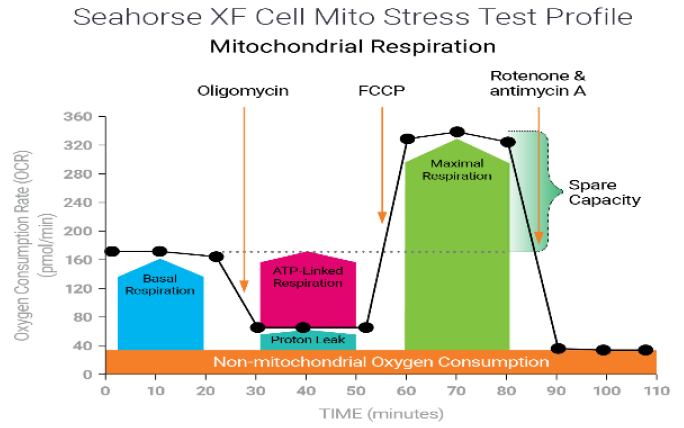
7. Run on the machine: according to the experimental design to complete the group definition settings, StartRun to run the experiment, according to the prompts to remove the cover of the probe plate to prevent on the tray, for calibration (about 20 min); after calibration is completed, the Utility Plate will be replaced by a cell culture plate, and begin to carry out the test of energy metabolism of the cells, after the end of the measurement, click Eject to remove the cell culture plate and the probe plate, and normalize the data. At the end of the measurement, click Eject to remove the cell culture plate and probe plate, and normalize the data.
Caveat
Cell status is the most important, we need to cultivate the cells well; the cell confluence of the adherent cells after adhering to the wall is 80~90%, and the ratio between the number of cells and the drug concentration needs to be controlled, so that we can detect the appropriate range of the oxygen consumption rate or the acid production rate, and do not excessively inhibit the activity of the cells. Common Problems 1. Hydration time for probe plates? 4~72 hours, overnight is recommended. 2. Can serum be added to the test solution? No. Serum will affect the buffering ability of the test solution and may also bind non-specifically to the drug and affect the test. 3. How long can the dissolved drug be used? It is recommended that the drug and the assay be prepared on an as-needed basis. 4. What is the reason that the OCR does not go up after adding FCCP? Consider whether there is poor cellular activity or if too much Oligomycin is inhibiting maximal respiration. 5. How to set the FCCP dose? Please refer to the concentrations in the literature or the suggestions on the website as follows: For more product details, please visit Aladdin Scientific website.