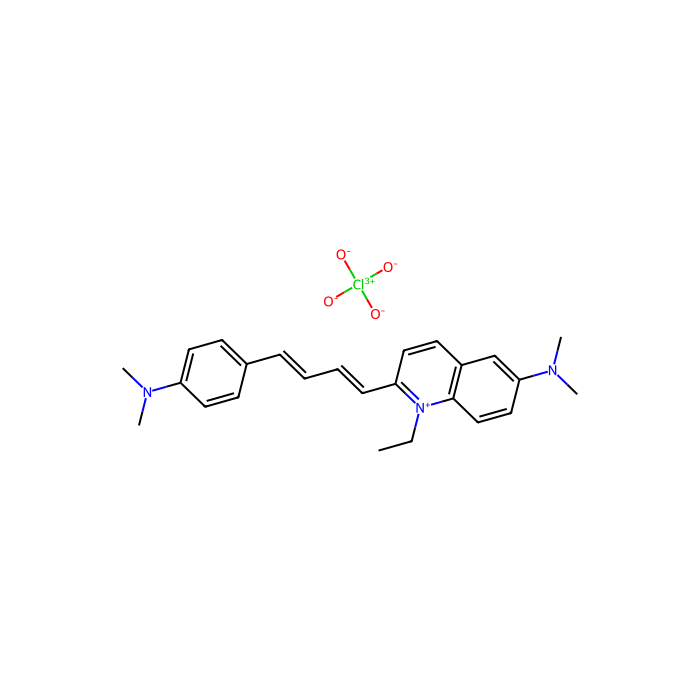
LDS 751 is a fluorescent cell-permeant nucleic acid stain that can be well excited with 488 nm laser line although it has a peak excitation at ~543 nm on dsDNA. It might be an alternative to DRAQ 5?, useful in multicolor analyses due to its long wavelength emission maximum (~712 nm). Upon binding to dsDNA LDS 751 has ~20-fold fluorescence enhancement. It has been reported that LDS-751 is excluded from the nucleus and binds the polarized membranes of mitochondria. Thiazole orange (an RNA dye) and LDS-751 (a DNA dye) composition has been used to separate reticulocytes from other cell populations. LDS 751 has been also used to separate red blood cells from nucleated cells.
This compound belongs to the class of organic compounds known as aminoquinolines and derivatives. These are organic compounds containing an amino group attached to a quinoline ring system.
External Descriptors
organic perchlorate salt
1. Djoumbou Feunang Y, Eisner R, Knox C, Chepelev L, Hastings J, Owen G, Fahy E, Steinbeck C, Subramanian S, Bolton E, Greiner R, and Wishart DS. ClassyFire: Automated Chemical Classification With A Comprehensive, Computable Taxonomy. Journal of Cheminformatics, 2016, 8:61.
P264:Wash hands [and …] thoroughly after handling.
Calculadoras de soluciones
Molarity Calculator
Determine the necessary mass, volume, or concentration for preparing a solution.
Dilution Calculator
Determine the dilution needed to prepare a stock solution.
Reconstitution Calculator
Reseñas
Reseñas de cliente
Application Protocols
Item-specific (Product Data): No tested applications, recommended dilutions, or validated protocols are provided for this item.
Please refer to the CoA/Spec Sheet and SDS for any available product‑specific handling notes. Researchers should optimize staining concentration, incubation time, and buffer composition empirically for their cell type and instrument settings.
Biological Roles
Item-specific (Product Data): none provided; this section summarizes literature/general information on dye behavior in biological systems.
Mechanistic behavior (literature):
LDS 751 is a cationic, lipophilic nucleic‑acid stain. In live cells it preferentially accumulates in mitochondria, exhibiting weak nuclear staining due to intact membranes; upon loss of membrane integrity (dead/permeabilized cells), it intercalates with DNA and intensely labels nuclei.
Binding to nucleic acids stabilizes the dye’s excited state and increases fluorescence quantum yield; emission shifts to the far‑red with reduced background autofluorescence.
Applications derived from these roles:
Viability discrimination in flow cytometry when excited at common laser lines (e.g., 488 or 532 nm), detected with far‑red channels; complements fluorophores in blue/green detectors.
DNA content analysis for cell‑cycle studies following RNase treatment to remove RNA contributions.
Considerations:
Membrane potential and mitochondrial mass can influence uptake in viable cells; experimental conditions (temperature, incubation time, serum) modulate staining patterns.
Photophysical properties depend on the local microenvironment (polarity/viscosity) and can vary between free dye, mitochondria‑associated dye, and DNA‑bound dye.
Note: These roles describe general behavior reported for LDS 751 and related styryl dyes; they are not therapeutic or diagnostic claims and should be validated in each research system.
Buffer Applications
Item-specific (Product Data): none provided.
General laboratory guidance (literature/practice; not product specifications):
Staining buffers: PBS or HBSS supplemented with 0.5–1% BSA and 2 mM EDTA can reduce nonspecific binding and cell clumping. Keep buffers at room temperature for consistent uptake in live‑cell assays.
Stock dilution: Add DMSO‑based dye stocks slowly into vortexing buffer to achieve final organic solvent ≤0.5–1% to maintain cell viability and prevent precipitation.
Live/dead assays: Include an unstained control, a live control, and a permeabilized/dead control (e.g., ethanol‑treated) to set gates.
DNA content: For fixed/permeabilized cells, stain in PBS containing RNase A to minimize RNA signal; adjust ionic strength to optimize histogram resolution.
Filtration: Pass working solutions through 0.2 μm PVDF/nylon filters to remove particulates before flow cytometry.
Light protection: Use amber tubes and keep samples on ice or at RT in the dark to minimize photobleaching during setup.
These are general buffer recommendations. For lot‑specific directions, consult the product CoA/Spec Sheet.
Green Alternatives
While LDS 751 itself is a specialized far‑red dye, greener choices often relate to solvent systems and alternative stains with safer handling profiles.
Solvent alternatives (general guidance):
Prefer aqueous buffers with minimal DMSO (≤0.5–1%) over neat organic solvents when feasible.
Use ethanol over DMF where solubility/performance allow due to lower chronic toxicity.
Dye alternatives (contextual; selection depends on instrument/assay):
Dyes with aqueous‑stock formulations (e.g., some SYTO/SYTOX series) reduce reliance on high‑boiling polar aprotics; trade‑offs include spectral shifts and membrane permeability differences.
Using fixable amine‑reactive viability dyes (water‑based) may reduce solvent use, but they require specific fixation workflows and have different spectral properties.
Comparison (literature; not product specifications):
LDS 751 vs aqueous nucleic‑acid dyes:
Solvent need: LDS 751 typically requires DMSO stock; aqueous dyes can be used directly in buffer.
Spectral position: LDS 751 emits far‑red (>650 nm), often easing panel design; many aqueous dyes emit green/cyan or far‑red depending on variant.
Trade‑offs: LDS 751 offers good penetration and low FITC/PE overlap; greener choices may simplify handling but could alter panel compensation and viability discrimination.
Recommendation: Minimize solvent volumes, prepare small aliquots to limit waste, and validate greener substitutes to ensure equivalent sensitivity and panel compatibility.
Pharmaceutical Uses
This product is a research‑use fluorescent dye and is not an excipient or active ingredient.
Item-specific (Product Data): No pharmacopeial or formulation status is provided for this item.
General context:
Dyes of this class are employed in research workflows (e.g., cell analysis, microscopy). They are not typically incorporated into pharmaceutical dosage forms.
If used in process analytics or QC research, ensure segregation from GMP manufacturing streams and handle as laboratory chemicals only.
No medical or therapeutic claims are made. For any regulated use, obtain written confirmation of suitability and review all regulatory requirements.
Physical Properties
Item-specific (Product Data):
Appearance: Not specified for this item; refer to CoA/Spec Sheet.
Grade/Purity: Not specified for this item; refer to CoA/Spec Sheet.
Molecular weight: Not specified for this item; refer to CoA/Spec Sheet.
Literature/General properties (typical for LDS 751; informational only, not product specifications):
Physical state: solid dye, typically dark red to purple crystalline/powder.
Solubility: readily soluble in polar aprotic organics (DMSO, DMF), moderately soluble in alcohols; limited solubility in pure water but can be formulated in aqueous buffers with co‑solvent or surfactant/protein carrier.
Optical characteristics: far‑red absorption/emission suitable for 488–532 nm excitation with emission in >650 nm range (exact λmax depends on solvent and binding to nucleic acids).
Acid/base: cationic chromophore; protonation state relatively insensitive near neutral pH; fluorescence and absorbance can shift with polarity/viscosity and nucleic‑acid binding.
Partitioning: amphiphilic behavior (hydrophobic core with cationic center) promotes membrane permeability and mitochondrial accumulation in live cells (literature observation).
Thermal data (mp, bp), density, logP, pKa, refractive index: not reliably established here; consult primary literature or CoA for definitive values.
Practical note: Optical properties are environment‑dependent; record spectra in the exact solvent/buffer system and concentration used for your assay to set instrument compensation accurately.
Quality and Grades
Item-specific (Product Data):
Grade/Purity: Not specified for this item; refer to CoA/Spec Sheet.
Stabilizers: Not specified for this item; refer to CoA/Spec Sheet.
Research grade fluorescent dyes are usually qualified by spectroscopic purity (absorbance/emission profile, low impurity peaks), residual solvents, water content, and counter‑ion identity. For cytometry, low particulate content and consistent extinction coefficient/quantum yield are important.
If labeled “analytical” or “HPLC grade solution,” expect low background fluorescence/UV impurities and filtration through 0.2 μm.
Stabilizers (if present) can include desiccants or acid counter‑ions to improve shelf life; verify compatibility with your assay if absolute background is critical.
Recommendations:
Verify batch‑specific identity by recording absorbance spectrum in your assay solvent and comparing λmax and spectral shape to literature.
Review the CoA for residual water/solvent and counter‑ion, which can influence solubility and photophysics.
For quantitative cell‑cycle analyses, consider lot qualification against a reference standard (e.g., fixed cells with known DNA content).
Reaction and Applications
Item-specific (Product Data):
Manufacturer Applications: Not specified for this item.
Applications (literature/general; for research use only):
Flow cytometry: live/dead discrimination with 488–532 nm excitation; LDS 751 accumulates in mitochondria of viable cells and strongly stains nuclei of dead/permeabilized cells, providing far‑red emission that minimally overlaps FITC/PE.
Cell‑cycle/DNA content: as a DNA‑binding dye for cell‑cycle profiling, often combined with RNase treatment and compatible with multi‑color panels due to far‑red emission.
Microscopy: far‑red nuclear counterstain in fixed or permeabilized samples; reduced photobleaching relative to some blue dyes.
Compensation/controls: used as a viability channel in panels employing 488‑nm excitation; includes single‑stained controls for compensation matrices.
Practical assay tips:
Work under dim light; prepare fresh dilutions immediately before use.
Optimize concentration and incubation time by cell type; over‑staining can increase background and spectral spillover.
For live/dead assays, include detergent‑permeabilized control to demonstrate maximal staining.
Validate emission filter sets (e.g., 675/20, 695/40) and set voltages using dye‑only control.
Note: Specific recommended concentrations, incubation times, and validated applications for this catalog item are not provided; consult CoA/Spec Sheet and SDS, and verify empirically in your system.
Reaction Conditions
Not typically applicable. LDS 751 functions as a fluorescent stain rather than a reagent in chemical transformations.
For experimental use, the relevant “conditions” pertain to staining/incubation rather than chemical reactions. See Buffer Applications and Storage & Reconstitution for practical handling guidance.
If you require photophysical characterization conditions (e.g., absorption/emission measurements), report solvent, concentration (avoid inner‑filter effects), path length, and temperature; however, item‑specific validated conditions are not provided in the Product Data.
Safety and Handling
Item-specific (Product Data):
Storage conditions: Protect from light; Store at −20 °C; Argon charged; Desiccated.
Shipment: Ice chest + ice pads.
GHS/Signal word/H‑statements/Pictograms: Not specified for this item; refer to SDS.
General safety considerations (informational; defer to SDS for authoritative guidance):
Hazards: Many cationic DNA‑binding dyes are harmful if swallowed/inhaled and may cause skin/eye irritation; handle as potentially mutagenic due to DNA intercalation potential.
PPE: lab coat, nitrile gloves (double‑glove for weighing), safety glasses or face shield for solution prep. Work in a fume hood to avoid dust/aerosol generation.
Light sensitivity: store and handle under subdued light; use amber vials and foil wrap to prevent photodegradation.
Incompatibilities: strong oxidizers and strong acids/bases may degrade the chromophore; moisture can clump hygroscopic dyes; avoid prolonged exposure to air—argon blanket per Product Data.
Spill/cleanup: avoid dry sweeping; gently wet with ethanol/IPA, collect with inert absorbent, dispose per institutional hazardous waste procedures.
First aid (overview): rinse skin/eyes with water for ≥15 min; remove contaminated clothing; if inhaled, move to fresh air; seek medical attention as appropriate.
Always consult the product‑specific SDS for definitive hazard classification, exposure limits, and disposal instructions.
Solvent Selection
Role: LDS 751 is typically prepared as a concentrated stock in a polar aprotic solvent, then diluted into aqueous staining buffers.
Solvent choices (general/literature guidance; not item specifications):
DMSO: excellent solubilizer; minimal absorbance in visible range; commonly used for 1–5 mM stocks. Keep water content low to prevent aggregation.
DMF: similar to DMSO; slightly more volatile; handle under dry conditions.
Ethanol/Isopropanol: workable for lower‑concentration stocks; increased risk of precipitation upon aqueous dilution; pre‑mix with buffer under vortexing.
Aqueous buffers (PBS, HBSS): limited direct solubility; addition of ≤1% DMSO or 0.1% BSA/Tween‑20 can aid dispersion.
Polarity/miscibility (literature): amphiphilic cationic dye; prefers polar organic media; forms stronger complexes upon binding nucleic acids in water.
Practical tips:
Filter 0.2 μm if using in flow cytometry to minimize clogging/background from particulates.
Add stock slowly to vigorously mixed buffer to avoid local supersaturation/precipitation.
Prepare single‑use aliquots to avoid repeated freeze‑thaw and moisture ingress.
Comparison (guidance):
DMSO vs ethanol: DMSO offers higher solubility and reduced precipitation on dilution; ethanol provides faster drying on surfaces but may extract plastics—test compatibility with tubes/sheaths.
Storage and Reconstitution
Item-specific (Product Data):
Storage: Protect from light; Store at −20 °C; Argon charged; Desiccated.
Shipping: Ice chest + ice pads.
Practical guidance (literature/general; not product specifications):
Reconstitution solvent: prepare concentrated stocks in anhydrous DMSO or DMF. If using alcohols, confirm solubility and check for precipitation upon dilution into buffer.
Aliquoting: dissolve to a convenient stock (e.g., 1–5 mM), dispense into amber, argon‑flushed micro‑aliquots to minimize headspace and moisture; freeze at −20 °C.
Handling: thaw aliquots briefly at room temperature, mix gently, and use immediately; avoid repeated freeze–thaw cycles.
Working solutions: prepare fresh in the dark immediately before use; minimize final organic solvent (≤0.5–1%) in cell‑based assays.
Containers: use low‑binding, amber vials or foil‑wrapped tubes; PTFE‑lined caps recommended.
Stability: dyes can undergo photobleaching and hydrolysis; maintain desiccation and inert gas blanket per Product Data. Discard solutions showing visible precipitate or spectral changes.
Always follow the SDS and CoA for lot‑specific stability and reconstitution instructions.
Structure and Identity
Brief overview: LDS 751 is a far‑red fluorescent nucleic acid stain (styryl/cyanine‑type dye) widely used in flow cytometry for DNA content and live/dead discrimination.
Item-specific (Product Data):
CAS: 181885-68-7
CID: 5706752
InChIKey: Not specified for this item; refer to CoA/Spec Sheet. (Note: provided string "81861" is not a standard InChIKey.)
SMILES: Not specified for this item; refer to CoA/Spec Sheet.
Molecular formula: Not specified for this item; refer to CoA/Spec Sheet.
Molecular weight: Not specified for this item; refer to CoA/Spec Sheet.
Literature/General identity (for context; not item specifications):
Structural features: extended conjugated polymethine chain linking heteroaromatic rings; typically carries a permanent cation facilitating nucleic‑acid binding; often bears hydrophobic substituents aiding membrane permeability.
2D description in words: two aromatic/heteroaromatic end groups connected by a conjugated chain (polymethine or styryl linkage); one end commonly quaternized nitrogen conferring positive charge; auxochromes extend absorbance into the red/near‑IR.
Notes: Exact stereochemistry and substituent pattern for the supplied lot are not provided in the Product Data; consult the CoA/SDS for definitive identifiers.
Synthetic Utility
LDS 751 is a finished fluorescent probe, not a synthetic building block.
Item-specific (Product Data): none provided on reactive functionality or protecting groups.
General note:
The dye’s cationic polymethine/styryl framework and extended conjugation make it photophysically useful but not typically employed as a reagent or intermediate in organic synthesis.
It may be used as a spectroscopic reporter in reaction monitoring (e.g., nucleic‑acid binding assays), but it does not play an active chemical role in standard named reactions.
Conclusion: Synthetic utility is not a primary use case; see Reaction & Applications and Buffer Applications for relevant guidance.
Target Specificity
Item-specific (Product Data): Not specified for this item; refer to CoA/Spec Sheet.
General note: In research contexts, LDS 751 is commonly described as a nucleic‑acid–binding dye with preferential accumulation in mitochondria of viable cells (literature). This statement is provided for context only and is not a product‑specific validation.
Preguntas frecuentes
What is the purity of this product?
This product is supplied at ≥98% purity (chemical assay). Lot-specific values are stated on the Certificate of Analysis.
How should this product be stored?
Store at ?20 °C, protected from light, desiccated, under argon. It is supplied under an argon blanket; reseal under inert gas after each use.
How is this product shipped?
This product ships in an insulated container with ice pads. Unpack on arrival and transfer it to the storage condition stated above.
What are the CAS number, molecular formula and molecular weight?
The CAS Number is 181885-68-7, the molecular formula is C25H30N3?ClO4, and the molecular weight is 471.98 g/mol. InChIKey FGBAVQUHSKYMTC-UHFFFAOYSA-M.
What documentation is provided?
Available product documentation, including Certificates of Analysis (COA), Safety Data Sheets (SDS), and specification sheets, is shown in the product document area. Document availability and access follow the current site policy.
Utilizamos cookies para garantizar el correcto funcionamiento del sitio web y, cuando esté permitido, para mejorar su experiencia. Puede gestionar sus preferencias en cualquier momento en Configuración. Más información en nuestra Política de Cookies.
¿Quieres que te enviemos un mensaje cuando tengamos descuentos disponibles?
Recordármelo más tarde
¡Gracias! Por favor, revisa tu bandeja de entrada de correo electrónico para confirmar.
Products are supplied to verified businesses, institutions, and qualified professionals for research and development use only. Not for use in humans, animals, diagnosis, or therapy.

 E2611638