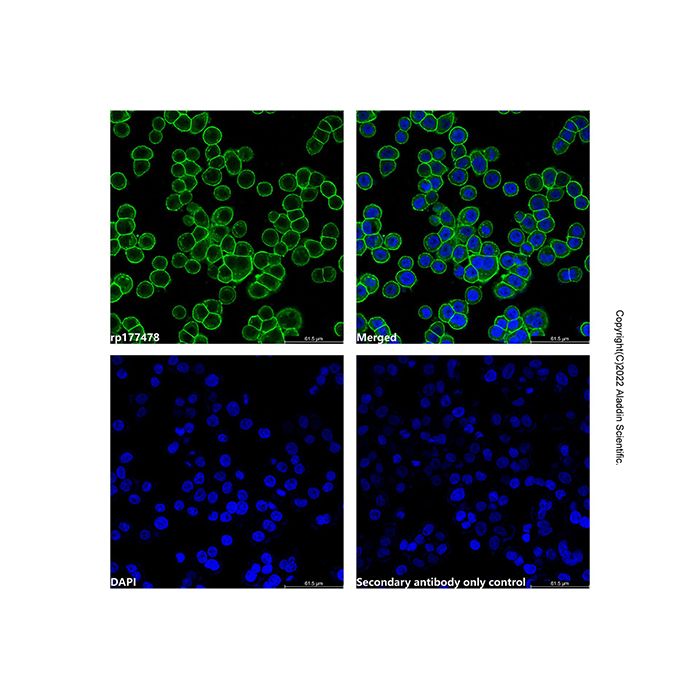
LumiDye™ AF532 NHS Ester isa yellow-fluorescent dye with excitation designed for use with the frequency-doubled Nd:YAG laser line. AF 532 dye is pH-insensitive over a wide molar range, helping ensure that you get stable signals in live-cell imaging applications. NHS esters can be used to label to the primary amines (R-NH2) of proteins, amine-modified oligonucleotides, and other amine-containing molecules. The resulting AF532-conjugate will exhibit brighter fluorescence and greater photostability than the conjugates of other spectrally similar fluorophores. In addition to reactive dye formulations, we offer AF532 dye conjugated to a variety of antibodies, peptides, proteins, tracers, and amplification substrates optimized for cellular labeling and detection.
Detailed information about this LumiDye™ AF532 NHS Ester:
Fluorophore label: LumiDye™ AF532 NHS Ester
Reactive group: NHS ester
Reactivity: Primary amines on proteins and ligands, amine-modified oligonucleotides
Ex/Em of the conjugate: 530/555 nm
Extinction coefficient: 81,000 cm-1M-1
Molecular weight: 723.8
CF280: 0.09
Spectrum:

Typical Labeling Protocol
1. Dissolve ~10 mg of the protein in 1 mL of 0.1 M sodium bicarbonate buffer pH 8.3.
2. Preparing the Reactive Dye Solution: Immediately before use, dissolve the Reactive dye in high-quality, anhydrous dimethylsulfoxide (DMSO) or dimethylformamide (DMF) at a final concentration of 10 mg/mL. Once reconstituted, use the reactive dye solution immediately.
3. While stirring or vortexing the protein solution (step 1), slowly add 50–100 μL of the reactive dye solution.
4. Incubate the reaction for 1 hour at room temperature with continuous stirring.
5. Optional: Stop the reaction by adding 0.1 mL of freshly prepared 1.5 M hydroxylamine, pH 8.5, and incubate the hydroxylamine-containing reaction for one hour at room temperature.
6. Separating the conjugate from unreacted labeling reagent by dialysis or gel filtration media with an appropriate molecular weight cutoff.
7. Determining the Degree of Labeling: Measure the absorbance of the protein–dye conjugate at 280 nm (A₂₈₀) and at the λmax for the dye (Aₘₐₓ).
8. The following formula can be used to calculate the protein concentration:
Protein concentration (mg/mL) = ( A280 - CF280 ×Amax) ×MW/ εprotein
9. The following formula can be used to calculate the degree of labeling:
DOL = ( Amax × MW) / (Protein concentration× εdye )
where MW = the molecular weight of the protein, εdye = the extinction coefficient of the dye at its absorbance maximum, and the protein concentration is in mg/mL.
10. Storing the Protein Conjugate: Add 0.05–0.2% Proclin 300 or 0.05% sodium azide, along with a protein stabilizer (such as 0.1% BSA), to the labeled protein.