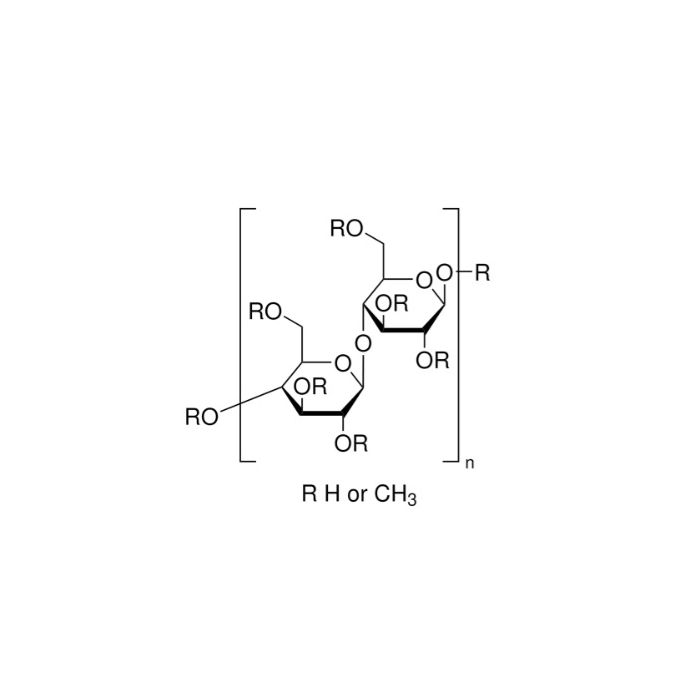
Methyl cellulose(MC) - 1500mPa.s , CAS No.9004-67-5

CAS: 9004-67-5 Cat. No.: M112867 Número EC: 618-391-7 PubChem CID: 51063134
Disponible para pedir
CALIDAD & PUREZA 1500mPa.s
Synonyms
Methocel 181 | Metilcellulosa | MRJ667KA5E | Hydrolose | Methocel 4000CPS | Cesca MC 25S | UNII-ME8KD9K6LP | 9-Fluoro-11beta,17,21-trihydroxy-16beta-methylpregna-1,4-diene-3,20-dione-17-valerate | Celacol M 2500 | Napolone | Celacol WA | EMP-H | FEMA No.
Storage
Room temperature,Desiccated
Shipped In
Normal
★
Talla
USA
Alemania (EU)*
Precio
Cantidad
100g
M112867-100g
5 Disponible
—

19,90US$

28,90US$
Guardar 9,00 US$ (31.14%)
500g
M112867-500g
3 Disponible
—

57,90US$

79,90US$
Guardar 22,00 US$ (27.53%)
Enter a quantity for the sizes you want to add.
🧪
Por qué esta calidad

1500mPa.s para flujos de trabajo cromatográficos y analíticos sensibles que requieren una interferencia mínima de la línea base.

🌡

Almacenamiento y envío

Room temperature,Desiccated Envío Normal. Consulte el COA específico del lote para conocer las especificaciones exactas.

📋

Documentos de calidad

SDS, COA, ficha técnica y hoja de especificaciones disponibles para descargar. COA específico del lote accesible mediante búsqueda por número de lote.

📚

Prueba documental

Citado en 162 publicaciones revisadas por pares sobre cromatografía, síntesis orgánica y reacciones de acoplamiento cruzado.

Especificaciones

Sinónimos
Methocel 181 | Metilcellulosa | MRJ667KA5E | Hydrolose | Methocel 4000CPS | Cesca MC 25S | UNII-ME8KD9K6LP | 9-Fluoro-11beta,17,21-trihydroxy-16beta-methylpregna-1,4-diene-3,20-dione-17-valerate | Celacol M 2500 | Napolone | Celacol WA | EMP-H | FEMA No.
Especificaciones y pureza
1500mPa.s
Condiciones de almacenamiento de almacenamiento
Room temperature,Desiccated
Enviado en
Normal
Nombres e identificadores
Pubchem Sid
Sonrisas canónicas
[*]OC[C@H]1O[C@@H](O[C@@H]2[C@@H](CO[*])O[C@@H](O[*])[C@H](O[*])[C@H]2O[*])[C@H](O[*])[C@@H](O[*])[C@@H]1O[*]
IUPAC Name
(5R)-2,3,4-trimethoxy-6-(methoxymethyl)-5-[(2S)-3,4,5-trimethoxy-6-(methoxymethyl)oxan-2-yl]oxyoxane
InChIKey
YLGXILFCIXHCMC-JHGZEJCSSA-N
INCHI
1S/C20H38O11/c1-21-9-11-13(23-3)15(24-4)18(27-7)20(30-11)31-14-12(10-22-2)29-19(28-8)17(26-6)16(14)25-5/h11-20H,9-10H2,1-8H3/t11?,12?,13?,14-,15?,16?,17?,18?,19?,20+/m1/s1
Isómeros SMILES
COCC1[C@H](C(C(C(O1)OC)OC)OC)O[C@H]2C(C(C(C(O2)COC)OC)OC)OC
WGK Alemania
1
RTECS
FJ5959000
PubChem CID
51063134

Documentación

📋 Hoja de datos de seguridad (SDS)

Documento completo sobre peligros, manipulación, almacenamiento y cumplimiento normativo.

<<<<<<< HEAD Descargar SDS → ======= Descargar SDS → >>>>>>> release248-p3

✅ Certificado de análisis (COA)

Datos de calidad específicos del lote. Introduzca su número de lote para obtener el COA exacto.

Buscar COA →

📊 Ficha técnica

Resumen de referencia rápida de las especificaciones y aplicaciones del producto.

Ver ficha técnica →

🔬 Hoja de especificaciones

Atributos de calidad completos y criterios de aceptación para esta calidad.

Ver hoja de especificaciones →

Datos avanzados

Taxonomic Classification

Taxonomy Tree

KingdomOrganic compounds
SuperclassOrganic oxygen compounds
ClaseOrganooxygen compounds
SubclassCarbohydrates and carbohydrate conjugates
Intermediate Tree Nodes Glycosyl compounds
Direct ParentO-glycosyl compounds
Alternative Parents Disaccharides  Oxanes  Oxacyclic compounds  Dialkyl ethers  Acetals  Hydrocarbon derivatives  
Molecular FrameworkAliphatic heteromonocyclic compounds
Substituents O-glycosyl compound - Disaccharide - Oxane - Oxacycle - Organoheterocyclic compound - Ether - Dialkyl ether - Acetal - Hydrocarbon derivative - Aliphatic heteromonocyclic compound
DescripciónThis compound belongs to the class of organic compounds known as o-glycosyl compounds. These are glycoside in which a sugar group is bonded through one carbon to another group via a O-glycosidic bond.
External Descriptors Not available
Estructura 3D
Modelo de Estructura Química Interactiva


Certificados (CoA, COO, BSE/TSE y tabla de análisis)
C of A & Other Certificates(BSE/TSE, COO):
Analytical Chart:

Find and download the COA for your product by matching the lot number on the packaging.

21 results found

Lot NumberCertificate TypeFechaArticulo
L2503430L2503430Certificate of AnalysisNov 20, 2025 M112867
L2503429L2503429Certificate of AnalysisNov 20, 2025 M112867
L2503421L2503421Certificate of AnalysisNov 20, 2025 M112867
E2521400E2521400Certificate of AnalysisMay 07, 2025 M112867
E2521401E2521401Certificate of AnalysisMay 07, 2025 M112867
E2521442E2521442Certificate of AnalysisMay 07, 2025 M112867
H2430366H2430366Certificate of AnalysisAug 15, 2024 M112867
H2430365H2430365Certificate of AnalysisAug 15, 2024 M112867
F2424328F2424328Certificate of AnalysisJun 07, 2024 M112867
F2424329F2424329Certificate of AnalysisJun 07, 2024 M112867
F2424332F2424332Certificate of AnalysisJun 07, 2024 M112867
G2429032G2429032Certificate of AnalysisJun 07, 2024 M112867
G2424026G2424026Certificate of AnalysisJun 07, 2024 M112867
G23181239G23181239Certificate of AnalysisJun 19, 2023 M112867
G2318928G2318928Certificate of AnalysisJun 19, 2023 M112867
G23181252G23181252Certificate of AnalysisJun 19, 2023 M112867
G23181251G23181251Certificate of AnalysisJun 19, 2023 M112867
G23181235G23181235Certificate of AnalysisJun 19, 2023 M112867
D2314994D2314994Certificate of AnalysisApr 04, 2023 M112867
G2311033G2311033Certificate of AnalysisApr 04, 2023 M112867
D2314995D2314995Certificate of AnalysisApr 04, 2023 M112867
Propiedades químicas y físicas
SolubilidadReadily Soluble in a water below 50°C and wide variety of solvents.
Peso molecular454.500 g/mol
XLogP3-1.000
Hydrogen Bond Donor Count0
Hydrogen Bond Acceptor Count11
Rotatable Bond Count12
Exact Mass454.241 Da
Monoisotopic Mass454.241 Da
Topological Polar Surface Area102.000 Ų
Heavy Atom Count31
Formal Charge0
Complexity496.000
Isotope Atom Count0
Defined Atom Stereocenter Count2
Undefined Atom Stereocenter Count8
Defined Bond Stereocenter Count0
Undefined Bond Stereocenter Count0
The total count of all stereochemical bonds0
Covalently-Bonded Unit Count1
Preguntas frecuentes y artículos
Microcrystalline Cellulose (MCC): A Comprehensive Primer and Selection Guide—Structural Features, Key Performance Metrics, and Application Scenarios
Materials Can “Switch”: How Smart Polymers Respond to Temperature, pH, and Light (with Experimental Selection Tips & Product Navigation)
Understanding Hydrophilic Polymers in Aqueous Systems: Hydration Mechanisms, Structural Knobs, and Task-Oriented Selection Guide (Including Tables 1–3)
FGF2-Induced Angiogenesis Model: Standard Operating Procedure (Protocol)
Functional Framework of Starch Metabolism-Related Enzymes in Food Science Research and Mechanistic Analysis of Quality Regulation
Key Judgments in Medical Hydrogel R&D: From Polymer Source and Crosslinking Strategy to Sterilization Planning, Scale-Up Feasibility, and Quality Control
Injectable Thermosensitive Gels: Gelation Behavior, Rheological Properties, and Drug Release Characteristics
From Structure to Rheology: Thickening, Stabilization, and Selection Logic of Cellulose Ethers for Personal Care Applications
Analysis of the Production Process of Hydroxypropyl Methylcellulose (HPMC) for Putty: Understanding Differences in Substitution Structure and Gelation Temperature from High-Ratio and Low-Ratio Formulations
Types, Mechanisms of Action, Key Quality Indicators, and Selection and Application of Common Cellulose Ethers in Wall Putty
Influencing Factors and Control Strategies for Blistering in Neutral Wall Putty: An Experimental Analysis Based on HPMC Dosage, Viscosity, and Ground Calcium Carbonate Fineness
How to Select Binding/Gel Materials for Neutral Wall Putty? A Comparison of Pregelatinized Starch, PVA, and Redispersible Polymer Powder Based on Four Application Trials
Causes and Mechanism Analysis of Delamination During Sanding of Water-Resistant Putty
What Are the Differences Between Polyvinyl Alcohol 1788, 2488, and 2699? Understanding Workability, Bonding Strength, and Relative Water Resistance from the Perspective of Degree of Polymerization and Degree of Hydrolysis
Why Do Rust Spots Appear on Neutral Wall Putty? Iron Sources, Moisture Migration, Oxidative Color Development, and Prevention Measures
Common Problems and Formulation Adjustment Strategies for Neutral Putty Under High Summer Temperatures
Differences and Application Selection of Cassava- and Corn-Based Pregelatinized Starch in Neutral Putty Formulations
The Role, Selection, Cracking Risk Analysis, and Dosage Control of Bentonite in Neutral Putty
Experimental Applications of Carboxymethyl Cellulose (CMC) Solution in Enzyme Assays, Suspension Systems, and Functional Materials
Citations of This Product
Calculadoras de soluciones
Reseñas

Reseñas de cliente

¿Quieres que te enviemos un mensaje cuando tengamos descuentos disponibles?

Recordármelo más tarde

¡Gracias! Por favor, revisa tu bandeja de entrada de correo electrónico para confirmar.

¡Vaya! Las notificaciones están desactivadas.