CALIDAD & PUREZADistillation grade?Distillation grade — purified by/for distillation with controlled volatile profile. Use where distillation behavior and low residue are important.≥99.5%
Distillation grade, ≥99.5% Distillation grade para flujos de trabajo cromatográficos y analíticos sensibles que requieren una interferencia mínima de la línea base.
🌡
Almacenamiento y envío
Protected from light,Room temperature Envío FedEx DG Service. Consulte el COA específico del lote para conocer las especificaciones exactas.
📋
Documentos de calidad
SDS, COA, ficha técnica y hoja de especificaciones disponibles para descargar. COA específico del lote accesible mediante búsqueda por número de lote.
📚
Prueba documental
Citado en 68 publicaciones revisadas por pares sobre cromatografía, síntesis orgánica y reacciones de acoplamiento cruzado.
This compound belongs to the class of organic compounds known as dialkylarylamines. These are aliphatic aromatic amines in which the amino group is linked to two aliphatic chains and one aromatic group.
External Descriptors
a small molecule
1. Djoumbou Feunang Y, Eisner R, Knox C, Chepelev L, Hastings J, Owen G, Fahy E, Steinbeck C, Subramanian S, Bolton E, Greiner R, and Wishart DS. ClassyFire: Automated Chemical Classification With A Comprehensive, Computable Taxonomy. Journal of Cheminformatics, 2016, 8:61.
Determine the necessary mass, volume, or concentration for preparing a solution.
Dilution Calculator
Determine the dilution needed to prepare a stock solution.
Reconstitution Calculator
Reseñas
Reseñas de cliente
Application Protocols
Not applicable. This item is a neat organic reagent rather than an assay-ready biological reagent. There are no validated immunoassay protocols (WB, IHC, IF, FC) associated with this product.
Practical usage notes (chemistry):
For use as a reagent/base, measure by volume or mass and add under inert atmosphere if oxidation/color is a concern.
For removal during workup, acidify the aqueous phase (e.g., 1–2 M HCl) to extract as the anilinium salt; then basify and extract, if recovery is desired.
Biological Roles
Scope note: N,N-dimethylaniline is a synthetic aromatic amine with no intrinsic biological role; the following summarizes literature observations relevant to toxicology and environmental fate for research context only.
Biochemical interactions (literature):
Metabolism: In mammals, hepatic cytochrome P450s mediate N-demethylation to N-methylaniline and aniline; N-oxidation to the amine N-oxide can also occur. Conjugation (sulfation, glucuronidation) of hydroxylated aromatic metabolites facilitates excretion.
Hemotoxicity mechanism: Aromatic amines may induce methemoglobinemia via oxidative stress or reactive metabolites; effects are dose-dependent and context-specific (toxicology literature).
Enzymatic inhibition/induction: Some tertiary anilines can modulate P450 activities in vitro; specific potencies vary by isoform and are not standardized for DMA.
Environmental fate (literature):
Persistence: Moderately persistent in soils/sediments due to aromaticity and limited biodegradability; may undergo photolysis and oxidative degradation.
Bioaccumulation: Moderate potential consistent with logP ~2.4; however, metabolism limits long-term bioaccumulation in higher organisms.
Aquatic toxicity: Potentially harmful to aquatic organisms; avoid release to the environment.
Applications note:
Any experimental use in biological systems should be performed strictly for research purposes with appropriate approvals. This product is labeled For research use only per Product Data and is not intended for food, drug, or diagnostic use.
Buffer Applications
Not typically applicable. N,N-Dimethylaniline is a hydrophobic, weakly basic aromatic amine and is not used as a buffering agent in aqueous systems. Its low water solubility, strong UV absorbance, and potential toxicity make it unsuitable for preparing biological or analytical buffers.
Practical guidance:
For buffering near pH 5–8, consider conventional buffer systems (e.g., phosphate, acetate, Tris, HEPES) rather than aromatic amines.
If DMA is present in an aqueous reaction mixture (e.g., as a reagent), do not rely on it for pH control; monitor and adjust pH with an appropriate buffer and segregate DMA removal steps (acidic extraction) during workup.
Green Alternatives
Context: N,N-dimethylaniline is effective but presents toxicity and environmental persistence typical of aromatic amines. Selection of greener alternatives depends on the role DMA plays (base, electron donor, arene substrate, or nucleophile).
Potential alternatives (literature comparisons):
As a base (non-nucleophilic):
DIPEA (Hünig’s base): Lower nucleophilicity; still flammable and harmful but generally less hazardous than aromatic amines. Often enables cleaner acylations.
DBU/DBN: Stronger, non-nucleophilic amidines; catalytic loadings possible but corrosive and more expensive.
Tertiary amines with better EHS profiles (e.g., N-methylmorpholine) may reduce odor/toxicity and are more water-miscible for easier removal.
As an electron donor (photoredox):
DIPEA or triethanolamine (TEOA, aqueous-compatible) can substitute with improved EHS characteristics; TEOA is less volatile and widely used in aqueous photochemistry.
As an arene substrate (EAS chemistry):
If the product is a para-dimethylamino aryl derivative, DMA is structurally required (no direct “green” substitute). Process intensification (continuous flow, solvent choice like 2-MeTHF, minimizing Lewis acid loadings) improves sustainability.
Compact comparison (qualitative):
DMA: Strong +M director; toxic; low water solubility; versatile but colored byproducts form on oxidation.
N-Methylmorpholine: Lower toxicity/odor; miscible with water; weaker base than DIPEA.
Greener practices when DMA is necessary:
Employ closed systems and efficient capture (activated carbon) to minimize emissions.
Recycle via vacuum distillation.
Use safer solvents (e.g., 2-MeTHF, CPME, EtOAc) when compatible with the transformation.
Opt for catalytic over stoichiometric Lewis acids; explore solid acids to simplify waste handling.
Pharmaceutical Uses
Scope: No therapeutic claims. This section addresses formulation/manufacturing context only.
General context (literature):
N,N-Dimethylaniline is not used as a pharmaceutical excipient due to toxicity and regulatory concerns typical of aromatic amines.
Process chemistry: It may appear as a starting material or intermediate en route to fine chemicals and dye-like auxiliaries; quaternized derivatives may serve as phase-transfer catalysts or ionic liquid components in process development.
Impurity considerations: If used upstream in API synthesis, stringent purge and analytical control are required due to class-specific toxicological alerts (aromatic amines, potential nitrosamine formation in presence of nitrites under acidic conditions).
Regulatory notes:
Not a compendial excipient in major pharmacopeias to the best of general knowledge; any use must be justified with appropriate toxicological assessment and validated removal.
Safer alternatives (process perspective):
For base functions in acylations/condensations, prefer DIPEA, TEA, or N-methylmorpholine.
For electron-donor roles in photoprocesses, consider DIPEA or triethanolamine.
Conclusion:
In pharmaceuticals, DMA is relevant primarily as a synthetic building block or process aid under controlled conditions, not as a finished formulation component.
Physical Properties
Important: Unless stated otherwise, values below are literature references for N,N-dimethylaniline and are not specifications for this catalog item.
Item-specific (from Product Data):
Appearance: Not specified for this item; refer to CoA/Spec Sheet.
Literature/general values for N,N-dimethylaniline:
Physical state/appearance (literature): Oily liquid, often colorless to pale yellow that darkens on air/light exposure.
Boiling point: ~193–195 °C at 1 atm (literature).
Melting point/freezing point: ~−25 °C (literature).
Density: ~0.956 g/mL at 25 °C (literature).
Refractive index: nD20 ~1.558 (literature).
Water solubility: Low (slightly soluble; on the order of a few g/L at ambient temperature) (literature). Miscible with many organic solvents (Et2O, EtOAc, toluene, alcohols, chlorinated solvents) (literature).
pKa (conjugate acid, anilinium): ~5.1–5.3 in water (literature). The free base is weakly basic; basicity is reduced by resonance delocalization into the ring.
UV/Vis: Strong π→π* absorption of the dimethylamino-substituted ring; typical λmax around 280–300 nm with extended tailing (literature). Not a specification.
Vapor pressure: Low at room temperature relative to aliphatic amines (literature qualitative).
Notes:
Exact values for this item (e.g., residual water, metals, UV cutoff) are Not specified for this item; refer to CoA/Spec Sheet.
Quality and Grades
Item-specific details:
Grade/Purity: Distillation grade (from Product Data). No explicit assay or impurity limits are provided here; Not specified for this item; refer to CoA/Spec Sheet for purity, color (APHA), amine value, water content, or stabilizers if any.
What “Distillation grade” typically implies (general guidance):
Distillation grade materials are suitable for laboratory use where purification by simple or fractional distillation is customary or expected prior to sensitive applications.
Such materials generally have a controlled boiling range and modest impurity burden compatible with redistillation to achieve very high purity for kinetic or spectroscopic work.
Not equivalent to “HPLC grade” or “GC grade,” which emphasize low UV absorbance/background or extremely low non-volatile residue.
Stabilizers/antioxidants:
None are listed in Product Data. If stabilizers or inhibitors are of concern (e.g., for photophysical studies), Not specified for this item; refer to CoA/Spec Sheet.
Fit-for-purpose selection:
For routine synthesis (e.g., Friedel–Crafts acylations, quaternization, sacrificial donor in photoredox), Distillation grade is typically acceptable.
For photonics, analytical calibration, or trace analysis, consider redistilling under reduced pressure and inert atmosphere to minimize colored oxidized species.
Documentation:
For batch-specific assay, residual solvents, metals, or color, consult the Certificate of Analysis (CoA) and Specification Sheet.
Reaction and Applications
Key roles of N,N-dimethylaniline (DMA) in synthesis (literature):
Electron-rich arene for electrophilic aromatic substitution (EAS): The –NMe2 group is a strong ortho/para director. Typical transformations include para-selective formylation (Vilsmeier–Haack), acylation (Friedel–Crafts), sulfonylation, and nitration under controlled conditions. Para selectivity is favored by sterics; ortho substitution increases under low temperature/kinetic control or chelation.
Precursor to dye intermediates: Friedel–Crafts acylation and subsequent transformations lead to 4-(dimethylamino)benzophenone (Michler’s ketone) and related chromophores; condensation with activated species provides push–pull systems for NLO materials.
Nucleophilic/electron-donor role: Acts as a sacrificial electron donor in photoredox processes and photosensitized oxidations; can reduce photoexcited species or participate in oxidative quenching cycles.
Base/catalyst: Serves as a tertiary amine base in acylations and Knoevenagel-type condensations, although less sterically hindered and more nucleophilic than DIPEA; can undergo alkylation to give quaternary ammonium salts (phase-transfer reagents or ionic liquids precursors).
Formation of anilinium salts and quaternization: Alkyl halides (e.g., MeI) quaternize the nitrogen rapidly; salts are more water-soluble and may serve as phase-transfer catalysts or substrates for Hofmann elimination (when β-hydrogens available external to aryl).
Practical tips:
Use anhydrous conditions for Lewis acid–mediated EAS (e.g., AlCl3) to avoid hydrolysis.
Protect from light/air during long reactions to minimize color formation; sparge with N2/Ar if color affects downstream analytics.
Workup: Neutralize/extract carefully; aromatic amines can partition strongly into organic layers—acidic washes (dil. HCl) help remove residual DMA, followed by basification to recover products if needed.
Reaction Conditions
General, literature-based guidance (not item-specific specifications):
Vilsmeier–Haack formylation to 4-(dimethylamino)benzaldehyde (p-DMAB):
Reagents/solvent: POCl3 (or POCl3/oxalyl chloride) in DMF (which forms the Vilsmeier reagent in situ); DMA as substrate.
Typical conditions: 0–5 °C addition, then 50–90 °C for 2–6 h. Quench into ice/water, neutralize, extract. Reported yields commonly 60–85% depending on stoichiometry and workup.
Notes: Control exotherm; excess DMF often used. Para selectivity is high.
Friedel–Crafts acylation (para-acylation):
Reagents: Acid chloride or phosgene equivalents with AlCl3 or FeCl3.
Conditions: 0–25 °C addition, then 50–80 °C for 2–8 h in DCM, CS2, or nitrobenzene/toluene (literature). Product examples include 4-acyl dimethylanilines and, under specific conditions, Michler’s ketone.
Notes: Strictly anhydrous; Lewis acids deactivate in moisture. Workup via careful hydrolysis of complexes.
Quaternization (e.g., methylation):
Reagents: Methyl iodide, dimethyl sulfate, or benzyl halides.
Conditions: Acetonitrile/acetone, 20–60 °C or reflux; 1–24 h. Tetralkylammonium salts precipitate or crystallize from polar solvents.
Notes: Use appropriate controls for alkylating agent hazards.
Oxidation to N-oxide:
Reagents: mCPBA or peracetic acid in DCM/CH2Cl2 at 0–25 °C, 1–3 eq oxidant.
Outcome: Selective N-oxidation; over-oxidation can occur with strong conditions.
Photoredox sacrificial donor:
Setup: Blue LEDs (e.g., 450 nm), photocatalyst (Ru(bpy)3Cl2, Ir(ppy)3, or organic dyes) in MeCN/DMF/MeOH.
Conditions: Ambient temperature, 0.05–0.5 M substrate, 1–2 eq DMA as donor, inert atmosphere beneficial. Reaction times 1–24 h depending on substrate.
Always validate on small scale; adjust stoichiometry and temperature to manage exotherms and selectivity.
Safety and Handling
Safety summary (general guidance; consult the SDS for authoritative information):
Hazard profile (literature): Aromatic tertiary amine with significant acute toxicity by inhalation, dermal, and oral exposure; can cause methemoglobinemia and CNS symptoms upon significant exposure. May be harmful to aquatic life.
GHS: Specific classification and H-statements are Not specified for this item; refer to SDS. Typical literature classifications include Acute Toxicity categories and Combustible Liquid.
Engineering controls and PPE:
Work in a fume hood to minimize inhalation exposure and odors.
Wear chemical-resistant gloves (e.g., nitrile), lab coat, and splash goggles. Consider butyl rubber for extended contact.
Avoid skin contact; aromatic amines can be absorbed dermally.
Handling and storage:
Product Data storage: Protected from light, Room temperature. Store in amber glass or otherwise light-protected, tightly closed, under inert atmosphere if possible to limit oxidative darkening.
Incompatibilities: Strong oxidizers, strong acids (risk of salt formation/exotherm), acylating/halogenating agents (risk of vigorous reaction), nitrosating agents (risk of nitrosamine formation), and air/light (color change via oxidation). Avoid contact with copper/bronze in presence of air/oxidants.
Special risks: Can slowly darken on exposure to air/light due to oxidative byproducts; may form hazardous fumes on heating. Not known to form peroxides like ethers, but oxidation of the aniline or N-oxide formation is possible.
First aid (overview):
Inhalation: Move to fresh air, monitor for respiratory distress or cyanosis; seek medical attention.
Skin/eye contact: Immediate decontamination with water for ≥15 min; remove contaminated clothing.
Ingestion: Rinse mouth; do not induce vomiting; seek medical attention promptly.
Spill/response:
Contain with inert absorbent; avoid ignition sources; collect for disposal as hazardous waste.
Solvent Selection
Applicability: N,N-Dimethylaniline is primarily used as a reagent/base/electron donor rather than as a general-purpose solvent. Nonetheless, understanding its polarity and miscibility helps in reaction design.
General solvent characteristics (literature):
Polarity: Moderately polar aromatic amine; significantly less polar than amide solvents (DMF, NMP), more polar than toluene.
Dielectric constant: Not widely tabulated; expected to be in the low-to-mid teens qualitatively (literature expectation for substituted anilines). Use dedicated solvents for ionic chemistry when high polarity is required.
Miscibility: Slightly soluble in water; miscible with common organics (ethers, alcohols, aromatics, chlorinated solvents, esters).
When to choose/avoid:
Choose when a tertiary aniline component is beneficial (e.g., dual role as base/nucleophile/electron donor) or when solubilizing strongly activated electrophiles or arenes in aromatic media.
Avoid as the bulk solvent when precise control of basicity, UV transparency, or low toxicity is required. Its innate basicity and strong UV absorbance can interfere with photochemical measurements and chromatographic detection.
Comparisons (qualitative):
Versus triethylamine/DIPEA: Those are better as non-nucleophilic bases; N,N-dimethylaniline is more nucleophilic and ring-activating, which can lead to side reactions (e.g., acylation on the ring).
Versus pyridine: Similar basic functionality but DMA is less coordinating to metals and more electron-rich/aromatic; pyridine is more polar and often a better solvent/base for acylations.
Versus toluene: DMA is more polar and basic; toluene is inert and better as an apolar solvent when basicity is undesired.
Practical tip:
If used as a co-solvent/reagent, account for its base strength and UV absorbance when planning workups and analytical detection.
Storage and Reconstitution
Item-specific (from Product Data):
Storage Conditions: Protected from light, Room temperature.
Shipped In: FedEx DG Service (hazardous materials handling during transport).
Appearance: Not specified for this item; refer to CoA/Spec Sheet.
General handling guidance (literature/practice):
Container: Store in amber glass with PTFE-lined cap to minimize light exposure and prevent reaction with metal closures.
Atmosphere: If long-term storage is anticipated, consider blanketing headspace with nitrogen or argon to retard oxidative darkening.
Shelf life: Aromatic amines can slowly oxidize; monitor color and, for sensitive uses, consider redistillation prior to critical experiments.
Reconstitution:
Not applicable; product is typically supplied neat as a liquid reagent. If solidification occurs at low temperature (freezing point ~−25 °C, literature), warm gently to ambient and mix thoroughly before use.
Freeze–thaw:
Not applicable as a solution/biologic; however, avoid repetitive heating/cooling cycles that can promote oxidation/polymerization. Keep container tightly closed when not in use to limit moisture and air ingress.
Documentation:
For any batch-specific attributes (assay, color, water, inhibitors), Not specified for this item; refer to CoA/Spec Sheet.
Research Use Note:
For research use only (as stated in Product Data). Not for food, drug, household, or diagnostic use.
Structure and Identity
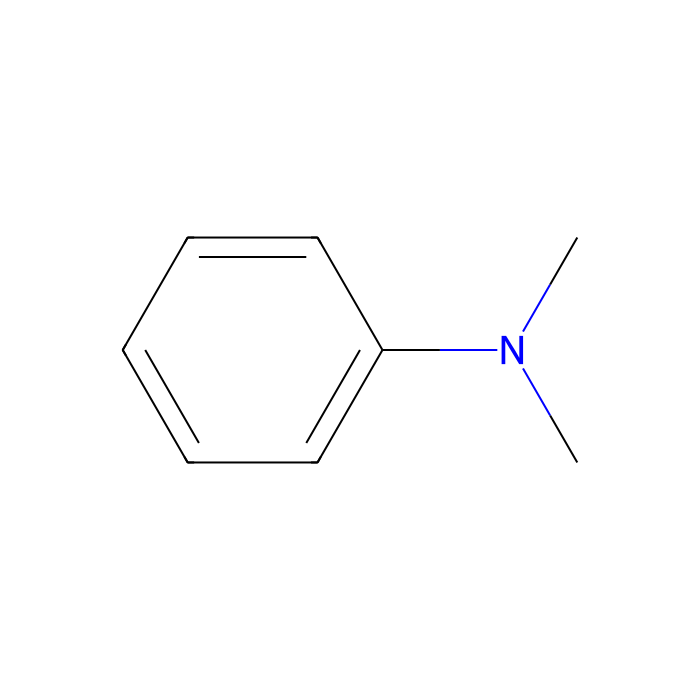
Brief overview: N,N-Dimethylaniline is a tertiary aromatic amine consisting of an aniline core bearing two N-methyl substituents; the strongly electron-donating dimethylamino group activates the benzene ring toward electrophilic substitution, favoring para/ortho positions.
Item-specific (from Product Data):
SKU: D100063
Product Name: N,N-Dimethylaniline
CAS: 121-69-7
CID: 949
InChIKey: 163783 (as provided)
Grade: Distillation grade
Computed/Literature identifiers and descriptors (not item-specific):
Structural features (general chemistry description):
Core ring system: monosubstituted benzene ring.
Functional group: tertiary aniline (dimethylamino, –N(CH3)2) directly attached to the aromatic ring.
Hybridization: anilide nitrogen is sp2-like due to conjugation; lone pair delocalizes into the ring, producing a strong +M/+R effect.
Regiochemistry: Powerful ortho/para director; para position is typically most reactive/accessible in EAS due to sterics.
2D structure in words: A benzene ring bearing a single substituent, a dimethylamino group; the nitrogen is bound to the ring carbon and to two methyl groups, forming a trigonal pyramidal center in rapid inversion; no stereocenters present.
Notes:
Where an identifier or value is not present in Product Data, the above literature descriptors are provided for reference only and are not item specifications.
Synthetic Utility
Functional group reactivity (literature):
Arene activation: –NMe2 is among the strongest π-donors on benzene, enabling high-rate EAS. Para substitution dominates due to sterics and resonance stabilization of σ-complexes.
Nitrogen-centered chemistry: Tertiary amine readily undergoes alkylation to quaternary ammonium salts; oxidation affords the N-oxide (via peracids), which can be leveraged for subsequent rearrangements or as a milder nucleophile.
Formylation and acylation: Vilsmeier–Haack (DMF/POCl3) provides 4-(dimethylamino)benzaldehyde; Friedel–Crafts acylation forms para-acylated products (precursor to Michler’s ketone under specific conditions).
Cross-coupling adjunct: While DMA itself is not a typical cross-coupling substrate, its para-functionalized derivatives (e.g., aryl halides or boronates formed after directed lithiation/halogenation) participate in Suzuki–Miyaura or Buchwald–Hartwig couplings.
Donor–acceptor materials: The dimethylamino donor is integral in push–pull systems (e.g., 4-N,N-dimethylaminostilbenes), accessible via Wittig, Heck, or Knoevenagel chemistry from para-formylated DMA.
Retrosynthetic value:
DMA offers an efficient portal to para-dimethylaminophenyl motifs. Many target structures can be traced back to: DMA → p-CHO derivative → alcohols, acids, styrenes, azo dyes, benzophenones.
Practical considerations:
High basicity at nitrogen but attenuated basicity vs aliphatic amines due to resonance; still sufficient to neutralize HX formed during acylations.
Oxidative sensitivity: Store protected from light/air to avoid colored byproducts that complicate purifications and spectral baselines.
Target Specificity
Not applicable. This product is a small-molecule chemical (aromatic amine), not a biological targeting reagent. No antigen/epitope, species reactivity, clone, or isotype information applies.
Preguntas frecuentes
What is the purity of this product?
This product is supplied at ≥99.5% purity (chemical assay). Lot-specific values are stated on the Certificate of Analysis.
What does Distillation grade mean?
Distillation grade indicates that the material has been processed and tested for specialty industrial processing. Specifications focus on the impurities that affect performance in that application — for example, metal content for electronics, particle size for batteries, refractive index for optics, or moisture content for moisture-sensitive processes.
How should this product be stored?
Store at room temperature, protected from light. The material is light-sensitive — keep it in its original opaque or amber container.
How is this product shipped?
This product is classified as dangerous goods and ships via FedEx DG Service. Ground and other economy services are not available, and delivery to some destinations or address types may be restricted.
What are the CAS number, molecular formula and molecular weight?
The CAS Number is 121-69-7, the molecular formula is C8H11N, and the molecular weight is 121.18 g/mol. InChIKey JLTDJTHDQAWBAV-UHFFFAOYSA-N.
What documentation is provided?
Available product documentation, including Certificates of Analysis (COA), Safety Data Sheets (SDS), and specification sheets, is shown in the product document area. Document availability and access follow the current site policy.
Nuestra guía de selección de calidades cubre la pureza, el estado del estabilizador y la idoneidad de la aplicación para todas las variantes de nuestro catálogo.
Utilizamos cookies para garantizar el correcto funcionamiento del sitio web y, cuando esté permitido, para mejorar su experiencia. Puede gestionar sus preferencias en cualquier momento en Configuración. Más información en nuestra Política de Cookies.
¿Quieres que te enviemos un mensaje cuando tengamos descuentos disponibles?
Recordármelo más tarde
¡Gracias! Por favor, revisa tu bandeja de entrada de correo electrónico para confirmar.
Products are supplied to verified businesses, institutions, and qualified professionals for research and development use only. Not for use in humans, animals, diagnosis, or therapy.

 F2624277