Determine the necessary mass, volume, or concentration for preparing a solution.
| Activity Type | Activity Value -log(M) | Mechanism of Action | Activity Reference | Publications (PubMed IDs) |
|---|

Moligand™, 10mM in DMSO Moligand™ for sensitive chromatographic and analytical workflows requiring minimal baseline interference.
Store at -80°C Ships Dry ice packs + Cold packs Check lot-specific COA for exact specifications.
SDS, COA, datasheet, and spec sheet available for download. Lot-specific COA accessible via lot number lookup.
Cited in 14 peer-reviewed publications across chromatography, organic synthesis, and cross-coupling reactions.
Information
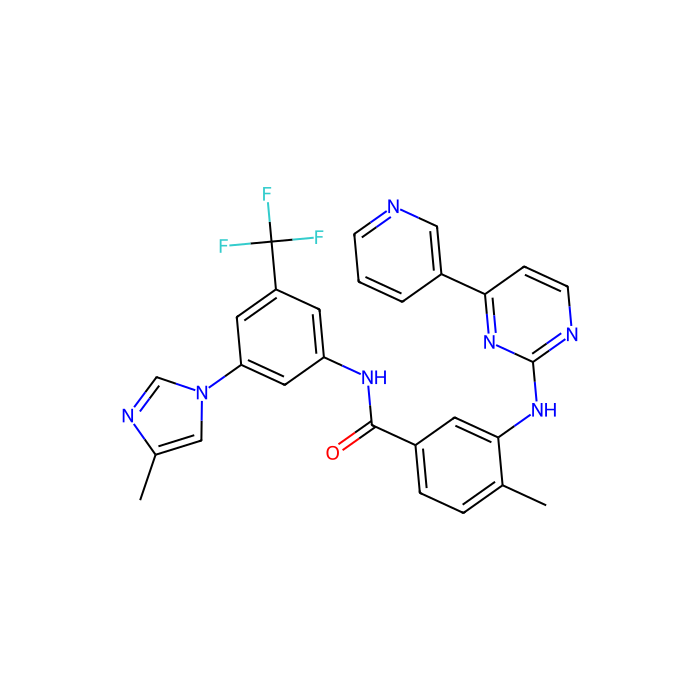
Nilotinib (AMN-107) Nilotinib (AMN-107) is a selective Bcr-Abl inhibitor with IC50 less than 30 nM in Murine myeloid progenitor cells. Nilotinib induces autophagy through AMPK activition.
In vitro
Nilotinib inhibits proliferation, migration, and actin filament formation, as well as the expression of α-SMA and collagen in activated HSCs. Nilotinib induces apoptosis of HSCs, which is correlated with reduced bcl-2 expression, increases p53 expression, cleavage of PARP, as well as increases expression of PPARγ and TRAIL-R. Nilotinib also induces cell cycle arrest, accompanied by increased expression of p27 and downregulation of cyclin D1. Interestingly, Nilotinib not only inhibits activation of PDGFR, but also TGFRII through Src. Nilotinib significantly inhibits PDGF and TGFβ-simulated phosphorylation of ERK and Akt. Furthermore, PDGF- and TGFβ-activated phosphorylated form(s) of Abl in human HSCs are inhibited by Nilotinib. Nilotinib inhibits most imatinib-resistant Bcr-Abl mutations, except for T315I. Nilotinib inhibits PDGF-DD-mediated ERK1/2 activation, basal and PDGF-DD-mediated activation of PDGFRβ and Akt, and schwannoma proliferation. Nilotinib is more potent than imatinib, exerting its maximal inhibitory effect at concentrations lower than steady-state trough plasma levels. Nilotinib also significantly reduces the expression levels of the genes for TGF-β1 and platelet-derived growth factor (PDGF). Nilotinib treatment also significantly inhibits the PDGF-induced proliferation of lung fibroblasts. Nilotinib inhibits the proliferation of Ba/F3 cells expressing p210- and p190-Bcr-Abl, or K562 and Ku-812F cells with IC50 values ≤12 nM.
In vivo
Nilotinib reduces collagen deposition and α-SMA expression in CCl4 and BDL-induced fibrosis. Nilotinib could induce HSC undergoing apoptosis, which is correlated with downregulation of bcl-2. Nilotinib attenuates the extent of lung injury and fibrosis. Nilotinib therapy significantly reduces the levels of hydroxyproline on days 14 and 21, which is accompanied by decreased expression levels of transforming growth factor (TGF)-β1 and PDGFRβ. AMN107 prolongs survival of mice injected with Bcr-Abl-transformed hematopoietic cell lines or primary marrow cells, and prolongs survival in imatinib-resistant CML mouse models.
Cell Data
cell lines:
Concentrations:1-10 μM
Incubation Time:72 hours
Powder Purity:≥99%
Comprehensive hazard, handling, storage, and regulatory compliance document.
Download SDS →Lot-specific quality data. Enter your lot number to retrieve the exact COA.
Look up COA →Full quality attributes and acceptance criteria for this grade.
View spec sheet →| Activity Type | Activity Value -log(M) | Mechanism of Action | Activity Reference | Publications (PubMed IDs) |
|---|
| Activity Type | Activity Value -log(M) | Mechanism of Action | Activity Reference | Publications (PubMed IDs) |
|---|
| Activity Type | Activity Value -log(M) | Mechanism of Action | Activity Reference | Publications (PubMed IDs) |
|---|
| Activity Type | Activity Value -log(M) | Mechanism of Action | Activity Reference | Publications (PubMed IDs) |
|---|
| Activity Type | Activity Value -log(M) | Mechanism of Action | Activity Reference | Publications (PubMed IDs) |
|---|
| Activity Type | Activity Value -log(M) | Mechanism of Action | Activity Reference | Publications (PubMed IDs) |
|---|
| Activity Type | Activity Value -log(M) | Mechanism of Action | Activity Reference | Publications (PubMed IDs) |
|---|
| Activity Type | Activity Value -log(M) | Mechanism of Action | Activity Reference | Publications (PubMed IDs) |
|---|
| Activity Type | Activity Value -log(M) | Mechanism of Action | Activity Reference | Publications (PubMed IDs) |
|---|
| Activity Type | Activity Value -log(M) | Mechanism of Action | Activity Reference | Publications (PubMed IDs) |
|---|
| Activity Type | Activity Value -log(M) | Mechanism of Action | Activity Reference | Publications (PubMed IDs) |
|---|
| Activity Type | Activity Value -log(M) | Mechanism of Action | Activity Reference | Publications (PubMed IDs) |
|---|
| Activity Type | Activity Value -log(M) | Mechanism of Action | Activity Reference | Publications (PubMed IDs) |
|---|
| Activity Type | Activity Value -log(M) | Mechanism of Action | Activity Reference | Publications (PubMed IDs) |
|---|
| Activity Type | Activity Value -log(M) | Mechanism of Action | Activity Reference | Publications (PubMed IDs) |
|---|
| Activity Type | Activity Value -log(M) | Mechanism of Action | Activity Reference | Publications (PubMed IDs) |
|---|
| Activity Type | Activity Value -log(M) | Mechanism of Action | Activity Reference | Publications (PubMed IDs) |
|---|
| Activity Type | Activity Value -log(M) | Mechanism of Action | Activity Reference | Publications (PubMed IDs) |
|---|
| Activity Type | Activity Value -log(M) | Mechanism of Action | Activity Reference | Publications (PubMed IDs) |
|---|
| Activity Type | Activity Value -log(M) | Mechanism of Action | Activity Reference | Publications (PubMed IDs) |
|---|
| Activity Type | Activity Value -log(M) | Mechanism of Action | Activity Reference | Publications (PubMed IDs) |
|---|
Find and download the COA for your product by matching the lot number on the packaging.
| Lot Number | Certificate Type | Fecha | Articulo |
|---|---|---|---|
 L2221013 L2221013 | Certificate of Analysis | Sep 18, 2026 | N408607 |
| Índice de refracción | 1.65 |
|---|---|
| Punto de fusión (°C) | 230-242℃ |
Not specified for this item; refer to CoA/Spec Sheet. No tested applications, assay formats, or recommended dilutions are provided in the Product Data.
General note: When incorporating this compound into screening or biochemical assays, develop protocol-specific handling (stock concentration, vehicle percentage, plate type, incubation time) and verify solubility and stability empirically.
General description (literature)
Research utility
ADME/behaviors (literature, qualitative)
Important caveats
This product is not a buffering reagent. It does not define pH or buffer capacity in aqueous systems.
Practical guidance
Buffer recipes and pH ranges are not applicable to this compound; select buffers based on your assay (e.g., HEPES, PBS, Tris) and validate compound solubility and stability within that system.
Because this item is a solid bioactive small molecule rather than a process solvent or bulk reagent, “green alternatives” primarily relate to solvent choices for handling and analysis rather than substitution of the compound itself.
Greener solvent considerations for stock preparation and assays
Small comparison (general)
Operational green tips
No clinical or therapeutic claims are made for this item. It is provided strictly for research use only.
Relevant non-clinical roles (general)
Pharmacopeial status, excipient roles, GMP suitability
Formulation research (non-clinical)
Item-specific specifications were not provided. The following are general literature descriptors for the free base; they are not product specifications.
Practical note: For analytical chromatography, strong UV absorption across 220–300 nm can be expected due to the extended aromatic system (general literature behavior). Validate wavelength and extinction empirically.
Item-specific grade
What Moligand™ usually implies (general guidance; not a specification)
This item’s specifics
Practical recommendations
As a finalized, drug-like small molecule, this compound is not typically employed as a reagent or intermediate in synthetic transformations. Instead, its primary laboratory applications are in discovery biology and analytical chemistry.
Research applications (general, non-clinical)
Not commonly applicable
Practical assay considerations
Note: No manufacturer application notes were provided beyond “For research use only.” The above are literature-style use cases and should be adapted to your specific protocols.
This compound is supplied as a finished small molecule for research; it is not typically used as a reagent in synthetic reactions. Accordingly, classical “reaction conditions” (catalysts, yields, scopes) are not applicable.
Handling conditions for experimental use (general)
Stability notes
If your intent is chemical derivatization, conditions will be scaffold- and substitution-specific; consult primary literature for routes to analogs.
GHS/SDS status
General laboratory handling (good practice for drug-like heteroaromatics)
Storage incompatibilities and stability
First-aid overview (consult SDS for details)
Waste disposal
Note: Always defer to the product’s SDS and institutional EHS guidance for mandatory hazard communication and response measures.
This product is a solid, lipophilic, heteroaromatic small molecule typically handled as a concentrated DMSO stock for screening and biochemical assays.
Polarity and miscibility (literature-based behavior)
Practical solvent choices
Comparison to alternatives
Tips
Storage (item-specific)
Packaging and handling
Reconstitution (general guidance)
Stability notes
For lot-specific stability/shelf-life and any appearance specifications, consult the CoA/Spec Sheet.
Brief overview: Nilotinib (AMN-107) is a drug-like, heteroaromatic small molecule commonly used as a tool compound in kinase-pathway research and screening libraries.
Item-specific identifiers (from Product Data)
Literature structural information (for reference; not item specification)
2D structure description (literature): A polycyclic, largely planar aromatic framework with one CF3-bearing phenyl ring coupled through a carbonyl-linked heteroaromatic core containing multiple ring nitrogens; overall neutral at physiological pH with limited ionizable centers.
Notes: Where exact structural strings (SMILES/InChI) are required for cheminformatics, please consult the CoA/Spec Sheet for this specific lot.
Although not commonly used as a reagent, the molecule’s architecture is informative for medicinal chemistry and SAR exploration.
Functional group features (literature)
Derivatization concepts
Retrosynthetic perspective (conceptual)
Note: The above points are literature-style design heuristics for related scaffolds and do not constitute a synthetic route for this specific item.
Not specified for this item; refer to CoA/Spec Sheet. No target, panel selectivity, or potency data are provided in the Product Data. For study design, consult primary literature and generate in-house target engagement data under your assay conditions.
Our grade selection guide covers purity, stabilizer status, and application suitability for all variants in our catalog.
View Moligand™ grade guide →