CALIDAD & PUREZAMoligand™?Moligand™ — Aladdin's line of ligands and bioactive small molecules. Use for receptor, pathway, and binding studies needing defined small-molecule tools.10 mM in DMSO
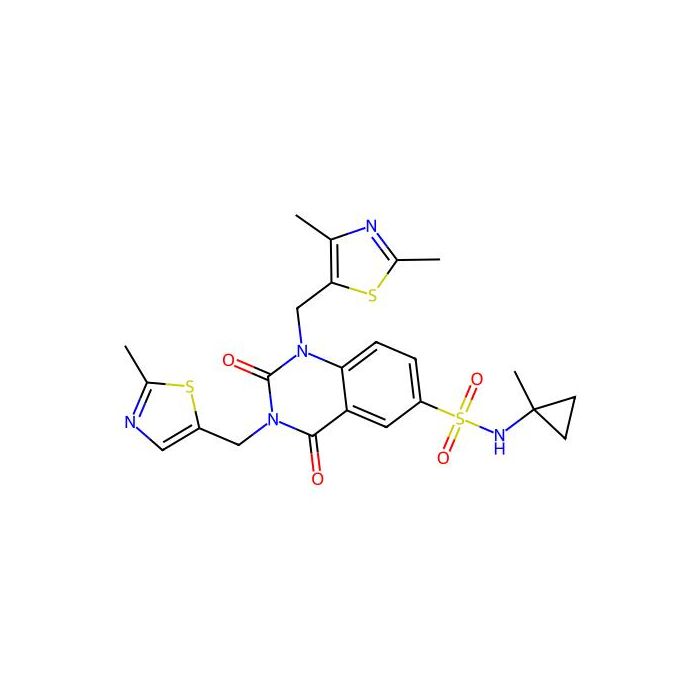
PDD00017272 (34f) is a potent inhibitor of Poly(ADP-ribose) Glycohydrolase (PARG) , with EC 50 of 4.8 nM and 9.2 nM in biochemical assay and cell POM, respectively.
Especificaciones
Especificaciones y pureza
Moligand™, 10 mM in DMSO
Condiciones de almacenamiento de almacenamiento
Store at -80°C
Enviado en
Dry ice packs + Cold packs
Este producto requiere envío en cadena de frío. Los servicios terrestres y otros servicios económicos no están disponibles.
Certificados (CoA, COO, BSE/TSE y tabla de análisis)
C of A & Other Certificates(BSE/TSE, COO):
Analytical Chart:
Calculadoras de soluciones
Molarity Calculator
Determine the necessary mass, volume, or concentration for preparing a solution.
Dilution Calculator
Determine the dilution needed to prepare a stock solution.
Reconstitution Calculator
Reseñas
Reseñas de cliente
Application Protocols
No vendor-tested application protocols are provided for this SKU.
General HTS/assay workflow guidance for small-molecule ligands:
Stock solutions: Prepare 10–50 mM in anhydrous DMSO. Store single-use aliquots at −80°C. Label with concentration, lot, and date.
Plate setup: Use low-binding, solvent-resistant plates. Normalize DMSO across all wells. Include positive/negative controls and QC compounds.
Dilution series: 1:3 or 1:2 serial dilutions over 8–12 points typically provide robust curve fits; randomize positions to mitigate edge effects.
Readouts: Choose orthogonal detection where feasible (e.g., fluorescence plus DSF or enzymatic readout plus SPR) to minimize false positives.
Data QC: Monitor Z′-factor, signal window, and intra/inter-plate CVs; repeat hits in independent runs and fresh aliquots.
If you require structure-specific protocols (e.g., crystallography soaking concentrations, NMR ligand-observed settings), request the compound’s structure and any internal method notes under your project’s data-sharing agreement.
Biological Roles
The biological function/target for PDD00017272 is not disclosed in the public catalog entry.
General context for Moligand™ small molecules:
Such compounds are typically used as chemical probes or ligands in exploratory studies to interrogate protein targets, pathways, or phenotypes. Any apparent activity identified in HTS should be considered preliminary until validated across orthogonal assays and counter-screens.
Common follow-ups include: thermal shift assays (protein stabilization/destabilization), surface plasmon resonance or MST (binding kinetics/affinity), and cellular target engagement assays (e.g., CETSA), subject to compatibility.
Important cautions:
Do not ascribe biological roles or mechanisms to this item without validated data. Pan-assay interference (PAINS), redox cycling, fluorescence/quenching artifacts, and aggregation can confound early results.
Implement standard controls: detergent, redox quenchers (as appropriate), orthogonal readouts, and purity checks before drawing conclusions.
Data needs for definitive assignment:
Verified structure (SMILES/InChI), stereochemistry, and salt form.
This product is for research use only and not for human or veterinary applications.
Buffer Applications
This item is not a buffering reagent. No acid/base pair or pH range is specified, and no buffer recipes apply.
Guidance for assay buffers when using small-molecule ligands (general):
Choose buffers with minimal compound interaction and optical interference: HEPES, PBS, or Tris at 10–50 mM are common starting points, adjusted to the biological system.
Maintain consistent DMSO percentage across all wells/tubes to avoid apparent pH or ionic strength shifts caused by solvent composition changes.
Include 0.01–0.05% non-ionic detergent if colloidal aggregation is suspected; verify that detergent does not disrupt the target system.
Item-specific buffering properties: Not specified for this item; refer to CoA/Spec Sheet if any pKa information is provided.
Green Alternatives
A green-alternatives assessment is not directly applicable without the compound’s structure, hazard profile, and solvent/system context.
General sustainability guidance for handling screening compounds:
Prefer high-solubility stocks in DMSO to minimize use of halogenated solvents in downstream dilutions.
Consolidate assay plates and use acoustic or low-volume dispensing to reduce solvent and plastic waste.
Where possible, select aqueous-based assay buffers and avoid excessive organic co-solvent percentages that demand special waste handling.
If this compound is to be used as a synthetic substrate or reagent (structure-dependent):
Consider replacing chlorinated solvents (e.g., DCM) with greener media such as 2-MeTHF, CPME, EtOAc, or propylene carbonate, contingent on solubility and reactivity.
Apply solvent selection guides (e.g., CHEM21, ACS GCI) and life-cycle assessments when designing workflows.
Because item-specific data are not available here, no definitive substitution matrix can be presented. Refer to your internal green-chemistry policy and the item’s CoA/SDS once obtained.
Pharmaceutical Uses
No pharmacopeial status, excipient role, or manufacturing use is specified for this product. It is sold for research use only.
General notes for discovery-stage compounds:
Early-stage ligands may inform medicinal chemistry campaigns but are not suitable for formulation development without extensive characterization (solid form, stability, polymorphism, hygroscopicity, impurity profile).
Any consideration of preformulation requires item-specific data (solubility across pH, pKa, logP/logD, permeability, chemical and photostability). These data are not provided here for PDD00017272.
Regulatory statement:
Not intended for use in humans or animals. Not manufactured under GMP. No clinical, diagnostic, or therapeutic claims are made or implied.
Physical Properties
Item-specific physicochemical data are not publicly listed for this Moligand™ entry.
Appearance: Not specified for this item; refer to CoA/Spec Sheet.
Melting point: Not specified for this item; refer to CoA/Spec Sheet.
Boiling point: Not specified for this item; refer to CoA/Spec Sheet.
Density: Not specified for this item; refer to CoA/Spec Sheet.
Solubility profile: Not specified for this item; refer to CoA/Spec Sheet.
logP/logD: Not specified for this item; refer to CoA/Spec Sheet.
pKa(s): Not specified for this item; refer to CoA/Spec Sheet.
Refractive index: Not specified for this item; refer to CoA/Spec Sheet.
UV–Vis characteristics: Not specified for this item; refer to CoA/Spec Sheet.
General guidance for small-molecule screening compounds (literature/general):
Most library members are supplied as solids or DMSO stock solutions and exhibit good solubility in high-purity DMSO (≥10–20 mM) with subsequent dilution into assay buffers containing 0.1–1% DMSO.
If crystallinity or limited aqueous solubility is encountered, consider co-solvents (e.g., DMF, ethanol) or surfactants (0.01–0.05% Tween-20), subject to assay compatibility.
Assess compound integrity by LC–MS and ensure absence of aggregates at working concentrations (dynamic light scattering or detergent controls), especially above 10–20 µM in biochemical assays.
Note: Treat any property value not listed above as unspecified for this specific item until confirmed on the lot-specific CoA or Spec Sheet.
Quality and Grades
Grade/Purity: Moligand™ (from Product Data)
What Moligand™ typically signifies (general description):
A curated small-molecule/ligand screening grade intended for discovery workflows (e.g., target engagement, biochemical or biophysical assays, fragment/lead identification). Emphasis is placed on identity confirmation and suitability for high-throughput operations rather than pharmacopeial compliance.
Common quality controls for Moligand™-type items (general; refer to item’s CoA for specifics):
Identity by LC–MS/HRMS; purity by LC–UV/ELSD at multiple wavelengths. Typical screening-grade thresholds are often ≥90–95% by LC, but the exact minimum acceptance criterion is lot-specific.
Water content (Karl Fischer), residual solvents, and salt/counterion content may be reported where relevant. If not reported: Not specified for this item; refer to CoA/Spec Sheet.
Solid form (free base vs. salt), polymorph, and stoichiometry may be indicated on the CoA.
What this means for users:
Suitable for hit finding, SAR-by-catalog, and orthogonal assay confirmation when paired with internal QC (re-verify purity/integrity after shipping and storage).
Not manufactured to GMP; not intended for human or veterinary use.
Documentation and traceability:
Each lot is traceable to CAS 1945950-20-8 and the Aladdin SKU P1496265. Request the CoA/Spec Sheet to access item-specific analytical data and any stabilizer/additive information if applicable.
Reaction and Applications
This SKU is positioned as a Moligand™ screening compound. No synthetic transformation role or reaction-grade use is specified for this particular item.
Research applications (general for small-molecule ligands):
Primary screening/HTS in biochemical assays (enzyme activity, receptor binding) with subsequent hit confirmation by orthogonal readouts (e.g., thermal shift, MST, SPR).
Cellular assays for preliminary phenotypic responses, subject to cytotoxicity profiling and solubility/aggregation controls.
Fragment/lead identification workflows, including NMR-based screening or computational triage followed by biophysical validation.
Assay design considerations (general):
Employ serial dilutions spanning at least 3–4 logs to capture full response curves; maintain constant DMSO across wells/conditions.
Include aggregate controls (0.01–0.05% non-ionic detergent) and redox interference controls where assay chemistry is susceptible.
Confirm chemical integrity post-assay by LC–MS to exclude degradation or adduct formation.
Note: If your intended use is as a synthetic reagent or building block, obtain the structure/functional group information first. Without a disclosed scaffold, no reliable guidance on reaction classes (e.g., coupling, protection, functional group interconversions) can be provided for this item.
Reaction Conditions
No reaction usage or conditions are specified for this SKU. Without the structure, authoritative guidance on solvent, base/acid, catalyst, temperature, or time for any transformation cannot be provided.
General testing conditions for assay use (not synthetic reactions):
Stock preparation: Dissolve in dry DMSO at 10–50 mM; vortex and, if necessary, sonicate briefly. Filter through 0.22 µm PTFE if particulate persists.
Assay dilution: Add DMSO stocks to buffered systems to a final DMSO of 0.1–1% v/v, ensuring consistent DMSO across controls and treatments.
Light/temperature: Keep solutions protected from light and work on ice or at 4°C during plate preparation if instability is suspected.
Any synthetic reaction conditions mentioned in literature for unrelated compounds should not be generalized to this item without structural confirmation.
Safety and Handling
Safety data specific to this SKU are not provided in the public entry. Always consult the lot-specific SDS.
GHS classification: Not specified for this item; refer to SDS.
Signal word / H-statements / pictograms: Not specified for this item; refer to SDS.
Primary hazards (general for small organic molecules): May cause skin/eye irritation; avoid inhalation of dust or aerosols; some screening compounds can be harmful if swallowed or inhaled.
Storage conditions (from Product Data): Store at −80°C. Shipments are made on dry ice packs + cold packs.
Handling recommendations (general best practice):
Work in a chemical fume hood; avoid open handling of powders and volatile solvents.
Wear appropriate PPE: lab coat, safety glasses, and nitrile gloves; change gloves frequently when handling DMSO stocks.
Prevent cross-contamination in screening libraries by using sterile, solvent-resistant tips and low-retention plastics.
Avoid repeated freeze–thaw of aliquots to minimize degradation; keep on dry ice or in a cooled rack during plate dispensing.
Incompatibilities (general):
Strong oxidizers and reducing agents until stability is known.
Avoid prolonged exposure to light and moisture unless validated as stable under those conditions.
First-aid (overview; defer to SDS):
Skin/eye contact: Rinse with water for several minutes; remove contaminated clothing.
Inhalation: Move to fresh air; seek medical attention if symptoms persist.
Ingestion: Rinse mouth; seek medical advice.
Waste: Collect organic waste in halogenated/non-halogenated streams per local regulations.
Solvent Selection
Item-specific solvent compatibility and solubility are not disclosed.
General selection principles for small-molecule library members:
Primary stock solvent: High-purity DMSO (anhydrous, ≥99.9%) is the default for discovery screening due to broad solvating power and assay compatibility at 0.1–1% final v/v.
Alternative solvents (assay-dependent): DMF, ethanol, or acetonitrile can be used for initial dissolution, followed by dilution into aqueous buffers containing 0.01–0.05% non-ionic surfactant if needed to mitigate aggregation.
Water miscibility: Many organic compounds show limited direct aqueous solubility; pre-dissolve in DMSO, then titrate into buffer with vigorous mixing to avoid precipitation.
Practical tips:
Prepare concentrated master stocks (e.g., 10–50 mM in DMSO) and store as single-use aliquots at −80°C.
Verify clarity upon dilution into assay buffer at working concentration; if opalescence appears, reduce final concentration of compound or DMSO, adjust ionic strength, or add surfactant within assay tolerance.
For biophysical assays (ITC, SPR, DSF), match the cosolvent in sample and reference channels to minimize artifacts.
Comparison to alternatives (general):
DMSO: Widest applicability; can affect protein stability at >2–5%.
DMF: Strong solvent but more hygroscopic and cytotoxic; often less preferred in cell-based assays.
Ethanol: Biocompatible at low %; limited solvating power for highly lipophilic chemotypes.
Storage and Reconstitution
Storage conditions (from Product Data): Store at −80°C. Shipped on dry ice packs + cold packs to maintain low temperature throughout transit.
Appearance: Not specified for this item; refer to CoA/Spec Sheet.
Reconstitution (general guidance for screening compounds; not item-specific):
Solvent: Use anhydrous, high-purity DMSO to prepare concentrated stock solutions (e.g., 10–50 mM). If insoluble, warm gently to room temperature and sonicate briefly. Avoid water uptake.
Filtration: If particulates remain, filter through a 0.22 µm PTFE membrane under inert conditions if sensitivity to air/moisture is suspected.
Aliquoting: Dispense into single-use aliquots (e.g., 10–50 µL) in solvent-resistant tubes/plates. Minimize headspace and store at −80°C.
Freeze–thaw: Avoid repeated cycles. Thaw rapidly on ice and keep solutions cold and protected from light during handling.
Stability: Not specified for this item; refer to CoA/Spec Sheet and SDS. As a precaution, limit bench exposure and return unused material to −80°C promptly.
Documentation: Record lot number, concentration, solvent, preparation date, and storage location in your LIMS for full traceability.
Research Use Only: This product is intended exclusively for laboratory research, not for diagnostic or therapeutic use.
Structure and Identity
Overview: This SKU represents a single small-molecule library member from Aladdin’s Moligand™ collection. Item-specific structural identifiers are not disclosed in the public catalog entry.
Product name: PDD00017272 (catalog identifier)
CAS: 1945950-20-8 (from Product Data)
PubChem CID: 134169694 (from Product Data)
Molecular formula: Not specified for this item; refer to CoA/Spec Sheet.
Molecular weight: Not specified for this item; refer to CoA/Spec Sheet.
InChIKey: Not specified for this item; refer to CoA/Spec Sheet.
SMILES: Not specified for this item; refer to CoA/Spec Sheet.
Stereochemistry: Not specified for this item; refer to CoA/Spec Sheet.
Structural features: Not specified for this item; refer to CoA/Spec Sheet.
2D structure description (general): Without the SMILES/InChI or structure file, functional groups, ring systems, and heteroatom content cannot be summarized. Please consult the compound’s CoA/structure file provided to qualified customers for substructure and scaffold information.
Identity control recommendations (general):
Match CAS, CID, and internal lot number to accompanying CoA.
Confirm identity by orthogonal methods (e.g., LC–MS exact mass, HRMS, 1H/13C NMR) as appropriate for your workflow.
For screening use, verify plate maps and barcode/QR code against LIMS prior to assay setup.
Synthetic Utility
Synthetic utility cannot be described without the compound’s disclosed structure and functional groups. No role as a reagent, catalyst, or building block is specified for this Moligand™ entry.
If structure becomes available (general guidance):
Identify key functional handles (e.g., aryl halides, boronates, amines, acids) for diversification via cross-coupling (Suzuki–Miyaura, Buchwald–Hartwig), amide coupling, reductive amination, or heterocycle elaboration.
Assess protecting group needs based on pKa and nucleophilicity/acidity of functional groups.
Consider late-stage diversification to probe SAR if the scaffold shows activity in screening.
Until then, treat this item primarily as a screening ligand rather than a synthetic intermediate.
Target Specificity
Target, selectivity, and mechanism of action are not specified for PDD00017272.
Antigen/epitope: Not applicable (small molecule).
Target class (enzyme/receptor/channel): Not specified for this item; refer to accompanying project documentation if available.
Off-target profile and selectivity panels: Not specified for this item; recommend generating with a suitable screening panel once primary activity is observed.
For researchers:
Establish target engagement using orthogonal assays (e.g., CETSA, SPR, MST, DSF) before investing in downstream biology.
Incorporate counter-screens that address common assay interferences relevant to your modality (redox, fluorescence, aggregation).
¿Necesita ayuda para elegir la calidad?
Nuestra guía de selección de calidades cubre la pureza, el estado del estabilizador y la idoneidad de la aplicación para todas las variantes de nuestro catálogo.
Utilizamos cookies para garantizar el correcto funcionamiento del sitio web y, cuando esté permitido, para mejorar su experiencia. Puede gestionar sus preferencias en cualquier momento en Configuración. Más información en nuestra Política de Cookies.
¿Quieres que te enviemos un mensaje cuando tengamos descuentos disponibles?
Recordármelo más tarde
¡Gracias! Por favor, revisa tu bandeja de entrada de correo electrónico para confirmar.
Products are supplied to verified businesses, institutions, and qualified professionals for research and development use only. Not for use in humans, animals, diagnosis, or therapy.