 I2524553
Determine the necessary mass, volume, or concentration for preparing a solution.
| Activity Type | Relation | Activity value | Units | Action Type | Journal | PubMed Id | doi | Assay Aladdin ID |
|---|

viscosity 1.2 dL/g for sensitive chromatographic and analytical workflows requiring minimal baseline interference.
Store at -20°C,Argon charged Ships Ice chest + Ice pads Check lot-specific COA for exact specifications.
SDS, COA, datasheet, and spec sheet available for download. Lot-specific COA accessible via lot number lookup.
Cited in 212 peer-reviewed publications across chromatography, organic synthesis, and cross-coupling reactions.
General Description
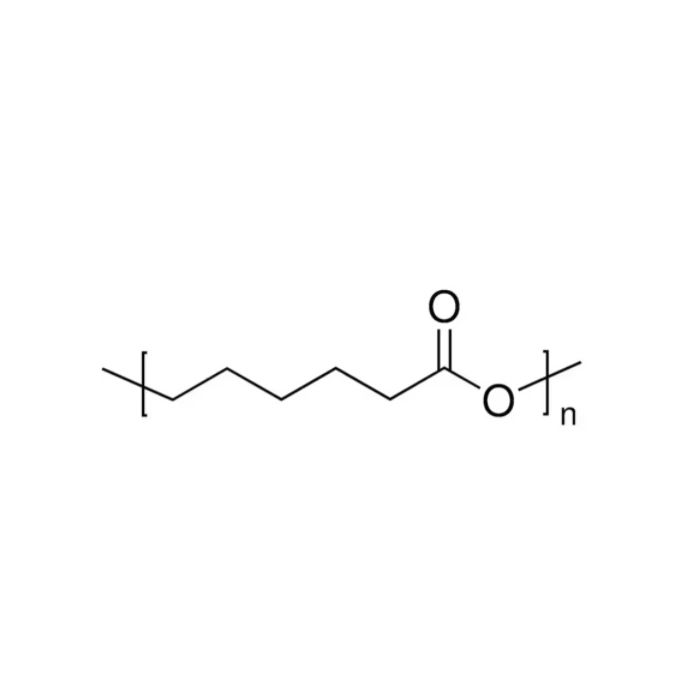
Polycaprolactone (PCL) is a biodegradable, semicrystalline polyester for use in tissue engineering and drug delivery research applications. Due to the increased length of the aliphatic chain, polycaprolactone degrades significantly slower than other common biodegradable polymers, such as polylactide. PCL features a low melting point (55-60 °C), making it ideal for thermal processing and increasing its use in novel applications such as 3D bioprinting. In addition to its favorable thermal properties, PCL also features high solubility in organic solvent allowing for a multitude of other processing options. This product features low residual water, monomer, and catalyst (tin) making it an ideal choice for use in tissue engineering and 3D bioprinting research.
Application
Research applications of this material include: Tissue engineering scaffolds. 3D Bioprinting. Drug delivery applications such as sustained release.
Comprehensive hazard, handling, storage, and regulatory compliance document.
Download SDS →Lot-specific quality data. Enter your lot number to retrieve the exact COA.
Look up COA →Full quality attributes and acceptance criteria for this grade.
View spec sheet →Taxonomy Tree
| Kingdom | Organic compounds |
|---|---|
| Superclass | Organoheterocyclic compounds |
| Clase | Lactones |
| Subclass | Not available |
| Intermediate Tree Nodes | Not available |
| Direct Parent | Lactones |
| Alternative Parents | Oxepanes Carboxylic acid esters Oxacyclic compounds Monocarboxylic acids and derivatives Organic oxides Hydrocarbon derivatives Carbonyl compounds |
| Molecular Framework | Aliphatic heteromonocyclic compounds |
| Substituents | Caprolactone - Oxepane - Lactone - Carboxylic acid ester - Oxacycle - Monocarboxylic acid or derivatives - Carboxylic acid derivative - Organic oxygen compound - Organic oxide - Hydrocarbon derivative - Organooxygen compound - Carbonyl group - Aliphatic heteromonocyclic compound |
| Descripción | This compound belongs to the class of organic compounds known as lactones. These are cyclic esters of hydroxy carboxylic acids, containing a 1-oxacycloalkan-2-one structure, or analogues having unsaturation or heteroatoms replacing one or more carbon atoms of the ring. |
| External Descriptors | a small molecule |
| Activity Type | Relation | Activity value | Units | Action Type | Journal | PubMed Id | doi | Assay Aladdin ID |
|---|
| Sensibilidad | Heat and moisture sensitive |
|---|---|
| Punto de inflamación (°C) | > 110°C |
| Punto de fusión (°C) | 60°C |
| Peso molecular | 114.140 g/mol |
| XLogP3 | 0.000 |
| Hydrogen Bond Donor Count | 0 |
| Hydrogen Bond Acceptor Count | 2 |
| Rotatable Bond Count | 0 |
| Exact Mass | 114.068 Da |
| Monoisotopic Mass | 114.068 Da |
| Topological Polar Surface Area | 26.300 Ų |
| Heavy Atom Count | 8 |
| Formal Charge | 0 |
| Complexity | 88.500 |
| Isotope Atom Count | 0 |
| Defined Atom Stereocenter Count | 0 |
| Undefined Atom Stereocenter Count | 0 |
| Defined Bond Stereocenter Count | 0 |
| Undefined Bond Stereocenter Count | 0 |
| The total count of all stereochemical bonds | 0 |
| Covalently-Bonded Unit Count | 1 |