GRADE & PURITYAnimal Free?Animal-free — produced without animal-derived components to reduce contamination risk. Use in biomanufacturing and culture avoiding animal-origin material.Carrier Free?Carrier-free — supplied without added carrier protein/stabilizer. Use when carriers (e.g. BSA) would interfere with conjugation or sensitive assays.Bioactive?Bioactive grade — verified to retain biological activity in functional assays. Use when the molecule must be functionally active, not just pure.ActiBioPure™?ActiBioPure™ — Aladdin's premier line for bioactive and recombinant products. Use when both high purity and preserved biological activity are required.Azide Free?Azide-free — without sodium azide preservative. Use in conjugations, cell work, or assays where azide is toxic or inhibitory.His Tag?His tag grade — recombinant protein bearing a His tag for affinity purification/detection. Use to purify, immobilize, or detect the tagged protein.≥95%(SDS-PAGE)
Expression System
HEK293
Accession #
P05067
Protein Tag
C-His
Expression system
HEK293
Endotoxin Concentration
<0.1 EU/μg
Bioactivity
Measured by its ability to inhibit trypsin cleavage of a fluorogenic peptide substrate, Mca-RPKPVE-Nval-WRK(Dnp)-NH2. The IC50 value is < 0.24 nM.
Animal Free,Carrier Free,Bioactive,ActiBioPure™,Azide Free,His-Tag,≥95%(SDS-PAGE) ActiBioPure™,Animal Free,Azide Free,Bioactive,Carrier Free,His Tag for sensitive chromatographic and analytical workflows requiring minimal baseline interference.
🌡
Storage & shipping
Store at -20°C,Avoid repeated freezing and thawing Ships Ice chest + Ice pads Check lot-specific COA for exact specifications.
📋
Quality documents
SDS, COA, datasheet, and spec sheet available for download. Lot-specific COA accessible via lot number lookup.
📚
Literature proof
Cited in 2 peer-reviewed publications across chromatography, organic synthesis, and cross-coupling reactions.
Descripción general
Purity ≥95% (SDS-PAGE) Endotoxin level <0.1 EU/μg Function Functions as a cell surface receptor and performs physiological functions on the surface of neurons relevant to neurite growth, neuronal adhesion and axonogenesis. Involved in cell mobility and transcription regulation through protein-protein interactions. Can promote transcription activation through binding to APBB1-KAT5 and inhibits Notch signaling through interaction with Numb. Couples to apoptosis-inducing pathways such as those mediated by G(O) and JIP. Inhibits G(o) alpha ATPase activity (By similarity). Acts as a kinesin I membrane receptor, mediating the axonal transport of beta-secretase and presenilin 1. Involved in copper homeostasis/oxidative stress through copper ion reduction. In vitro, copper-metallated APP induces neuronal death directly or is potentiated through Cu(2+)-mediated low-density lipoprotein oxidation. Can regulate neurite outgrowth through binding to components of the extracellular matrix such as heparin and collagen I and IV. The splice isoforms that contain the BPTI domain possess protease inhibitor activity. Induces a AGER-dependent pathway that involves activation of p38 MAPK, resulting in internalization of amyloid-beta peptide and leading to mitochondrial dysfunction in cultured cortical neurons. Provides Cu(2+) ions for GPC1 which are required for release of nitric oxide (NO) and subsequent degradation of the heparan sulfate chains on GPC1. Beta-amyloid peptides are lipophilic metal chelators with metal-reducing activity. Bind transient metals such as copper, zinc and iron. In vitro, can reduce Cu(2+) and Fe(3+) to Cu(+) and Fe(2+), respectively. Beta-amyloid 42 is a more effective reductant than beta-amyloid 40. Beta-amyloid peptides bind to lipoproteins and apolipoproteins E and J in the CSF and to HDL particles in plasma, inhibiting metal-catalyzed oxidation of lipoproteins. Beta-APP42 may activate mononuclear phagocytes in the brain and elicit inflammatory responses. Promotes both tau aggregation and TPK II-mediated phosphorylation. Interaction with overexpressed HADH2 leads to oxidative stress and neurotoxicity. Also binds GPC1 in lipid rafts. Appicans elicit adhesion of neural cells to the extracellular matrix and may regulate neurite outgrowth in the brain. The gamma-CTF peptides as well as the caspase-cleaved peptides, including C31, are potent enhancers of neuronal apoptosis. N-APP binds TNFRSF21 triggering caspase activation and degeneration of both neuronal cell bodies (via caspase-3) and axons (via caspase-6).
Specifications
Product Name
Recombinant Human Amyloid Precursor Protein, ≥95% (SDS-PAGE)
Sinónimos
ABPP | Alzheimer disease amyloid protein | Amyloid precursor protein | Amyloid-beta A4 protein | APP | APPI | Cerebral vascular amyloid peptide | CVAP | PN-II | PreA4 | Protease nexin-II | A4 amyloid protein | A4_HUMAN | AAA | ABETA | ABPP | AD1 | AICD-50
Grado
ActiBioPure™, Animal Free, Azide Free, Bioactive, Carrier Free, His Tag
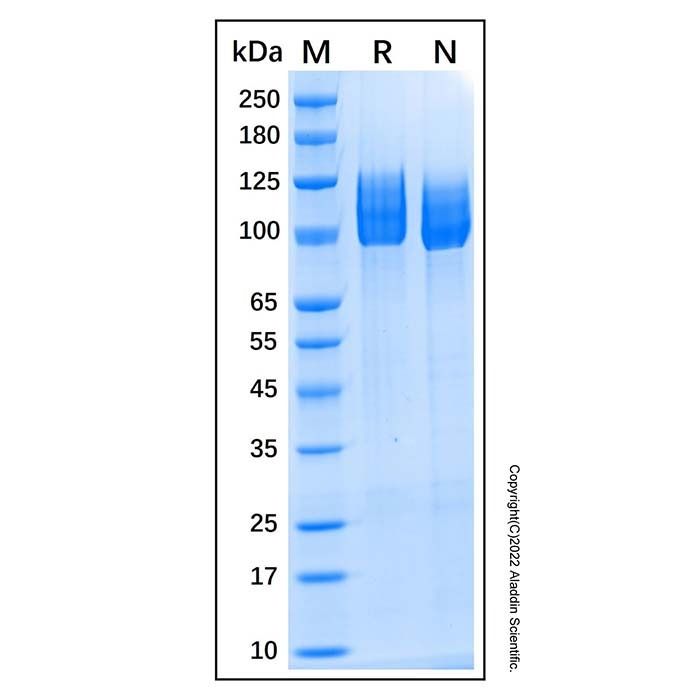
100 - 125 kDa, under reducing conditions; 100 - 125 kDa, under non-reducing conditions.
Tipo de molécula
Protein
Almacenamiento y envío
Forma
Lyophilized
Reconstitución
Reconstitute in sterile water to a concentration of 0.1-0.5 mg/ml.
Condiciones de almacenamiento de almacenamiento
Store at -20°C,Avoid repeated freezing and thawing
Enviado en
Ice chest + Ice pads
Estabilidad y almacenamiento
Store at -20~-80℃ for more than 1 year. Upon receipt, it is recommended to aliquot. Avoid freeze/thaw cycle.
Imágenes
Recombinant Human Amyloid Precursor Protein (rp142805) - SDS-PAGE 3 μg/lane of Recombinant Human Amyloid Precursor Protein was resolved with SDS-PAGE under reducing (R) and non-reducing (N) conditions and visualized by Coomassie® Blue staining, showing the band at 100 - 125 kDa.
Documentation
📋 Safety Data Sheet (SDS)
Comprehensive hazard, handling, storage, and regulatory compliance document.
We use cookies to ensure the website functions properly and, where permitted, to improve your experience. You can manage your preferences at any time in Settings. Learn more in our Cookie Policy.
Shall we send you a message when we have discounts available?
Remind me later
Thank you! Please check your email inbox to confirm.
Products are supplied to verified businesses, institutions, and qualified professionals for research and development use only. Not for use in humans, animals, diagnosis, or therapy.

 ZJ24F1214979