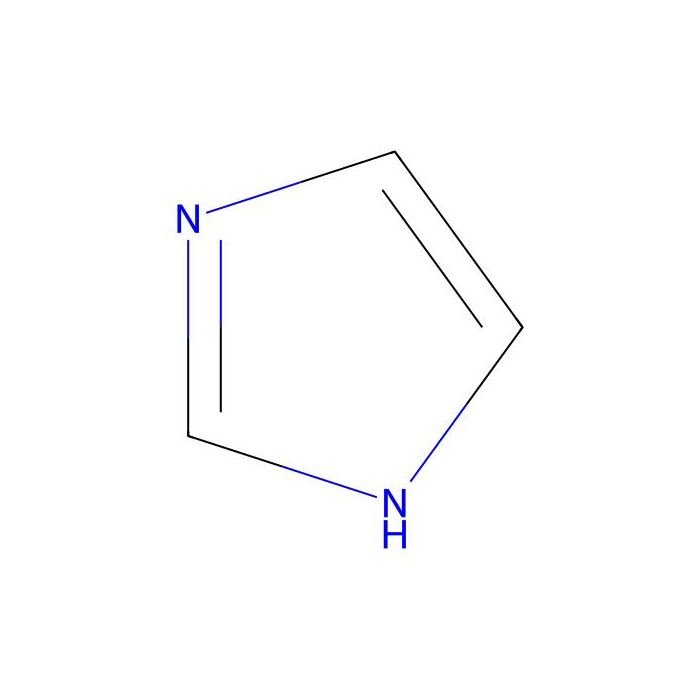
Imidazole - Ultra pure, ≥99%(NMR), useful in pH range 6.2-7.8 , CAS No.288-32-4

CAS: 288-32-4 Cat. No.: I755524 分子式: C3H4N2 分子量: 68.08 Beilstein Registry Number: 103853 EC番号: 206-019-2
注文可能
グレード&純度 Ultra pure ? Ultra-pure grade with very low impurity content across the board. Use for trace analysis, electronics, or processes intolerant of contamination. ≥99%(NMR) useful in pH range 6.2-7.8
Storage
Room temperature
Shipped In
Normal
★
サイズ
USA
ドイツ (EU)*
価格
個数
100g
I755524-100g
受注生産 · 8~12週間
$1,288.90
Enter a quantity for the sizes you want to add.
🧪
このグレードを選ぶ理由

Ultra pure, ≥99%(NMR), useful in pH range 6.2-7.8 Ultra pure ベースライン干渉を最小限に抑える必要がある、感度の高いクロマトグラフィーおよび分析ワークフロー向け。

🌡

保管・配送

Room temperature Normal に出荷。正確な仕様については、ロット固有の COA をご確認ください。

📋

品質書類

SDS、COA、データシート、仕様書をダウンロードできます。ロット固有の COA はロット番号検索で入手可能です。

📚

文献的裏付け

クロマトグラフィー、有機合成、クロスカップリング反応に関する 434 件の査読済み論文で引用されています。

概要

Superior buffer in the pH range of 6.2-7.8. Has a pKa of 7.0 at 20°C.
Useful in the pH range of 6.2-7.8.
Application:

  • Prediction of adsorption performance of ZIF-67 for malachite green based on artificial neural network using L-BFGS algorithm.: Utilizing imidazole-based frameworks, specifically ZIF-67, this study showcases the effectiveness of imidazole structures in adsorbing and removing industrial dyes from water, highlighting environmental applications of imidazole in water treatment processes (Xiong C et al., 2024).

仕様

仕様と純度
Ultra pure, ≥99%(NMR), useful in pH range 6.2-7.8
保管条件
Room temperature
入荷
Normal
等級
Ultra pure
純度
≥99%(NMR)
名前と識別子
カノニカル・スマイル
C1=CN=CN1
IUPAC Name
1H-imidazole
InChIKey
RAXXELZNTBOGNW-UHFFFAOYSA-N
INCHI
1S/C3H4N2/c1-2-5-3-4-1/h1-3H,(H,4,5)
異性体SMILES
C1=CN=CN1
WGKドイツ
1
RTECS
NI3325000
UN番号
2923
分子量
68.08
Beilstein
103853
Reaxy-Rn
103853
Reaxys-RN_link_address
https://www.reaxys.com/reaxys/secured/hopinto.do?context=S&query=IDE.XRN=103853&ln=

ドキュメント

📋 安全データシート(SDS)

危険性、取扱い、保管、および規制遵守を網羅した包括的な文書。

<<<<<<< HEAD SDS をダウンロード → ======= SDS をダウンロード → >>>>>>> release248-p3

✅ 分析証明書(COA)

ロット固有の品質データ。ロット番号を入力して、正確な COA を取得してください。

COA を検索 →

📊 データシート

製品仕様と用途のクイックリファレンス概要。

データシートを見る →

🔬 仕様書

このグレードの完全な品質特性と合格基準。

仕様書を見る →

詳細データ

Taxonomic Classification

Taxonomy Tree

KingdomOrganic compounds
SuperclassOrganoheterocyclic compounds
分類Azoles
SubclassImidazoles
Intermediate Tree Nodes Not available
Direct ParentImidazoles
Alternative Parents Heteroaromatic compounds  Azacyclic compounds  Organopnictogen compounds  Organonitrogen compounds  Hydrocarbon derivatives  
Molecular FrameworkAromatic heteromonocyclic compounds
Substituents Heteroaromatic compound - Imidazole - Azacycle - Organic nitrogen compound - Organopnictogen compound - Hydrocarbon derivative - Organonitrogen compound - Aromatic heteromonocyclic compound
説明This compound belongs to the class of organic compounds known as imidazoles. These are compounds containing an imidazole ring, which is an aromatic five-member ring with two nitrogen atoms at positions 1 and 3, and three carbon atoms.
External Descriptors an aromatic compound
3 D構造
インタラクティブ化学構造モデル


証明書(CoA、COO、BSE/TSEと分析図)
C of A & Other Certificates(BSE/TSE, COO):
Analytical Chart:
化学的性質と物理的性質
溶解度water: 100 mg/mL
引火点(°C)145℃
沸点(°C)257°C
融点(°C)90-91°C
分子量68.080 g/mol
XLogP3-0.100
Hydrogen Bond Donor Count1
Hydrogen Bond Acceptor Count1
Rotatable Bond Count0
Exact Mass68.0374 Da
Monoisotopic Mass68.0374 Da
Topological Polar Surface Area28.700 Ų
Heavy Atom Count5
Formal Charge0
Complexity28.100
Isotope Atom Count0
Defined Atom Stereocenter Count0
Undefined Atom Stereocenter Count0
Defined Bond Stereocenter Count0
Undefined Bond Stereocenter Count0
The total count of all stereochemical bonds0
Covalently-Bonded Unit Count1
よくある質問と記事
Comparing Guanidine Hydrochloride and Urea for Inclusion-Body Solubilization
Why Did Nickel Agarose Beads Lose Their Color?
Why Did My Ni-Agarose Beads Turn Black or Brown?
How to Optimize Buffer Components for Ni-Agarose Beads
Stripping, Cleaning, and Metal Recharging Workflow for Ni²⁺–Agarose Resins
Obtaining soluble and biologically active recombinant proteins from inclusion bodies
How to Choose the Best Protein Purification Technique
His-Tagged Protein Purification
His-Tag Protein Purification: Common Troubleshooting Questions and Practical Solutions
Scientific Decision-Making for Chromatography Buffer Selection: Tris-HCl vs Phosphate Systems
OSF/ASF Dual-Channel Toolbox: Divergent Reactions of Four-Membered Ring Sulfonyl Fluorides, Condition “Knobs,” and Selection Navigation
Protein Tags Demystified: Classification, Properties, and Suitable Experimental Applications
Why Copper Develops Local Pinholes in Water Systems: The Film-Forming Protection Mechanism of Benzotriazole (BTA), Key Variables, and a Selection Guide (Tables 1–3)
Tuning Logic of Imidazole Heteroaromatic Building Blocks: How Dual Nitrogen Sites and Substitution / Salt Forms / Ring Fusion Modulate Charge, Hydrogen Bonding, and Coordination (with Tables A–E)
Invertebrate Oxygen Carrier Proteins in Immunology and Vaccine Research
Silicon Reagent-Assisted Peptide Synthesis: Research Progress and Methodological Value of Peptide Bond Formation from Unprotected Substrates
Decision Logic for Peptide Synthesis Routes: Applicability and Criteria for Choosing among SPPS, LPPS, and Recombinant Expression
DMAP Is More Than Just an Organic Base: Experimental Judgment from Nucleophilic Acyl Transfer to Esterification and Macrolactonization
Experimental Selection of SEM-Cl: From O/N-SEM Protection and Directed Functionalization of N-Heterocycles to the Introduction of Protected C1 Fragments
4-[(tert-Butyldimethylsilyl)oxy]butan-1-ol: Experimental Selection Logic as a Monoprotected 1,4-Butanediol Building Block and a Protected C4 Linker
Formulation Design and Selection of Amine Curing Agents in Epoxy Systems
Protein Structure Analysis: An Experimental Path from Defining the Question to Functional Validation
Understanding Amine Curing Agents: Structure, Types, and Application Selection
Adding a Temperature-Triggered Switch to NCO: How Blocked Isocyanates Affect the Storage, Curing, and Film Performance of 1K Baking Coatings
Epoxy Phenolic Coatings: Why Are They Commonly Used for Chemical Resistance, Solvent Resistance, Heat Resistance, and Internal Metal Surface Protection?
What Is Synthetic Biology? The Industrialization Pathway from Upstream Reagent Toolchains to Biomanufacturing Applications
Why Is the meta-Fluoropyridine Motif Difficult to Make? Understanding the Synthetic Logic of Stable Enamine Building Blocks from the Risks of the Balz–Schiemann Reaction
Structural Features, Property Modulation, and Typical Applications of Triazole Compounds
Synthetic Application Logic of Triazoles and Related Compounds: Structural Introduction, Reactive Sites, and Target Molecule Construction
One-Pot Arylation of the Piperidine α-C–H Bond: From Directed Lithiation and Li→Zn Transmetalation to Negishi Coupling
Overcoming the Electronic-Effect Limitations of Nucleophilic Aromatic Substitution in Fluoroarenes: Anion Activation, Concerted Substitution, and HF Capture by t-Bu-P4
What Is “Plant Collagen”? Distinguishing Ingredient Types, Structural Differences, Production Methods, and Skincare Effects
From 459,000 Recorded Ring Systems to 3,902 Candidate Ring Systems: Selection Patterns of Clinically Relevant Ring Systems
Citations of This Product
ソリューション計算機
レビュー

顧客レビュー

よくある質問

How should this product be stored?
Store at room temperature.
What is the purity of this product, and how is it determined?
This product is supplied at ≥99% purity, determined by NMR. Lot-specific values are stated on the Certificate of Analysis.
What does Ultra pure mean?
Ultra pure is a defined analytical purity tier suitable for general analytical and reagent applications. It specifies a minimum assay percentage, controlled limits on common impurities (water, heavy metals, residue on ignition), and lot-to-lot consistency. Ultra pure is one of several purity tiers — choose based on the sensitivity and regulatory requirements of your method.
How is this product shipped?
This product ships under standard ambient conditions. No temperature-controlled packaging is required.
What are the CAS number, molecular formula and molecular weight?
The CAS Number is 288-32-4, the molecular formula is C3H4N2, and the molecular weight is 68.08 g/mol. InChIKey RAXXELZNTBOGNW-UHFFFAOYSA-N.
What documentation is provided?
Available product documentation, including Certificates of Analysis (COA), Safety Data Sheets (SDS), and specification sheets, is shown in the product document area. Document availability and access follow the current site policy.

Shall we send you a message when we have discounts available?

Remind me later

Thank you! Please check your email inbox to confirm.

Oops! Notifications are disabled.