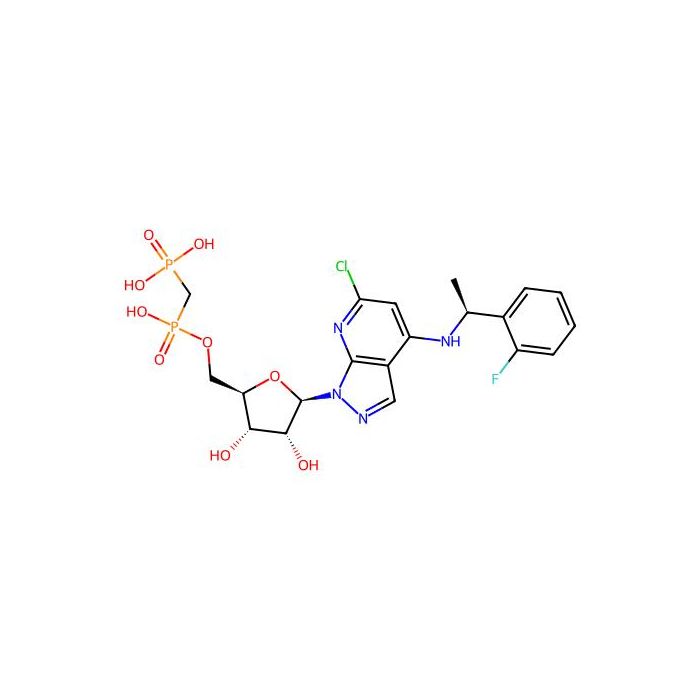
AB-680 - Moligand™, 10 mM in DMSO , CAS No.2105904-82-1

CAS: 2105904-82-1 Cat. No.: A1495695 분자식: C20H24ClFN4O9P2 분자량: 580.82 PubChem CID: 130205852
주문 가능
GRADE & PURITY Moligand™ ? Moligand™ — Aladdin's line of ligands and bioactive small molecules. Use for receptor, pathway, and binding studies needing defined small-molecule tools. 10 mM in DMSO
Storage
Argon charged,Store at -80°C
Shipped In
Dry ice packs + Cold packs
★
Size
USA
독일 (EU)*
Price
Qty
1ml
A1495695-1ml
주문제작 · 8~12주
US$402.90
Enter a quantity for the sizes you want to add.
🧪

Why this grade

Moligand™, 10 mM in DMSO Moligand™ for sensitive chromatographic and analytical workflows requiring minimal baseline interference.

🌡

Storage & shipping

Argon charged,Store at -80°C Ships Dry ice packs + Cold packs Check lot-specific COA for exact specifications.

📋

Quality documents

SDS, COA, datasheet, and spec sheet available for download. Lot-specific COA accessible via lot number lookup.

📚

Literature proof

Cited in 0 peer-reviewed publications across chromatography, organic synthesis, and cross-coupling reactions.

개요

AB-680 is a highly potent, reversible and selective inhibitor of CD73 (an ecto-nucleotidase), with a K i of 4.9 pM for hCD73, displays >10,000-fold selectivity over related ecto-nucleotidases CD39 . Anti-tumor activity.

Specifications

사양 및 순도
Moligand™, 10 mM in DMSO
보관 조건
Argon charged,Store at -80°C
배송
Dry ice packs + Cold packs
이 제품은 콜드 체인 배송이 필요합니다.지상 및 기타 경제 서비스는 사용할 수 없습니다.
등급
Moligand™
작업 유형
INHIBITOR
이름과 식별자
이성체 SMILES C[C@@H](C1=CC=CC=C1F)NC2=CC(=NC3=C2C=NN3[C@H]4[C@@H]([C@@H]([C@H](O4)COP(=O)(CP(=O)(O)O)O)O)O)Cl
대체 CAS 2105904-82-1
PubChem CID 130205852
MeSH 용어 AB680;quemliclustat
분자량 580.82

Documentation

📋 Safety Data Sheet (SDS)

Comprehensive hazard, handling, storage, and regulatory compliance document.

Download SDS →

✅ Certificate of Analysis (COA)

Lot-specific quality data. Enter your lot number to retrieve the exact COA.

Look up COA →

📊 Datasheet

Quick-reference summary of product specifications and applications.

View datasheet →

🔬 Specification Sheet

Full quality attributes and acceptance criteria for this grade.

View spec sheet →

Advanced Data

인증서(CoA, COO, BSE/TSE 및 분석 차트)
C of A & Other Certificates(BSE/TSE, COO):
Analytical Chart:
솔루션 계산기
리뷰

고객 리뷰

Application Protocols

Validated application data (e.g., specific assay types, concentrations, controls) are not specified for this item. The following are general, non-item-specific guidelines for handling small-molecule ligands in discovery assays:

  • Stock preparation: Dissolve in anhydrous DMSO to prepare a 10–50 mM stock; vortex and sonicate if needed; verify clarity.
  • Dilution: Perform serial dilutions in DMSO, then dilute into assay buffer to the desired final concentration, keeping DMSO constant across conditions.
  • Controls: Include vehicle-only controls and, where available, orthogonal positive/negative controls suitable for the assay modality.
  • Plate handling: Pre-wet tips and use low-binding plates/tubes to minimize adsorption for hydrophobic compounds.
  • Data quality: Run replicates and include inter-plate standards to monitor assay drift. These are general practices; optimize per your assay and institutional SOPs.
Biological Roles
  • Specific biological target(s), mode of action, and pathway engagement for this catalog entry are not provided in the Product Data. No claims of mechanism are made in this listing.

General guidance for bioactive small molecules in research (not item-specific):

  • Use in target validation, pathway interrogation, and phenotypic screening at sub-cytotoxic concentrations, with rigorous controls (vehicle, positive, and negative controls).
  • Establish concentration–response curves and replicate across cell lines or biochemical systems to ensure robustness.
  • Apply orthogonal assays (e.g., biochemical vs cellular) to confirm on-target effects and deconvolute polypharmacology.
  • Consider physicochemical liabilities that affect biology (permeability, efflux, nonspecific binding to plastic or serum proteins). Validate free concentrations where relevant.
  • For omics or proteomics follow-up, predefine sample handling to avoid solvent artifacts.

Research Use Only: This product is for laboratory research use; not for diagnostic, therapeutic, or other clinical applications.

Buffer Applications

This product is not a buffering agent and has no defined buffering capacity in the Product Data. Consequently, specific buffer recipes or pH ranges are not applicable.

Practical notes for assay buffers when using small-molecule ligands (general, not item-specific):

  • Maintain consistent vehicle content (e.g., DMSO at a fixed percentage across all wells) to eliminate solvent bias.
  • Include appropriate protein (e.g., BSA) or detergent (e.g., 0.01–0.05% Tween-20) only if validated to prevent adsorption without perturbing the biology.
  • Control pH and ionic strength to match the biological system; pre-equilibrate ligands to temperature before addition to minimize precipitation.
Green Alternatives

Because AB-680 is a specific research ligand rather than a commodity solvent or reagent, “green alternative” selection typically focuses on formulation choices rather than substituting the active itself.

General greener-practice suggestions for small-molecule assay work (not item-specific):

  • Prefer aqueous assay buffers with minimal DMSO (≤0.1–0.5% v/v) consistent with solubility and biology.
  • Choose lower-toxicity co-solvents (ethanol, isopropanol) where compatible and validated.
  • Minimize single-use plastics by employing glass vials for stock solutions and re-usable, solvent-rinsed plates where permitted.
  • Scale stocks to actual need to reduce waste of expired solutions; adopt just-in-time thaw/aliquot workflows.
  • For method development, consider miniaturized assay formats (384/1536-well) to reduce solvent and compound consumption.

There are no direct “alternative actives” to recommend without a defined mechanism/target for this listing. If you require mechanism-matched alternatives, contact us with the target class, and we can propose structurally and mechanistically related Moligand™ options.

Pharmaceutical Uses

No pharmacopeial status, excipient role, or formulation use is specified for this item. This product is supplied strictly for laboratory research use and is not intended for any clinical, diagnostic, or therapeutic application.

General information for discovery/formulation experiments (not item-specific):

  • Pre-formulation screens may explore solubility in biorelevant media, stability versus pH, and compatibility with common excipients; these studies must remain non-clinical.
  • For in vitro ADME or physicochemical profiling, standard panels include solubility, permeability (e.g., PAMPA, Caco-2), microsomal stability, and plasma protein binding.
  • If conducting non-clinical PK in animals within a research setting, ensure all institutional approvals and use fit-for-purpose grade with appropriate analytical release testing; this listing does not constitute GLP/GMP supply.
Physical Properties

Item-specific physicochemical data (appearance, melting point, boiling point, density, refractive index, logP/logD, pKa, UV cutoff, water/peroxide/metal limits, solubility) are not specified for this item; refer to CoA/Spec Sheet.

General considerations for small-molecule screening ligands (literature/practice, not item-specific):

  • Many discovery ligands are solids or glassy solids at ambient temperature and are commonly handled as concentrated DMSO stock solutions (e.g., 10–50 mM) for in vitro assays.
  • If the compound contains labile heterocycles or halogenated motifs, avoid prolonged exposure to moisture, base, or strong light. Absent explicit data, assume neutrality or weak basicity/ acidity may influence buffer compatibility.
  • If UV–Vis quantification is required, obtain an extinction coefficient for the correct solvent and ionization state; do not assume values without a validated spectrum.

Always rely on the lot-specific CoA/SDS for definitive physical constants and handling limits.

Quality and Grades
  • Grade: Moligand™ (Aladdin Scientific). This denotes a research-grade small-molecule ligand suitable for discovery screening, target validation, and chemical biology workflows. Typical expectations include high identity assurance (e.g., LC/MS match) and high chromatographic purity per internal specifications.
  • Purity statement: Not specified for this item; refer to CoA/Spec Sheet.
  • Stabilizers/inhibitors: Not specified for this item; refer to CoA/Spec Sheet.
  • Analytical control: For Moligand™ items, lots are commonly released against identity (LC/MS or HRMS), purity (HPLC/UPLC), and appearance. Spectral data (1H/13C NMR) may be available upon request depending on disclosure policy.
  • Implications for use:
    • Suitable for biochemical assays, binding studies, phenotypic screens, and mechanistic enzymology in vitro.
    • For quantitative biology, verify lot-specific purity and counter-ion/solvate state to ensure accurate molar dosing.
    • If trace absorbance or metal content is critical (e.g., photoassays, metalloenzymes), request expanded analytics; otherwise: Not specified for this item; refer to CoA/Spec Sheet.
Reaction and Applications

This product is offered as a research small-molecule ligand and is not primarily intended as a synthetic reagent. Accordingly, no item-specific reactivity profile or named-reaction utility is provided.

Typical applications in a discovery setting (general, not item-specific):

  • In vitro biochemical assays (enzyme activity, binding affinity, thermal shift) using DMSO stock solutions diluted into assay buffers.
  • Cell-based phenotypic assays to probe pathway modulation; include vehicle controls and a dilution series (e.g., 10-point half-log) to map concentration–response relationships.
  • Orthogonal target-engagement methods (e.g., CETSA/thermal shift, NanoBRET) when structural disclosure and tags permit.

If you intend to use this material in synthesis (e.g., as a reference scaffold or intermediate), obtain structural disclosure and perform compatibility checks. Absent disclosed functionality, no guidance on nucleophilicity/electrophilicity, redox behavior, or protective group strategy can be provided for this item.

Reaction Conditions

No reaction conditions are applicable to this product as a reagent because it is supplied as a research ligand rather than a synthetic catalyst or building block. Item-specific reactivity, catalytic activity, or participation in named reactions is not provided.

If you plan to explore chemical modifications (general, not item-specific):

  • Solvents: Begin with dry polar aprotic solvents (DMSO, DMF, NMP, MeCN) or alcohols as dictated by functionality; confirm stability first by LC/MS.
  • Temperatures: Start at ambient, then escalate cautiously while monitoring for decomposition.
  • Atmosphere: Where the listing specifies inert handling, maintain argon or nitrogen blanketing during manipulations.
  • Workup: Quench cautiously, avoid strong acid/base until stability is established, and purify using orthogonal methods (flash, prep HPLC) as needed.
Safety and Handling
  • GHS classification, pictograms, signal word, and H-statements: Not specified for this item; refer to the SDS.
  • Primary hazards: Unknown from listing. Treat as a laboratory research chemical of unknown toxicity. Avoid inhalation, ingestion, and skin/eye contact.
  • PPE: Lab coat, nitrile gloves (double-glove for DMSO solutions), and splash goggles. Handle solutions in a fume hood.
  • Storage incompatibilities: Until data are available, keep away from strong oxidizers/reductants and strong acids/bases. Prevent moisture ingress for hydrolytically sensitive scaffolds.
  • Special risks: Many bioactive small molecules are supplied as fine powders; minimize dust formation. If handled in DMSO, note enhanced dermal absorption risk—avoid skin contact.
  • First aid (overview; defer to SDS):
    • Skin/eye contact: Rinse with water for ≥15 min; remove contaminated clothing; seek medical attention.
    • Inhalation: Move to fresh air; monitor breathing; seek medical attention.
    • Ingestion: Rinse mouth; do not induce vomiting; seek medical attention.
  • Spill response: Absorb with inert material, collect in compatible container for disposal per institutional and local regulations.
  • Waste: Dispose as organic laboratory chemical waste; segregate halogenated vs non-halogenated streams as applicable.
Solvent Selection

Item-specific solubility is not provided; consult the CoA. General recommendations for handling discovery ligands:

  • Primary stock solvent: Anhydrous DMSO is typically preferred for preparing concentrated stocks (e.g., 10–50 mM) due to broad solubilizing power and assay compatibility at ≤0.1–1% v/v.
  • Alternative solvents (general, not item-specific):
    • DMF or NMP for more recalcitrant scaffolds (ensure assay compatibility and cytotoxicity limits).
    • Ethanol or isopropanol for less polar compounds; may aid co-solubilization with aqueous buffers.
    • Aqueous buffers with co-solvents (DMSO or ethanol) and gentle heating/sonication for working solutions.
  • Practical tips:
    • Filter or centrifuge stocks to remove particulates prior to assays.
    • Pre-wet plasticware with solvent to minimize adsorption of hydrophobic ligands.
    • Verify stability in chosen solvent over intended storage/assay time (conduct a short LC/MS check if possible).
  • Dielectric/miscibility: Not specified for this item; refer to CoA/Spec Sheet. When in doubt, begin with DMSO, then perform a mini solvent screen (DMSO, DMF, MeOH, EtOH, ACN) at small scale.
Storage and Reconstitution
  • Storage conditions (item-specific): Argon charged, Store at -80°C. Keep container tightly closed. Protect from moisture and light.
  • Shipped in (item-specific): Dry ice packs + Cold packs.
  • Appearance: Not specified for this item; refer to CoA/Spec Sheet.
  • Reconstitution: Item-specific solvent and solubility are not specified. General practice is to prepare concentrated stocks in anhydrous DMSO, then aliquot to avoid repeated freeze–thaw.
  • Aliquoting: Dispense single-use aliquots into inert, argon- or nitrogen-flushed vials or low-bind tubes. Label with concentration, solvent, and date.
  • Freeze–thaw: Minimize cycles; thaw on ice or at room temperature, mix gently, and return unused portions to -80°C promptly.
  • Stability: Lot-specific stability and retest dates are provided on the CoA/SDS; no shelf-life is stated here. For working solutions, confirm stability by LC/MS or activity readout over the intended assay window.
  • Incompatibilities: Absent specific data, avoid prolonged exposure to aqueous basic media, strong oxidants/reductants, and elevated temperatures during storage.
Structure and Identity
  • Item: AB-680 (SKU: A1495695)
  • CAS: 2105904-82-1; PubChem CID: 130205852
  • Molecular formula: Not specified for this item; refer to CoA/Spec Sheet.
  • Molecular weight: Not specified for this item; refer to CoA/Spec Sheet.
  • SMILES: Not specified for this item; refer to CoA/Spec Sheet.
  • InChIKey: Not specified for this item; refer to CoA/Spec Sheet.
  • Structural features: Specific functional groups, ring systems, stereochemistry, and tautomeric form are not provided in this listing. For definitive structural identifiers, consult the Certificate of Analysis (CoA) or an authenticated spectral package.

General note for chemists:

  • This product is supplied as a research small molecule (Moligand™ grade). Where structure is undisclosed in the catalog entry, identity is controlled internally by the manufacturer via analytical release testing (e.g., LC/MS, HPLC purity, and identity criteria). Request the current lot CoA for exact identifiers and spectral confirmation.
Synthetic Utility

AB-680 is offered here as a finished small-molecule research ligand. Its use as a general synthetic building block is not anticipated, and no structural disclosure is provided in the Product Data to support planning of transformations.

General notes if synthetic derivatization is intended (not item-specific):

  • Obtain full structural information (SMILES/InChI, functional groups, stereochemistry) and confirm lot-specific counter-ions/solvates.
  • Evaluate functional group compatibility (e.g., sensitivity to strong base/acid, oxidants/reductants) by small-scale scouting reactions.
  • Analytical verification (LC/MS, 1H/13C NMR, UPLC purity) after each synthetic step is recommended due to potential polyfunctional motifs in discovery ligands.
  • Consider protecting-group strategies only once key liabilities (hydrolysis, N-oxide formation, dehalogenation) are known from preliminary stress testing.
Target Specificity

Target, pathway, and selectivity data are not specified for this item in the Product Data. No claims are made regarding biochemical targets, potency, or selectivity. For detailed target annotations, please request the latest CoA or product technical note if available.

Need help choosing the grade?

Our grade selection guide covers purity, stabilizer status, and application suitability for all variants in our catalog.

View Moligand™ grade guide →

Shall we send you a message when we have discounts available?

Remind me later

Thank you! Please check your email inbox to confirm.

Oops! Notifications are disabled.