GRADE & PURITYMoligand™?Moligand™ — Aladdin's line of ligands and bioactive small molecules. Use for receptor, pathway, and binding studies needing defined small-molecule tools.10 mM in DMSO
1.Ferry Saputra, Yu-Heng Lai, Rey Arturo T. Fernandez, Allan Patrick G. Macabeo, Hong-Thih Lai, Jong-Chin Huang, Chung-Der Hsiao. (2021) Acute and Sub-Chronic Exposure to Artificial Sweeteners at the Highest Environmentally Relevant Concentration Induce Less Cardiovascular Physiology Alterations in Zebrafish Larvae. Biology-Basel, 10 (6):(548). [PMID:34207293][10.3390/biology10060548]
솔루션 계산기
Molarity Calculator
Determine the necessary mass, volume, or concentration for preparing a solution.
Dilution Calculator
Determine the dilution needed to prepare a stock solution.
Reconstitution Calculator
리뷰
고객 리뷰
Application Protocols
No vendor-validated assay protocols are provided for this catalog entry.
Item-specific tested applications and recommended dilutions: Not specified for this item; refer to CoA/Spec Sheet.
General starting points (informational only)
Cell-based receptor assay: prepare 10–100 mM DMSO stock; dilute to working concentrations spanning ≥6 half-log steps (e.g., 0.01 µM to 1 mM final), maintaining ≤0.1–0.5% DMSO in well. Read out via calcium flux, cAMP, or reporter assays 5–30 min post-dosing.
Analytical standard: prepare 1–10 mg/mL stock in ACN/H2O (1:1) with 0.1% FA; store aliquots at −80°C; inject 0.5–5 µg on RP-HPLC columns for system suitability.
Always validate conditions for your specific instrumentation and biological system.
Biological Roles
Nature of activity (literature/general)
Alitame is a high-potency nonnutritive sweet-taste ligand that activates the class C GPCR sweet receptor heterodimer TAS1R2/TAS1R3 in mammals. Activity depends strongly on stereochemistry and the presence of a hydrophobic, sulfur-containing substituent that engages receptor binding pockets.
Mechanistic notes (literature/general)
As with other aspartyl-dipeptide sweeteners, hydrogen-bonding and hydrophobic interactions across the dipeptidic scaffold and the lipophilic cap contribute to receptor activation. Species-dependent differences in human vs. rodent receptor sensitivity have been reported for several sweeteners, underscoring the need to select appropriate test systems.
Research utility
Serves as a reference agonist in chemosensory signaling studies, CRISPR-edited receptor pharmacology, and high-content screening for modulators of sweet taste signaling pathways (e.g., cAMP, Ca2+ mobilization, reporter gene readouts).
Off-target considerations (general)
At high concentrations, small peptidic ligands can interact nonspecifically with transporters or enzymes; include appropriate counterscreens and vehicle controls. Adsorptive losses to labware are possible; employ passivation strategies when working at sub-µM levels.
Clinical/medical claims: None. This product is for research use only (Product Data).
Buffer Applications
Alitame is not a buffering agent and is not used to control pH.
Applicability
Not typically employed as a buffer component. When used in bioassays, it is dissolved in preselected buffers compatible with the biological system (e.g., PBS, HEPES, HBSS) as a test ligand.
Practical note
Optimize buffer composition (ionic strength, pH ~7.2–7.4, surfactant/protein carriers) to maintain solubility and minimize nonspecific adsorption during receptor assays.
Green Alternatives
Because Alitame is a target molecule rather than a solvent or reagent, “green alternatives” focus on greener handling and solvent choices during its use.
Preferred solvents for stock and workup (general)
Favor water or aqueous buffers whenever feasible for bioassays.
If a co-solvent is required, prefer ethanol over higher-toxicity polar aprotics; for minimal volumes, DMSO is commonly acceptable in cell-based assays at ≤0.1–0.5% v/v final.
Comparative considerations (general)
Greener choice vs. Conventional choice — Rationale/Tradeoffs
Water/buffer vs. DMF/NMP — Eliminates reproductive-toxicity concerns; may limit maximum solubility; temperature or co-solvent may be needed.
Ethanol vs. Methanol — Lower acute toxicity; slightly lower polarity can affect solubility.
Aqueous ACN mixtures vs. neat ACN — Reduced solvent use and VOCs; watch for precipitation during gradient starts in LC methods.
Process minimization
Use small-volume, high-concentration master stocks to reduce solvent footprint.
Employ microplate formats and inline autosamplers to limit purge/flush volumes in analytical workflows.
Waste handling
Segregate halogen-free organic waste; neutral aqueous fractions can often be treated via standard lab wastewater protocols per institutional rules.
Item-specific environmental metrics (e.g., LCA, PMI): Not specified for this item; refer to CoA/Spec Sheet.
Pharmaceutical Uses
Role (general/formulation context; no therapeutic claims)
Alitame can serve as a nonnutritive sweetening excipient in oral and buccal formulation research, enabling taste masking and palatability optimization in prototype dosage forms (solutions, suspensions, chewables, ODTs). Use is subject to jurisdictional regulatory status and internal risk assessment.
Formulation considerations (general)
Solubility management: target aqueous or hydroalcoholic vehicles; cosolvents (e.g., glycerol, PEG 400) may aid dissolution. Verify compatibility with flavor systems and sweetener blends to achieve desired sensory profiles.
Stability: monitor for amide hydrolysis and oxidative degradation of sulfur-containing moieties under accelerated conditions; include antioxidants or chelators if justified by stability indicating methods.
Processing: low usage levels minimize impact on osmolarity; ensure uniform dispersion by preparing concentrated premixes before bulk dilution.
Analytical control
Develop stability-indicating HPLC/LC–MS methods; track related substances and potential racemization/epimerization. Include organoleptic assessments in early nonclinical development where appropriate.
Pharmacopeial status and compendial tests: Not specified for this item; refer to CoA/Spec Sheet.
Physical Properties
Product-specific values (this lot)
Melting point, boiling point, density, refractive index, pKa, logP/logD, aqueous/organic solubility: Not specified for this item; refer to CoA/Spec Sheet.
Literature/general considerations for alitame and related aspartyl-dipeptide sweeteners (informational only; not item specifications)
State at ambient conditions: typically a solid, owing to multiple amide functions and hydrogen-bonding propensity.
Polarity: amphiphilic—peptidic backbone is polar and hydrogen-bonding, while the sulfur-containing bulky substituent is hydrophobic; this duality often yields modest water solubility but improved solubility in aqueous-organic mixtures.
Ionization: peptide/amide groups are largely non-ionizing under neutral pH; terminal functionalities may show limited ionization depending on exact substitution; solutions are commonly prepared in neutral buffers or with small percentages of polar aprotic cosolvents (e.g., DMSO) to aid dissolution.
Solid-form behavior: like many peptidic solids, can exhibit polymorphism or amorphous character depending on synthesis and drying history; hygroscopicity may be moderate due to amide networks.
Practical notes (general)
If preparing concentrated stocks, begin with a small volume of DMSO or DMF to wet the solid, then back-dilute with buffer or water while mixing; filter if necessary through 0.22 µm for assay compatibility.
Always verify actual solubility and stability of your lot via small-scale trials and consult the CoA for definitive specifications.
Quality and Grades
Item-specific
Grade/Purity: Moligand™ (Product Data)
Appearance: Not specified for this item; refer to CoA/Spec Sheet.
What Moligand™ signifies (general brand context)
Moligand™ denotes material positioned for molecular recognition studies and ligand-oriented research workflows (e.g., receptor activation assays, sensory biology, chemoperception studies). While exact numeric purity criteria and spectral limits are batch-specific, Moligand™ products are curated to support binding/functional assays where trace impurities, moisture, and residual solvents can influence outcomes.
Practical implications
Expect comprehensive CoA/SDS support for each lot, with guidance on storage, handling, and recommended solvent systems; verify assay-sensitivity-relevant parameters (e.g., residual solvents, water content, and chromatographic purity) directly on the CoA.
For bioassay use, pre-validate each lot by running a small concentration–response pilot and confirm blank/background compatibility in your detection modality (fluorescence/bioluminescence/impedance).
Documentation reminder
Any unlisted item-specific specifications (UV cutoff, trace metals, residual solvents, water content, stabilizers) are Not specified for this item; refer to CoA/Spec Sheet.
Reaction and Applications
This product is most commonly used as a small-molecule ligand/standard rather than a synthetic reagent.
Research applications (general)
Chemosensory biology: positive control/agonist probe in heterologous expression assays for sweet taste receptors (e.g., TAS1R2/TAS1R3) in cell lines; supports functional screening, structure–activity studies, and receptor mutagenesis work.
Analytical reference: calibration/identity standard in HPLC/LC–MS methods for sweetener detection and quantification in complex matrices (food, media, or formulation extracts).
Formulation R&D: taste-masking excipient studies in non-clinical prototypes; evaluation of compatibility with polymers, binders, and buffers.
Not typically used as
A building block or general-purpose reagent; the molecule is already a fully elaborated ligand with defined stereochemistry and heteroatom features.
Practical tips (general)
Prepare concentrated stock solutions (e.g., 10–100 mM in DMSO or assay-compatible solvent), aliquot, and store frozen to minimize freeze–thaw cycles.
To reduce adsorption to plastics in low-µM assays, include carrier proteins (e.g., 0.1% BSA) or surfactant traces (e.g., 0.01% Tween-20) as assay design permits.
Validate stability under assay temperature and light exposure; sulfur-containing motifs can be sensitive to oxidative conditions—include antioxidants if mechanistically justified for your readout.
Item-specific application notes from manufacturer: Not specified for this item; refer to catalog/CoA.
Reaction Conditions
This product is not typically used as a reagent in transformations; thus, there are no standard “reaction conditions” for its deployment. For those synthesizing analogs or conjugates, the following literature-style guidance may help (informational only):
Peptide coupling to assemble the dipeptidic core (literature/general)
Solvents: DMF, NMP, or DCM with minimal base (DIPEA). Temperature: 0–25°C. Reagents: HATU or HBTU with Oxyma/HOAt to limit racemization. Typical coupling times: 0.5–4 h. Workup: aqueous quench, extraction, and RP-HPLC purification.
N-acylation/alkylation to append the sulfur-containing hydrophobic cap (literature/general)
Use preactivated derivatives (acid chlorides/anhydrides) or mild alkylation chemistry under non-racemizing conditions; temperatures ≤10°C recommended during activation; monitor by LC–MS.
Oxidation-state probing of sulfur (optional SAR, literature/general)
mCPBA or H2O2–urea adduct in MeOH/DCM at 0–5°C can give sulfoxides selectively; strict control avoids overoxidation and peptide degradation.
Purification
Reverse-phase HPLC with water/acetonitrile and 0.1% TFA/FA; collect fractions cold and lyophilize.
Yields
Highly sequence- and protecting-group-dependent; verify on small scale before scale-up.
Item-specific reaction data: Not specified for this item; refer to CoA/Spec Sheet.
Safety and Handling
GHS classification (item-specific)
Signal word, hazard statements, pictograms: Not specified for this item; refer to SDS.
General laboratory precautions (applicable to small organic peptidic ligands)
Avoid inhalation of dust and contact with skin/eyes. Handle solids in a fume hood or ventilated enclosure. Use standard PPE: lab coat, safety glasses, and suitable gloves (e.g., nitrile). Wash thoroughly after handling.
Prevent environmental release; collect spills with inert absorbent and dispose of according to institutional and local regulations.
Incompatibilities and stability (general)
Strong oxidizers can degrade sulfur-containing motifs. Strong acids/bases and elevated temperatures may promote hydrolysis of amide linkages. Protect from moisture to prevent clumping and potential hydrolysis over time.
Thermal sensitivity: store frozen as directed; repeated warming can accelerate degradation of peptide-like compounds.
First-aid overview (general guidance; defer to SDS)
Inhalation: move to fresh air; seek medical attention if symptoms persist.
Skin/eye contact: rinse with water for at least 15 minutes; remove contaminated clothing.
Ingestion: rinse mouth; do not induce vomiting; seek medical attention.
Reference
Always consult the product’s Safety Data Sheet (SDS) for authoritative hazard classification, exposure controls, and disposal guidance specific to your lot.
Solvent Selection
Alitame is a polar small molecule with multiple amide functions and a hydrophobic sulfur-containing substituent, yielding mixed solubility behavior.
Practical dissolution strategy (general)
Aqueous buffers: start with neutral pH (6.5–7.5) phosphate or HEPES. If dissolution is slow, add a small fraction (1–10% v/v) of polar aprotic co-solvent (DMSO or DMF), then back-dilute with buffer while mixing.
Organic media: soluble to varying degrees in highly polar aprotic solvents (DMSO, DMF, NMP). Solubility in lower alcohols (MeOH, EtOH) can be moderate; warming and sonication may help. Limited solubility expected in purely nonpolar solvents.
Filtration: after dissolution, 0.22 µm PVDF or PTFE filtration can improve solution clarity for plate-based assays.
Polarity and miscibility (general/literature)
Functional group polarity supports hydrogen-bonding with water; the hydrophobic cap benefits from aprotic environments. Mixed aqueous/organic systems typically give the most reliable results.
When to choose which system
Receptor/cell-based assays: use buffered saline or culture-compatible media with minimal DMSO (≤0.1–0.5% final) to protect cell viability and receptor function.
Analytical standards: for LC, DMSO or acetonitrile/water (with 0.1% FA or TFA as needed) enables stable stocks and consistent injections; validate for adsorption losses on glass/plastic.
Item-specific solubility values: Not specified for this item; refer to CoA/Spec Sheet.
Storage and Reconstitution
Storage (item-specific)
Store at −80°C (Product Data).
Shipped on dry ice packs + cold packs (Product Data). Minimize time at ambient temperature upon receipt; transfer immediately to −80°C.
Handling
Allow container to equilibrate to room temperature in a desiccator before opening to prevent condensation. Reseal promptly under dry atmosphere if possible.
Reconstitution (general guidance)
Prepare concentrated stock solutions in an appropriate solvent (e.g., DMSO, DMF, ethanol, or aqueous buffer as compatible). Typical stock ranges: 10–100 mM (or 1–10 mg/mL) depending on solubility.
Filter sterilize (0.22 µm) for cell-based applications. Dispense into single-use aliquots in low-bind tubes to avoid adsorption and freeze–thaw.
Stability after reconstitution (general)
Store aliquots at −80°C protected from light and moisture. Avoid repeated freeze–thaw; thaw on ice and use promptly. For working solutions in aqueous buffers, use the same day when possible; verify stability by LC or HPLC if solutions must be stored longer (e.g., 4°C for ≤24–48 h).
Item-specific stability/shelf-life and precise solubility limits: Not specified for this item; refer to CoA/Spec Sheet.
Structure and Identity
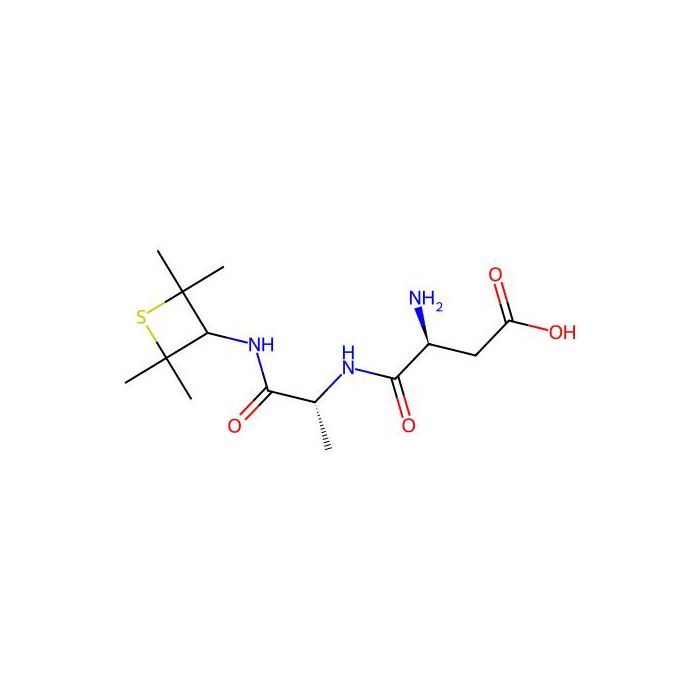
Alitame is a sulfur-containing dipeptidic sweet-taste ligand derived from an L-aspartyl–D-alaninamide scaffold bearing a bulky, tertiary thioacetal/thietanyl substituent on the amino terminus.
Item-specific identifiers
CAS: 80863-62-3 (Product Data)
PubChem CID: 64763 (Product Data)
InChIKey: Not specified for this item; refer to CoA/Spec Sheet.
SMILES: Not specified for this item; refer to CoA/Spec Sheet.
Molecular formula: Not specified for this item; refer to CoA/Spec Sheet.
Molecular weight: Not specified for this item; refer to CoA/Spec Sheet.
Structural features (literature/general)
Core: dipeptide-type framework based on L-aspartic acid (N-terminus) linked to D-alaninamide (C-terminus).
Heteroatom motif: a sulfur-containing saturated small ring/tertiary thioacetal-like substituent at the terminal nitrogen, which confers hydrophobic bulk and enhances receptor binding.
Functional groups: secondary/tertiary amide(s), carboxamide, and thioether; multiple hydrogen-bond donors/acceptors characteristic of aspartyl dipeptides.
Stereochemistry: typically L-configuration at the aspartyl center and D-configuration at the alaninyl center; overall chirality is critical for activity at sweet taste receptors.
2D description in words (literature/general)
An L-aspartyl residue with side-chain carboxylate converted to amide linkage, N-acylated by a sulfur-rich, sterically encumbered group; this fragment is coupled to a D-alaninamide terminus. The molecule comprises a polar dipeptidic backbone with a hydrophobic, sulfurous cap that modulates affinity/selectivity toward sweet-taste GPCRs.
Synthetic Utility
Alitame itself is an end-use ligand rather than a building block; however, its structural features inform synthetic planning and derivatization.
Functional group landscape (general)
Multiple amide bonds (limited nucleophilicity/basicity), a sulfur-containing thioether/thietanyl substituent (oxidation-sensitive), and defined stereocenters (L-aspartyl, D-alaninyl).
Derivatization opportunities (literature/general)
Prodrug or probe design: appending reporter tags (e.g., fluorophores) via side-chain handles or through amide nitrogen using mild coupling strategies; protect chiral integrity with low-temperature peptide coupling reagents (e.g., HATU/HBTU with collidine/DIPEA).
Oxidation series: controlled oxidation of sulfur (sulfoxide/sulfone) to probe SAR effects on receptor activity; requires chemoselective conditions to avoid peptide backbone degradation.
Retrosynthetic logic (literature/general)
Assemble from protected L-aspartic acid derivative and D-alaninamide using standard peptide coupling; introduce the sulfur-bearing bulky group via N-acylation/alkylation of the amino terminus with the preformed heterocycle under conditions that preserve configuration (avoid strong base, high heat).
Cautions
Racemization risks during coupling; use additive systems (e.g., HOAt/Oxyma) and low temperatures.
Avoid strong oxidizers and prolonged acidic/basic conditions to preserve the sulfur motif and amide bonds.
Item-specific synthetic route details: Not specified for this item; refer to literature/CoA.
Target Specificity
No antibody/biologic target information is provided for this small-molecule product.
Item-specific details required for this section (antigen/clone/isotype/species reactivity) are not applicable to Alitame and are Not specified for this item; refer to CoA/Spec Sheet.
For receptor pharmacology studies, consult primary literature to select appropriate expression constructs and species variants of sweet taste receptors.
We use cookies to ensure the website functions properly and, where permitted, to improve your experience. You can manage your preferences at any time in Settings. Learn more in our Cookie Policy.
Shall we send you a message when we have discounts available?
Remind me later
Thank you! Please check your email inbox to confirm.
Products are supplied to verified businesses, institutions, and qualified professionals for research and development use only. Not for use in humans, animals, diagnosis, or therapy.