등급 & 순도Moligand™?Moligand™ — Aladdin's line of ligands and bioactive small molecules. Use for receptor, pathway, and binding studies needing defined small-molecule tools.≥99%
Store at -20°C. Store under desiccating conditions. The product can be stored for up to 12 months.
사양
동의어
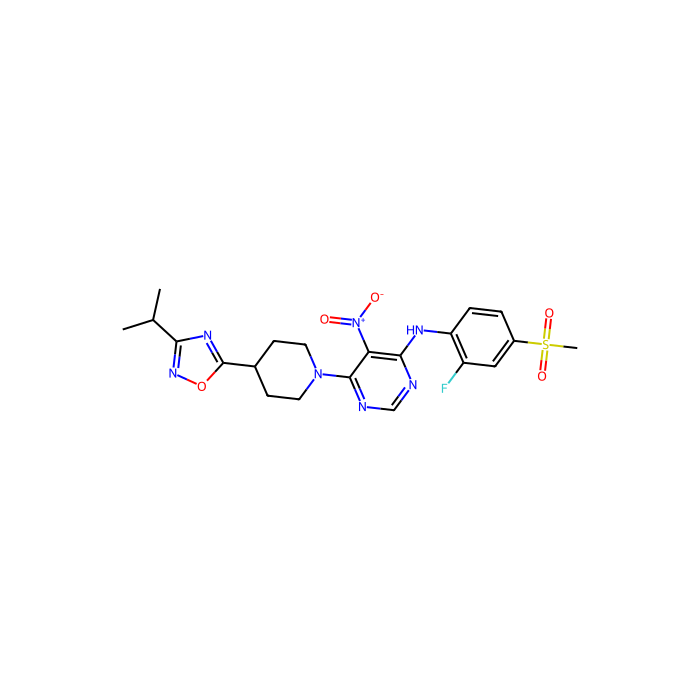
N-(2-fluoro-4-methanesulfonylphenyl)-(6-[4-(3-isopropyl-[1,2,4]oxadiazol-5-yl)-piperidin-1-yl]-5-nitro-pyrimidin-4-yl)amine | N-(2-fluoro-4-methanesulfonylphenyl)-(6-[4-(3-isopropyl-[1,2,4]oxadiazol-5-yl)-piperidin-1-yl]-5-nitropyrimidin-4-yl)amine | (2-Fluoro-4-(methanesulfonyl)phenyl)(6-(4-(3-isopropyl-(1,2,4)oxadiazol-5-yl)piperidin-1- Show more
사양 및 순도
Moligand™, ≥99%
생화학 및 생리적 메커니즘
Potent, selective G-protein coupled receptor 119 (GPR119) agonist (EC 50 = 0.68 nM). Enhances glucose-induced insulin release. Antidiabetic activity. Orally active in vivo .
보관 조건
Store at -20°C,Desiccated
배송
Ice chest + Ice pads
이 제품은 콜드 체인 배송이 필요합니다.지상 및 기타 경제 서비스는 사용할 수 없습니다.
등급
Moligand™
작업 유형
AGONIST
작동 메커니즘
Agonist of GPR119
참고
Wherever possible, you should prepare and use solutions on the same day. However, if you need to make up stock solutions in advance, we recommend that you store the solution as aliquots in tightly sealed vials at -20°C. Generally, these will be useable for up to one month. Before use, and prior to opening the vial we recommend that you allow your product to equilibrate to room temperature for at least 1 hour. Need more advice on solubility, usage and handling? Please visit our frequently asked questions (FAQ) page for more details.
This compound belongs to the class of organic compounds known as benzenesulfonyl compounds. These are aromatic compounds containing a benzenesulfonyl group, which consists of a monocyclic benzene moiety that carries a sulfonyl group.
External Descriptors
Not available
1. Djoumbou Feunang Y, Eisner R, Knox C, Chepelev L, Hastings J, Owen G, Fahy E, Steinbeck C, Subramanian S, Bolton E, Greiner R, and Wishart DS. ClassyFire: Automated Chemical Classification With A Comprehensive, Computable Taxonomy. Journal of Cheminformatics, 2016, 8:61.
Determine the necessary mass, volume, or concentration for preparing a solution.
Dilution Calculator
Determine the dilution needed to prepare a stock solution.
Reconstitution Calculator
리뷰
고객 리뷰
Application Protocols
No tested application protocols, validated dilutions, or assay conditions are specified for this item; refer to CoA/Spec Sheet.
General considerations for small-molecule screening compounds (non-item-specific):
Stock preparation: Dissolve in anhydrous DMSO to a convenient concentration (e.g., 10–50 mM). Vortex and, if needed, warm gently (≤37 °C) to aid dissolution. Filter if particulate persists.
Plating: Use low-retention polypropylene plates/tubes. For acoustic dispensing, confirm solvent and concentration compatibility with the instrument vendor guidance.
Controls: Include a vehicle control (matched DMSO) and an orthogonal positive control when possible. Randomize well positions to reduce edge effects.
Dose–response: Prepare serial dilutions (e.g., 1:3 or 1:2) to span expected potency; confirm top concentration is below solubility and assay interference thresholds.
Data quality: Monitor Z’ factor, signal window, and Hill slope reasonableness. Replicate across days/lots to confirm robustness.
All parameters above are general best practices and are not item-specific validations.
Biological Roles
General/literature context (no medical or clinical claims):
AR231453 is reported in the scientific literature as a small-molecule agonist used in G protein–coupled receptor research, frequently cited in studies of metabolic signaling pathways. Specific target annotations (e.g., receptor name) should be verified from primary literature using the CAS (733750-99-7) and CID (24939268) and cross-checked against your experimental requirements.
Typical research uses include probing receptor-mediated second messenger cascades (e.g., cAMP) in recombinant cell lines, delineating pathway selectivity, and benchmarking potency/efficacy relative to internal standards. None of these target claims are item-specific; they are literature descriptors that must be confirmed independently.
As a chemical biology tool, such ligands support: target engagement assays (e.g., CETSA or NanoBRET-displacement formats), desensitization/internalization studies, and GPCR signaling bias assessments.
Important caveats:
Off-target activities and pathway cross-talk can be cell-type dependent. Conduct orthogonal assays (e.g., binding vs functional readouts) to validate conclusions.
Compound integrity (isomer ratio, degradation) can alter apparent pharmacology; confirm identity/purity with batch-specific CoA and, if critical, in-house LC–MS.
For this specific catalog item, no biological activity specifications are provided by the manufacturer; treat all target associations as literature-only until verified experimentally.
Buffer Applications
This product is a small-molecule research ligand and is not a buffering agent. Therefore, conventional buffer system design (e.g., phosphate, HEPES, Tris) is not directly applicable.
Practical notes for assay buffers (general guidance):
Vehicle control: Match the final concentration of DMSO (or other cosolvent) across all wells/tubes, typically ≤0.1–1% v/v depending on the biological system.
Surfactant: 0.01–0.05% Tween-20 or Pluronic F-68 can mitigate nonspecific adsorption and improve dispersion; confirm no impact on your readout.
Protein carriers: 0.1–0.5% BSA can reduce compound stickiness; test for interference with detection methods.
pH and ionic strength: Choose buffers compatible with the biological target (e.g., HEPES pH 7.2–7.4 for mammalian cell assays), then optimize empirically to minimize baseline drift.
Item-specific buffer data: Not specified for this item; refer to your assay SOPs and validate conditions empirically.
Green Alternatives
Because this item functions as a research ligand rather than a process solvent or reagent, “green alternatives” primarily concern solvent and handling choices during stock preparation and assays.
Greener choices for dissolution and assay workflows (general guidance):
Prefer DMSO over DMF/NMP where feasible due to lower toxicity and regulatory burden; cap final DMSO in assays at ≤1% v/v.
Use ethanol or water–ethanol cosolvents when compound solubility permits and biological systems tolerate protic solvents.
Minimize solvent volumes by preparing the highest practical concentration stock (subject to solubility and stability) to reduce solvent waste.
Adopt microvolume plating and acoustic dispensing to curtail DMSO consumption.
Small comparison (general):
DMSO: broad solubility, low volatility, acceptable at ≤1–2% in many assays; moderate environmental impact.
DMF/NMP: excellent solvency; higher health concerns; avoid if a DMSO route is workable.
PEG400–water blends: improve aqueous delivery; may increase viscosity and assay background—qualify before use.
Operational sustainability:
Consolidate shipments and maintain cold-chain efficiency (as already shipped on ice) to lower environmental impact.
Implement solvent recovery and segregated waste streams where institutional infrastructure allows.
Pharmaceutical Uses
Regulatory/compendial status: Not pharmacopeial; supplied strictly for research use only.
Typical roles in pharmaceutical R&D (general, no therapeutic claims):
Reference standard or control article in discovery biology and early ADME method development.
Benchmark ligand in assay qualification, including determination of Z’ factors and dynamic range.
Analytical system suitability compound for LC–MS or HPLC methods when developing stability-indicating assays for related series.
Excipients/formulation: Not applicable.
Important notes:
This product is not intended for human or veterinary use, clinical diagnosis, or as an active pharmaceutical ingredient.
If used in regulated laboratories, qualify identity and purity against the batch CoA, establish an in-house reference standard, and document storage, handling, and expiry per your quality system.
Any statements regarding mechanism or target should be treated as literature-only and verified experimentally for your specific context.
Physical Properties
Item-specific specifications are not provided in the Product Data.
Physical state/appearance: Not specified for this item; refer to CoA/Spec Sheet.
Melting point: Not specified for this item; refer to CoA/Spec Sheet.
Boiling point: Not applicable/unknown for this solid research ligand; refer to CoA/Spec Sheet for any thermal data.
Density: Not specified for this item; refer to CoA/Spec Sheet.
Solubility: Not specified for this item; refer to CoA/Spec Sheet.
LogP/logD: Not specified for this item; refer to CoA/Spec Sheet.
pKa: Not specified for this item; refer to CoA/Spec Sheet.
Refractive index/UV cutoff: Not applicable to solids; Not specified for this item; refer to CoA/Spec Sheet.
General guidance (literature/practice, not item-specific):
Small-molecule receptor ligands like AR231453 are commonly prepared as DMSO stocks (e.g., 10–50 mM) based on their typical organic solubility profiles. Confirm actual solubility empirically for your lot.
If aqueous work is required, cosolvent (DMSO ≤1–2% v/v), surfactant (e.g., 0.01–0.05% Tween-20), or cyclodextrin formulations are often used to enhance apparent solubility. Validate compatibility with your assay.
Thermal behavior for discovery ligands can vary; minimize exposure to heat, light, and moisture to preserve integrity, as recommended by the storage guidance below.
Quality and Grades
Grade/Purity: Moligand™ (as provided).
What Moligand™ typically implies (general information):
Intended for discovery screening, target validation, and SAR workflows. Materials are prepared to support bioassay reliability, with attention to identity and purity suitable for research screening. Exact purity thresholds and analytical limits are batch-specific.
Analytical controls usually include identity confirmation (e.g., 1H NMR and/or LC–MS) and chromatographic purity by HPLC/UPLC; UV spectra may be provided for chromophoric compounds. For this specific item, detailed acceptance criteria are Not specified; consult the CoA/Spec Sheet.
Stabilizers/inhibitors:
Not specified for this item; refer to CoA/Spec Sheet. If present, stabilizers will be noted on the label and documentation.
Documentation and verification:
For regulated workstreams (e.g., GLP method development), request and archive batch CoA and any available spectral data. Confirm salt form, residual solvents, and water content where relevant to your application.
If low-UV absorbance or metal limits are critical (e.g., for photometric assays or catalysis), note that such parameters are Not specified for this item; verify by in-house QC as needed.
Reaction and Applications
This product is supplied as a research ligand and is not typically used as a synthetic reagent.
Practical applications (research context):
Tool compound in receptor/target pharmacology (literature), including ligand binding, reporter gene assays, cAMP or calcium flux readouts, and structure–activity relationship (SAR) comparisons with analogs. Item-specific target data are not provided here; consult literature by CAS/CID and verify against your experimental needs.
Positive control/reference standard in screening campaigns, where consistent response curves are required across plates or between laboratories. Record exact batch ID and concentration to ensure reproducibility.
Method development for LC–MS bioanalytical quantitation or stability-indicating HPLC, including forced-degradation studies to define chromatographic selectivity (acid/base, oxidative, thermal, photolytic stress). Conditions must be optimized empirically.
Not typically applicable:
Named organic reactions or catalytic transformations are generally not relevant for this item’s end-use. If you plan derivatization (e.g., SAR expansion, biotinylation, photoaffinity tagging), consult the definitive structure from the CoA/literature and design transformations accordingly.
Good practices:
Validate concentration by UV or quantitative NMR if molar dosing precision is critical.
Employ plate maps, interleaved controls, and randomized dosing to mitigate positional bias in screening assays.
Reaction Conditions
Not typically applicable. This product functions as a research ligand/tool compound rather than a reagent or substrate for synthetic transformations.
General laboratory handling conditions (applicable to solution preparation and stability studies):
Solvent: DMSO for primary stocks; secondary dilutions into aqueous assay buffers with final DMSO commonly ≤1% v/v.
Temperature: Prepare and store solutions at low temperature when feasible; avoid prolonged exposure to elevated temperatures. Follow storage guidance below.
Light/moisture: Protect from moisture (desiccation recommended) and, if the compound is chromophoric, protect from strong light to minimize photolysis. Specific sensitivities are Not specified for this item.
Filtration: Use 0.22 µm PTFE or PVDF syringe filters for sterile or particulate-free solutions if required by the assay.
If planning chemical transformations or stability-indicating studies, all conditions must be established empirically after confirming the compound’s exact structure and functional groups from the CoA/literature.
Safety and Handling
GHS classification: Not specified for this item; refer to SDS.
Signal word / hazard statements / pictograms: Not specified for this item; refer to SDS.
General laboratory precautions (good practice; defer to SDS for authoritative guidance):
Use in a chemical fume hood with appropriate PPE: lab coat, safety glasses, and disposable nitrile gloves. Consider double-gloving for extended handling of DMSO solutions.
Avoid inhalation, ingestion, and contact with skin or eyes. Prevent aerosolization during weighing and solution preparation.
Incompatibilities: Unknown for this item; avoid strong oxidizers and strong acids/bases unless compatibility is confirmed. Keep away from moisture per storage guidance (desiccated storage suggested).
First aid (general): In case of skin/eye contact, rinse with plenty of water for ≥15 minutes and remove contaminated clothing. If inhaled, move to fresh air. If swallowed, rinse mouth and seek medical attention. Always consult the SDS.
Spill response: Absorb small spills with inert material; collect for disposal. Decontaminate surfaces per institutional protocols.
Waste: Dispose of as organic laboratory waste according to local regulations and institutional EHS policies.
Special notes for screening compounds:
Prepare small, single-use aliquots to minimize repeated handling and potential exposure.
For DMSO stocks, prevent contact transfer through gloves; DMSO can facilitate dermal absorption of solutes.
Solvent Selection
Given the lack of item-specific solubility data, select solvents empirically while following best practices for small-molecule screening compounds.
Likely stock solvents (general practice):
DMSO: Primary choice for bioassay stocks due to broad solubilizing power and assay compatibility at ≤1–2% v/v.
DMF or NMP: Strong alternatives for initial dissolution; consider subsequent dilution into DMSO to improve handling. Evaluate assay compatibility/toxicity.
Ethanol/MeOH: Useful for some aromatic/heteroaromatic ligands; volatility facilitates film-casting for co-solvent methods.
Aqueous compatibility strategies:
Prepare concentrated DMSO stocks (e.g., 10–50 mM) and dilute into buffer with vigorous mixing to final DMSO ≤1%.
Use cosolvent blends (DMSO/PEG400/water) or cyclodextrin inclusion (e.g., 2–10 mM HP-β-CD) if precipitation occurs. Validate assay interference.
Polarity and miscibility (general):
DMSO, DMF, NMP: polar aprotic; completely miscible with water and most organics; excellent for dissolution screening.
EtOH/MeOH: polar protic; miscible with water; may affect enzyme activity; check controls.
Comparison note:
DMSO vs DMF: DMSO is typically favored for biological assays due to lower volatility and better biocompatibility at low percentages; DMF may enhance solubility for certain chemotypes but is less assay-friendly.
Always confirm the final solution is clear and homogeneous; discard or re-formulate if visible precipitation persists.
Storage and Reconstitution
Storage conditions (as provided): Store at −20 °C, desiccated.
Shipping: Ice chest + ice pads (cold chain). Inspect upon receipt; allow to equilibrate to room temperature in sealed packaging before opening to minimize moisture condensation.
Reconstitution and handling (general guidance, not item-specific):
Open under low-humidity conditions. If available as a solid, quickly weigh the required amount and promptly reseal/return the container to −20 °C with desiccant.
Prepare concentrated stock solutions in anhydrous DMSO (typical 10–50 mM). Record exact mass, solvent lot, and final concentration.
Aliquot into single-use microtubes or plate wells to avoid repeated freeze–thaw. Store aliquots at −20 °C (or −80 °C for long-term) in inert atmosphere if possible.
Stability: Item-specific stability data are Not specified; periodically assess by LC–MS or HPLC if solutions are stored >1–2 weeks. Avoid repeated temperature cycling and exposure to moisture/light.
Aqueous working solutions: Prepare fresh on the day of use. Keep on ice for extended assay setup if compatible, and discard if precipitation or turbidity is observed.
Labeling and documentation:
Note the SKU (A275017), lot number, preparation date, and concentration on all aliquots.
For critical studies, retain a reserve sample of the neat material under recommended storage for potential re-analysis.
Structure and Identity
Item name: AR 231453 (research ligand)
CAS: 733750-99-7 (literature identifier for AR231453)
PubChem CID: 24939268 (literature)
InChIKey: 62511 (as provided; truncated/incomplete format in Product Data)
SMILES: Not specified for this item; refer to CoA/Spec Sheet.
Molecular formula: Not specified for this item; refer to CoA/Spec Sheet.
Molecular weight: Not specified for this item; refer to CoA/Spec Sheet.
Structural features (general/literature context):
AR231453 is widely cited in the literature as a small-molecule ligand used in receptor pharmacology studies. Specific ring systems, heteroatoms, and stereochemical descriptors are not provided in this listing; consult the primary literature or the item’s CoA for definitive structural details.
2D structure description: Not specified in this listing. If structure is required for cheminformatics or docking, retrieve the canonical SMILES and InChI from a curated database (e.g., PubChem CID above, literature) and verify against the batch-specific CoA.
Identity considerations for screening libraries:
AR-numbered chemotypes are often tracked by their CAS/CID; when building plating maps or barcodes, use the CAS and internal SKU (A275017) to avoid ambiguity.
For structure-based work (QSAR, docking, PAINS filtering), always confirm the exact tautomer/salt form from the CoA/Spec Sheet before use.
Synthetic Utility
This item is provided as a finished small-molecule ligand and is not primarily intended as a synthetic building block. Consequently, classical synthetic utility (e.g., as a reagent, catalyst, or protecting group) is limited.
Potential uses in synthetic/medicinal chemistry workflows (general guidance):
SAR expansion: If the definitive structure is available from the CoA/literature, chemists may design analogs around identified pharmacophores. Plan retrosynthetic routes based on confirmed functional groups and substitution patterns; avoid assumptions without a verified structure.
Tagging/derivatization: For probe development (e.g., biotin, fluorophore, or photoaffinity tags), functional handles (amines, phenols, halides) are required—confirm their presence from authoritative structural data before attempting conjugation. Ensure tags do not abrogate target engagement.
Impurity profiling: Use forced-degradation products to develop stability-indicating methods and to understand potential liabilities (oxidation, hydrolysis, isomerization) that could guide analog design.
Limitations:
Named reactions, catalyst systems, and specific reactivity cannot be recommended without the confirmed structure. For this catalog item, such details are Not specified; consult literature for AR231453 and verify batch form (free base vs salt) prior to any synthetic manipulation.
Target Specificity
Item-specific target information (e.g., receptor, enzyme, binding partner), species selectivity, and potency are Not specified for this item; refer to CoA/Spec Sheet.
Notes:
While AR231453 is discussed in the literature as a research ligand, Aladdin provides no target or activity specifications for SKU A275017 in this listing. Users should consult primary literature by CAS (733750-99-7) and independently verify relevance to their experimental system.
No antibody/biologic attributes (antigen, clone, isotype) apply to this small-molecule product.
등급 선택에 도움이 필요하신가요?
당사의 등급 선택 가이드는 카탈로그의 모든 변형 제품에 대해 순도, 안정제 상태 및 용도 적합성을 다룹니다.
Products are supplied to verified businesses, institutions, and qualified professionals for research and development use only. Not for use in humans, animals, diagnosis, or therapy.