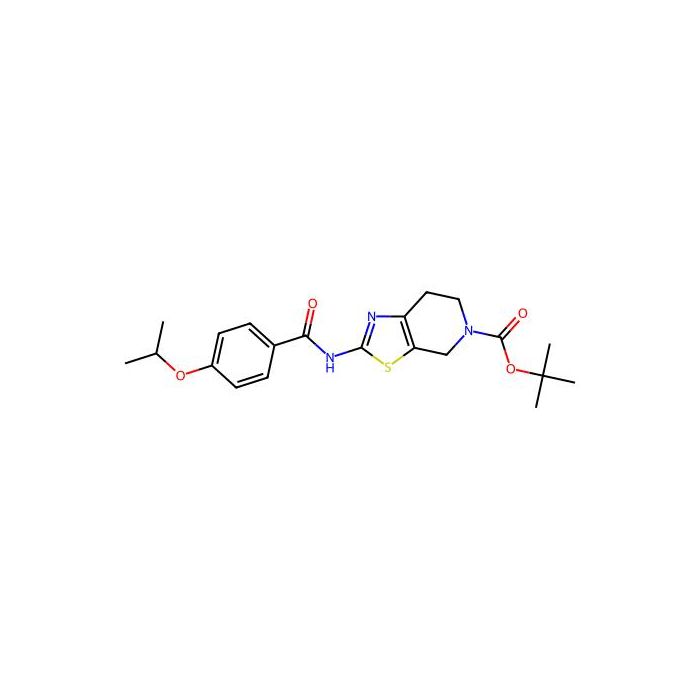
This compound belongs to the class of organic compounds known as benzamides. These are organic compounds containing a carboxamido substituent attached to a benzene ring.
External Descriptors
Not available
1. Djoumbou Feunang Y, Eisner R, Knox C, Chepelev L, Hastings J, Owen G, Fahy E, Steinbeck C, Subramanian S, Bolton E, Greiner R, and Wishart DS. ClassyFire: Automated Chemical Classification With A Comprehensive, Computable Taxonomy. Journal of Cheminformatics, 2016, 8:61.
Determine the necessary mass, volume, or concentration for preparing a solution.
Dilution Calculator
Determine the dilution needed to prepare a stock solution.
Reconstitution Calculator
리뷰
고객 리뷰
Application Protocols
Item-specific facts (Product Data)
No tested application protocols (e.g., WB, IHC, IF, FC) are provided for this item.
General protocols (for small-molecule handling in research)
Stock preparation: Dissolve in dry DMSO to 10–50 mM; vortex and sonicate as needed. Record exact concentration gravimetrically. Filter through 0.22 μm PTFE if particulate remains.
Working solutions: Dilute into assay buffer/media to the desired final concentration, ensuring final DMSO ≤0.1–1% depending on system tolerance. Mix thoroughly and confirm absence of precipitate by visual inspection and light scattering if available.
Analytical QC: Verify identity and purity of the working solution by LC–MS when feasible. Establish a stability-indicating method and time-in-use window.
Controls: Include vehicle controls (matching cosolvent %), positive controls (assay-dependent), and orthogonal readouts to rule out assay interference (e.g., redox or fluorescence artifacts).
Documentation: Record batch/lot, solution preparation date, storage conditions, and freeze–thaw count.
Biological Roles
Item-specific facts (Product Data)
No biological function, target, or pathway information is provided for Autogramin-2.
General considerations
If Autogramin-2 is employed as a tool compound, researchers typically evaluate: cellular permeability, cytotoxicity baselines, metabolic stability (microsomes/S9), and protein binding to contextualize in vitro results.
For biochemical assays, determine mechanism-of-action hypotheses empirically (e.g., enzyme inhibition kinetics, binding isotherms by ITC or SPR) only after structural identity and purity are confirmed.
ADME profiling (general): logD (pH 7.4), solubility at assay pH, microsomal clearance, and plasma stability support interpretation of cellular data.
Off-target screening (e.g., broad kinase or GPCR panels) can be used to establish selectivity fingerprints if pharmacology is under investigation; ensure such work remains strictly research-focused.
Important disclaimer
No clinical or therapeutic claims are made. All uses are limited to laboratory research. Consult the SDS and CoA when designing biological experiments.
Buffer Applications
Applicability
Autogramin-2 is not described as a buffering agent. No pKa or acid/base functionality is provided, so buffer preparation guidance is not applicable for this item.
Practical note (general)
If Autogramin-2 must be formulated into aqueous media for assays, use established biological buffers (e.g., PBS, HEPES, Tris) and adjust pH independently before adding the compound from an organic stock (commonly DMSO). Verify that dilution does not cause precipitation.
Document final cosolvent percentages and pH to ensure assay reproducibility.
Green Alternatives
Context
No specific solvent or process is tied to this item in the Product Data. Greenness therefore focuses on how you handle dissolution, purification, and analytics.
Greener choices (general guidance)
Prefer water and bio-based solvents (ethanol, ethyl acetate, 2-MeTHF) where compatible; avoid chlorinated solvents unless necessary for selectivity or stability.
Use ACN and MeOH sparingly in analytics; explore water-rich gradients, ethanol-modified mobile phases, or supercritical CO2 for preparative work when feasible.
Replace DMF/NMP with DMSO, propylene carbonate, or greener carbonate esters when solubility allows.
Implement microscale solubility screens and DoE to minimize solvent volumes and waste.
Trade-offs (general)
2-MeTHF/CPME reduce peroxide formation versus ethers like THF, but still require periodic peroxide testing and have characteristic odors and impurity profiles.
Ethanol is greener than ACN but may reduce chromatographic resolution and increase viscosity/backpressure.
Operational tips
Recycle high-purity ACN/MeOH via in-house solvent purification units for large-volume LC.
Segregate waste streams and adopt solvent selection guides (e.g., CHEM21, GSK) in route scouting and assay development.
Pharmaceutical Uses
Item-specific facts (Product Data)
No pharmacopeial status, excipient role, or formulation use is specified for Autogramin-2.
General guidance
In pharmaceutical R&D, non-clinical research compounds may be used as analytical reference materials, process development surrogates, or internal standards if properly qualified. Such uses require assignment of purity, potency (on an anhydrous basis if applicable), and solution stability.
If formulation-like studies are required (e.g., for in vitro dosing), consider simple vehicles compatible with research use: DMSO concentrates diluted into buffer, or cosolvent systems (PEG400/EtOH/Saline) for non-clinical in vivo method development where institutionally permitted. Note: This catalog item is for research use only and not for human or veterinary use.
No claims are made regarding safety, efficacy, or compliance with USP/EP/JP monographs.
Physical Properties
Item-specific facts (Product Data)
Physical state/appearance: Not specified for this item; refer to CoA/Spec Sheet.
Melting point (MP): Not specified for this item; refer to CoA/Spec Sheet.
Boiling point (BP): Not specified for this item; refer to CoA/Spec Sheet.
Density: Not specified for this item; refer to CoA/Spec Sheet.
Solubility: Not specified for this item; refer to CoA/Spec Sheet.
LogP, pKa, refractive index, UV cutoff: Not specified for this item; refer to CoA/Spec Sheet.
Literature/general guidance (for small-molecule research materials of unknown/undisclosed structure)
Perform a rapid solubility screen at small scale (1–2 mg): water, PBS, MeOH, EtOH, ACN, acetone, DMSO, DMF, and 2-MeTHF. Begin at 1–10 mg/mL; warm gently (≤40 °C) and sonicate as needed.
If hygroscopicity is suspected, equilibrate samples in a dry box and weigh quickly.
Establish a working UV profile (200–400 nm) once dissolved to support HPLC/UPLC method development; record λmax where signal-to-noise is suitable for analytical tracking.
If the compound is amphoteric or ionic, anticipate pH-dependent solubility and perform acidic/basic cosolvent titrations (e.g., 0.1% formic acid or 0.1% NH4OH in water/ACN).
Record stability upon dissolution at room temperature, 4 °C, and −20 °C over 24–72 h to inform storage of stock solutions.
Quality and Grades
Item-specific facts (Product Data)
Grade/Purity: Not specified for this item; refer to CoA/Spec Sheet.
How to interpret grade and documentation (general guidance)
CoA typically includes assay/purity method (e.g., HPLC area%, qNMR), identity confirmation (MS/NMR), residual solvent profile, and water content (KF). If a specific threshold is critical (e.g., ≥98% HPLC), confirm on your purchase order and verify batch CoA.
If the product is an analytical reference or screening compound, grades may be expressed as purity ranges by HPLC/LC–MS; low-UV-absorbing solvents are preferred when purity is assayed by UV.
Stabilizers/inhibitors: None specified for this item. If present in future lots, they will be listed on the CoA and may affect certain assays (e.g., BHT, ascorbate). Plan additional purification if your application is inhibitor-sensitive.
Trace metals, peroxides, UV cutoff, and other fine specs: Not specified for this item; refer to CoA/Spec Sheet.
Batch-to-batch considerations
Request the exact batch CoA prior to critical experiments.
For regulated workflows, consider qualification by system suitability: identity match, purity re-check, potency assignment (if applicable), and solution stability study under your storage conditions.
Reaction and Applications
Item-specific facts (Product Data)
Manufacturer applications: Not specified beyond research use only.
Practical positioning (general)
In the absence of disclosed structure and reactivity, Autogramin-2 should be treated primarily as a research chemical/tool compound rather than a synthetic reagent. Typical uses may include method development, biochemical screening, or materials evaluation once solubility and stability are established.
If used in synthesis (general considerations)
Without functional group information, avoid uncontrolled reactions. Conduct micro-scale scouting with benign conditions first (neutral solvents, ambient temperature) and analyze by LC–MS to assess transformation.
For potential salt forms or protecting groups, verify by NMR before attempting deprotection or salt exchange.
Analytical applications (general)
Establish a robust analytical method: UPLC with gradient ACN/H2O (0.1% FA) or MeOH/H2O with UV and MS detection; determine retention factor and purity window.
If volatility is suspected (unknown), consider GC–MS screening after a gentle derivatization (e.g., silylation) only if structural motifs justify it.
Stability screening (general)
Subject a small aliquot to stress (acidic, basic, oxidative, thermal, and photolytic) per ICH Q1A-style studies to map degradation pathways, which support both handling and any downstream applications.
Reaction Conditions
Item-specific facts (Product Data)
No reaction condition guidance is provided for Autogramin-2.
General guidance (only if chemistry is pursued after structure elucidation)
Solvents: Choose based on solubility and stability; begin with ACN, MeOH, DCM, EtOAc, toluene, or DMSO. For coupling chemistry, DMF/DMAc are common but consider greener alternatives when possible.
Temperatures: Scout at ambient first; escalate in 10–20 °C increments. Avoid >80 °C until thermal stability is confirmed by DSC/TGA.
Atmosphere: Use inert gas (N2/Ar) if air/moisture sensitivity is suspected.
Catalysts/bases/acids: Select only after functional groups are identified; e.g., Pd cross-coupling for aryl halides, EDCI/HATU for amide formations, or mild bases (DIPEA, K2CO3) for alkylations.
Workup: Quench cautiously; partition into appropriate phases; remove residual metals with scavengers if catalysts are used.
Yields/time: Not specified; establish via small-scale DoE to optimize conversion and selectivity.
Documentation: Record pH, temperature profiles, and sampling intervals; retain chromatograms and spectra for each step.
Safety and Handling
Item-specific facts (Product Data)
GHS classification, signal word, pictograms, H-statements: Not specified for this item; refer to SDS.
Storage: Store at −20 °C.
Shipping: Ice chest + ice pads.
Research use: For research use only.
General laboratory safety guidance (not a substitute for SDS)
Wear appropriate PPE: lab coat, safety glasses, nitrile gloves. Work in a certified fume hood when handling powders, volatile solvents, or solutions of uncertain hazard.
Avoid inhalation and skin/eye contact. Prevent environmental release. Wash thoroughly after handling.
Incompatibilities: Unknown for this item; avoid strong oxidizers/reductants and strong acids/bases until compatibility is established by small-scale testing.
First aid (general): Inhalation—move to fresh air; Skin—wash with soap/water; Eyes—rinse with water for 15 minutes; Ingestion—rinse mouth and seek medical attention. Always follow your institution’s EHS protocols.
Spill response: Absorb with inert material, collect in chemical waste. Decontaminate surfaces with suitable solvent/detergent. For solids, avoid dust generation.
Fire safety: Until properties are known, treat as combustible organic. Use CO2, dry chemical, or foam. Cool containers with water spray.
Waste: Dispose according to local regulations; segregate halogenated vs non-halogenated solvent waste.
Always consult the product-specific Safety Data Sheet (SDS) for authoritative hazards, exposure limits, and reactivity data.
Solvent Selection
Item-specific facts (Product Data)
No solubility profile provided; solvent choice must be determined empirically.
Practical solvent strategy (general guidance for small molecules)
Start with DMSO for high-concentration stocks (10–50 mM), then dilute into assay media with vigorous mixing to avoid precipitation; keep final DMSO ≤0.1–1% for biochemical/cell assays.
Water-miscible organics for analytical work: acetonitrile or methanol (HPLC grade) with 0.1% formic acid (LC–MS) or 10 mM ammonium acetate (neutral LC–MS). For low-polarity analytes, add 5–20% isopropanol.
Water-immiscible options for extractions or workups: ethyl acetate, MTBE, or toluene. Consider 2-MeTHF or CPME as greener ethers if compatible.
For poorly soluble bases/acids, use salt formation or pH adjustment (e.g., HCl or TFA salts for amines; NaOH or NH4OH for acids) to improve aqueous solubility.
Small comparison (general)
DMSO vs DMF: DMSO is broadly less volatile and typically more benign; DMF offers similar solubility but poses greater health and regulatory concerns.
ACN vs MeOH in LC: ACN gives lower backpressure and often sharper peaks; MeOH is greener but may require higher pressure and longer times.
Drying and stability
If moisture sensitivity is suspected, prepare stock solutions in anhydrous solvents and store under inert gas at −20 °C; check for degradation by LC–MS over time.
Storage and Reconstitution
Item-specific facts (Product Data)
Storage: Store at −20 °C.
Shipping: Ice chest + ice pads.
Stabilizers/inert atmosphere: Not specified for this item; refer to CoA/Spec Sheet.
General storage guidance
Keep container tightly closed in a dry, inert environment. Protect from moisture and light until compound-specific stability is known.
Upon receipt, allow the sealed container to equilibrate to room temperature before opening to prevent condensation. If hygroscopicity is suspected, handle in a desiccator or glove box.
Reconstitution (general)
Preferred initial solvent: anhydrous DMSO for concentrated stocks (e.g., 10–50 mM). Alternatively, use MeOH or ACN if compatible with downstream assays.
Procedure: Add calculated solvent volume, vortex, and sonicate gently. If necessary, warm to 30–40 °C briefly. Avoid prolonged heating.
Aliquoting: Prepare single-use aliquots to minimize freeze–thaw cycles. Store aliquots at −20 °C or below; purge headspace with nitrogen/argon for sensitive materials.
Stability monitoring: Inspect solutions periodically for color change or precipitation; confirm by LC–MS/HPLC at defined intervals. Define a maximum time-in-use based on your data (e.g., 1–4 weeks at −20 °C).
Aqueous use: Dilute DMSO stock into pre-equilibrated buffer with rapid mixing. Verify that pH and ionic strength do not induce precipitation.
For any item-specific limits (water/peroxide/metal), UV cutoff, or exact shelf life: Not specified for this item; refer to CoA/Spec Sheet.
Structure and Identity
Item-specific facts (Product Data)
Product name: Autogramin-2 (SKU: A958310)
CAS: 2375541-45-8
PubChem CID: 36765911
InChIKey: 282281 (as provided)
Molecular formula: Not specified for this item; refer to CoA/Spec Sheet.
Molecular weight: Not specified for this item; refer to CoA/Spec Sheet.
SMILES: Not specified for this item; refer to CoA/Spec Sheet.
Appearance: Not specified for this item; refer to CoA/Spec Sheet.
Structural features (general note)
The 2D functional groups, ring systems, and stereochemistry are not available in the provided data. Consult the Certificate of Analysis (CoA) or Structure Sheet for definitive structural representation, including any stereochemical descriptors and functional moieties.
Identity confirmation (general guidance)
Recommended orthogonal identity checks when structure is known: 1H/13C NMR, HRMS (ESI), IR, and HPLC/UPLC retention time matched to a qualified reference.
For unknown or proprietary structures, rely on provided batch-specific CoA (purity assay method, chromatograms) and, if necessary, independent confirmation by LC–MS and NMR under your lab’s methods.
If chirality is relevant, request optical rotation or chiral HPLC data.
Synthetic Utility
Applicability
Without disclosed structure or functional groups, specific synthetic transformations involving Autogramin-2 cannot be recommended.
General strategies if used as a building block (only after structure is known)
Map reactive handles (e.g., halides for cross-coupling, carbonyls for condensations, amines/acids for amide couplings) and confirm by NMR/IR.
If chiral, preserve enantiopurity with mild conditions and consider chiral resolution or asymmetric synthesis for scale-up.
For late-stage diversification, employ chemoselective transformations (e.g., SuFEx, CuAAC, Buchwald–Hartwig) only when compatible with other motifs.
Analytical control
Track reactions by LC–MS and orthogonal TLC/HPLC methods; assign mass balance including potential regioisomers or protecting-group byproducts.
Purify using flash chromatography or preparative HPLC as dictated by polarity and stability once characterized.
Bottom line
Treat Autogramin-2 primarily as a characterized research material; synthetic applications require prior structural disclosure and compatibility assessment.
Target Specificity
Applicability
Target specificity parameters (antigen, epitope, clone, isotype, species reactivity) apply to biological reagents such as antibodies or binding proteins. Autogramin-2 is supplied as a chemical/biochemical reagent, and no target-binding specificity is provided in the Product Data.
Guidance
If Autogramin-2 is used as a tool compound in target-based assays, determine specificity empirically via appropriate panels (e.g., enzyme selectivity, receptor profiling) and report assay conditions and controls for reproducibility.
We use cookies to ensure the website functions properly and, where permitted, to improve your experience. You can manage your preferences at any time in Settings. Learn more in our Cookie Policy.
Shall we send you a message when we have discounts available?
Remind me later
Thank you! Please check your email inbox to confirm.
Products are supplied to verified businesses, institutions, and qualified professionals for research and development use only. Not for use in humans, animals, diagnosis, or therapy.