
Determine the necessary mass, volume, or concentration for preparing a solution.
Avenanthramide A - ≥99% , CAS No.108605-70-5
주문 가능
GRADE & PURITY ≥99%
Storage
Store at 2-8°C,Protected from light
Shipped In
Wet ice
≥99% for sensitive chromatographic and analytical workflows requiring minimal baseline interference.
Store at 2-8°C,Protected from light Ships Wet ice Check lot-specific COA for exact specifications.
SDS, COA, datasheet, and spec sheet available for download. Lot-specific COA accessible via lot number lookup.
Cited in 0 peer-reviewed publications across chromatography, organic synthesis, and cross-coupling reactions.
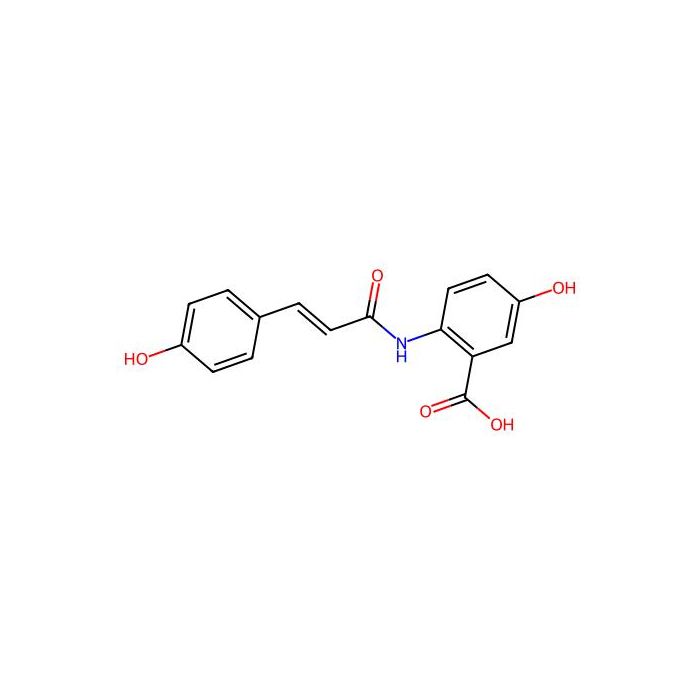
| 정식 스마일 | C1=CC(=CC=C1C=CC(=O)NC2=C(C=C(C=C2)O)C(=O)O)O |
|---|---|
| IUPAC Name | 5-hydroxy-2-[[(E)-3-(4-hydroxyphenyl)prop-2-enoyl]amino]benzoic acid |
| InChIKey | QGUMNWHANDITDB-FPYGCLRLSA-N |
| INCHI | 1S/C16H13NO5/c18-11-4-1-10(2-5-11)3-8-15(20)17-14-7-6-12(19)9-13(14)16(21)22/h1-9,18-19H,(H,17,20)(H,21,22)/b8-3+ |
| 이성체 SMILES | C1=CC(=CC=C1/C=C/C(=O)NC2=C(C=C(C=C2)O)C(=O)O)O |
| 대체 CAS | 108605-70-5 |
| PubChem CID | 5281157 |
| MeSH 용어 | avenanthramide A |
Comprehensive hazard, handling, storage, and regulatory compliance document.
Download SDS →Lot-specific quality data. Enter your lot number to retrieve the exact COA.
Look up COA →Full quality attributes and acceptance criteria for this grade.
View spec sheet →Taxonomy Tree
| Kingdom | Organic compounds |
|---|---|
| Superclass | Phenylpropanoids and polyketides |
| 분류 | Cinnamic acids and derivatives |
| Subclass | Hydroxycinnamic acids and derivatives |
| Intermediate Tree Nodes | Hydroxycinnamic acids |
| Direct Parent | Avenanthramides |
| Alternative Parents | N-cinnamoylanthranilic acids Acylaminobenzoic acid and derivatives Coumaric acids and derivatives Hydroxybenzoic acid derivatives Anilides Benzoic acids Styrenes Benzoyl derivatives N-arylamides 1-hydroxy-2-unsubstituted benzenoids Vinylogous amides Secondary carboxylic acid amides Carboxylic acids Monocarboxylic acids and derivatives Hydrocarbon derivatives Organopnictogen compounds Carbonyl compounds Organic oxides |
| Molecular Framework | Aromatic homomonocyclic compounds |
| Substituents | Avenanthramide - N-cinnamoylanthranilic acid - Acylaminobenzoic acid or derivatives - Coumaric acid or derivatives - Cinnamic acid amide - Hydroxybenzoic acid - Benzoic acid or derivatives - Anilide - Benzoic acid - N-arylamide - Styrene - Benzoyl - 1-hydroxy-2-unsubstituted benzenoid - Phenol - Benzenoid - Monocyclic benzene moiety - Vinylogous amide - Secondary carboxylic acid amide - Carboxamide group - Carboxylic acid derivative - Carboxylic acid - Monocarboxylic acid or derivatives - Organic nitrogen compound - Hydrocarbon derivative - Carbonyl group - Organic oxide - Organopnictogen compound - Organooxygen compound - Organonitrogen compound - Organic oxygen compound - Aromatic homomonocyclic compound |
| 설명 | This compound belongs to the class of organic compounds known as avenanthramides. These are a group of phenolic alkaloids consisting of conjugate of three phenylpropanoids (ferulic, caffeic, or p-coumaric acid) and anthranilic acid. |
| External Descriptors | hydroxycinnamic acid |
| 분자량 | 299.280 g/mol |
|---|---|
| XLogP3 | 2.600 |
| Hydrogen Bond Donor Count | 4 |
| Hydrogen Bond Acceptor Count | 5 |
| Rotatable Bond Count | 4 |
| Exact Mass | 299.079 Da |
| Monoisotopic Mass | 299.079 Da |
| Topological Polar Surface Area | 107.000 Ų |
| Heavy Atom Count | 22 |
| Formal Charge | 0 |
| Complexity | 428.000 |
| Isotope Atom Count | 0 |
| Defined Atom Stereocenter Count | 0 |
| Undefined Atom Stereocenter Count | 0 |
| Defined Bond Stereocenter Count | 1 |
| Undefined Bond Stereocenter Count | 0 |
| The total count of all stereochemical bonds | 1 |
| Covalently-Bonded Unit Count | 1 |
No item-specific, validated protocols are provided for this SKU. The following general procedures are commonly used when employing Avenanthramide A as an analytical standard or research probe; adjust to your system and validate internally.
HPLC/LC–UV assay (general):
LC–MS setup (general):
Photostability test (general):
Antioxidant assay controls (chemical, not biological claims):
These are general/literature-style methods. Item-specific performance characteristics are Not specified for this item; refer to CoA/Spec Sheet and SDS.
General/literature perspective (no clinical claims):
Natural occurrence: Avenanthramide A is a predominant phenylpropanoid amide in oats (Avena sativa). It consists of p-coumaric acid coupled via an amide bond to 5-hydroxyanthranilic acid. It belongs to the avenanthramide family (A, B, C) that vary by substitution on the cinnamoyl ring.
Biosynthesis (plant biochemistry): Formed via the phenylpropanoid pathway and arylamine N-acyltransferases that couple hydroxycinnamoyl-CoA thioesters to hydroxyanthranilic acid. The trans cinnamoyl double bond is typical in the native metabolite.
Biochemical properties: The conjugated system and phenolic groups support radical stabilization and metal-chelation behaviors; these underlie common observations of antioxidant capacity in chemical assays (e.g., DPPH, ABTS, ORAC) in vitro. Such assay activities are context-dependent and do not imply physiological effects.
Plant role: Reported to participate in defense-related responses and stress signaling in oats, consistent with phenylpropanoid amide functions in plants (literature).
Analytical relevance: Serves as a marker compound for authenticity and quality assessment of oat-derived materials and for comparative metabolomics across cultivars and processing conditions.
Note: The above are literature/general insights and are not specifications or performance guarantees for this specific item. For research use only.
This compound is not a buffering reagent. However, it can be used in buffers as an analyte or assay probe.
Compatibility (general guidance):
Adsorption considerations: Phenolic aromatics may adsorb to plastics at low concentrations; prefer glass vials and silanized glass LC vials for trace work.
Filtration: Use low-binding PTFE or PVDF syringe filters; avoid nylon for acidic solutions due to potential interaction with phenolics.
Example preparation (general, not item-specific):
Item-specific buffer capacities, pKa values, and ionic strength effects are Not specified for this item; consult primary literature and validate in your system.
While Avenanthramide A itself is a target analyte rather than a solvent/reagent, greener choices can be made in its handling, extraction, and analysis.
Greener solvent choices (general):
Minimizing environmental footprint:
Trade-offs (balanced view):
Comparison snapshot (general guidance):
Note: No item-specific green certifications apply; implement lab-level green chemistry practices aligned with your method constraints.
No pharmacopeial grade or excipient status is provided for this item. This product is supplied strictly for research use.
Formulation context (general): Avenanthramide A may be employed as a reference marker in quality control of botanical raw materials or experimental formulations containing oat-derived phenolics. It can assist in identity testing, content uniformity studies, and stability-indicating method development.
Analytical roles:
Not a drug substance/excipient: There is no claim of compliance with USP/Ph.Eur./JP monographs for this specific lot. Any use in regulated development would require independent qualification and fit-for-purpose validation by the user.
Stability-indicating studies (general): Useful for forced-degradation panels (light, oxidative, thermal, pH stress) to challenge analytical methods intended for oat or phenolic-containing formulations.
Item-specific regulatory status, residual solvent limits, and elemental impurity profiles: Not specified for this item; refer to CoA/Spec Sheet.
Item-specific specifications have not been provided for this SKU. Where helpful, representative literature values are included strictly for contextual use in method development; verify against the CoA/SDS before use.
Stability considerations (literature): photosensitive (cinnamoyl E→Z isomerization and oxidation possible); phenolic oxidation in air/light may occur—protect from light and store cool as per Product Data.
Item-specific grade/purity: Not specified for this item; refer to CoA/Spec Sheet. In the absence of a declared grade, users should confirm assay, residual solvents, and chromatographic purity by reviewing the CoA and, if needed, running orthogonal purity checks (e.g., HPLC-UV with dual wavelengths, LC–MS, and 1H NMR).
Typical quality considerations for Avenanthramide A standards:
Stabilizers: None stated for this item. If present in other lots, stabilizers (e.g., antioxidants) can impact UV/Vis and redox assays—verify prior to analytical use.
Documentation: Request CoA, NMR, and chromatograms for the specific lot received. For quantitative studies (e.g., calibration standards), consider secondary verification against a certified reference material when available.
This compound is primarily used as a reference standard and probe molecule in natural products, redox chemistry, and plant metabolite studies, rather than as a routine reagent. Nevertheless, its conjugated phenylpropanoid amide scaffold lends itself to several practical applications.
Research applications (general/literature):
Chemical reactivity/transformations (literature):
Practical tips:
General literature conditions related to synthesis/derivatization of Avenanthramide A (for context; not item specifications):
Amide bond formation (EDC/HOBt):
Acid chloride coupling:
Esterification (Fischer):
Photochemistry:
Oxidation studies:
All parameters above are literature/general guidance and must be optimized per laboratory conditions.
Regulatory/SDS note: Definitive hazard classification and exposure controls must be taken from the product SDS. The following are general laboratory precautions for phenolic amide natural products.
GHS classification and hazard statements: Not specified for this item; refer to SDS. In absence of classification, handle as a Combustible Solid, Harmful if swallowed/inhaled/absorbed, Eye/Skin Irritant (general precautionary approach).
Primary hazards (general):
PPE and engineering controls:
Incompatibilities (general):
First aid overview (consult SDS for detailed steps):
Fire response: Use CO2, dry chemical, or foam; combustion may produce CO/CO2 and nitrogen oxides.
Waste: Collect solutions/solids as organic chemical waste per institutional and local regulations.
Avenanthramide A is a moderately polar, polyphenolic amide with limited aqueous solubility at neutral pH but good solubility in polar organics.
Practical solvent choices (literature/practice):
Polarity/miscibility (general):
When to choose alternatives:
Small comparison (general):
Note: Item-specific solvent specifications (water solubility, partition coefficients, UV cutoff) are Not specified for this item; refer to CoA/Spec Sheet.
Storage conditions (from Product Data): Store at 2–8°C, protected from light. Shipments are on wet ice.
Light/oxygen precautions: Use amber vials or wrap in aluminum foil to minimize E→Z isomerization and oxidative degradation. For long-term retention of potency and chromatographic purity, minimize headspace oxygen and consider inert gas overlay (N2/Ar) after opening.
Reconstitution (general guidance):
Aliquoting and freeze–thaw: To avoid concentration drift and degradation, prepare single-use aliquots. If freezing solutions, store at ≤−20°C in amber vials and avoid repeated freeze–thaw cycles.
Stability notes (general/literature): Phenolic amides can slowly degrade under light, heat, and alkaline pH; monitor by HPLC. Maintain neutral pH in aqueous media when possible and use fresh dilutions.
Container compatibility: Prefer glass. For low-concentration aqueous work, use low-bind/silanized glass to limit adsorption.
Item-specific shelf life, assay limits, and impurity specifications: Not specified for this item; refer to CoA/Spec Sheet.
Avenanthramide A is a phenylpropanoid amide (oat-derived avenanthramide) comprising a p-coumaroyl moiety conjugated to 5-hydroxyanthranilic acid via an amide linkage.
Item-specific identifiers (from Product Data):
Structure description (general/literature):
Empirical identifiers (literature, for reference only; not item specifications):
2D depiction in words: an anthranilic acid ring bearing CO2H at C1, amide at C2 linking to a para-hydroxycinnamoyl chain terminating in a phenyl ring with a p-OH; an additional phenolic OH at C5 of the anthranilic ring; the cinnamoyl double bond is conjugated to the aryl ring and the amide carbonyl.
Although Avenanthramide A is typically a target/analyte rather than a synthon, its functionality provides instructive chemistry and potential derivatizations.
Functional group handles:
Named methods relevant to preparation/derivatization (literature):
Retrosynthetic note: Disconnection at the amide reveals hydroxycinnamic acid (p-coumaric) and 5-hydroxyanthranilic acid building blocks; protecting-group strategy typically required to control O- vs N-acylation.
These points are literature/general; they are not manufacturing instructions for this item.
Not applicable. This product is a small-molecule phenylpropanoid amide, not an antibody or affinity reagent. No antigen/epitope, clone, isotype, or species reactivity information applies.