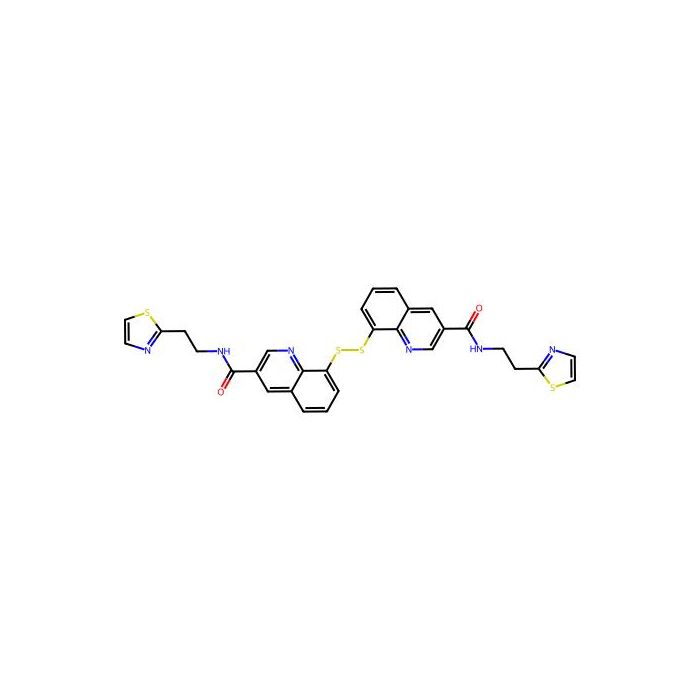
Capzimin is a potent and moderately specific proteasome isopeptidase Rpn11 inhibitor.
In Vitro
Capzimin (3027) shows 80-fold selectivity for Rpn11 over Csn5, 10-fold over AMSH and 6-fold over BRCC36 (IC 50 =30 μM, 4.5 μM and 2.3 μM respectively. Capzimin is screened against the NCI panel of 60 cancer cell lines. The median GI 50 is 3.3 μM. Capzimin exhibits promising activity in leukemia cells including the SR and K562 cell lines (GI 50 values of 0.67 μM and 1 μM respectively), as well as several solid tumor cell lines including NCI-H460 (non-small cell lung cancer; GI 50 = 0.7 μM) and MCF7 (breast cancer; GI 50 =1.0 μM). Immunoblotting for the processed form of caspase 3 and caspase-cleaved poly ADP-ribose polymerase in HCT116 cells confirm that Capzimin not only blocks cell growth, but also induces apoptosis. MCE has not independently confirmed the accuracy of these methods. They are for reference only.
Form:Solid
IC50& Target:Target: Rpn11
사양
사양 및 순도
≥99%
생화학 및 생리적 메커니즘
Capzimin is a potent and moderately specific proteasome isopeptidase Rpn11 inhibitor.
This compound belongs to the class of organic compounds known as quinoline-3-carboxamides. These are quinolines in which the quinoline ring system is substituted by one carboxamide group at the 3-position.
External Descriptors
Not available
1. Djoumbou Feunang Y, Eisner R, Knox C, Chepelev L, Hastings J, Owen G, Fahy E, Steinbeck C, Subramanian S, Bolton E, Greiner R, and Wishart DS. ClassyFire: Automated Chemical Classification With A Comprehensive, Computable Taxonomy. Journal of Cheminformatics, 2016, 8:61.
Products are supplied to verified businesses, institutions, and qualified professionals for research and development use only. Not for use in humans, animals, diagnosis, or therapy.