GRADE & PURITYMoligand™?Moligand™ — Aladdin's line of ligands and bioactive small molecules. Use for receptor, pathway, and binding studies needing defined small-molecule tools.10 mM in DMSO
Moligand™, 10 mM in DMSO Moligand™ for sensitive chromatographic and analytical workflows requiring minimal baseline interference.
🌡
Storage & shipping
Protected from light,Store at -80°C Ships Dry ice packs + Cold packs Check lot-specific COA for exact specifications.
📋
Quality documents
SDS, COA, datasheet, and spec sheet available for download. Lot-specific COA accessible via lot number lookup.
📚
Literature proof
Cited in 0 peer-reviewed publications across chromatography, organic synthesis, and cross-coupling reactions.
개요
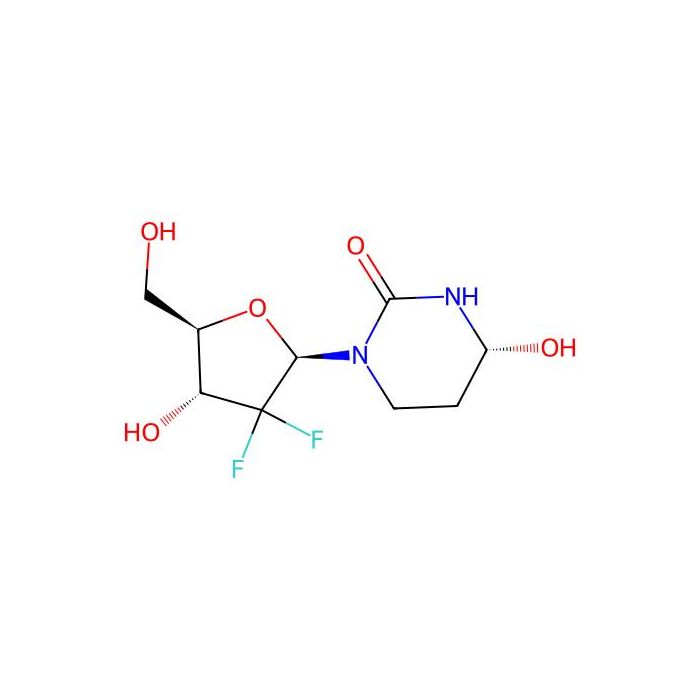
Cedazuridine (E7727) (Compound 7a) is an orally active cytidine deaminase (CDA) inhibitor with an IC 50 value of 0.4 μM. Cedazuridine can be used for cancer research.
Determine the necessary mass, volume, or concentration for preparing a solution.
Dilution Calculator
Determine the dilution needed to prepare a stock solution.
Reconstitution Calculator
리뷰
고객 리뷰
Application Protocols
No application protocols are provided in the Product Data for this SKU.
Not specified for this item; refer to CoA/Spec Sheet.
General guidance (non-validated, for consideration only)
Preparation of stock: Dissolve in anhydrous DMSO to a convenient concentration based on solubility; vortex and, if needed, sonicate briefly. Filter (0.22 µm) for sterile applications.
Working solutions: Dilute into assay buffer with vigorous mixing; include vehicle controls matching final DMSO content.
Storage of aliquots: Dispense single-use aliquots into amber vials or plates; freeze at −80°C to minimize freeze–thaw cycles.
Documentation: Record lot number, stock concentration, solvent, and preparation date on each container for traceability.
Biological Roles
Cedazuridine is commonly employed as a research tool in pyrimidine nucleoside metabolism studies (literature, general description). The following points summarize its relevance in biochemical contexts without making clinical claims.
Conceptual role in metabolism (general)
Nucleoside analogs can modulate or report on enzyme activities within the cytidine/uridine salvage and catabolic pathways. Such compounds are used to interrogate deamination, phosphorylation, and transport processes in cell-free or cell-based systems.
Enzyme and pathway studies (general)
Applied in in vitro assays to characterize kinetic parameters (Km, Vmax, Ki) for nucleoside-processing enzymes using spectrophotometric or LC–MS readouts.
Used to investigate uptake and efflux behavior through equilibrative or concentrative nucleoside transporters in membrane vesicles or engineered cell lines.
Bioanalytical considerations
Nucleoside analogs can undergo enzymatic or chemical deamination, phosphorolysis, or glycosidic bond cleavage; controlling pH, temperature, and incubation time is critical for reliable interpretation.
Matrix effects in complex lysates or media can alter apparent potency; include appropriate vehicle controls, internal standards, and stability checks.
Research use only
This material is intended strictly for in vitro/in vivo laboratory research by qualified professionals. No medical or diagnostic use is intended or implied.
Buffer Applications
While Cedazuridine is not a buffering reagent, it is frequently prepared and tested in aqueous media for biochemical assays. The following guidance addresses common buffer contexts for nucleoside analog studies (general; not item-specific specifications).
Common buffer systems
Phosphate-buffered saline (PBS, pH ~7.2–7.4): broadly compatible with enzyme assays and transporter studies; monitor for phosphate sensitivity if enzymes require specific cofactors.
HEPES (10–50 mM, pH 7.2–7.6): good pKa near neutrality and low temperature coefficient; suitable for kinetic measurements at ambient to physiological temperatures.
Tris or MOPS: alternatives depending on enzyme pH optima; verify any amine-buffer interactions with assay reagents.
Practical preparation tips
Prepare a concentrated DMSO stock and dilute into buffer with vigorous mixing to avoid precipitation; keep final DMSO low (e.g., ≤0.1–1% v/v) as the assay tolerates.
Use freshly prepared, filtered buffers; consider adding low levels of antioxidants or metal chelators only if validated for the assay system.
For long incubations, verify analyte stability at the chosen pH and temperature via time-course sampling and LC–MS or HPLC analysis.
Compatibility notes
High salt or divalent cations can influence nucleoside enzyme activities; optimize ionic strength and Mg2+/Mn2+ as required for the specific system under study.
Green Alternatives
As a specialty research compound rather than a bulk solvent or reagent, green-chemistry considerations focus on solvent and process choices during handling, analysis, and disposal.
Greener handling choices (general guidance)
Prefer water or aqueous buffers for working solutions when compatible with the assay, minimizing reliance on high-boiling aprotic solvents.
Use the minimum effective DMSO percentage and adopt miniaturized formats (e.g., 384/1536-well plates, acoustic dispensing) to reduce solvent consumption.
For analytics, consider ethanol/water or acetonitrile/water mixtures with efficient gradient methods to limit solvent volumes.
Waste minimization
Consolidate DMSO-containing waste streams; implement microscale assays to reduce chemical loading. Use amberware and cold storage to extend solution lifetime and reduce remake frequency.
Example comparison (general)
DMSO vs aqueous buffer: DMSO offers superior solubility but higher environmental persistence; aqueous buffers are greener but may require pH control to prevent precipitation or degradation. Select based on assay tolerance and compound stability.
Packaging and storage
Maintain frozen aliquots to reduce repeated thaw/refreeze cycles, thereby limiting compound wastage and associated solvent use.
Pharmaceutical Uses
For research use only. This section outlines formulation and analytical contexts relevant to pre-formulation and method-development work performed in laboratory settings (no therapeutic claims).
Reference standard and method development (general)
Cedazuridine can serve as a reference analyte for LC–MS/MS method development in plasma surrogates, buffer, or tissue homogenates used in preclinical laboratories. Validate selectivity, linearity, accuracy/precision, carryover, and stability per internal SOPs.
Pre-formulation screening (general)
Solubility and stability profiling across pH 2–8 in aqueous media and cosolvent systems (e.g., DMSO, ethanol, PEG 400 admixtures) supports early-stage formulation research. Evaluate photostability given the light sensitivity indicated in the Product Data.
Solid-form considerations
Polymorph/salt form and residual solvent content can impact dissolution behavior and analytical response. Confirm the exact form from the lot-specific CoA/Spec Sheet prior to comparative studies.
Compendial status
Pharmacopeial monographs: Not specified for this item; refer to CoA/Spec Sheet and current pharmacopeial listings.
Handling for dosage-form simulation (research context)
If preparing simulated dosage matrices (e.g., for in vitro release studies), document vehicle composition rigorously and control temperature/light to preserve analyte integrity.
Physical Properties
Item-specific data
Appearance: Not specified for this item; refer to CoA/Spec Sheet.
Molecular weight: Not specified for this item; refer to CoA/Spec Sheet.
Solubility (specification): Not specified for this item; refer to CoA/Spec Sheet.
Melting point, boiling point, density, refractive index, pKa, logP, UV cutoff: Not specified for this item; refer to CoA/Spec Sheet.
General/literature expectations for nucleoside analogs (not item specifications)
Physical state: typically a white to off-white crystalline or amorphous solid with high polarity and multiple hydrogen-bond donors/acceptors (literature, general).
Solubility profile: nucleoside analogs are commonly soluble in polar protic solvents (water, aqueous buffers) and polar aprotic solvents (DMSO); limited solubility in nonpolar media (literature, general).
Ionization: neutral to weakly basic/acidic depending on ring substitution; aqueous solubility may increase modestly with pH adjustment within stability limits (literature, general).
Hygroscopicity: many nucleosides can exhibit moisture uptake; minimize exposure to ambient humidity to retain assay-grade quality (general best practice).
Quality and Grades
Grade: Moligand™ (Product Data)
The Moligand™ designation indicates inclusion in a curated small-molecule/compound library suitable for screening, target validation, and chemical biology research. Materials are intended for research use only and not for human or veterinary use.
What this typically implies (general expectations; not item specification)
Identity and purity appropriate for discovery screening and biochemical assays. Batch-specific CoA typically provides analytical characterization (e.g., HPLC/LC–MS, NMR, or HRMS as applicable). For exact acceptance criteria and analytical methods, refer to the CoA/Spec Sheet for this SKU/lot.
Packaging designed to minimize moisture and photodegradation risk, facilitating reproducible assay performance.
Stabilizers and additives
Stabilizers, counter-ions, and residual solvents: Not specified for this item; refer to CoA/Spec Sheet.
Fit-for-purpose notes
Suitable for use as a reference compound or tool molecule in enzymology, nucleotide metabolism studies, and cell-free target engagement assays.
For analytical and bioanalytical method development (e.g., LC–MS quantification), confirm exact purity, salt form, and residual solvent content from the lot-specific documentation prior to calibration curve preparation.
Reaction and Applications
This product is intended primarily as a research tool compound rather than a synthetic reagent.
Research applications (general; expand on catalog context)
Chemical biology and enzymology: Cedazuridine is widely employed in studies of pyrimidine nucleoside metabolism and deamination pathways, supporting target engagement assays, kinetic profiling, and structure–activity investigations (literature, general description). It can serve as a positive control or comparator molecule in nucleoside-processing enzyme assays.
Analytical reference: Suitable for developing and validating LC–MS/MS methods to quantify nucleoside analogs in in vitro matrices (buffer, microsomes, S9, or cell lysates). Use stable internal standards where available and confirm retention/time and ion transitions empirically.
Assay development: Evaluate buffer composition, metal ions, and pH to maintain nucleoside stability during incubations; include time-zero and vehicle controls.
Not a general-purpose building block
Cedazuridine is not commonly used as a reagent for named organic reactions or as a protecting-group handle. If derivatization is desired (e.g., prodrug or labeling chemistry), specialized nucleoside coupling/protection strategies may be required (literature, general guidance).
Practical tips
Prepare fresh working solutions to minimize hydrolytic or oxidative degradation. Employ amber vials and minimize light exposure. For time-course experiments, quench aliquots promptly (e.g., with cold organic solvent or acidified media compatible with the analyte) before analysis.
Reaction Conditions
This product is supplied as a research compound rather than a reagent for preparative organic synthesis. As such, there are no item-specific reaction conditions.
Not specified for this item; refer to CoA/Spec Sheet for any available analytical or handling notes relevant to solution preparation.
General laboratory handling of nucleoside analogs in solution
Solvents: DMSO for concentrated stocks; water/HEPES/PBS for working solutions.
Temperature: Prepare and store solutions at low temperature when feasible; conduct assays at the enzyme’s optimum (often 20–37°C) and minimize exposure to elevated temperatures.
Light: Use amber vials or wrap containers in foil; Product Data specifies protection from light.
Time: Prepare fresh working solutions and limit room-temperature standing time to reduce degradation.
If performing derivatization chemistry (general)
Employ anhydrous conditions and appropriate protecting groups for sugar hydroxyls; monitor reactions by LC–MS or TLC under low-UV to avoid photolysis.
Workup and purification: Reverse-phase chromatography (water/acetonitrile with volatile buffers) is commonly used for nucleosides; lyophilization preserves labile materials.
Safety and Handling
GHS classification and hazard statements: Not specified for this item; refer to SDS.
Signal word and pictograms: Not specified for this item; refer to SDS.
General laboratory precautions for nucleoside analogs (informational; defer to SDS)
Avoid inhalation, ingestion, and skin/eye contact. Handle in a certified chemical fume hood or ventilated enclosure when weighing or preparing stocks.
Recommended PPE: lab coat, safety glasses or splash goggles, and appropriate chemical-resistant gloves (e.g., nitrile). Consider double-gloving for extended handling of DMSO stocks.
Hygiene: wash thoroughly after handling; do not pipette by mouth; keep away from food and beverages.
Incompatibilities and stability (general)
Store away from strong oxidizers and strong acids/bases that may promote degradation of nucleoside rings or glycosidic bonds.
Protect from light to limit photolytic degradation (Product Data indicates light sensitivity).
Thermal sensitivity: prolonged heating may accelerate decomposition; prepare working solutions shortly before use when feasible.
Skin/eye contact: rinse with water for ≥15 minutes; remove contaminated clothing; seek medical attention as warranted.
Inhalation: move to fresh air; obtain medical advice if symptoms occur.
Ingestion: rinse mouth; do not induce vomiting; get medical attention.
Waste disposal
Collect solutions and solids as organic laboratory waste consistent with institutional and local regulations; DMSO solutions may require specific labeling.
Solvent Selection
Cedazuridine is a polar nucleoside analog. Solvent selection should prioritize solubility, stability, and assay compatibility.
Primary stock solvent choices (general guidance)
DMSO: Preferred for preparing concentrated stocks for biochemical and cell-based screening due to broad solubilizing power and small delivery volumes to aqueous assays. Filter-sterilize if required and store aliquots at −80°C protected from light.
Water/aqueous buffers (e.g., PBS, HEPES): Often compatible for immediate-use working solutions; consider pH 6.5–7.5 for nucleoside stability unless specific assay conditions dictate otherwise.
Methanol or ethanol (analytical sample prep): Useful for LC–MS sample preparation and spiking solutions; ensure assay tolerance to organic content.
Miscibility and polarity (general)
DMSO is fully miscible with water; gradual dilution into buffer minimizes precipitation. Avoid introducing high DMSO percentages to sensitive biochemical assays; keep final DMSO typically ≤0.1–1% v/v as assay permits (literature, general practice).
When to choose alternatives
For high-throughput screening: DMSO stocks (5–50 mM as solubility allows) with automated acoustic or pin transfer to minimize solvent burden.
For enzyme kinetics: Aqueous buffers reduce solvent artifacts; include matching solvent controls to correct for co-solvent effects.
Practical tips
Pre-warm and vortex to fully dissolve solids; brief sonication can aid dissolution. Verify solution clarity before use. If needed, adjust ionic strength or pH slightly to maintain solubility without compromising stability.
Storage and Reconstitution
Item-specific storage conditions (Product Data)
Store at −80°C.
Protect from light.
Shipped on dry ice packs + cold packs to maintain low temperature.
Reconstitution guidance (general best practices; not item specification)
Allow the sealed container to equilibrate to room temperature in a desiccated, light-protected environment before opening to avoid moisture condensation.
Prepare a concentrated stock in anhydrous DMSO or compatible solvent. Mix thoroughly (vortex/brief sonication) until fully dissolved. If aqueous stocks are required, slowly dilute the DMSO solution into buffer with vigorous mixing.
Optional: Sterile-filter working solutions (0.22 µm) for cell-free or cell-based assays if sterility is required.
Aliquoting and stability (general)
Dispense single-use aliquots into amber vials/tubes. Avoid repeated freeze–thaw cycles; each aliquot should be thawed only once.
Short-term handling: Keep solutions on ice and protected from light during assay setup. Discard any turbid or discolored solutions.
Long-term storage: Maintain frozen stocks at −80°C in the dark. For exact shelf life and retest intervals, consult the lot-specific CoA/Spec Sheet.
Documentation
Record solvent, concentration, preparation date, and lot number. Verify concentration by UV or LC–MS where applicable before critical experiments.
Structure and Identity
Cedazuridine is a nucleoside analog included in Aladdin’s Moligand™ small-molecule library collection. It is commonly used as a biochemical tool compound in nucleotide metabolism research.
Item-specific identifiers
CAS: 1141397-80-9 (Product Data)
SKU: C1494246 (Product Data)
InChIKey: Not specified for this item; refer to CoA/Spec Sheet.
SMILES: Not specified for this item; refer to CoA/Spec Sheet.
Molecular formula: Not specified for this item; refer to CoA/Spec Sheet.
Molecular weight: Not specified for this item; refer to CoA/Spec Sheet.
Structural features (general, literature-based description without item-specific claims)
Cedazuridine is a cytidine/uridine-family nucleoside analog containing a pyrimidine base linked to a pentofuranose (sugar) framework via an N-glycosidic bond (literature, general description).
Functional groups: heteroaromatic pyrimidinone/pyrimidin-amine motifs, multiple hydroxyls on the ribose/deoxyribose-like ring enabling hydrogen bonding and high polarity (literature, general description).
Stereochemistry: typical nucleosides possess defined stereocenters at the 2′, 3′, 4′, and 5′ positions of the sugar; cedazuridine conforms to a fixed configuration enabling recognition by nucleoside-processing enzymes (literature, general description).
2D structure in words (general)
A six-membered nitrogenous pyrimidine ring bearing exocyclic substituents is N-linked at the anomeric center (1′) of a five-membered furanose ring with primary and secondary alcohols (literature, general description).
Synthetic Utility
Cedazuridine is primarily a bioactive tool compound and is not commonly used as a general synthetic building block. Nevertheless, several considerations may be relevant to chemists exploring derivatization in a research context (general literature guidance):
Functional group landscape (general)
Heteroaromatic pyrimidine core with exocyclic heteroatoms; multiple hydroxyls on a furanose ring enabling selective protection/deprotection strategies.
Potential reaction handles include hydroxyl functionalization (e.g., acylation, carbonate/carbamate formation) and N-modification strategies on the heterocycle, subject to preserving the glycosidic linkage.
Protection strategies
Orthogonal protection (e.g., silyl ethers, acyl groups) on the sugar ring can enable selective transformations; careful control of acid/base conditions is required to prevent glycosidic bond cleavage (literature, general practice for nucleosides).
Conjugation concepts
Pro-moiety installation (e.g., phosphate, phosphoramidate, carbonate) or reporter tagging (e.g., fluorophores via carbonate/carbamate linkers) may be feasible using standard nucleoside chemistry workflows.
Limitations
The compound’s dense heteroatom content and multiple stereocenters constrain reaction scope; global transformations risk degradation and loss of stereochemical integrity.
Note
No item-specific synthetic transformations or yields are provided here; consult specialized nucleoside chemistry references for stepwise procedures.
Target Specificity
Not specified for this item; refer to CoA/Spec Sheet. No target, epitope, clone, species reactivity, or isotype details are provided in the Product Data for SKU C1494246.
Need help choosing the grade?
Our grade selection guide covers purity, stabilizer status, and application suitability for all variants in our catalog.
We use cookies to ensure the website functions properly and, where permitted, to improve your experience. You can manage your preferences at any time in Settings. Learn more in our Cookie Policy.
Shall we send you a message when we have discounts available?
Remind me later
Thank you! Please check your email inbox to confirm.
Products are supplied to verified businesses, institutions, and qualified professionals for research and development use only. Not for use in humans, animals, diagnosis, or therapy.