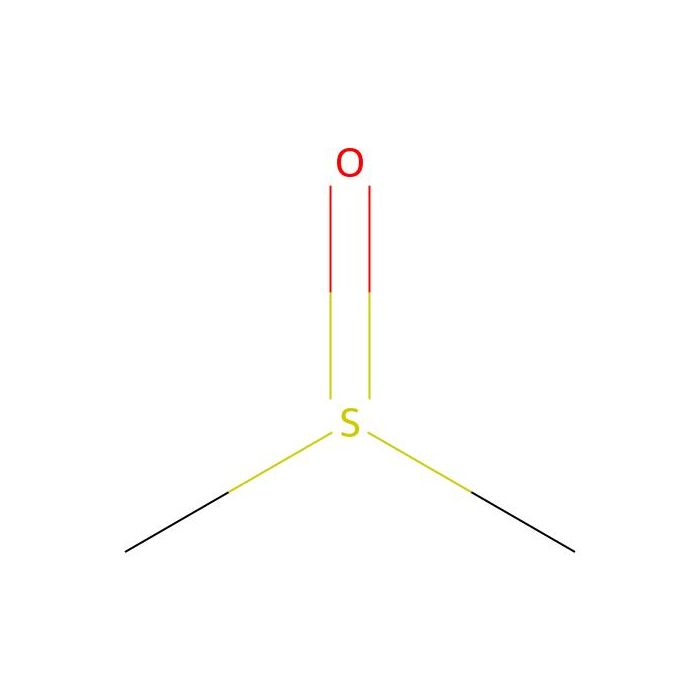
Dimethyl sulfoxide(DMSO) - UltraBio™, Suitable for molecular biology, ≥99.5%(GC) , CAS No.67-68-5

CAS: 67-68-5 Cat. No.: D755745 분자식: C2H6SO 분자량: 78.13 Beilstein Registry Number: 506008 EC 번호: 200-664-3
주문 가능
GRADE & PURITY Suitable for molecular biology ? Molecular-biology grade — free of nucleases and contaminants that degrade DNA/RNA. Use in cloning, PCR, and nucleic-acid work needing clean reagents. UltraBio™ ? UltraBio™ — Aladdin's line for molecular-biology applications. Use for nuclease-free, high-consistency reagents across molecular workflows. ≥99.5%(GC)
Storage
Room temperature
Shipped In
Normal
★
Size
USA
독일 (EU)*
Price
Qty
100ml
D755745-100ml
주문제작 · 8~12주
US$312.90
500ml
D755745-500ml
주문제작 · 8~12주
US$920.90
Enter a quantity for the sizes you want to add.
🧪
Why this grade

UltraBio™, Suitable for molecular biology, ≥99.5%(GC) Suitable for molecular biology,UltraBio™ for sensitive chromatographic and analytical workflows requiring minimal baseline interference.

🌡

Storage & shipping

Room temperature Ships Normal Check lot-specific COA for exact specifications.

📋

Quality documents

SDS, COA, datasheet, and spec sheet available for download. Lot-specific COA accessible via lot number lookup.

📚

Literature proof

Cited in 5308 peer-reviewed publications across chromatography, organic synthesis, and cross-coupling reactions.

개요

Dimethyl sulfoxide (DMSO) is an effective aprotic solvent. It is colorless, odorless and hygroscopic in nature. DMSO enhance the permeability of various hydrophilic and lipophilic permeants. It is one of the widely used solvents in the laboratory.

Application:

Dimethyl sulfoxide (DMSO) has been used as a vehicle for test compounds in various experimental studies. It has also been used as a solvent during amyloid β (Aβ) aggregation protocol for resolubilization of peptide to maintain its dissociated state.

Specifications

사양 및 순도
UltraBio™, Suitable for molecular biology, ≥99.5%(GC)
보관 조건
Room temperature
배송
Normal
등급
Suitable for molecular biology, UltraBio™
순수함
≥99.5%(GC)
이름과 식별자
정식 스마일CS(=O)C
IUPAC Namemethylsulfinylmethane
InChIKeyIAZDPXIOMUYVGZ-UHFFFAOYSA-N
INCHI1S/C2H6OS/c1-4(2)3/h1-2H3
이성체 SMILES CS(=O)C
WGK 독일 1
RTECS PV6210000
분자량 78.13
Beilstein 506008
Reaxy-Rn 506008
Reaxys-RN_link_address https://www.reaxys.com/reaxys/secured/hopinto.do?context=S&query=IDE.XRN=506008&ln=

Documentation

📋 Safety Data Sheet (SDS)

Comprehensive hazard, handling, storage, and regulatory compliance document.

Download SDS →

✅ Certificate of Analysis (COA)

Lot-specific quality data. Enter your lot number to retrieve the exact COA.

Look up COA →

📊 Datasheet

Quick-reference summary of product specifications and applications.

View datasheet →

🔬 Specification Sheet

Full quality attributes and acceptance criteria for this grade.

View spec sheet →

Advanced Data

Taxonomic Classification

Taxonomy Tree

KingdomOrganic compounds
SuperclassOrganosulfur compounds
분류Sulfoxides
SubclassNot available
Intermediate Tree Nodes Not available
Direct ParentSulfoxides
Alternative Parents Sulfinyl compounds  Organic oxides  Hydrocarbon derivatives  
Molecular FrameworkAliphatic acyclic compounds
Substituents Sulfoxide - Sulfinyl compound - Organic oxygen compound - Organic oxide - Hydrocarbon derivative - Aliphatic acyclic compound
설명This compound belongs to the class of organic compounds known as sulfoxides. These are compounds containing a sulfoxide functional group, with the structure RS(=O)R' (R,R' not H).
External Descriptors a small molecule
3D 구조
상호 작용 화학 구조 모델


인증서(CoA, COO, BSE/TSE 및 분석 차트)
C of A & Other Certificates(BSE/TSE, COO):
Analytical Chart:
화학 및 물리적 특성
용해성H 2 O: miscible (completely)
굴절률1.477-1.48
발화점(°F)189 °F
발화점(°C)87℃
끓는점(°C)189°C
녹는점(°C)16-19 °C (lit.)
분자량78.140 g/mol
XLogP3-0.600
Hydrogen Bond Donor Count0
Hydrogen Bond Acceptor Count2
Rotatable Bond Count0
Exact Mass78.0139 Da
Monoisotopic Mass78.0139 Da
Topological Polar Surface Area36.300 Ų
Heavy Atom Count4
Formal Charge0
Complexity29.000
Isotope Atom Count0
Defined Atom Stereocenter Count0
Undefined Atom Stereocenter Count0
Defined Bond Stereocenter Count0
Undefined Bond Stereocenter Count0
The total count of all stereochemical bonds0
Covalently-Bonded Unit Count1
자주 묻는 질문과 기사
Dimethyl sulfoxide (DMSO)
UltraBio™: Defining Excellence in Molecular Biology Applications
Molecular Biology Grade
Common Reducing Agents Used in Protein Experiments
How do I load a hydrophobic drug into liposomes?
Differences Between Transformation and Transfection
How to Dissolve Biotin for Streptavidin Elution Buffers
CRISPR Gene-Editing Therapies
How should laboratory strains be preserved?
Hoechst Staining for Apoptosis Detection: Experimental Workflow
What methods are used to measure cell proliferation?
FeRhoNox-1 (Fe²⁺ Indicator) Fluorescent Probe Instruction Manual — Practical Guide for Specific Detection of Intracellular Fe²⁺ in Live Cells
Operational Guide for Fluorescent Labeling of Antibodies Using AF594 NHS Ester
Cyanine 3 Tyramide (Cy3 Tyramide): Principles, Applications, and Experimental Selection Guide for Tyramide Signal Amplification (TSA)
Application Guide to Super Fluor 680 / 750 Near-Infrared Dyes for In Vivo Small-Animal Fluorescence Imaging
FAQ on Cell Culture Serum
General Principles of Antibody Labeling with NHS-Activated Esters, F/P Calculation, and Troubleshooting Guide
Mag-Fluo-4 AM Magnesium/Calcium Ion Fluorescent Probe: Properties, Experimental Use, and Aladdin Metal Ion Fluorescent Probe Selection Guide
Rapamycin: A Life-Balance Regulator Born from Easter Island Soil
Hesperidin: A Multifunctional Flavonoid Hidden in Citrus Peels
Protease & Phosphatase Inhibitor Cocktails: Research Applications and Principles
Carotenoids: Structural Features, Dietary Sources and Research Applications – With an Aladdin Natural Pigments Product Selection Guide
Principles and Application Strategies of Common PCR Enhancers
Applications of Nanoclay in Materials and Formulations: Dispersion Mechanisms, Performance Enhancement, and Product Selection
One-Stop Handbook for Palladium-Catalyzed Reactions: Catalytic Cycles, Deactivation Troubleshooting, Ligand/Precatalyst Selection, and an Aladdin Reference List
Installing a Redox Switch on Biomolecules: Principles, Conjugation Essentials, and an Application Guide for ATTO MB2 NHS ester
A Practical Guide to Small-Molecule Chemical Probes: Concept Clarification, Causal Validation, and Experimental Selection (with Product Navigation and Tables A–D)
CCK-8 (WST-8) Colorimetric Cell Viability Assay: Principles, Experimental Design, and Typical Applications
From Piperidine to Pyridine: The “Most Common N-Heterocycle” Shift in FDA Small-Molecule New Drugs (2013–2023) and a Selection Guide (Tables 1–4)
Structural–Functional Analysis of the Methoxy Group (–OCH₃) in Approved Small-Molecule Drugs: Mechanisms, Evidence Chains, and Product-Selection Navigation (with Related Product Tables)
A Review of Ten Commonly Used Techniques for Detection, Quantification, and Interaction Analysis in Nucleic Acid Research
Why Acridine Can Turn “Trace Molecules” into a Measurable Light Signal: A Mechanistic, Selection, and Troubleshooting Guide to Acridinium Ester Chemiluminescent Immunoassays (Including Product Tables 1–4)
GelRed Nucleic Acid Stain: Frequently Asked Questions
Plant Omics Panorama: Workflow Frameworks and Multi-Omics Integration from Genomics to Transcriptomics, Proteomics, and Metabolomics
Diaphorase: NAD(P)H-Dependent Electron-Transfer Activity and Its Applications in Detection and Research
How to Make the Suzuki–Miyaura Reaction Robust: Pinpoint the Bottleneck and Lock in a Reproducible Operating Window (with Selection Navigation and Product Tables 1–5)
Angiotensin-Converting Enzyme (ACE): A Review of Molecular Features, Catalytic Functions, and Research and Translational Applications
Fluconazole: Physicochemical Properties, Mechanism of Action, and Key Points for Clinical and Research Applications
AmpC β-Lactamases (Cephalosporinases): Mechanisms of Production, Diagnostic Pathways, and Research and Clinical Applications
Azithromycin: Physicochemical Features, Mechanism of Action, and Key Points for Research Applications
Ferulic Acid: Structural Features, Preparation Routes, and Key Points for Research Applications
Paeonol: Physicochemical Features, Uses, and Key Points for Research Applications
Famotidine: Physicochemical Features, Mechanism of Action, and Key Points for Research Applications
Reassessing Trimethylaluminum: Method Design and Experimental Value of One-Pot Peptide Elongation from Unprotected Amino Acids
What a Disagreement in Specific Rotation Results Reveals About Method Control: Why Specific Rotation Values for Chiral Samples Cannot Be Discussed Apart from Measurement Conditions
The Methodological Value of DSC: Building NHS-Type Activated Intermediates and Deciding When to Use Them
How to Construct Nitriles: Route Selection Across Direct Introduction, Precursor Dehydration, Oxidation/Dehydrogenation, and Cyanide-Free Processes
Experimental Decision-Making for Introducing Aminoalkyl Side Chains Using N-Haloalkyl Phthalimides: Chain Length, Leaving Group, and Deprotection Choice
Polyetherimide (PEI): Structural Features, Main Properties, and Typical Application Directions
4-[(tert-Butyldimethylsilyl)oxy]butan-1-ol: Experimental Selection Logic as a Monoprotected 1,4-Butanediol Building Block and a Protected C4 Linker
Application Comparison of the Neutral Red Assay and the MTT/CCK-8 Assays in Cytotoxicity Testing
Comparison of Principles, System Control, and Result Interpretation in Hydroxyl Radical Scavenging Capacity Assays
From Functional Groups to Experimental Decision-Making: Protein Crosslinker Selection and Experimental Essentials
Metal Halide Perovskite Solar Cells: Sources of High Efficiency, Stability Bottlenecks, and Experimental Decision Logic
Mechanisms and Experimental Applications of β-GP, Ascorbic Acid, and Dexamethasone in Osteogenic Induction Systems
Avertin Anesthetic (Avertin, 2,2,2-Tribromoethanol): Overview, Applications, and Experimental Precautions
How to Troubleshoot Abnormal Impurities in Peptide Synthesis? Locating Process Issues Through Amino-Related Side Reactions
Practical Guide to TSA Tyramide Signal Amplification: How to Select Reagents, Optimize the Workflow, and Reduce Background When Detection Signals Are Weak for Low-Abundance Targets
What Is Synthetic Biology? The Industrialization Pathway from Upstream Reagent Toolchains to Biomanufacturing Applications
CTSOBt Benzotriazole–Sulfonate Coupling Reagent: Carboxylic Acid Activation and Synthetic Application Value
From Photocatalytic Ring Opening to Skeletal Reconstruction: Reaction Logic and Synthetic Applications of Oxygen-Atom Replacement in Oxetanes
Reactions and Applications of 3,3-Difluoroallyl Sulfonium Salts (DFASs): Small-Molecule gem-Difluoroallylation, Selective Peptide Modification, and Subsequent Functionalization
3,3-Spiro-α-Proline Building Blocks: Structural Features, Complementary Synthetic Routes, and Multigram-Scale Preparation
Stereoretentive Decarboxylative Amidation with Dioxazolones: A Two-Electron Rearrangement Mechanism for Stereochemical Transfer from Chiral Carboxylic Acids
Reaction Logic of I₂/DMSO-Mediated Oxidation of Aryl Methyl Ketones: In Situ Generation, Trapping, and Heterocycle Construction of Aryl Glyoxals
Dual Role of NH₄SCN and CN Transfer: From Electrochemical Oxidation of SCN⁻ to the Construction of 1-Cyanoimidazo[1,5-a]pyridines
Citations of This Product
솔루션 계산기
리뷰

고객 리뷰

자주 묻는 질문

What is the purity of this product, and how is it determined?
This product is supplied at ≥99.5% purity, determined by gas chromatography (GC). Lot-specific values are stated on the Certificate of Analysis.
What does UltraBio? mean?
UltraBio? indicates that the product has been processed and tested for biological and biochemical applications. Specifications may include endotoxin limits, microbial controls, sterility, low DNase/RNase/protease activity, and verified biological activity where relevant.
What does Suitable for molecular biology mean?
Suitable for molecular biology indicates that the product has been processed and tested for molecular biology and proteomics. Typical specifications include low or undetectable nuclease/protease activity, low endotoxin, controlled microbial limits and high lot-to-lot reproducibility.
How should this product be stored?
Store at room temperature.
How is this product shipped?
This product ships under standard ambient conditions. No temperature-controlled packaging is required.
What are the CAS number, molecular formula and molecular weight?
The CAS Number is 67-68-5, the molecular formula is C2H6SO, and the molecular weight is 78.13 g/mol. InChIKey IAZDPXIOMUYVGZ-UHFFFAOYSA-N.
What documentation is provided?
Available product documentation, including Certificates of Analysis (COA), Safety Data Sheets (SDS), and specification sheets, is shown in the product document area. Document availability and access follow the current site policy.

Need help choosing the grade?

Our grade selection guide covers purity, stabilizer status, and application suitability for all variants in our catalog.

View Suitable for molecular biology grade guide → View UltraBio™ grade guide →

Shall we send you a message when we have discounts available?

Remind me later

Thank you! Please check your email inbox to confirm.

Oops! Notifications are disabled.