
Operational Guide for Fluorescent Labeling of Antibodies Using AF594 NHS Ester
Operational Guide for Fluorescent Labeling of Antibodies Using AF594 NHS Ester
AF594 NHS Ester Product Overview
AF594 NHS Ester (Alexa Fluor 594 NHS Ester / AF594 NHS Ester) is the active ester form of a red-region fluorescent dye. It reacts with primary amines (–NH₂) on proteins, antibodies, peptides, and other biomolecules under mild, slightly basic conditions to form stable amide bonds, and is widely used as a fluorescent labeling reagent for proteins and antibodies.
Basic Information:
(1) Product name: AF594 NHS Ester
(2) English name: Alexa Fluor 594 NHS Ester / AF594 NHS Ester
(3) CAS No.: 295348-87-7
(4) Molecular formula: C₃₉H₃₇N₃O₁₃S₂
(5) Molecular weight: 819.85 Da
(6) Appearance: Blue-violet to reddish-violet solid powder
(7) Spectral properties: Excitation maximum ~590 nm; emission maximum ~617 nm; orange-red fluorescence
(8) Applicable pH range: Fluorescence signal is essentially unaffected by pH within the range pH 4–10
Key Features:
(1) High brightness and excellent photostability, suitable for cell imaging, flow cytometry, immunofluorescence, ELISA, and related applications;
(2) Sulfonated dye structure provides good hydrophilicity and low non-specific binding, allowing labeling at relatively high dye/protein ratios without excessive self-quenching;
(3) Compatible with commonly used laser lines such as 561 nm / 594 nm, facilitating multicolor panel design and combined use.
Storage and Handling Recommendations
· Solid reagent:
(1) Recommended long-term storage at –20 °C, dry, protected from light, and tightly sealed; avoid frequent opening of the container to prevent moisture uptake.
· DMSO stock solution:
(1) It is recommended to prepare a concentrated stock solution (e.g. 10 mM) in anhydrous DMSO;
(2) After aliquoting into small vials, store at –20 °C protected from light, and avoid repeated freeze–thaw cycles;
(3) For best activity, use within 1–2 weeks after preparation.
Note: AF594 NHS Ester is readily hydrolyzed and inactivated in aqueous solutions. All solution preparation and labeling procedures should be carried out as quickly as possible and protected from light.
Basic Principles for Antibody Labeling
When labeling antibodies with AF594 NHS Ester, it is recommended to follow the principles below:
1. Reaction pH
(a) An optimal pH is typically 8.0–8.5: at lower pH the reaction proceeds slowly, while at higher pH the NHS ester undergoes rapid hydrolysis.
(b) Common practice: first dissolve the antibody in 1× PBS (pH 7.2–7.4), then add a small volume of 1 M NaHCO₃ or carbonate buffer to adjust the reaction mixture to approximately pH 8.3.
2. Buffer System
(a) Recommended: 1× PBS (pH 7.2–7.4) plus an appropriate amount of sodium bicarbonate or carbonate buffer to raise the pH;
(b) To avoid: buffers containing primary amines such as Tris or glycine, as well as high concentrations of ammonium salts such as ammonium sulfate or ammonium acetate, as these will compete with the antibody for reaction with the NHS ester.
3. Antibody Preparation Requirements
(a) Whenever possible, use antibody formulations free of protein stabilizers such as BSA or gelatin;
(b) Avoid preservatives such as sodium azide or thimerosal; remove them by dialysis or desalting columns when necessary;
(c) To achieve good labeling efficiency, an antibody concentration of 2–10 mg/mL is recommended. When the concentration is below 1–2 mg/mL, coupling efficiency decreases significantly.
4. Dye-to-Antibody Molar Ratio (Dye/Protein)
(a) A typical starting molar ratio is 5–10 : 1 (dye : antibody);
(b) During optimization, adjust according to signal intensity and antibody activity to obtain an appropriate degree of labeling (DOL), generally recommended to be 3–8.
5. Reaction Conditions
(a) Usually incubate at room temperature (20–25 °C) with gentle mixing for 30–60 min;
(b) Perform all steps protected from light.
Example Preparation of AF594 DMSO Stock Solution
Using the preparation of a 10 mM DMSO stock solution as an example, assume that 1 mg AF594 NHS Ester is weighed once:
(a) Molecular weight: 819.85 g/mol
(b) Amount of substance:

(c) To prepare a 10 mM (0.01 mol/L) solution, the required volume is:

Recommended procedure:
(a) Allow the solid reagent to equilibrate to room temperature before opening the vial;
(b) Add approximately 120–125 μL of anhydrous DMSO, and gently pipette or briefly vortex until completely dissolved;
(c) Aliquot into several small tubes (e.g. 10–20 μL per tube) and store at –20 °C, protected from light.
Example Labeling Protocol: Goat Anti-Mouse IgG with AF594 NHS Ester
The following example uses 1 mg goat anti-mouse IgG and can be scaled up or down proportionally.
1. Antibody Solution Preparation (Solution A)
a) Ensure that goat anti-mouse IgG is dissolved in 1× PBS (pH 7.2–7.4) and is free of BSA/gelatin/Tris/glycine and other such components;
b) Adjust the antibody concentration to 1 mg/mL, and transfer 1.0 mL (containing 1 mg antibody) into a 1.5 mL microcentrifuge tube;
c) Add 100 μL of 1 M NaHCO₃ (pH 8.3–8.5) and mix thoroughly to raise the reaction pH to approximately 8.3.
At this point, the total volume is about 1.1 mL and the antibody concentration is slightly reduced but still suitable for labeling.
Assuming the molecular weight of IgG is approximately 150 kDa, the amount of substance in 1 mg antibody is:

2. Dye Stock Solution (Solution B)
a) Immediately before use, take one aliquot of 10 mM AF594 DMSO stock solution from –20 °C, and allow it to warm briefly at room temperature until completely thawed;
b) Return the remaining stock solution to –20 °C promptly after use.
3. Calculation of Dye Amount and Addition
Using a 10-fold molar excess of dye as the initial condition:
a) Antibody amount: ~6.7 nmol
b) Dye amount (10×): ~67 nmol
c) Required volume of 10 mM dye solution:

Procedure:
(1) Add approximately 6.7 μL of 10 mM AF594 DMSO solution to the 1.1 mL antibody solution (Solution A);
(2) Gently pipette or briefly vortex to mix, avoiding vigorous shaking and foam formation.
To optimize labeling conditions, parallel reactions can be set up with, for example, 5×, 10×, and 15× molar excess of dye:
(a) 5×: ~3.3 μL (10 mM)
(b) 10×: ~6.7 μL (10 mM)
(c) 15×: ~10 μL (10 mM)
4. Conjugation Reaction
1. Incubate the reaction mixture at room temperature (20–25 °C);
2. Place on a gentle rocker or rotator and incubate for 30–60 min;
3. Keep the reaction protected from light throughout (e.g. wrap the tube in aluminum foil);
4. Upon completion, proceed immediately to purification to remove free dye.
Purification of the Conjugate: Removal of Free AF594
To reduce background signal and improve labeling consistency, it is recommended to remove free AF594 dye after the reaction is complete.
1. Using a Desalting Column (Recommended)
Sephadex G-25 or similar pre-packed desalting/centrifugal columns can be used:
(1) Equilibrate the column with 1× PBS (pH 7.2–7.4) according to the manufacturer’s instructions;
(2) Load the labeling reaction mixture (approximately 1.1 mL) onto the column;
(3) Elute with an appropriate volume of PBS and collect the earliest eluting pale-yellow/protein peak fractions, which are typically the labeled antibody;
(4) Measure and
of the collected fractions to confirm the presence of both protein and dye, and that the free dye peak has been substantially reduced.
2. Using Dialysis Tubing (Alternative)
If desalting columns are not available, dialysis can be used as an alternative:
(1) Choose dialysis tubing with a molecular weight cutoff (MWCO) of 10–20 kDa;
(2) Transfer the reaction mixture into the dialysis tubing and dialyze against a large volume of 1× PBS (pH 7.4);
(3) Dialyze at 4 °C, protected from light, for 4–12 h, replacing the external buffer 2–3 times;
(4) After dialysis, the resulting solution is AF594-labeled antibody with most free dye removed.
The purified conjugate can be used for cell staining, flow cytometry, or immunoassays and related experiments.
Brief Evaluation of Degree of Labeling (DOL)
For users requiring more precise control of labeling, the dye-to-antibody degree of labeling (DOL) can be estimated from the absorption spectrum. A typical recommended DOL for antibodies is approximately 3–8.
Basic Approach
1. Measure the absorbance of the purified conjugate at:
(a) 280 nm (protein absorbance peak), giving ;
(b) ~590 nm (near the absorption maximum of AF594), giving .
2. Since AF594 also absorbs at 280 nm, the manufacturer’s correction factor (typical value ~0.56; refer to the COA of this product for the exact value) should be used to correct
.
Note: The exact CF₂₈₀ value for AF594 may vary slightly between manufacturers or isomers. Always use the value given in the COA for the current lot.

3. Using known molar extinction coefficients to estimate concentrations:
(A) Molar extinction coefficient of AF594 at its absorption maximum: ε_AF594 ≈ 92,000 L·mol⁻¹·cm⁻¹;
(B) Molar extinction coefficient of IgG at 280 nm: ε_IgG,280 ≈ 203,000 L·mol⁻¹·cm⁻¹
Thus:
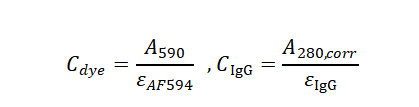
Estimated degree of labeling:
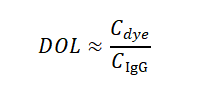
If the conjugate is used only for routine qualitative or semi-quantitative assays, and the signal intensity and antibody activity obtained under the recommended conditions are satisfactory, it is not necessary to calculate DOL for every batch. However, for applications requiring high lot-to-lot consistency (such as commercial antibodies or quantitative assays), regular DOL evaluation is recommended.
Notes and Compliance Statement
(1) AF594 NHS Ester and its antibody conjugates are for scientific research or industrial use only. They must not be used for human or animal clinical diagnosis or therapy, and must not be used as pharmaceuticals or food additives;
(2) Appropriate personal protective equipment (such as gloves and safety goggles) should be worn during handling. Avoid contact with skin and eyes.
Storage Recommendations for Conjugates
(1) The conjugate may be stored in PBS supplemented with an appropriate amount of glycerol (e.g. 50% v/v) and, where compatible with downstream applications, a preservative such as 0.02% sodium azide;
(2) For short-term storage, keep at 4 °C; for long-term storage, keep at –20 °C or below, avoiding repeated freeze–thaw cycles;
(3) In practical use, always refer to the COA (Certificate of Analysis) and MSDS of the corresponding Aladdin product batch for more detailed safety and handling information.
Summary of Major Reagents Used in the AF594 Antibody Labeling Protocol (Including AF Series Multicolor Dyes)
Product Name (English) | Aladdin Cat. No. | Grade / Purity | CAS No. | Role / Use in This Protocol and Related Applications |
Alexa Fluor 594 NHS Ester / AF594 NHS Ester | ≥95% | 295348-87-7 | Core fluorescent dye in this protocol: a red, sulfonated rhodamine-type NHS ester that reacts with primary amines on antibodies/proteins around pH 8 to form stable amide bonds, used to prepare AF594-labeled antibodies and proteins. Typical Ex/Em ≈ 590 / 610–617 nm. Signal is stable over pH 4–10, with high brightness and excellent photostability. | |
AF488 NHS ester / Alexa Fluor 488 NHS Ester | – | 1374019-99-4 | Green-channel AF dye and a high-brightness alternative to FITC. The NHS ester labels primary amine–containing molecules such as proteins, antibodies, and oligonucleotides. Typical Ex/Em ≈ 495 / 519 nm. Highly water-soluble and fluorescence is largely unaffected in the pH 4–10 range, suitable for cell imaging and flow cytometry. | |
Aladdin® 488 NHS Ester (Succinimidyl Ester) | A598198 | ≥80% (HPLC) | 1374019-99-4 (free base) | Green-channel fluorescent labeling dye corresponding to the 488 nm laser. The NHS ester covalently couples to primary amines on antibodies/proteins to prepare 488-channel labeled antibodies. Serves as a high-brightness alternative to FITC and can be used in multicolor panels together with AF594, Aladdin Fluor 568, AF647, etc. |
Aladdin Fluor 568 NHS Ester (AF568-equivalent dye) | Ex: 579 nm Em: 603 nm | – | Orange-red AF-type dye suitable as an intermediate wavelength channel between AF488 and AF594/AF647. Used for covalent labeling of proteins/antibodies and other primary amine–containing molecules. Typical Ex/Em ≈ 578 / 602–603 nm, with high brightness and good photostability, and stable signal from pH 4–10. | |
Alexa Fluor 647 NHS Ester / AF647 NHS ester | – | 1620475-28-6 | Far-red/near-infrared AF dye and an ideal alternative to Cy5. The NHS ester labels proteins, antibodies, and amine-containing small molecules. Typical Ex/Em ≈ 650 / 665–668 nm. It provides low background and high signal-to-noise ratio, suitable for multicolor combinations, deep-tissue imaging, and samples with high autofluorescence. | |
Dimethyl sulfoxide (DMSO) | Anhydrous grade ≥99.9% | 67-68-5 | Used as an anhydrous organic solvent to dissolve AF594 / AF488 / AF568 / AF647 and other NHS esters to prepare 10 mM and other high-concentration stock solutions. Stock solutions can be stored at –20 °C, protected from light, for short periods and used for subsequent labeling reactions. | |
Sodium bicarbonate | AR ≥99.8% | 144-55-8 | Used to prepare 1 M NaHCO₃ or bicarbonate buffer (pH 8.3–8.5) to adjust antibody solutions from pH 7.2–7.4 up to pH 8.0–8.5, thereby promoting efficient coupling of NHS esters to lysine primary amines on antibodies. It can also be included as part of the labeling reaction buffer. | |
Phosphate Buffered Saline (PBS, 1×) | P301982 | 1×, pH 7.2–7.4, powder, Ca²⁺/Mg²⁺-free | Mixture (no single CAS) | Serves as the basic buffer system for antibody solutions, dialysis, and purification. The typical pH 7.2–7.4 helps maintain antibody structural integrity. PBS can also be used to equilibrate and elute desalting columns to obtain AF-labeled antibodies after removal of free dye. |
Potassium phosphate dibasic (K₂HPO₄) | AR ≥99% | 7758-11-4 | When preparing PBS from scratch, used together with NaH₂PO₄ or KH₂PO₄ to form the phosphate buffer system for adjusting and maintaining pH 7.2–7.4. | |
Sodium dihydrogen phosphate (NaH₂PO₄) | AR ≥99% | 7558-80-7 | Monobasic sodium phosphate component for self-prepared PBS. Used with K₂HPO₄ to adjust PBS pH and buffering capacity. | |
Potassium dihydrogen phosphate (KH₂PO₄) | AR ≥99.5% | 7778-77-0 | Another commonly used phosphate component for self-prepared PBS; can be combined with Na₂HPO₄ or K₂HPO₄ to form Na⁺/K⁺ mixed PBS buffer systems. | |
Glycerol | Molecular biology grade ≥99% | 56-81-5 | Used as a stabilizing agent for long-term storage of AF-labeled antibodies. Typically prepared as PBS containing 25–50% (v/v) glycerol to reduce freeze–thaw damage and improve stability at low temperatures (–20 °C or below). |
Aladdin: https://www.aladdinsci.com/