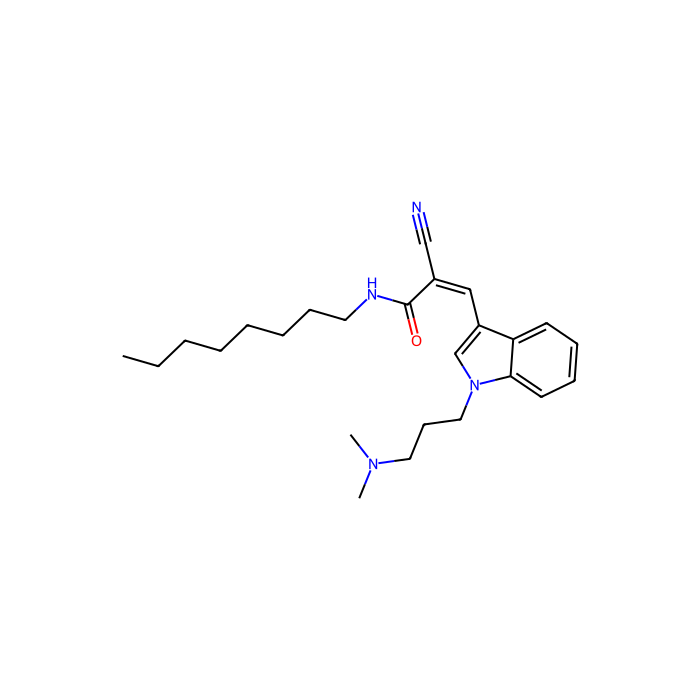
Potent, cell-permeable dynamin I and dynamin II inhibitor (IC 50 values are 1.3 and 14.2 μM for inhibition of dynamin I and II GTPase, respectively). Targets the GTPase domain at an allosteric site.
보관 조건
Store at -20°C,Desiccated
배송
Ice chest + Ice pads
이 제품은 콜드 체인 배송이 필요합니다.지상 및 기타 경제 서비스는 사용할 수 없습니다.
작업 유형
INHIBITOR
참고
Wherever possible, you should prepare and use solutions on the same day. However, if you need to make up stock solutions in advance, we recommend that you store the solution as aliquots in tightly sealed vials at -20°C. Generally, these will be useable for up to one month. Before use, and prior to opening the vial we recommend that you allow your product to equilibrate to room temperature for at least 1 hour. Need more advice on solubility, usage and handling? Please visit our frequently asked questions (FAQ) page for more details.
This compound belongs to the class of organic compounds known as n-alkylindoles. These are compounds containing an indole moiety that carries an alkyl chain at the 1-position.
External Descriptors
Not available
1. Djoumbou Feunang Y, Eisner R, Knox C, Chepelev L, Hastings J, Owen G, Fahy E, Steinbeck C, Subramanian S, Bolton E, Greiner R, and Wishart DS. ClassyFire: Automated Chemical Classification With A Comprehensive, Computable Taxonomy. Journal of Cheminformatics, 2016, 8:61.
Determine the necessary mass, volume, or concentration for preparing a solution.
Dilution Calculator
Determine the dilution needed to prepare a stock solution.
Reconstitution Calculator
리뷰
고객 리뷰
Application Protocols
No tested application data (e.g., WB, IF, IHC, cell assays) are provided for this SKU.
General starting points for small-molecule tool compounds (not item-specific; user must optimize):
Stock preparation: Dissolve in anhydrous DMSO to 10–50 mM. Store aliquots at −20 °C, desiccated, protected from moisture; avoid repeated freeze–thaw.
Cell-based assays: Begin with a broad concentration range (e.g., 0.1–30 µM) with vehicle controls. Assess cytotoxicity independently (e.g., resazurin/ATP assays). Include positive controls for dynamin-dependent endocytosis (e.g., transferrin uptake inhibition paradigms) where relevant.
Treatment time courses: Pilot 5–120 min for acute endocytosis effects; longer incubations may introduce compensatory changes.
Readouts: Fluorescent cargo uptake (transferrin–Alexa Fluor), receptor internalization assays, or imaging of clathrin/dynamin puncta. Validate on your specific cell model.
These are general recommendations; specific conditions for Dynole 34-2 must be established empirically.
Biological Roles
General literature (not item-specific) describes Dynole-class molecules as inhibitors of dynamin GTPases (e.g., dynamin 1/2), which are key regulators of clathrin-mediated endocytosis and vesicle scission.
Mechanistic context (literature):
Dynamins are large GTPases that oligomerize at membrane necks and, upon GTP hydrolysis, drive membrane fission.
Dynole-type inhibitors have been reported to reduce dynamin-dependent endocytic uptake, thereby modulating internalization of receptors, cargos, and some viruses in cell models.
Research utility:
Temporal control of endocytosis to dissect trafficking pathways.
Tool compounds for validating dynamin involvement in uptake phenotypes alongside genetic knockdown/knockout.
Potential effects on downstream signaling due to altered receptor internalization.
Important notes:
Exact potency (IC50/Ki), isoform selectivity, and off-target profile for Dynole 34-2 should be verified from primary literature and the product CoA/SDS; these are not specified here.
Effects can be context- and cell-type–dependent; include vehicle controls, time-matched treatments, and orthogonal assays (e.g., transferrin uptake) to confirm dynamin dependence.
Compliance: This product is for research use only. No medical or clinical claims are made.
Buffer Applications
This item is not a buffer or buffering agent. However, it is commonly used in biological assays that require compatible buffer systems.
General guidance for assay buffers (not item-specific):
Prepare concentrated DMSO stocks of the compound and dilute into physiological buffers such as HBSS, PBS, or HEPES-buffered saline.
Maintain final DMSO at ≤0.5–1% v/v to limit vehicle effects in cells; verify with vehicle controls.
For endocytosis assays, serum presence can influence uptake kinetics; decide between serum-free and serum-containing media based on experimental design and standardize conditions.
Include carrier proteins (e.g., 0.1% BSA) only if needed to reduce adsorption; confirm no unintended binding that alters free concentration.
If precipitation occurs on dilution:
Titrate DMSO content slightly upward within biological tolerance, or pre-warm buffers and add compound slowly with vigorous mixing.
Consult your assay SOPs for buffer composition and validation.
Green Alternatives
As a research tool compound (not a solvent or bulk reagent), “green alternative” considerations focus on the choice of vehicles and work-up practices rather than substituting the active itself.
Greener handling strategies (general guidance):
Prefer DMSO over DMF/NMP when feasible due to lower toxicity and better biodegradation metrics in many contexts.
Minimize organic solvent volumes during stock preparation; employ concentrated stocks (e.g., 10–50 mM) to reduce waste.
Use aqueous buffers with small percentages of DMSO/ethanol for assays, keeping final organic content ≤0.5–1% when biology allows.
Implement microscale assays to limit chemical usage and waste generation.
Apply closed-well plates and solvent recovery where compatible with workflow.
Illustrative comparison for stock solvents (general):
DMSO: Broad solubility, good assay compatibility, moderate EHS profile.
Ethanol: Renewable source, good EHS, but limited solubility for many hydrophobic inhibitors.
DMF/NMP: Excellent solubilizers but poorer EHS profiles; restrict use to cases where necessary and control exposure.
Disposal: Follow institutional and local regulations; segregate halogenated vs non-halogenated organic waste as applicable.
Pharmaceutical Uses
No pharmacopeial status, excipient role, or manufacturing use is specified for this item. Dynole 34-2 is supplied strictly for research use only.
General context (non-clinical):
Small-molecule tool compounds like Dynole 34-2 are often utilized in discovery biology to probe target function and pathway dependence. They are not qualified as APIs or excipients, and no clinical or therapeutic claims are made.
If considered for preclinical formulation studies, perform de novo characterization of solubility, stability (pH/light), and compatibility with common vehicles; such activities are outside the scope of this catalog listing and must be user-validated.
Physical Properties
Item-specific physico-chemical specifications have not been provided in the Product Data.
Molecular weight (exact): Not specified for this item; refer to CoA/Spec Sheet.
Molecular formula: Not specified for this item; refer to CoA/Spec Sheet.
Appearance: Not specified for this item; refer to CoA/Spec Sheet.
Melting point: Not specified for this item; refer to CoA/Spec Sheet.
Boiling point: Not applicable/Not typically reported for nonvolatile bioactive solids; refer to CoA/Spec Sheet.
Density: Not specified for this item; refer to CoA/Spec Sheet.
Refractive index: Not applicable to solids; refer to CoA/Spec Sheet if provided.
Solubility: Not specified for this item; refer to CoA/Spec Sheet.
LogP, pKa: Not specified for this item; refer to CoA/Spec Sheet.
General literature guidance for dynole-class small molecules (not item-specific):
Frequently handled as DMSO stock solutions (e.g., 10–50 mM) due to limited aqueous solubility; dilution into assay buffers typically below 0.5–1% DMSO v/v to minimize vehicle effects.
Stability can be sensitive to moisture and light for some analogs; store desiccated and protected from light when practical.
Always rely on the product CoA/SDS for authoritative specifications for this SKU (D275968).
Quality and Grades
Grade/Purity: Not specified for this item; refer to CoA/Spec Sheet.
Interpreting common grades (general guidance):
Research grade: Suitable for discovery biology/chemistry; may not meet pharmacopeial monographs.
≥95–98% purity (typical for screening libraries): Minimizes confounding bioassay artifacts; verify by HPLC/LC–MS on CoA.
Stabilizers: Not specified for this item; refer to CoA/Spec Sheet. If present, stabilizers can influence solubility and assay background—account for them in controls.
Water content (Karl Fischer), peroxides, and metal content: Not specified for this item; refer to CoA/Spec Sheet.
If your use is LC–MS or high-sensitivity screening, confirm low UV/fluorescence background and absence of reactive impurities (e.g., aldehydes).
Documentation:
Consult the provided CoA/Spec Sheet for this SKU (D275968) for definitive quality attributes and any additional test parameters.
Reaction and Applications
This product is primarily a bioactive research tool compound and is not typically used as a synthetic reagent or solvent.
Synthetic reaction roles (e.g., catalysts, coupling partners) are not applicable to Dynole 34-2.
If chemical modification or derivatization is intended (e.g., probe development or SAR expansion), consult primary structural data (SMILES/InChI) from the CoA and plan transformations compatible with the compound’s heteroaromatic scaffold and functional groups.
For laboratory applications more relevant to this item, see the sections “Biological Roles,” “Application Protocols,” and “Target Specificity.”
Reaction Conditions
Not applicable. Dynole 34-2 is provided as a research tool compound rather than a reagent or solvent for chemical reactions.
If you intend to perform chemical transformations on Dynole 34-2 (e.g., to generate probes), first obtain the exact structural information from the CoA and design conditions specific to the functional groups present. General conditions (e.g., Pd-catalyzed cross-couplings, amide couplings, or protecting-group manipulations) should be selected only after functional group compatibility is established.
For biological assay conditions, see “Application Protocols” and “Biological Roles.”
Safety and Handling
Hazard classification for this specific item has not been provided.
Signal word (GHS): Not specified for this item; refer to SDS.
Hazard statements (H-Statements): Not specified for this item; refer to SDS.
GHS classification and pictograms: Not specified for this item; refer to SDS.
General laboratory safety for small-molecule research reagents:
Use in a chemical fume hood with appropriate PPE: lab coat, safety glasses, and nitrile gloves. Avoid inhalation of dust/aerosols and contact with skin/eyes.
Storage incompatibilities: Keep separate from strong oxidizers, strong acids/bases, and sources of ignition. Follow desiccated, low-temperature storage as provided in Product Data.
First aid overview (consult SDS for details):
Inhalation: Move to fresh air; seek medical attention if symptoms persist.
Skin contact: Wash with soap and water; remove contaminated clothing.
Eye contact: Rinse cautiously with water for several minutes; remove contact lenses if present and easy to do.
Ingestion: Rinse mouth; do not induce vomiting; seek medical attention.
Spill response: Avoid dust formation; absorb solids/liquids with inert material; dispose according to local regulations.
Special notes:
This product is for research use only. No assessment for human or veterinary use.
Always defer to the official SDS accompanying your lot for precise hazard, toxicological, and disposal information.
Solvent Selection
Item-specific solubility data are not provided for this SKU; consult the CoA/Spec Sheet. The following guidance is general for hydrophobic small-molecule tool compounds like Dynole 34-2.
Polarity class: Likely moderately lipophilic small molecule; often handled in polar aprotic organic solvents.
Recommended primary solvent for stocks: DMSO (analytical grade) due to broad solvating power and assay compatibility.
Alternative solvents (screen as needed):
N,N-Dimethylformamide (DMF), N-methyl-2-pyrrolidone (NMP) for difficult solubilization.
Ethanol or methanol for certain assay contexts (ensure compatibility with biology and plastics).
Aqueous buffers typically require cosolvent or surfactant; pre-dissolve in DMSO then dilute.
Miscibility/handling tips:
Warm gently (room temperature to 37 °C) and vortex/sonicate to fully dissolve before dilution.
Filter (0.2 µm PTFE) to remove particulates if necessary; verify no adsorption to filters.
Avoid: Nonpolar alkanes (e.g., hexanes) are generally poor for polar heteroaromatic inhibitors.
Comparison (general):
DMSO vs DMF: DMSO offers better biocompatibility at ≤0.5–1% v/v in cell-based assays; DMF/NMP can have higher cytotoxicity—use minimal final concentrations.
Always pilot-test solubility and stability under your specific assay conditions.
Storage and Reconstitution
Storage (as provided): Store at −20 °C, desiccated. This item is shipped in an ice chest with ice pads to maintain low temperature during transit.
Light/moisture sensitivity: Not specified for this item; as good practice, protect from ambient moisture and, if feasible, from light.
Reconstitution:
Solvent: Not specified for this item; DMSO is commonly used for similar small molecules (general guidance). Verify compatibility on the CoA.
Technique: Allow vial to equilibrate to room temperature in a desiccator before opening. Accurately weigh or use provided mass, then add measured solvent to achieve desired stock concentration. Mix by gentle vortexing and brief sonication if needed.
Aliquoting: Prepare single-use aliquots to avoid freeze–thaw; store aliquots tightly sealed at −20 °C in a desiccated environment.
Stability after reconstitution: Not specified for this item; refer to CoA/Spec Sheet. As a general precaution, minimize time at room temperature and avoid extended exposure to aqueous buffers.
Always consult the lot-specific CoA/SDS for definitive storage limits and stability guidance. Research use only.
InChIKey: Not specified for this item; refer to CoA/Spec Sheet.
SMILES: Not specified for this item; refer to CoA/Spec Sheet.
Molecular formula: Not specified for this item; refer to CoA/Spec Sheet.
Molecular weight: Not specified for this item; refer to CoA/Spec Sheet.
Structural features (general, literature-based):
Dynole chemotype(s) are described in the literature as small-molecule inhibitors of dynamin GTPases, often bearing heteroaromatic or bicyclic scaffolds with H-bond acceptors/donors enabling interaction with the GTPase domain or allosteric pockets. Exact atom connectivity for Dynole 34-2 should be confirmed from the CoA/SDS for this catalog item.
2D description (qualitative, literature):
Typically a compact, largely aromatic/heteroaromatic framework with one or more polar substituents enabling DMSO solubility and formulation into aqueous systems via cosolvent. Stereochemistry is generally not central to activity in reported dynole series, but confirm for this specific SKU from primary documentation.
Notes:
Where an exact structure is required (SMILES/InChI), consult the product CoA/Spec Sheet or authoritative databases using the provided CAS/CID.
Synthetic Utility
Dynole 34-2 is a finished small-molecule research tool and is not typically employed as a synthetic intermediate or reagent.
Without the disclosed structure in this listing, proposing specific transformations would be speculative. If derivatization is desired (e.g., biotinylation, photoaffinity probes, or SAR analogs), obtain the exact structure (SMILES/InChI) from the CoA or primary literature and plan transformations that preserve the pharmacophore.
Common late-stage modification strategies for bioactive heteroaromatics (general):
N- or O-alkylation/acylation on accessible heteroatoms.
Cross-coupling at aryl halide positions (if present) using Pd-catalyzed Suzuki/Negishi conditions.
Amide coupling to append linkers for conjugates.
For this SKU, please treat it as a terminal compound unless you have structural data and IP clearance for derivative work.
Target Specificity
Item-specific target data are not provided in the Product Data for this SKU.
General literature context (not item-specific):
Dynole-class inhibitors are reported to target dynamin GTPases (DnM1/2/3) with variable potency and selectivity across isoforms depending on substitution patterns.
For this catalog item (D275968):
Confirm any quantitative potency (IC50), isoform selectivity, and off-target interactions from the product CoA/Spec Sheet or peer-reviewed sources before experimental use.
We use cookies to ensure the website functions properly and, where permitted, to improve your experience. You can manage your preferences at any time in Settings. Learn more in our Cookie Policy.
Shall we send you a message when we have discounts available?
Remind me later
Thank you! Please check your email inbox to confirm.
Products are supplied to verified businesses, institutions, and qualified professionals for research and development use only. Not for use in humans, animals, diagnosis, or therapy.

 I2202244