GRADE & PURITYCarrier Free?Carrier-free — supplied without added carrier protein/stabilizer. Use when carriers (e.g. BSA) would interfere with conjugation or sensitive assays.Validated?Validated grade — performance confirmed in defined applications before release. Use when you want documented assurance the reagent works as stated.ExactAb™?ExactAb™ — Aladdin's antibody line emphasizing precision and validated quality. Use for reliable, specificity-validated antibody applications.0.5 mg/mL
ExactAb™, Validated, Carrier Free, 0.5 mg/mL Carrier Free,ExactAb™,Validated for sensitive chromatographic and analytical workflows requiring minimal baseline interference.
🌡
Storage & shipping
Store at -20°C,Avoid repeated freezing and thawing Ships Ice chest + Ice pads Check lot-specific COA for exact specifications.
📋
Quality documents
SDS, COA, datasheet, and spec sheet available for download. Lot-specific COA accessible via lot number lookup.
📚
Literature proof
Cited in 0 peer-reviewed publications across chromatography, organic synthesis, and cross-coupling reactions.
개요
Rabbit anti Human EIF4E2 Antibody, Polyclonal, could be used for WB, IHC and so on. Application WB: 1/1000 IHC: 1/100-1/500 Protein function Recognizes and binds the 7-methylguanosine-containing mRNA cap during an early step in the initiation of protein synthesis and facilitates ribosome binding by inducing the unwinding of the mRNAs secondary structures.
Specifications
Product Name
EIF4E2 Antibody - 1차 항체, specific to EIF4E2, Rabbit IgG
동의어
4E LP | 4EHP | 4ELP | EIF 4E type 2 | eIF-4E type 2 | EIF4 E2 | EIF4E 2 | EIF4E HOMOLOGOUS PROTEIN | EIF4E like cap binding protein | EIF4E like protein 4E LP | EIF4E like protein 4ELP | EIF4E type 2 | EIF4E type 3 | eIF4E-like protein 4E-LP | EIF4EL3 | E
사양 및 순도
ExactAb™, Validated, Carrier Free, 0.5 mg/mL
숙주 종
토끼
특이성
EIF4E2
면역원
Recombinant Human EIF4E2 Protein expressed in E.coli (AA 1-245)
포지티브 제어
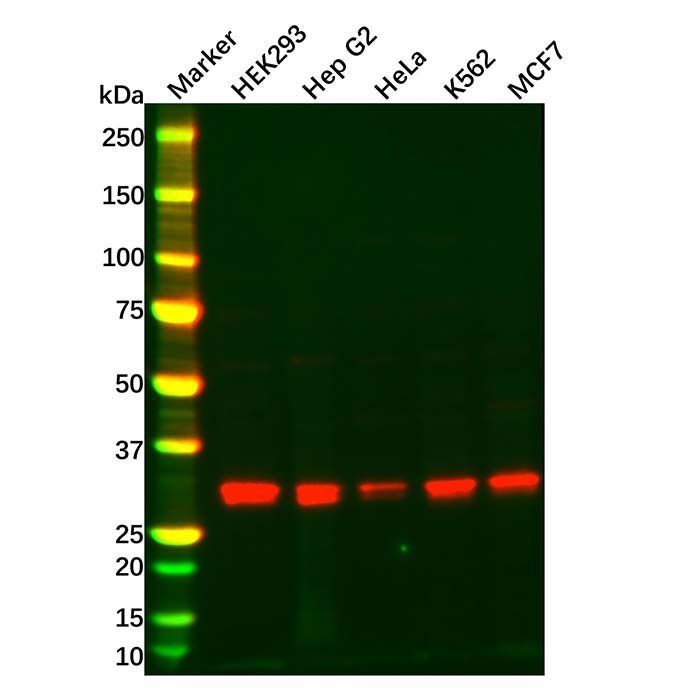
WB: HEK293, Hep G2, HeLa, K562 and MCF7 cell lysates. IHC: Human stomach tissue.
변화
Unconjugated
등급
Carrier Free, ExactAb™, Validated
아이소타입
Rabbit IgG
SDS-PAGE
150 kDa
정화 방법
Protein A purified + Peptide Affinity purified
집중력
0.5 mg/mL
보관 및 배송
모양
Liquid
보관 조건
Store at -20°C,Avoid repeated freezing and thawing
배송
Ice chest + Ice pads
안정성 및 스토리지
Store at 4°C short term (1-2 weeks). Store at -20°C long term (24 months). Upon receipt, it is recommended to aliquot. Avoid freeze/thaw cycle.
이미지
EIF4E2 Antibody (Ab101387) - Western Blot All lanes: EIF4E2 Antibody (Ab101387) at 1/1000 dilution Samples: Lysates at 20 µg per lane Secondary: Goat Anti-Rabbit IgG H&L (HRP) (Ab170144) at 1/20000 dilution
Predicted band size: 28 kDa Observed band size: 30 kDa Exposure time: 9.5 s
EIF4E2 Antibody (Ab101387) - IHC EIF4E2 Antibody (Ab101387) staining EIF4E2 in human stomach tissue sections by Immunohistochemistry. Tissue was fixed with formaldehyde and blocked with 3% BSA for 0. 5 hour at room temperature; antigen retrieval was by heat mediation with a citrate buffer (pH6). Samples were incubated with EIF4E2 Antibody (Ab101387) (1/25) for 1 hours at 37°C. A undiluted biotinylated goat polyvalent antibody was used as the secondary antibody.
적용
적용
Dilution info
IHC
1/100-1/500
WB
1/1000
Documentation
📋 Safety Data Sheet (SDS)
Comprehensive hazard, handling, storage, and regulatory compliance document.
Determine the necessary mass, volume, or concentration for preparing a solution.
Dilution Calculator
Determine the dilution needed to prepare a stock solution.
Reconstitution Calculator
리뷰
고객 리뷰
Application Protocols
Manufacturer-tested applications and recommended dilutions are not specified for this item; refer to the CoA/Spec Sheet for authoritative guidance. The following are general starting-point protocols to be adapted after confirming compatibility with this antibody.
Western blot (general):
Sample: 20–40 µg total protein per lane. Transfer to PVDF or nitrocellulose.
Block: 5% milk in TBST (or 5% BSA for phospho-sensitive targets) for 30–60 min.
Primary: Start at 1:500–1:2,000 in blocking buffer; incubate 1–2 h RT or overnight at 4°C.
Secondary: HRP-conjugate 1:5,000–1:20,000. Develop with ECL.
Immunoprecipitation (general):
Use 1–5 µg antibody per 0.5–1 mg lysate protein; rotate 1–4 h at 4°C; capture with Protein A/G beads 30–60 min; wash 3–5×; elute with low-pH glycine or Laemmli buffer.
Coat capture Ab 0.5–2 µg/mL overnight 4°C; block 1% BSA; detect with primary/secondary system compatible with the capture format.
Adjust all parameters based on the product’s actual concentration, isotype, and validation data once obtained from the CoA/Spec Sheet.
Biological Roles
Target overview (literature, for contextual understanding of assay results):
EIF4E2 (also known as eIF4E2 or 4EHP) is a cap-binding protein related to eIF4E. Unlike canonical eIF4E, EIF4E2 generally acts as a translational repressor by competing for the 7‑methylguanosine cap or by participating in repressive complexes.
EIF4E2 associates with regulatory factors (e.g., GIGYF1/2 complexes, 4E-T/EIF4ENIF1) to modulate mRNA fate, often leading to translational silencing and/or mRNA decay pathways.
Under hypoxic conditions, EIF4E2 has been implicated in alternative cap-dependent translation programs that help cells adapt to low oxygen, distinct from the eIF4E–eIF4G–eIF4A initiation axis.
EIF4E2 impacts developmental and stress responses by tuning translation of specific mRNA cohorts; it can interface with microRNA-mediated silencing and deadenylation machinery depending on cellular context.
Implications for experimentation:
EIF4E2 protein levels, subcellular localization (cytosolic, membrane-proximal, or punctate foci), and complex formation may vary with oxygen tension, growth factors, and cellular stress.
When interpreting immunoassays, consider that EIF4E2 function is often governed by interaction partners and post-translational modifications rather than bulk abundance alone.
Note: The above is general biological context. This product’s species reactivity, epitope, and application validations are not specified for this item; refer to CoA/Spec Sheet for item-specific details.
Buffer Applications
While classic buffer systems are not “applications” per se, correct buffer choice is crucial for antibody performance. For this carrier-free EIF4E2 Antibody, select buffers based on your assay and downstream needs.
Stock/Storage buffer: Not specified for this item; if buffer exchange is required, perform gentle desalting or dialysis at 4°C to maintain activity.
Working buffers (general guidance):
PBS, pH 7.4 with 0.05% Tween‑20 for immunoblots and plate washes to reduce nonspecific binding.
TBS, pH 7.6–8.0 when phosphate interferes with alkaline phosphatase detection or certain phospho-epitopes.
For IHC, pair buffer with appropriate antigen retrieval (citrate pH 6.0 or Tris-EDTA pH 9.0); determine empirically based on tissue and fixation.
Blocking buffers:
3–5% non-fat dry milk in TBST for many WB applications (may mask phospho-epitopes).
1–5% BSA or casein for phospho-sensitive detection and many ELISAs.
Preservatives and carriers:
Because the item is carrier free, add carriers (e.g., 0.1% BSA) only if needed to mitigate adsorption at low working concentrations. If live cells are involved, avoid sodium azide.
Sample preparation:
For IP of EIF4E2-associated complexes, use non-denaturing lysis buffers (e.g., 20–50 mM Tris, 150 mM NaCl, 1% NP-40/Triton X‑100) with RNase inhibitors if studying cap-binding assemblies.
Always verify the supplied formulation and compatibility requirements on the CoA/Spec Sheet.
Green Alternatives
For antibody-based workflows, environmental impact is driven more by buffer systems, plastics, and cold-chain logistics than by organic solvent choice. Consider the following greener practices and tradeoffs:
Greener practice vs. Conventional approach:
Powdered PBS/TBS prepared on-site vs. shipping pre-made buffer: Reduces shipping weight/volume and plastic waste; requires in-lab water purification and QC of pH/ionic strength.
Reusable, autoclavable glassware for buffer prep vs. single-use plastics: Lowers plastic waste; ensure proper cleaning to prevent protein adsorption/denaturation.
Azide-free preservation with 0.2 µm sterile filtration and chilled storage vs. sodium azide: Safer for wastewater and compatible with live-cell assays; may reduce shelf-life—monitor bioburden.
Room-temperature stable lyophilized formats vs. liquid cold-chain: Cuts transport emissions; this item’s format is not specified—follow product directions.
High-sensitivity chemiluminescent substrates enabling lower antibody loads vs. high-load protocols: Reduces reagent consumption; may require optimized imaging systems.
Additional suggestions:
Consolidate shipments and maintain accurate forecasting to minimize expedited, high-impact cold-chain deliveries.
Use “green” detergents and low-toxicity blocking agents when compatible with your assay.
Implement buffer recycling where feasible (e.g., reusing wash buffers within a single experiment) while preventing cross-contamination.
Note: Storage at −20°C is specified for this item; energy-efficient freezers and proper door-open discipline reduce energy consumption without compromising product integrity.
Pharmaceutical Uses
This product is for research use only and is not intended for diagnostic, therapeutic, or GMP manufacturing use.
Relevant formulation concepts for research antibodies (general):
Carrier-free format is advantageous when the antibody will be chemically modified (e.g., enzyme/fluorophore conjugation, biotinylation) or used in cell-based assays sensitive to exogenous proteins.
Common excipients in antibody formulations include sugars (trehalose, sucrose), amino acids (arginine), salts, and surfactants (polysorbates) to enhance stability; presence/absence for this item is not specified—consult CoA.
Endotoxin levels may be critical for sensitive primary cell assays; specification is not provided for this item and should be verified if needed.
Regulatory note:
No pharmacopeial monograph or clinical claims apply. If adaptation to regulated workflows is envisioned (e.g., as a reagent in a QC assay), perform formal qualification/validation (specificity, precision, linearity, robustness) and secure consistent documentation (CoA, SDS, lot traceability).
Packaging and shipping:
Shipped in an ice chest with ice pads as specified to maintain cold-chain integrity. Minimize transit time and promptly store at the recommended temperature upon receipt.
Physical Properties
Item-specific physicochemical specifications have not been provided for this antibody preparation.
Appearance: Not specified for this item; refer to CoA/Spec Sheet.
Molecular weight: Not specified for this item; refer to CoA/Spec Sheet. (Literature: typical full-length IgG ≈150 kDa; may differ for fragments/recombinants.)
Molecular formula, exact mass: Not applicable/Not specified for this item.
pI (isoelectric point): Not specified for this item. (Literature: monoclonal antibodies commonly span pI ~6–9, sequence-dependent.)
Solubility: Antibody proteins are generally soluble in physiological aqueous buffers (e.g., PBS, TBS); actual buffer composition for this item is not specified.
Extinction coefficient (A280): Not specified for this item; refer to CoA/Spec Sheet. (Literature: many IgGs use A280 1.0 ≈ 0.7–1.5 mg/mL depending on sequence.)
Stability modifiers: Carrier Free indicates no added carrier proteins such as BSA; absence/presence of azide, glycerol, or other excipients is not specified for this item.
pH range for stability: Not specified for this item; consult SDS/CoA.
Notes for practitioners (general):
Avoid elevated temperatures and repeated freeze–thaw, which can promote aggregation and activity loss.
If concentration is unknown, determine protein by A280 with the correct E(1%, 1 cm) or by BCA/Bradford using appropriate standards.
Filtration through low-protein-binding 0.22 µm membranes may reduce particulates if required for certain assays, but confirm compatibility with your application.
Quality and Grades
This product is designated Carrier Free, ExactAb™, Validated.
Carrier Free (item-specific): Formulated without added carrier proteins such as BSA. Practical implications:
Facilitates chemical conjugation (e.g., NHS esters, maleimides) and labeling without interference from carrier proteins.
Reduces background in cell culture or functional assays where carrier proteins can confound readouts.
Stabilizer content (e.g., glycerol, azide) is not specified for this item; check CoA/Spec Sheet if compatibility with live cells, conjugation chemistry, or MS is critical.
ExactAb™ (platform/format): Recombinant, sequence-defined antibody platform aimed at high lot-to-lot consistency, controlled glycosylation/host expression, and reproducible binding characteristics. Benefits include improved reproducibility across studies and reliable supply continuity. The specific expression host and sequence details are not specified for this item; consult documentation if needed for regulatory files or assay transfer.
Validated: The antibody has been performance-checked by the manufacturer. Application types, test systems, and validation data are not specified for this item; refer to the datasheet for supported applications, positive controls, and example images.
Quality assurance recommendations:
Request CoA for the supplied lot to confirm concentration, purity assessment (e.g., SEC-HPLC/SDS-PAGE), endotoxin level (for cell work), and residual host-cell proteins/DNA if applicable.
For critical assays, perform in-house qualification: titer determination, dilution linearity, and specificity testing against EIF4E2-positive and -negative controls.
Reaction and Applications
As an antibody against EIF4E2, this reagent is intended for immunodetection and affinity applications rather than chemical synthesis. Typical research workflows include:
Immunoblotting (Western blot): Detection of EIF4E2 in cell/tissue lysates following SDS-PAGE and transfer. Optimize antibody dilution empirically based on membrane type, blocking reagent, and detection chemistry. Include EIF4E2-positive controls and knockout/knockdown negatives where possible.
Immunoprecipitation (IP)/Co-IP: Enrichment of EIF4E2 and associated complexes from lysates to enable downstream MS or immunoblot analysis. Use gentle lysis buffers to preserve RNA/protein interactions if of interest; include RNase inhibitors when studying cap-binding complexes.
Immunofluorescence/Immunocytochemistry: Cellular localization of EIF4E2. Fixation and antigen retrieval conditions critically impact epitope exposure; start with paraformaldehyde fixation and mild permeabilization, and adjust as needed.
ELISA/Protein quantification: Sandwich or indirect formats to measure relative EIF4E2 levels across samples.
Functional blocking/neutralization: Potential use depends on epitope and affinity; not specified for this item. Validate in-house before drawing mechanistic conclusions.
Practical tips (general):
Titrate primary antibody across 3–5 dilutions; maintain consistent incubation times and temperatures.
Use species-matched secondary antibodies with appropriate cross-adsorption.
Verify specificity by RNAi/CRISPR depletion or using overexpression/rescue controls.
For reproducibility with a carrier-free format, consider adding inert protein (e.g., 0.1% BSA) only at the working dilution if nonspecific adsorption to plastics is observed.
Reaction Conditions
The following conditions are general literature guidance for common antibody manipulations; item-specific parameters (concentration, buffer composition, isotype) are not specified for this product and should be confirmed on the CoA/Spec Sheet.
NHS-ester labeling (amines):
Buffer: 50–100 mM NaHCO3/Na2CO3, pH 8.3–8.6 (amine-free).
Temperature/time: 20–25°C for 15–60 min; gentle mixing.
Molar ratio: 3–10 equivalents of NHS reagent per lysine intended; empirically 2–6 mol dye per mol IgG often preserves affinity.
Quench: 50 mM Tris or 10–50 mM ethanolamine, pH 8.0–8.5.
Maleimide–thiol coupling:
Buffer: 50 mM phosphate or HEPES, 1–5 mM EDTA, pH 6.5–7.0.
Free thiols: Generate with mild reduction (e.g., TCEP 0.5–2 mM, 15–30 min, 4–20°C) if needed; avoid excess reduction that disrupts antigen binding.
Reaction: 20–25°C, 30–120 min; protect from light for fluorophores.
Buffer exchange/desalting:
Methods: Spin desalting columns (e.g., 7–10 kDa MWCO), centrifugal ultrafiltration (30–100 kDa MWCO), or dialysis at 4°C.
Recovery: Pre-block plastics with inert protein if losses occur; this product is carrier free, so adsorption can be more pronounced at low concentrations.
Immunoprecipitation (general):
Antibody–bead coupling: 1–10 µg Ab per 20–30 µL bead slurry; incubate 30–60 min at 4°C.
Lysate: 0.5–2 mg total protein per IP; rotate 1–4 h (or overnight) at 4°C.
All conditions should be optimized for your specific system and verified not to compromise EIF4E2 binding.
Safety and Handling
Safety information specific to this item is not provided in the Product Data. Always consult the product SDS for authoritative guidance.
GHS classification, signal word, H-statements, pictograms: Not specified for this item; refer to SDS.
General risk profile (proteins): Antibody solutions are typically considered low hazard; however, handle as laboratory chemicals. Formulations may contain preservatives (e.g., sodium azide) in some products; for this item, composition is not specified—verify before use.
Good laboratory practice:
PPE: Laboratory coat, nitrile gloves, and safety glasses. Use biological safety cabinet if aerosol generation is possible.
Avoid ingestion, inhalation of aerosols, and contact with skin/eyes. Wash hands after handling.
Incompatibilities: Avoid strong oxidizers and extreme pH. Do not mix with reactive metals if azide is present (not specified for this item) due to potential formation of explosive metal azides in plumbing—collect azide-containing waste separately.
First aid (general): In case of skin/eye contact, rinse with water. If inhaled, move to fresh air. If ingested, rinse mouth. Seek medical attention as needed.
Spill response: Absorb with inert material, clean with water/detergent. For large spills or powders, avoid dust/aerosols and use appropriate containment.
Special handling:
Avoid repeated freeze–thaw cycles as specified; aliquot upon first thaw if supplied frozen.
Keep cold during handling to preserve immunoreactivity; use ice bath/cooling racks for prolonged bench work.
Solvent Selection
Traditional organic solvent selection is not applicable to antibody reagents. Instead, focus on aqueous buffer selection and formulation compatibility.
Common working buffers (general):
PBS (10–50 mM phosphate, 150 mM NaCl), pH 7.2–7.6: isotonic, broadly compatible with immunoassays.
TBS (20–50 mM Tris, 150 mM NaCl), pH 7.4–8.0: useful for phospho-sensitive systems or when phosphate interferes.
HEPES-buffered saline, pH 7.2–7.6: good pH stability near neutrality and for live-cell work.
Additives (use only if compatible with your assay; none are specified for this item):
0.01–0.05% Tween‑20 can reduce nonspecific binding in washes (WB/IHC/ELISA); avoid in some binding/biophysical assays.
0.1–1% inert proteins (BSA) or 1–5% serum for blocking; note that this item is carrier free—exogenous carriers are user-added if desired.
Preservatives (e.g., 0.02% sodium azide) to deter microbial growth; avoid for live cells and certain enzymes.
Conjugation compatibility:
For NHS-ester labeling, use amine-free buffers (e.g., 50–100 mM sodium bicarbonate, pH 8.3–8.6). Avoid Tris, glycine during coupling.
For maleimide-thiol coupling, buffer at pH 6.5–7.0 with EDTA; avoid primary amines.
Always verify the supplied formulation on the CoA/Spec Sheet to ensure compatibility with your planned buffer exchanges or conjugations.
Storage and Reconstitution
Item-specific storage conditions are provided; formulation and reconstitution details are not.
Storage (item-specific): Store at −20°C. Avoid repeated freezing and thawing.
Shipping (item-specific): Shipped in an ice chest with ice pads; place into appropriate cold storage immediately upon receipt.
Best practices (general):
If supplied in liquid form: Upon first thaw, mix gently, briefly microcentrifuge to collect contents, and aliquot into low-protein-binding tubes to avoid repeated freeze–thaw. Store aliquots at −20°C (short-to-medium term) or −80°C (long term), consistent with the product’s guidance.
If supplied lyophilized: Reconstitute with sterile, buffered water or PBS to the desired concentration. Gently invert to dissolve—do not vortex vigorously. Allow full hydration on ice for 10–15 min before use. Exact diluent and target concentration are not specified for this item; refer to CoA/Spec Sheet.
Thawing: Thaw on ice. Avoid warming above 4–8°C except during brief handling.
Stability: Working solutions should be kept on ice during experiments. For extended storage, consider adding cryoprotectants (e.g., glycerol to 40–50%) only if compatible; presence/absence in the supplied material is not specified.
Documentation: Record aliquot concentrations and freeze dates; use the earliest aliquots first (FIFO).
Always consult the CoA/Spec Sheet for formulation, concentration, and any specific reconstitution instructions applicable to your lot.
Structure and Identity
EIF4E2 Antibody is a research-grade immunoreagent directed against the cap-binding protein EIF4E2 (eIF4E2/4EHP), supplied as a carrier-free, validated ExactAb™ format.
SKU: Ab101387
Product type: Research antibody (protein biopolymer)
Target: EIF4E2 (Eukaryotic Translation Initiation Factor 4E Type 2)
Molecular formula: Not specified for this item; refer to CoA/Spec Sheet.
Molecular weight: Not specified for this item; refer to CoA/Spec Sheet.
SMILES / InChI / InChIKey: Not applicable to proteins; not provided for this item.
Structural features (general, literature):
Typical IgG-class antibodies are Y‑shaped heterotetrameric glycoproteins composed of two heavy and two light chains linked by disulfide bonds.
Domain architecture includes variable domains (VH/VL) forming the antigen-binding fragments (Fabs) and a constant Fc domain mediating effector interactions. Paratopes recognize epitopes on EIF4E2 via complementarity-determining regions (CDRs).
Post-translational features may include N‑linked glycosylation on Fc (if an IgG); carrier-free format indicates absence of exogenous carrier proteins in the formulation, not absence of intrinsic glycosylation.
2D/“verbal” description:
Two symmetric arms (Fabs) connected to a stem (Fc). Each arm contains an antigen-binding site shaped by six CDR loops that engage the EIF4E2 epitope through noncovalent interactions (H-bonding, electrostatic, van der Waals, and hydrophobic contacts).
Item-specific identifiers beyond SKU and product name are not specified for this item; refer to CoA/Spec Sheet for clone, isotype, sequence, and concentration if applicable.
Synthetic Utility
Classical chemical synthesis applications are not applicable to antibodies; however, this carrier-free format is well-suited for bioconjugation and assay construction.
Bioconjugation strategies (general):
Amine-targeted labeling (NHS esters): Introduces fluorophores, biotin, or haptens on lysines. Perform in amine-free buffer (e.g., 50–100 mM NaHCO3, pH 8.3–8.6). Quench with Tris or ethanolamine post-reaction.
Thiol-directed coupling (maleimides): Reduce interchain disulfides carefully or use engineered cysteines to control DAR. Perform at pH 6.5–7.0 with EDTA to prevent metal-catalyzed oxidation.
Enzymatic conjugation: Sortase A, microbial transglutaminase, or glycan remodeling for site-specific payload attachment, improving homogeneity and function.
Click chemistry: Azide–alkyne cycloaddition (CuAAC or SPAAC) after installing azide/alkyne handles via NHS chemistry or metabolic/enzymatic methods.
Assay construction:
Generate custom ELISA capture or detection reagents by pairing with complementary anti-EIF4E2 antibodies (non-competing epitopes) or by tagging with HRP/AP/biotin/fluorophores.
Immobilization on beads (Protein A/G, streptavidin if biotinylated) enables IP/Co-IP or proximity labeling workflows.
Quality considerations:
Carrier-free eliminates competing amines/proteins that can scavenge labeling reagents, improving conjugation efficiency and reproducibility.
Control degree of labeling (DOL) to preserve affinity; overlabeling can impair antigen binding.
Item-specific parameters (concentration, buffer, isotype) are not specified; adjust stoichiometry and conditions accordingly once verified from the CoA/Spec Sheet.
Target Specificity
Item-specific target-binding details provided by the manufacturer are limited.
Target: EIF4E2 (Eukaryotic Translation Initiation Factor 4E Type 2)
Clone, isotype, host species, epitope, and species reactivity: Not specified for this item; refer to CoA/Spec Sheet.
Cross-reactivity and competition data: Not specified for this item; refer to CoA/Spec Sheet.
Affinity/avidity (KD), WB banding pattern, IHC localization: Not specified for this item; refer to CoA/Spec Sheet.
Notes:
For independent verification of specificity, include appropriate positive and negative controls (e.g., EIF4E2 knockout/knockdown lysates, overexpression with epitope tags) and perform peptide/epitope competition only if the immunogen/epitope is disclosed.
Validate species reactivity empirically if your organism of interest is not listed on the product documentation.
Need help choosing the grade?
Our grade selection guide covers purity, stabilizer status, and application suitability for all variants in our catalog.
We use cookies to ensure the website functions properly and, where permitted, to improve your experience. You can manage your preferences at any time in Settings. Learn more in our Cookie Policy.
Shall we send you a message when we have discounts available?
Remind me later
Thank you! Please check your email inbox to confirm.
Products are supplied to verified businesses, institutions, and qualified professionals for research and development use only. Not for use in humans, animals, diagnosis, or therapy.

 ZJ23F1202113