
1,4-Benzodioxane Building-Block Guide: Definition & Nomenclature, Derivatization Entry Points, and Medicinal-Lead Applications (with Tables 1–3)
1,4-Benzodioxane Building-Block Guide: Definition & Nomenclature, Derivatization Entry Points, and Medicinal-Lead Applications (with Tables 1–3)
1.The practical problem: why drug molecules need heterocyclic building blocks like “benzodioxane”
Many lead compounds show activity in early screening, but when they move into further research, more “engineering-oriented” bottlenecks often appear:
①. The molecule is too hydrophobic, or its polarity distribution is not ideal, making it difficult to stabilize solubility, exposure, or tissue distribution;
②. The conformation is too flexible, so structure–activity relationships (SAR) are not clear enough, and optimization iterations become inefficient;
③. The attachment point is not “user-friendly”: it is hard to make rapid modifications without disrupting the core scaffold.
Benzodioxane (benzodioxane) repeatedly appears in drug discovery and lead optimization mainly because it offers a relatively compact, modifiable oxygen-containing fused-ring scaffold that simultaneously provides moderate polarity, clearer substituent directionality (exit vectors), and convenient structural interfaces for building derivatives. As a result, it has been used long-term across many target classes and design strategies.
2.Definition and basic concepts: what is benzodioxane?
2.1 Parent scaffold definition
①. Benzodioxane (1,4-benzodioxane / 1,4-benzodioxan) is a bicyclic oxygen-containing heterocyclic scaffold formed by fusion of a benzene ring with a six-membered ring containing two oxygen atoms. The parent molecular formula is C₈H₈O₂, and it is commonly indexed by CAS 493-09-4.
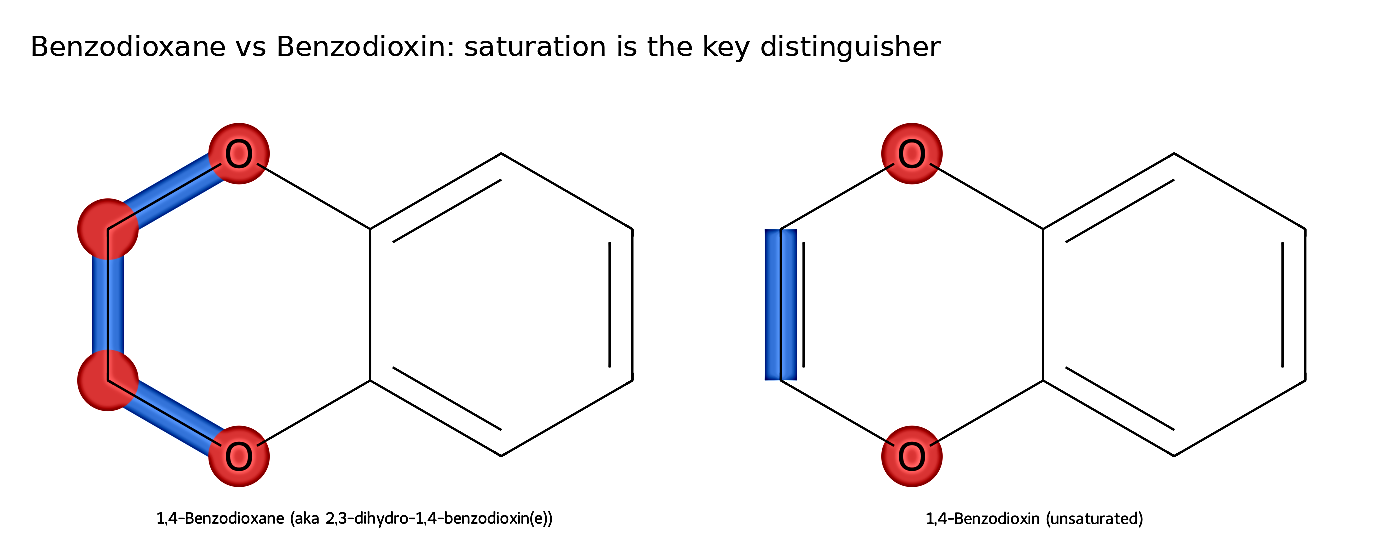
②. In databases and supplier listings, it is also often written as 2,3-dihydro-1,4-benzodioxin(e) (or the equivalent reordered form “1,4-benzodioxin, 2,3-dihydro-”), to emphasize that this scaffold is the dihydrogenated/more saturated version relative to 1,4-benzodioxin.
③. In most databases and medicinal-chemistry IUPAC fragment usage: 2,3-dihydro-1,4-benzodioxin ≈ 1,4-benzodioxane (two naming routes for the same core scaffold).
2.2 Common confusion: benzodioxane vs benzodioxin (1,4-benzodioxin)
①. The most important difference between 1,4-benzodioxin (the more unsaturated form) and 1,4-benzodioxane lies in the degree of saturation of the oxygen-containing six-membered ring:
②. Benzodioxane can be viewed as 2,3-dihydro-1,4-benzodioxin(e) (introducing a pair of hydrogens on the oxygen ring so that this segment becomes the saturated linkage –O–CH₂–CH₂–O–). Therefore, its molecular formula is C₈H₈O₂; by contrast, 1,4-benzodioxin is more unsaturated, with molecular formula C₈H₆O₂. When searching and selecting building blocks, it is best to use “dihydro-” as a keyword, or cross-check the molecular formula/structure diagram (whether –CH₂–CH₂– appears) together with the CAS number, to avoid mistaking the unsaturated form for the benzodioxane parent scaffold.
3.Structural features: the three most-used advantages of benzodioxane in molecular design
Structural feature | What it changes (properties/conformation) | Typical use |
Two oxygen atoms (two H-bond acceptors) | Introduces predictable polarity/interaction sites without a large increase in size (note: acceptors only; no inherent donor) | Fine-tuning the balance among solubility, logP/logD, and binding interactions; the net effect still depends on the whole-molecule context |
Fused bicyclic, relatively compact | Compared with “softer” acyclic ether/ethylene glycol motifs, it has fewer conformational degrees of freedom and more controllable substituent directionality | Easier SAR establishment: reduces “conformational noise” and makes the true effect of substituent changes clearer |
Series-ready substitution sites (e.g., the 2-position) | Enables systematic comparisons on the same scaffold: rapid deployment of different side chains/functional groups | Quickly building a small “same-scaffold, different-substituent” library for synchronized activity × ADME screening and iteration |
4.Benzodioxane: commonly used functional-handle building blocks
Common building-block form | What it is mainly used for |
Aryl halides/pseudohalides (Br/Cl/I/OTf, etc.) | General entry points for coupling and substitution reactions; used to rapidly reshape the aromatic substitution pattern (different positions/electronic effects/sterics). This is also one of the most common modification routes in lead optimization. |
Aryl boronic acids/boronate esters (B(OH)₂ / Bpin, etc.) | Often paired with aryl halides/pseudohalides for Suzuki and related couplings; commonly serves as the “other-end” partner to aryl halides, enabling modular assembly and parallel synthesis. |
2-position side-chain entry points (2-substituted series) | A high-frequency entry point for series derivatization: using the same parent scaffold to rapidly map different side chains/functional groups. Pay attention to whether a chiral center is introduced and whether a single enantiomer vs a racemate is available for purchase. |
Alcohols/activated alcohols/haloalkyls (–CH₂OH, –CH₂X, –OMs/OTs, etc.) | Used to introduce linkers and perform “chain-installation” reactions such as etherification/amination; suitable when benzodioxane is used as a platform scaffold and functional termini are appended outward for series comparisons. |
Amines / N-containing side-chain entry points (–NH₂, –CH₂NH₂, secondary amines/amine salts, etc.) | Commonly used to rapidly introduce salt-forming sites and increase interaction/polarity tuning; also a frequent starting point for derivatization via amides/ureas/sulfonamides/reductive amination, etc. |
Carboxylic acids and derivatives (–CO₂H / –CO₂R / –COCl / –CONR₂) | Used for amide-bond construction and systematic tuning (polarity, H-bonding, metabolic stability, etc.); on the same scaffold, the sequence “acid → acyl chloride → amide/ester” enables rapid generation of a comparable series. |
5.Representative applications: a commonly used scaffold template in drug discovery and lead optimization
Literature reviews and summary analyses indicate that 1,4-benzodioxane (1,4-benzodioxane) has long been a frequently used scaffold in medicinal chemistry, spanning multiple categories of bioactivity and a wide range of lead discovery/optimization strategies.
5.1 Three common ways benzodioxane is used in drug design: replacement, linking, and series expansion
①. Modular replacement (scaffold hop): Replace a certain “ring/chain module” in a molecule with a benzodioxane scaffold to create a set of directly comparable analogs, and then observe in parallel how activity, selectivity, and ADME trends change (to judge whether it is worth further expanding along this scaffold).
②. As a linking and space-occupying module: In “pharmacophore–pharmacophore” assembly or when introducing a linker, use benzodioxane as a linking/occupying unit that can be systematically diversified, enabling rapid structural comparisons and improving the efficiency of SAR iteration.
③. Stereochemical and series expansion around key positions: Many studies build systematic comparisons around 2-position side chains and aryl substitution. When a chiral center is introduced at the 2-position, comparing racemates vs single enantiomers often becomes part of lead optimization as well.
5.2 Real drug anchors: benzodioxane fragments in marketed drugs and the corresponding Aladdin products
Naming reminder: In drug IUPAC names and database entries, the 1,4-benzodioxane ring is often written as “2,3-dihydro-1,4-benzodioxin-…” (highlighting 2,3-dihydrogenation/saturation). This refers to the same scaffold as “1,4-benzodioxane/benzodioxan”—the difference is only the naming route.
Using Doxazosin and Eliglustat as examples, their structural/nomenclature records show the benzodioxane scaffold appearing in different written forms within real drug structures:
①. Doxazosin (free base 74191-85-8 / mesylate 77883-43-3): Its systematic naming often contains the fragment “(2S)-2,3-dihydro-1,4-benzodioxin-2-yl …”, which is a common IUPAC/database expression for the 1,4-benzodioxane ring. A change in salt form does not alter the ring scaffold; it only changes the physical/chemical form in which the compound exists.
②. Eliglustat: In its IUPAC/database naming, the ring fragment is typically written as “2,3-dihydro-1,4-benzodioxin-6-yl …” (corresponding to the 1,4-benzodioxane ring). In other words, the benzodioxane fragment is discussed as part of the molecule, and is often considered in drug R&D descriptions in relation to metabolism and physicochemical properties.
Category (anchor drug × form) | CAS No. | Aladdin Cat. No. | Name | Specification/Purity | Typical use or feature |
Eliglustat | Free base (API) | 491833-29-5 | Eliglustat | Moligand™, ≥98% | More direct as a parent-structure reference: commonly used for spectral/structural confirmation, method development, and impurity-profile referencing; also better suited for “parent compound” property/metabolism-related comparisons. | |
Eliglustat | Salt form (hemitartrate) | 928659-70-5 | Eliglustat hemitartrate | ≥99% | Closer to the actual supplied/solid-state form: used for salt-form-related QC references; also convenient for assessing how salt form impacts properties such as solubility and stability (more robust when compared side-by-side with the free base). | |
Doxazosin | Free base (API) | 74191-85-8 | Doxazosin | Moligand™, ≥98% | Structural anchor reference: used for structural/spectral confirmation and method benchmarking; also frequently used as a comparator when developing series derivatives on the same scaffold. | |
Doxazosin | Salt form (mesylate) | 77883-43-3 | Doxazosin mesylate | ≥99% | A common drug salt form: more frequently used for QC/standard reference; also suitable for comparing “free base vs salt” differences in dissolution behavior and formulation-relevant performance. |
6.Aladdin benzodioxane-related chemicals: a task-oriented guide to quickly choose the right table (Tables 1–3)
Research/experimental need | Recommended table to check first | Table-selection logic | Representative products in the table |
Need the parent scaffold/basic reference: confirm the core, run blank controls, or use as a derivatization starting point | Table 1: Core scaffold and linker/attachable entry points | Table 1 includes the parent scaffold and the most common “2-position attachable entry points,” making it a good universal starting point and reference baseline | 1,4-Benzodioxane (493-09-4, B103171) |
Want to append the benzodioxane fragment to a target molecule (build a linker / introduce amino or ether side chains) | Table 1: Core scaffold and linker/attachable entry points | Table 1 focuses on the most universal 2-position “attachment handles” such as amines/halomethyls/hydroxymethyls, enabling rapid outward extension of the scaffold and series comparisons | 2-(Aminomethyl)-1,4-benzodioxane (4442-59-5, A170391); 2-(Bromomethyl)-1,4-benzodioxane (2164-34-3, B470628); 2-(Hydroxymethyl)-1,4-benzodioxane (3663-82-9, H136282) |
Need a more stable, easy-to-weigh amine supply form (for salt formation; downstream amide/urea/sulfonamide synthesis) | Table 1: Core scaffold and linker/attachable entry points | Hydrochloride salts are often more stable and easier for storage and weighing; suitable when building a series around an N-linked attachment point | 1,4-Benzodioxane-2-methanamine hydrochloride (1446-27-1, B701410) |
Derivatization mainly via amidation/esterification (need a carboxylic acid or derivatives as the attachment point) | Table 2: Transformable functional handles on the aryl ring (also check Table 3 if your attachment point is at C-2) | Table 2 contains “direct bond-forming” handles such as 5/6-carboxylic acids, phenols, and amines; if you want to use C-2 as the attachment point, the C-2 carboxylic acid/methyl ester in Table 3 is often more suitable | 1,4-Benzodioxane-5-carboxylic acid (4442-53-9, B153005); 1,4-Benzodioxane-6-carboxylic acid (4442-54-0, B138847); 1,4-Benzodioxane-2-carboxylic acid (3663-80-7, B153003) |
Need aryl-position substitution scanning (tune electronics/metabolic hot spots/polarity window: e.g., OH, NH₂, NO₂, CN) | Table 2: Transformable functional handles on the aryl ring | Table 2 concentrates the most common “aryl tuning positions” (phenols, anilines, nitro, nitrile, etc.), suitable for structure–property and structure–activity comparisons | 6-Hydroxy-1,4-benzodioxane (10288-72-9, D189394); 5-Amino-1,4-benzodioxane (16081-45-1, D174599); 6-Nitro-1,4-benzodioxane (16498-20-7, N132790); (19102-07-9, D182405) |
Need to further convert phenol/hydroxymethyl into ethers, carbonates, sulfonates, or perform further oxidation/functional switching (route switching) | Table 2: Transformable functional handles on the aryl ring | The 6-OH / 6-CH₂OH entries in Table 2 are high-frequency “route-switch points”: they can introduce side chains and can also be oxidized/activated to access more derivative types | 6-Hydroxy-1,4-benzodioxane (10288-72-9, D189394); Benzo-1,4-dioxane-6-methanol (39270-39-8, D588974) |
Need rapid side-chain expansion via reductive amination (use aldehydes/ketones to “grow the carbon framework”) | Table 2: Transformable functional handles on the aryl ring | Aldehydes/ketones are the most direct “side-chain expansion entry points,” enabling rapid generation of amine derivatives and SAR establishment | 3,4-(Ethylenedioxy)benzaldehyde (29668-44-8, E156097); 6-Acetyl-1,4-benzodioxane (2879-20-1, A151115) |
Need to rapidly “swap aryl/heteroaryl” via Suzuki and related couplings to expand aromatic structural space | Table 3: Coupling and rapid aryl-swap entry points | Table 3 focuses on classic coupling handles (aryl bromides / aryl boronic acids) for minimal-step expansion of aryl structural space | 6-Bromo-1,4-benzodioxane (52287-51-1, B133470); Benzo-1,4-dioxane-6-boronic acid (164014-95-3, W132665) |
Want to stock a “reserve form” of the C-2 carboxylic acid first, then hydrolyze/convert to amide/ester later (improve route flexibility) | Table 3: Coupling and rapid aryl-swap entry points | Methyl esters are often more storage-friendly and offer flexibility in reaction-condition selection; convert back to the acid when needed for amidation/esterification | Methyl 1,4-benzodioxane-2-carboxylate (3663-79-4, M184053) |
Practical usage tips:
1. To “extend outward from the scaffold”: check Table 1 first (2-position amine/halomethyl/hydroxymethyl are the most universal).
2. To “tune properties/electronics or run positional controls”: prioritize Table 2 (OH, NH₂, NO₂, CN, CHO, Ac, etc.).
3. To “rapidly swap aryl groups / expand aromatic space”: prioritize Table 3 (bromide/boronic acid + C-2 acid/methyl ester).
Table 1 | Core scaffold and “linker/attachable entry points” (most often used to incorporate the benzodioxane fragment into a target molecule)
Category | CAS No. | Aladdin Cat. No. | Name | Specification/Purity | Product features & applications |
Parent scaffold | Basic core / reference | 493-09-4 | 1,4-Benzodioxane | ≥98% | Parent scaffold: used as a basic starting material, reference standard, or for solvent/additive-related studies; also a key parent core for constructing substituted benzodioxane derivatives, and is common in drug and functional-molecule scaffold libraries. | |
Side-chain amine | Linker entry point (C-2) | 4442-59-5 | 2-(Aminomethyl)-1,4-benzodioxane | ≥97% | The C-2 primary amine is a typical “attachment interface”: enables series derivatization (amides/ureas/sulfonamides, etc.) to rapidly assess how different substituents and linkers affect activity and ADME; commonly used in medicinal-chemistry building-block libraries. | |
Amine salt | Stable supply form (C-2) | 1446-27-1 | 1,4-Benzodioxane-2-methanamine hydrochloride | ≥97% | Hydrochloride form is convenient for weighing and storage: as a C-2 nitrogen attachment point, it can be used to access secondary/tertiary amines, amides, ureas, etc.; often used to append the benzodioxane scaffold into pharmacophores or linkers to optimize solubility and binding modes. | |
Halomethyl side chain | Nucleophilic substitution/alkylation entry (C-2) | 2164-34-3 | 2-(Bromomethyl)-1,4-benzodioxane | ≥97% | Typical electrophile: introduces O/N/S nucleophiles via SN2 to rapidly build ethers, amines, thioethers, and various linkers; used to “graft” the benzodioxane scaffold onto different functional fragments. | |
Side-chain alcohol | Etherification/esterification entry (C-2) | 3663-82-9 | 2-(Hydroxymethyl)-1,4-benzodioxane | ≥97% | A general derivatization site at C-2: enables etherification, esterification, carbonate formation, etc., and is suitable for building linkers with tunable length/polarity; also easy to switch routes via further oxidation/halogenation/activation. |
Table 2 | Aryl-position “transformable functional handles” (carboxylic acid/phenol/amine/nitro/nitrile/alcohol/aldehyde/ketone)
Category | CAS No. | Aladdin Cat. No. | Name | Specification/Purity | Product features & applications |
Carboxylic acid | Amidation/attachment entry (5-position) | 4442-53-9 | 1,4-Benzodioxane-5-carboxylic acid | ≥98% (HPLC) | A typical “carboxylic-acid handle”: directly used for amide/ester formation to attach side chains and build series derivatives; positional isomer counterpart to the 6-carboxylic acid, commonly used for SAR and property-window comparisons. | |
Carboxylic acid | Amidation/attachment entry (6-position) | 4442-54-0 | 1,4-Benzodioxane-6-carboxylic acid | ≥98% | A commonly used “aryl carboxylic-acid handle”: used to build amides/esters and tune polarity and metabolic sites; forms a positional-isomer pair with the 5-carboxylic acid, suitable for comparing substitution-position effects on activity/properties within the same scaffold. | |
Phenol/hydroxyl | Aryl-position derivatization entry (6-position) | 10288-72-9 | 6-Hydroxy-1,4-benzodioxane | ≥95% | A high-frequency aryl “exit point”: can be converted to ethers, carbonates, or sulfonates to introduce side chains and adjust polarity; commonly used for fine structure–property tuning around the benzodioxane scaffold. | |
Hydroxymethyl | Linker start / further oxidation entry (6-position) | 39270-39-8 | Benzo-1,4-dioxane-6-methanol | ≥95% | A dual-purpose handle at C-6: serves as a linker start point (via ether/ester formation) and as a “route-switch point” (oxidize to aldehyde/acid to expand derivative types); useful for systematic comparisons of different functional groups at the same position. | |
Aryl amine | Positional-isomer control / derivatization entry (5-position) | 16081-45-1 | 5-Amino-1,4-benzodioxane | ≥97% | The 5-amino handle supports amide/urea/sulfonamide formation; provides positional comparisons against other aniline positions, helping evaluate how substitution position affects binding and properties—one of the common SAR entry building blocks. | |
Aryl amine | Amide/urea/sulfonamide entry (aryl position) | 22013-33-8 | 3,4-(Ethylenedioxy)aniline | ≥98% | A typical aniline “derivatization handle”: commonly used for rapid construction of nitrogen-containing derivatives via amidation, urea formation, and sulfonylation; used in lead optimization to introduce tunable polarity and key interaction sites while retaining the benzodioxane-related motif. | |
Nitro | Electronic-effect scan / precursor to amine (6-position) | 16498-20-7 | 6-Nitro-1,4-benzodioxane | ≥97% | Nitro provides a strong electron-withdrawing substituent for electronics/property-window evaluation; it can also serve as a precursor to the corresponding aniline (via reduction), enabling further derivatization (amide formation/coupling) and route-to-series flexibility. | |
Nitrile | Strong EWG handle / downstream conversion entry (6-position) | 19102-07-9 | 2,3-Dihydro-1,4-benzodioxin-6-carbonitrile | ≥97% | Nitrile is a stable strong electron-withdrawing group: used for electronics/property tuning; also a common “convertible handle” in synthesis (e.g., routes toward amides/acids), with feasibility dependent on the specific system and conditions. | |
Aldehyde | Reductive amination / carbon-framework expansion entry | 29668-44-8 | 3,4-(Ethylenedioxy)benzaldehyde | ≥98% (GC) | An aromatic-aldehyde “extension handle”: used for reductive amination, condensations (Schiff bases/oximes, etc.), and further functionalization to rapidly introduce amine/alcohol side chains; useful for building benzodioxane-related aromatic aldehyde series in lead optimization and intermediate synthesis. | |
Ketone | Reductive amination / α-functionalization entry (6-position) | 2879-20-1 | 6-Acetyl-1,4-benzodioxane | ≥98% (GC) | A stable “carbon-framework growth point” at C-6: supports reductive amination to access amine side chains, as well as oxime/hydrazone formation or reduction to alcohol; commonly used for rapid substituent expansion and SAR building around the benzodioxane scaffold. |
Table 3 | Coupling and “rapid aryl-swap” entry points (halide/boronic acid) + C-2 carboxylic-acid derivatives (for stocking and downstream conversion)
Category | CAS No. | Aladdin Cat. No. | Name | Specification/Purity | Product features & applications |
Aryl halide | Coupling entry (6-position) | 52287-51-1 | 6-Bromo-1,4-benzodioxane | ≥98% | A high-frequency cross-coupling handle: suitable for Suzuki, Buchwald–Hartwig, and related strategies to rapidly introduce aryl/heteroaryl/amine fragments; commonly used for building block libraries and positional substitution scanning. | |
Boronic acid | Suzuki coupling entry (6-position) | 164014-95-3 | Benzo-1,4-dioxane-6-boronic acid (contains varying amounts of anhydride) | ≥97% | A classic Suzuki building block: couples with aryl/heteroaryl halides to rapidly generate arylated derivative libraries; suitable for “aryl replacement” and structural expansion while keeping the benzodioxane core (when anhydride is present, dose based on the actual content and reactivity). | |
Carboxylic acid | C-2 attachment-point entry (side-chain construction) | 3663-80-7 | 1,4-Benzodioxane-2-carboxylic acid | ≥98% | C-2 is often used as an attachment point: the acid can be directly used for amidation/esterification to introduce linkers and pharmacophores; convenient for substituent scanning and property optimization in series derivatives (as needed, manage stereoisomerism if C-2 substitution introduces stereochemistry). | |
Ester | C-2 carboxylic-acid derivative (storage-friendly, convertible) | 3663-79-4 | Methyl 1,4-benzodioxane-2-carboxylate | ≥95% | A common “reserve, convertible form”: can be hydrolyzed back to the acid for amidation/esterification, or used for transesterification under specific conditions; suitable as an intermediate and stocking form for C-2 linker series build-out. |
For more related articles, please see below:
Targeted drug discovery: scarce and inefficient, what is the geometry of its effectiveness?
Innovations in the design of stereospecific drug molecular structures: Spirocyclic Scaffolds