
Mechanistic Basis of Acetyl Hexapeptide-8 in the Management of Expression Lines: SNARE Complex Interference, Constraints on Percutaneous Delivery, and Combination Strategies
Mechanistic Basis of Acetyl Hexapeptide-8 in the Management of Expression Lines: SNARE Complex Interference, Constraints on Percutaneous Delivery, and Combination Strategies
Introduction
Forehead lines, glabellar lines, and crow’s feet are commonly associated with repeated facial expressions. When a person frowns, raises the eyebrows, or squints, contraction of the facial expression muscles pulls on the overlying skin, causing it to fold repeatedly along relatively fixed directions. Young skin generally has a better hydration status and greater mechanical resilience, allowing these lines to rebound relatively quickly once the facial expression ends. As intrinsic aging and photoaging accumulate, however, epidermal renewal slows and the collagen and elastic structures of the dermis undergo changes. Dynamic lines that initially appear only during facial expression may therefore gradually remain visible even when the face is at rest.
Most anti-wrinkle ingredients act primarily by promoting epidermal renewal, improving collagen homeostasis, reducing oxidative damage, or increasing skin hydration. Acetyl Hexapeptide-8, by contrast, targets the vesicle-fusion process that precedes neurotransmitter release in an attempt to reduce the signals responsible for facial muscle contraction. It is therefore often described as a “botulinum toxin–like peptide” or a “topical botulinum toxin–like agent.”
Both Acetyl Hexapeptide-8 and botulinum neurotoxin type A involve synaptosomal-associated protein of 25 kDa (SNAP-25) and the membrane-fusion system in which it participates. However, the two differ in molecular structure, mode of action, and route of delivery. Understanding this ingredient requires answering three questions in sequence:
① Why is its hexapeptide structure related to SNAP-25?
② How does it affect the soluble N-ethylmaleimide-sensitive factor attachment protein receptor complex, or SNARE complex?
③ After topical application, how much intact peptide can enter the skin and translate its in vitro activity into an improvement in the appearance of wrinkles?
Keywords: Acetyl Hexapeptide-8; Argireline; SNAP-25; SNARE complex; expression lines; transdermal delivery; retinol; anti-wrinkle combinations
1 What Is Acetyl Hexapeptide-8?
1.1 Name and Amino Acid Sequence
Acetyl Hexapeptide-8, commonly marketed under the name Argireline®, is also generally referred to as Argireline. Early studies and some reference materials used the name “Acetyl Hexapeptide-3,” whereas current cosmetic ingredient nomenclature generally uses Acetyl Hexapeptide-8.
Its amino acid sequence is:
Ac–Glu–Glu–Met–Gln–Arg–Arg–NH₂
Its single-letter abbreviation is:
Ac–EEMQRR–NH₂
Here, Ac denotes N-terminal acetylation, and NH₂ denotes C-terminal amidation. Its CAS Registry Number is 616204-22-9, and its molecular formula is C₃₄H₆₀N₁₄O₁₂S.[1]
1.2 Relationship Between the EEMQRR Sequence and SNAP-25
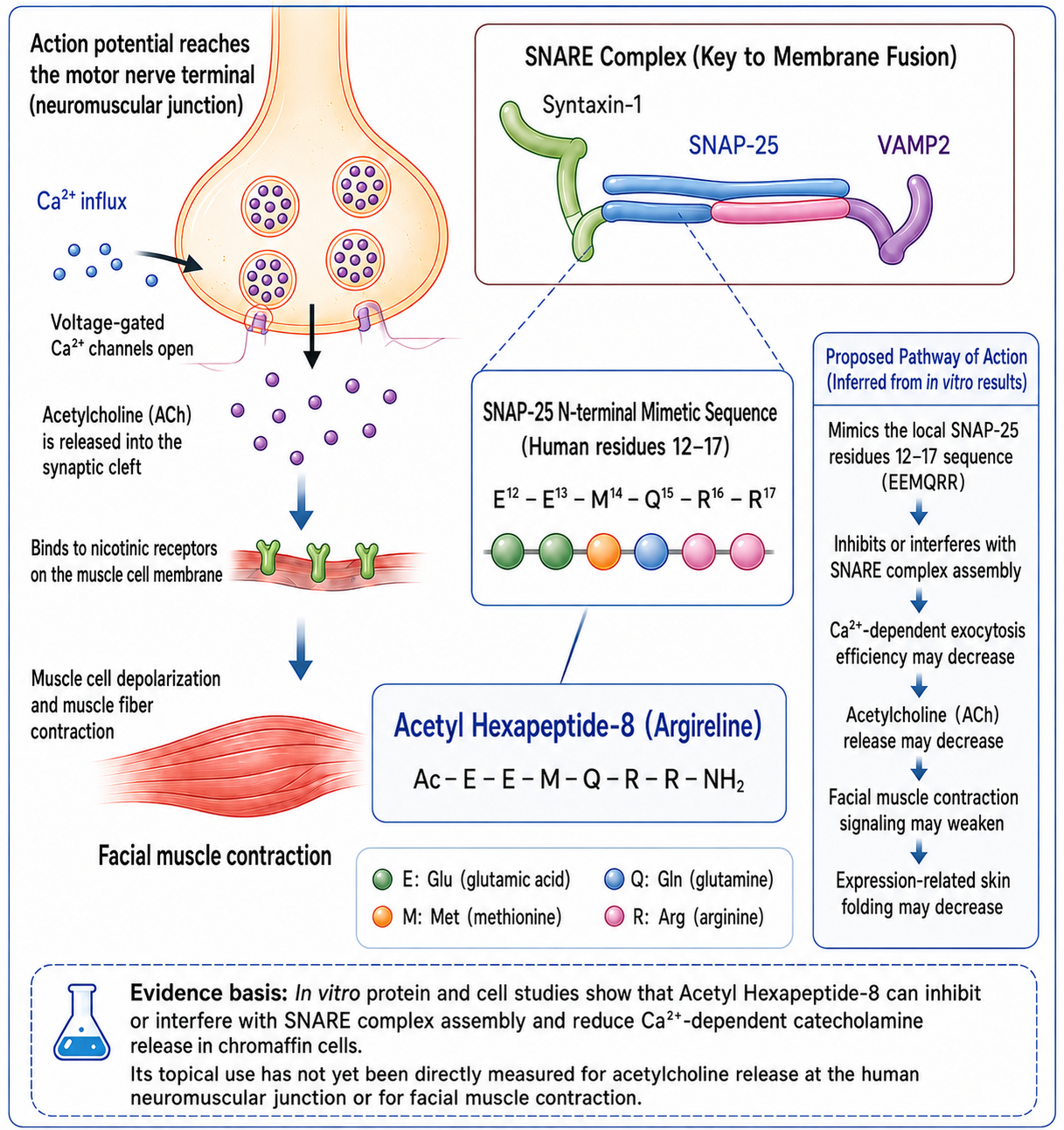
Human SNAP-25 consists of 206 amino acids and participates in synaptic vesicle docking and membrane fusion. The EEMQRR sequence in Acetyl Hexapeptide-8 corresponds to amino acid residues 12–17 at the N-terminus of human SNAP-25, establishing a clear local primary-sequence relationship between the two.[2]
This relationship does not mean that Acetyl Hexapeptide-8 is a miniature form of the complete SNAP-25 protein. Full-length SNAP-25 contains two relatively long SNARE helical domains and can contribute two α-helices to the SNARE complex. Acetyl Hexapeptide-8 contains only six amino acids and lacks the length, membrane-localization properties, and higher-order structure of the full protein.
1.3 Terminal Modifications and Physicochemical Properties
Acetyl Hexapeptide-8 is acetylated at the N-terminus and amidated at the C-terminus. These two modifications block the free amino and carboxyl groups at the ends of the peptide chain, alter the terminal charge states, and may reduce the likelihood of hydrolysis by certain exopeptidases acting directly from the peptide termini.
Its sequence contains:
① Two glutamic acid residues, whose side chains contain carboxyl groups;
② Two arginine residues, whose side chains contain guanidino groups;
③ One glutamine residue, whose side chain contains an amide group;
④ One methionine residue, whose side chain contains a thioether group.
Under conditions close to the physiological environment of the skin, the glutamic acid side chains are predominantly negatively charged, whereas the arginine side chains are predominantly positively charged. Although the overall net charge of the molecule may approach neutrality, its surface still contains multiple charged groups and hydrogen-bonding sites, giving it strong hydrophilicity and a relatively large polar surface area.
Acetyl Hexapeptide-8 does not contain long-chain hydrophobic groups such as a palmitoyl group. Compared with lipidated peptides such as Palmitoyl Tripeptide-1 and Palmitoyl Pentapeptide-4, it disperses more readily in the aqueous phase but enters the stratum corneum less readily through the intercellular lipid pathway.
2 Facial Muscle Contraction and the SNARE Complex
2.1 How Neural Signals Trigger Facial Muscle Contraction
Contraction of the facial expression muscles depends on signal transmission at the neuromuscular junction. When a motor nerve impulse reaches the nerve terminal, voltage-dependent Ca²⁺ channels open, allowing Ca²⁺ to enter the presynaptic nerve terminal.
As intracellular Ca²⁺ concentrations rise, synaptic vesicles containing acetylcholine move toward the cell membrane and fuse with the presynaptic membrane. After acetylcholine is released into the neuromuscular junction, it binds to nicotinic acetylcholine receptors on the muscle-cell membrane, causing membrane depolarization and subsequently initiating muscle-fiber contraction.
2.2 How the SNARE Complex Drives Vesicle Fusion
Both the synaptic vesicle membrane and the neuronal cell membrane are stable lipid bilayers. For these two membranes to approach one another and form a fusion pore, SNARE proteins must provide the mechanical force that draws them together.
The three core SNARE proteins involved in neurotransmitter release include:
Protein | Primary Location | Role in the Complex |
Vesicle-associated membrane protein 2 (VAMP2) | Synaptic vesicle membrane | Provides one SNARE helix |
Syntaxin-1 | Presynaptic cell membrane | Provides one SNARE helix |
SNAP-25 | Surface of the presynaptic cell membrane | Provides two SNARE helices |
When assembled, these three proteins form a parallel four-helix bundle: VAMP2 and Syntaxin-1 each contribute one helix, whereas SNAP-25 contributes two helices.[3]
During SNARE protein assembly, the helical structure progressively tightens, pulling the synaptic vesicle membrane toward the neuronal cell membrane. Once the distance between the two membranes becomes sufficiently small, local lipids rearrange and form a fusion pore, allowing the neurotransmitter contained in the vesicle to be released into the extracellular space.
2.3 Why Expression Lines Gradually Become Fixed
When facial expression muscles contract, the skin repeatedly bends along relatively fixed directions. In the early stages, the lines appear mainly during facial expression and are therefore classified as dynamic lines. As skin hydration decreases, the epidermal structure changes, and dermal collagen and elastic structures become damaged, the skin’s ability to return to its original state declines. Dynamic lines may then gradually develop into static lines.
3 How Acetyl Hexapeptide-8 Interferes with the SNARE Complex
3.1 Local Mimicry of SNAP-25 and Interference with Complex Assembly
The original design concept of Acetyl Hexapeptide-8 was to use the short EEMQRR sequence from the N-terminus of SNAP-25 to interfere with the formation of the protein complex required for neurotransmitter release.
Early studies showed that Acetyl Hexapeptide-8 could reduce Ca²⁺-dependent catecholamine release from neuroendocrine cells and inhibit or interfere with the assembly of the SNARE complex.[4]
Based on these findings, its possible sequence of action may be described as follows:
Acetyl Hexapeptide-8 mimics a local sequence at the N-terminus of SNAP-25 → inhibits or interferes with SNARE complex assembly → reduces the efficiency of fusion between synaptic vesicles and the cell membrane → decreases Ca²⁺-dependent exocytosis → may theoretically weaken cholinergic signals that trigger contraction of the facial expression muscles → reduces the extent of repeated skin folding
3.2 Why It Is Described as a “Topical Botulinum Toxin–Like Agent”
Botulinum neurotoxin type A (BoNT/A) also acts on the SNAP-25–SNARE system. After entering cholinergic nerve terminals, the light chain of botulinum neurotoxin type A functions as a zinc-dependent protease and cleaves SNAP-25 near its C-terminal region. This prevents SNAP-25 from properly supporting synaptic vesicle fusion and thereby reduces acetylcholine release.[5]
The similarity between Acetyl Hexapeptide-8 and botulinum neurotoxin type A is that both target the neurotransmitter-release process involving SNAP-25. The difference is that Acetyl Hexapeptide-8 has no protease activity and does not cleave SNAP-25.
Comparison Item | Acetyl Hexapeptide-8 | Botulinum Neurotoxin Type A |
Molecular type | Synthetic hexapeptide | Neurotoxic protein |
Method of use | Topical application to the skin | Local injection |
Relationship with SNAP-25 | Mimics a local sequence at its N-terminus | Cleaves its C-terminal region |
Primary mode of action | Inhibits or interferes with SNARE complex assembly in vitro | Enzymatically disrupts SNAP-25 function |
Protein cleavage | Does not cleave proteins | Cleaves proteins |
Need to cross the stratum corneum | Yes | Injection bypasses the stratum corneum |
Effect on muscle activity | Theoretical effect depends on delivery efficiency | Can markedly reduce contraction of the targeted muscle |
Primary application category | Cosmetic anti-wrinkle ingredient | Medical biologic |
4 From In Vitro Mechanisms to Anti-Wrinkle Effects in Humans
Research on Acetyl Hexapeptide-8 can be divided into three levels: in vitro activity, skin delivery, and the evaluation of wrinkles in humans.
4.1 What Limits Its Delivery into the Skin?
The stratum corneum consists of corneocytes and intercellular lipids. Most topically applied molecules diffuse primarily through the intercellular lipid regions. Molecular size, lipid–water partitioning, hydrogen-bonding capacity, and ionization state therefore all influence skin-penetration efficiency.
Acetyl Hexapeptide-8 has a relative molecular mass of approximately 889 and contains multiple charged and highly polar groups. These structural characteristics facilitate its dispersion in aqueous formulations but hinder its entry into the highly organized lipids of the stratum corneum.
In one ex vivo skin study, an oil-in-water emulsion containing 10% Acetyl Hexapeptide-8 was applied at 2 mg/cm² to human cadaver skin and hairless guinea pig skin. After 24 hours, most of the hexapeptide remained on the skin surface and was removed during washing.[6]
The amounts detected in human skin were as follows:
Skin Compartment | Acetyl Hexapeptide-8 Detected |
Stratum corneum | Approximately 0.22% of the applied dose |
Epidermis | Approximately 0.01% of the applied dose |
Dermis | Not detected |
Receptor fluid beneath the skin | Not detected |
This study indicates that, under the tested emulsion, application dose, and 24-hour experimental conditions, intact Acetyl Hexapeptide-8 was distributed primarily on the skin surface and within the stratum corneum, with no detectable delivery into the dermis.[6]
These findings cannot represent all formulations, but they indicate that the effects of Acetyl Hexapeptide-8 are highly dependent on the delivery vehicle and its distribution within the skin. Technologies such as liposomes, emulsion systems, penetration enhancers, or microneedles may alter delivery. However, whether they genuinely increase the amount of intact hexapeptide in the viable epidermis or dermis must be confirmed through quantitative analysis.
4.2 Early Human Topical Study
In addition to its in vitro mechanistic experiments, the original 2002 study used a split-face design to evaluate the effects of an emulsion containing Argireline (Acetyl Hexapeptide-8) on wrinkles around the eyes. Ten healthy women applied the products twice daily for 30 days. The results showed that the wrinkle-depth index decreased by an average of approximately 30% on the side treated with an oil-in-water emulsion containing 10% Argireline solution, whereas the corresponding reduction on the contralateral side treated with the vehicle emulsion without this ingredient was approximately 10%.[4]
4.3 Randomized, Placebo-Controlled Study
A randomized, placebo-controlled study published in 2013 enrolled 60 participants, who were assigned in a 3:1 ratio to the Acetyl Hexapeptide-8 group or the placebo group. The participants applied the products around the eyes twice daily for four weeks.[7]
The study used subjective wrinkle grading and silicone skin-replica analysis for evaluation. The results showed that:
① The overall subjective anti-wrinkle efficacy rate was 48.9% in the Acetyl Hexapeptide-8 group and 0% in the placebo group;
② Multiple skin-roughness parameters decreased in the Acetyl Hexapeptide-8 group;
③ The placebo group did not show changes of the same magnitude.[7]
The 48.9% figure means that 22 of the 45 participants in the Argireline group achieved a grade of 3 or 4 in the investigator-conducted overall appearance assessment, meeting the study’s predefined criterion for effectiveness. It does not mean that wrinkles were reduced by an average of 48.9%.[7]
4.4 What the Existing Evidence Can Support
The available research findings support the following conclusions:
Level of Research | Main Findings | Conclusion Supported |
In vitro protein and cell studies | Inhibition or interference with SNARE complex assembly and reduction of catecholamine exocytosis | Provides a mechanistic basis for modulating vesicle fusion |
Ex vivo skin studies | The peptide remains primarily on the skin surface and within the stratum corneum | Deep delivery from conventional emulsions is limited |
Human topical studies | Improvements in the appearance of periorbital wrinkles and skin-roughness parameters | Specific formulations may improve the appearance of wrinkles around the eyes |
Acetyl Hexapeptide-8 may be positioned as a peptide for the management of expression lines, supported by in vitro evidence of SNARE complex interference and a certain amount of human data showing improvement in the appearance of periorbital wrinkles. Its practical effects are generally modest and are influenced by factors including the amount of intact peptide, the formulation vehicle, duration of use, and skin condition.
5 How Does Acetyl Hexapeptide-8 Differ from Retinol?
Retinol is a vitamin A–based skincare ingredient. After entering the skin, retinol can be metabolically converted into retinaldehyde and retinoic acid. It then regulates the expression of genes associated with epidermal differentiation, collagen synthesis, and extracellular-matrix homeostasis through nuclear receptors.
Human studies have shown that continued use of retinol can increase epidermal thickness, enhance the expression of the type I collagen α1-chain gene (COL1A1) and the type III collagen α1-chain gene (COL3A1), and increase type I and type III procollagen. Improvements in facial wrinkles have also been observed after 12 weeks of use.[8]
The difference between Acetyl Hexapeptide-8 and retinol lies in the different stages of wrinkle formation that they target.
Comparison Item | Acetyl Hexapeptide-8 | Retinol |
Primary concern | Dynamic folding caused by facial expressions | Photoaging and structural fine lines |
Primary pathway | SNARE complex and vesicular exocytosis | Vitamin A metabolism and nuclear-receptor regulation |
Primary target | Neurotransmitter-release process | Keratinocytes and fibroblasts |
Direct evidence relating to collagen | Not a principal basis of its currently proposed action | Supported by human histological and molecular studies |
Effect on epidermal renewal | Not a primary direction of action | Can regulate epidermal proliferation and differentiation |
Effect on uneven pigmentation | Not a primary use | May improve certain pigmentation changes associated with photoaging |
Irritation potential | Generally low | May cause dryness, erythema, and desquamation |
Delivery characteristics | Relatively large and hydrophilic molecule with limited skin penetration | Smaller molecule with comparatively good cutaneous accessibility |
6 Which Ingredients Are Suitable for Combination with Acetyl Hexapeptide-8?
6.1 Combination with Hyaluronic Acid: Improving Hydration and Surface Smoothness
Hyaluronic acid, also known as hyaluronan, is commonly used in skincare products in the form of sodium hyaluronate or systems containing hyaluronic acid of different molecular weights. Following topical application, it primarily improves dryness, roughness, and superficial fine lines by attracting moisture, forming a film, and increasing the water content of the stratum corneum.
Human studies have shown that continued use of certain low-molecular-weight hyaluronic acid products can increase skin hydration and elasticity and reduce wrinkle depth. However, the results depend on the molecular weight of the hyaluronic acid, the delivery vehicle, and the overall combination system.[9]
The rationale for combining the two is as follows:
Ingredient | Primary Function |
Hyaluronic acid | Increases the water content of the stratum corneum and improves dehydration lines and surface smoothness |
Acetyl Hexapeptide-8 | Acts on vesicular exocytosis processes associated with facial expression |
6.2 Combination with Vitamin C: Antioxidant Activity and Collagen Support
Vitamin C has antioxidant activity and is also an important cofactor in the hydroxylation of proline and lysine during collagen synthesis. A double-blind, randomized, vehicle-controlled study showed that six months of continuous use of a topical cream containing 5% vitamin C improved clinical scores, deep furrows, and certain ultrastructural parameters in photoaged skin.[10]
The combination of Acetyl Hexapeptide-8 and vitamin C targets different processes:
① Acetyl Hexapeptide-8: neurotransmitter-release processes associated with facial expression;
② Vitamin C: oxidative stress, photoaging, and collagen-related reactions.
Pure L-Ascorbic Acid
Pure L-ascorbic acid is generally formulated in a relatively acidic environment. When pure L-ascorbic acid and Acetyl Hexapeptide-8 are incorporated into the same product, the retention of both ingredients and the formation of degradation products must be evaluated under the target pH, temperature, and storage conditions.
Vitamin C Derivatives
Ascorbyl glucoside, ascorbyl phosphates, and certain ethylated vitamin C derivatives can be used under comparatively mild formulation conditions and generally provide greater formulation flexibility for peptide-containing products. However, different derivatives vary in their conversion efficiency within the skin and in the outcomes reported in human studies. Each product must therefore be evaluated individually.
6.3 Combination with Retinol or Matrix-Signaling Peptides
Retinol can complement pathways involving epidermal renewal and collagen regulation. Matrix-signaling peptides such as Palmitoyl Tripeptide-1 and Palmitoyl Pentapeptide-4 have primarily been studied in relation to fibroblast responses and extracellular-matrix homeostasis.
When combined with Acetyl Hexapeptide-8, they may provide:
Management of expression-related skin folding + epidermal renewal or matrix support
These combinations offer complementary pathways of action, but the simultaneous presence of multiple peptides does not necessarily produce synergistic effects. When evaluating multi-peptide products, it is also necessary to consider the final concentration, stability, delivery vehicle, and human data for the finished product.
6.4 Combination with Barrier-Supporting Ingredients
Ingredients such as niacinamide, ceramides, panthenol, glycerin, and squalane are primarily used to increase skin hydration, maintain the skin barrier, and reduce dryness.
These ingredients do not directly enhance the effects of Acetyl Hexapeptide-8 on the SNARE system, but they may improve product tolerability. For individuals who also use retinol, vitamin C, or alpha-hydroxy acids, maintaining a stable skin barrier may also help support consistent long-term use.
6.5 Sun Protection Is the Foundation of an Anti-Wrinkle Regimen
Acetyl Hexapeptide-8 primarily addresses folding associated with facial expression and cannot replace sun protection. Ultraviolet radiation can continuously promote oxidative damage and changes in the dermal matrix, making dynamic lines more likely to develop into static lines.
7 Representative Categories of Chemicals and Their Research Applications in Acetyl Hexapeptide-8 Construction, SNARE-Mediated Exocytosis, Skin-Penetration Evaluation, and Anti-Wrinkle Combination Studies
Note: The following products are primarily intended for research related to Acetyl Hexapeptide-8, including studies of neurotransmitter release, peptide synthesis and analysis, anti-wrinkle mechanisms, and formulation stability. The products listed in the tables are not necessarily suitable for direct use in cosmetic formulations or finished-product manufacturing. Their actual applications should be determined according to product grade, regulatory requirements, safety information, and formulation-validation results.
Table 1. Products for Research on Acetyl Hexapeptide-8, Related Anti-Wrinkle Peptides, and Neurotransmitter Exocytosis
Category | CAS No. | Aladdin Catalog No. | Name | Specification or Purity | Product Features and Applications |
Core acetyl hexapeptide active ingredient | 616204-22-9 | Hexapeptide | ≥98% | Used in studies of the Acetyl Hexapeptide-8 sequence, local mimicry of SNAP-25, SNARE complex interference, Ca²⁺-dependent exocytosis, and formulations targeting expression lines. | |
Extended SNAP-25-related mimetic peptide | 868844-74-0 | Acetyl Octapeptide-3 (Acetate) | ≥99% | Used in studies of extended SNAP-25-related mimetic peptides, regulation of neurotransmitter release, and comparative evaluation of neuromodulatory anti-wrinkle peptides. | |
Enkephalin-mimetic neuromodulatory peptide | 64963-01-5 | [D-Ala²]Leucine Enkephalin | Moligand™, ≥98% | Used in studies of enkephalin-receptor activity, resistance of neuropeptides to enzymatic degradation, neural signaling, and control comparisons involving neuromodulatory anti-wrinkle peptides. | |
Matrix-signaling lipidated tripeptide | 147732-56-7 | Palmitoyl Tripeptide-1 | ≥97% | Used in studies of lipidated signaling peptides, fibroblast responses, procollagen expression, and matrix-level complementarity with Acetyl Hexapeptide-8. | |
Control for acetylcholine-release studies | 60-31-1 | Acetylcholine Chloride (ACh) | For cell culture, ≥99% | Used in studies of cholinergic neurotransmission, receptor activation, neuromuscular signaling, and as a control for acetylcholine detection. | |
Precursor for choline metabolism and synthesis | 67-48-1 | Choline Chloride | AR, ≥98% | Used in studies of choline uptake, acetylcholine biosynthesis, membrane-phospholipid metabolism, and neuronal cell-culture systems. | |
Cholinergic receptor agonist | 51-83-2 | Carbachol Chloride | Moligand™, ≥96% | Used in studies of cholinergic receptor activation, intracellular Ca²⁺ responses, muscle-cell excitation, and neuromuscular signaling models. | |
Inducer of Ca²⁺-dependent exocytosis | 56092-81-0 | Ionomycin | ≥98% (HPLC) | Used to increase intracellular Ca²⁺ levels, induce Ca²⁺-dependent exocytosis, and evaluate vesicular-release responses. | |
Component of calcium-containing exocytosis systems | 10043-52-4 | Calcium Chloride | Anhydrous grade, ≥97% | Used to prepare calcium-containing exocytosis buffers, regulate free Ca²⁺ concentrations, and evaluate Ca²⁺-dependent membrane fusion. | |
Ca²⁺ chelator and low-calcium control reagent | 67-42-5 | 3,6-Dioxa-1,8-octanediaminetetraacetic Acid (EGTA) | Molecular biology grade, ≥99% | Used to selectively chelate Ca²⁺, establish low-calcium controls, and verify the Ca²⁺ dependence of neurotransmitter exocytosis. | |
Thiol-modifying and membrane-fusion research reagent | 128-53-0 | N-Ethylmaleimide (NEM) | Moligand™, ultrapure grade, ≥99% | Used in studies of thiol modification, N-ethylmaleimide-sensitive factor, and SNARE-related membrane fusion. |
Table 2. Products for Solid-Phase Synthesis, Purification, and Oxidative-Stability Evaluation of Acetyl Hexapeptide-8
Category | CAS No. | Aladdin Catalog No. | Name | Specification or Purity | Product Features and Applications |
Protected glutamic acid amino acid monomer | 71989-18-9 | Fmoc-O-tert-butyl-L-glutamic Acid | ≥98% | Used for solid-phase assembly of glutamic acid residues in Acetyl Hexapeptide-8, protection of side-chain carboxyl groups, and peptide-chain elongation. | |
Protected methionine amino acid monomer | 71989-28-1 | Fmoc-L-Methionine | ≥98% (HPLC) | Used for solid-phase assembly of methionine residues in Acetyl Hexapeptide-8 and synthesis of sulfur-containing peptide segments. | |
Protected glutamine amino acid monomer | 132327-80-1 | Fmoc-N-trityl-L-glutamine | ≥95% | Used for glutamine-residue coupling, protection of side-chain amide groups, and construction of the Acetyl Hexapeptide-8 peptide chain. | |
Protected arginine amino acid monomer | 154445-77-9 | Fmoc-Pbf-Arginine | ≥98% | Used for arginine-residue coupling, protection of guanidino side chains, and assembly of the C-terminal arginine sequence of the hexapeptide. | |
Peptide coupling reagent | 148893-10-1 | O-(7-Azabenzotriazol-1-yl)-N,N,N′,N′-tetramethyluronium Hexafluorophosphate (HATU) | ≥99% | Used for activation of protected amino acids, peptide-bond formation, and stepwise elongation of the Acetyl Hexapeptide-8 peptide chain. | |
Organic base for coupling reactions | 7087-68-5 | N,N-Diisopropylethylamine | Distillation grade, ≥99.5% | Used for alkalization of coupling reactions, coordination with activating reagents, and adjustment of solid-phase peptide-synthesis conditions. | |
Fmoc-deprotection reagent | 110-89-4 | P1506301 | Piperidine (Regulated Precursor Chemical) | AR, ≥99.5% | Used for fluorenylmethoxycarbonyl deprotection, release of amino groups from resin-bound peptide chains, and stepwise peptide-chain elongation. |
N-terminal acetylation reagent | 108-24-7 | A1506320 | Acetic Anhydride (Regulated Precursor Chemical) | European Pharmacopoeia (Ph. Eur.), puriss. p.a., ISO, ACS, ≥99% (GC) | Used for N-terminal acetylation of Acetyl Hexapeptide-8, capping of unreacted amino groups, and terminal-modification studies. |
Solvent for solid-phase peptide synthesis | 68-12-2 | N,N-Dimethylformamide (DMF) | Anhydrous grade, ≥99.8% | Used for resin swelling, dissolution of protected amino acids and coupling reagents, coupling reactions, and deprotection procedures. | |
Peptide-chain cleavage reagent and acidic additive | 76-05-1 | Trifluoroacetic Acid (TFA) | Chromatographic HPLC grade, ≥99.5% | Used for peptide-chain cleavage, removal of acid-sensitive side-chain protecting groups, and acidification of reversed-phase chromatographic mobile phases. | |
Organic phase for reversed-phase chromatography | 75-05-8 | Acetonitrile (ACN) | HPLC gradient grade, chromatographic HPLC grade, ≥99.9% | Used for reversed-phase chromatographic purification of Acetyl Hexapeptide-8, gradient elution, content determination, and impurity analysis. | |
Acidic additive for LC–MS analysis | 64-18-6 | Formic Acid (FA) | UltraPureChrom™, for LC–MS, ≥99% | Used for acidification of liquid chromatography–mass spectrometry mobile phases, peptide ionization, and confirmation of molecular mass. | |
Methionine-composition and oxidation reference | 63-68-3 | L-Methionine (H-Met-OH) | Animal-origin-free, USP, JP, Moligand™, European Pharmacopoeia (Ph. Eur.), for cell culture, ≥99% | Used as a reference for Acetyl Hexapeptide-8 sequence composition, methionine identity, oxidation sensitivity, and analytical methods. | |
Methionine oxidation-product reference | 3226-65-1 | L-Methionine Sulfoxide | ≥98% | Used for qualitative and quantitative analysis of methionine oxidation impurities, chromatographic peak confirmation, and evaluation of hexapeptide oxidative stability. |
Table 3. Vitamin A, Vitamin C, and Anti-Wrinkle Tolerability-Support Products
Category | CAS No. | Aladdin Catalog No. | Name | Specification or Purity | Product Features and Applications |
Retinol-based anti-aging active ingredient | 68-26-8 | Retinol | Moligand™, ≥95% | Used in studies of epidermal renewal, collagen homeostasis, photoaging evaluation, and dual-pathway anti-wrinkle effects in combination with Acetyl Hexapeptide-8. | |
Retinol metabolic intermediate | 116-31-4 | All-trans-Retinal | Moligand™, ≥98% | Used in studies of vitamin A metabolic conversion, upstream effects on retinoic acid receptors, and activity comparisons among different forms of vitamin A. | |
Retinoic acid receptor research control | 302-79-4 | Retinoic Acid | Moligand™, ≥98% | Used in studies of retinoic acid receptor signaling, epidermal differentiation, collagen metabolism, and as a mechanistic control for vitamin A derivatives. | |
Pure vitamin C antioxidant active ingredient | 50-81-7 | L-Ascorbic Acid | Anhydrous grade, Moligand™, ACS, ≥99% | Used in studies of oxidative stress, collagen hydroxylation, photoaging, and the stability of hexapeptide combinations under low-pH conditions. | |
Ethylated vitamin C derivative | 86404-04-8 | 3-O-Ethyl-L-ascorbic Acid | Moligand™, ≥98% (HPLC) (T) | Used in studies of antioxidant activity, skin-tone regulation, collagen-related reactions, and peptide-containing formulations under mild-pH conditions. | |
Glycosylated vitamin C derivative | 129499-78-1 | 2-O-α-D-Glucopyranosyl-L-ascorbic Acid | ≥98% (HPLC) | Used in studies of vitamin C glucoside stability, enzymatic conversion within the skin, antioxidant activity, and peptide-containing combination formulations. | |
Phosphate ester vitamin C derivative | 66170-10-3 | Trisodium L-Ascorbate 2-Phosphate | ≥96% | Used in studies of water-soluble vitamin C phosphates, antioxidant activity, skin-tone regulation, and compatibility with peptide-containing formulations. | |
Niacinamide barrier-support active ingredient | 98-92-0 | Niacinamide | ≥99% | Used in studies of barrier lipids, transepidermal water loss, skin tone, redness, and the tolerability of anti-wrinkle formulations. | |
Panthenol moisturizing and soothing active ingredient | 81-13-0 | D-Panthenol | ≥98% | Used in studies of stratum corneum hydration, barrier recovery, irritation relief, and the tolerability of peptide- and vitamin A-containing formulations. |
Table 4. Products for Research on Hyaluronic Acid, Humectants, Barrier Lipids, and Delivery Vehicles
Category | CAS No. | Aladdin Catalog No. | Name | Specification or Purity | Product Features and Applications |
Low-molecular-weight humectant | 56-81-5 | Glycerol | Molecular biology grade, ≥99% | Used in studies of stratum corneum hydration, water-activity regulation, moisturizing matrices, and aqueous Acetyl Hexapeptide-8 formulations. | |
Hyaluronate moisturizing material | 9067-32-7 | Sodium Hyaluronate | European Pharmacopoeia (Ph. Eur.) | Used in studies of moisture absorption and retention, film formation, superficial dehydration lines, formulation rheology, and peptide-containing anti-wrinkle systems. | |
High-molecular-weight hyaluronic acid material | 9004-61-9 | Hyaluronic Acid | Moligand™, derived from rooster comb | Used in studies of hyaluronic acid molecular weight, rheological properties, film-forming moisturization, and distribution on the skin surface. | |
Stratum corneum barrier sterol | 57-88-5 | Cholesterol | For cell culture, ≥99% (GC) | Used in stratum corneum lipid models, construction of liposomal membranes, barrier-function studies, and peptide-carrier compatibility research. | |
Barrier-related unsaturated fatty acid | 60-33-3 | Linoleic Acid | Moligand™, ≥99% (GC) | Used in studies of skin-barrier lipids, unsaturated fatty-acid oxidation, emulsion vehicles, and lipid membranes. | |
Emollient oil-phase and carrier component | 111-01-3 | Squalane | ≥98% | Used for emollience, reduction of skin water loss, oil-phase delivery systems, and studies of the sensory properties and stability of peptide-containing formulations. |
Table 5. Products for Research on Alpha-Hydroxy Acids, Low-pH Compatibility, and Formulation Stability
Category | CAS No. | Aladdin Catalog No. | Name | Specification or Purity | Product Features and Applications |
Low-molecular-weight alpha-hydroxy acid | 79-14-1 | Glycolic Acid | Suitable for analysis, guaranteed reagent grade | Used in studies of keratinization renewal, low-pH irritation, barrier permeability, Acetyl Hexapeptide-8 stability, and time-separated application. | |
Moisturizing alpha-hydroxy acid | 50-21-5 | DL-Lactic Acid | AR, 85–90% | Used in studies of alpha-hydroxy acid moisturization, keratinization renewal, acidity adjustment, and tolerability comparisons in peptide-containing formulations. | |
Aromatic alpha-hydroxy acid | 90-64-2 | DL-Mandelic Acid | AR, ≥99% | Used in studies of the skin distribution of aromatic alpha-hydroxy acids, keratinization renewal, irritation potential, and comparisons of application methods with the hexapeptide. | |
Dicarboxylic alpha-hydroxy acid | 6915-15-7 | DL-Malic Acid | AR, ≥99% (T) | Used in studies of polycarboxylic alpha-hydroxy acids, buffer systems, mixed-acid formulations, and hexapeptide stability under low-pH conditions. | |
Polycarboxylic alpha-hydroxy acid and pH regulator | 77-92-9 | Anhydrous Citric Acid Powder | Anhydrous grade, UltraBio™, ≥99.5% (T) | Used for formulation-acidity adjustment, buffering, metal-ion chelation, and stability studies of hexapeptide and vitamin C systems. |
Note: The products listed above are representative Aladdin products related to scientific research. Their specific uses should be determined according to the product specifications, batch certificate of analysis (COA), and the target reaction or evaluation system. Additional product specifications, grades, and COA information can be retrieved from the Aladdin website using the product name, CAS number, or catalog number.
References
[1] National Center for Advancing Translational Sciences. Acetyl Hexapeptide-8 Amide. Global Substance Registration System (GSRS). UNII: L4EL31FWIL. Accessed August 5, 2026.
[2] The UniProt Consortium. SNAP25—Synaptosomal-associated protein 25, Homo sapiens (Human). UniProtKB. Accession: P60880. Accessed August 5, 2026.
[3] Poirier MA, Xiao W, Macosko JC, Chan C, Shin YK, Bennett MK. The synaptic SNARE complex is a parallel four-stranded helical bundle. Nat Struct Biol. 1998;5(9):765–769. doi:10.1038/1799.
[4] Blanes-Mira C, Clemente J, Jodas G, Gil A, Fernández-Ballester G, Ponsati B, Gutierrez L, Pérez-Payá E, Ferrer-Montiel A. A synthetic hexapeptide (Argireline) with antiwrinkle activity. Int J Cosmet Sci. 2002;24(5):303–310. doi:10.1046/j.1467-2494.2002.00153.x.
[5] Blasi J, Chapman ER, Link E, Binz T, Yamasaki S, De Camilli P, Südhof TC, Niemann H, Jahn R. Botulinum neurotoxin A selectively cleaves the synaptic protein SNAP-25. Nature. 1993;365(6442):160–163. doi:10.1038/365160a0.
[6] Kraeling MEK, Zhou W, Wang P, Ogunsola OA. In vitro skin penetration of acetyl hexapeptide-8 from a cosmetic formulation. Cutan Ocul Toxicol. 2015;34(1):46–52. doi:10.3109/15569527.2014.894521.
[7] Wang Y, Wang M, Xiao S, Pan P, Li P, Huo J. The anti-wrinkle efficacy of argireline, a synthetic hexapeptide, in Chinese subjects: a randomized, placebo-controlled study. Am J Clin Dermatol. 2013;14(2):147–153. doi:10.1007/s40257-013-0009-9.
[8] Kong R, Cui Y, Fisher GJ, et al. A comparative study of the effects of retinol and retinoic acid on histological, molecular, and clinical properties of human skin. J Cosmet Dermatol. 2016;15(1):49–57. doi:10.1111/jocd.12193.
[9] Jegasothy SM, Zabolotniaia V, Bielfeldt S. Efficacy of a new topical nano-hyaluronic acid in humans. J Clin Aesthet Dermatol. 2014;7(3):27–29.
[10] Humbert PG, Haftek M, Creidi P, et al. Topical ascorbic acid on photoaged skin: clinical, topographical and ultrastructural evaluation—double-blind study versus placebo. Exp Dermatol. 2003;12(3):237–244. doi:10.1034/j.1600-0625.2003.00008.x.
For more related articles, see below:
Antioxidant Mechanisms, Stability, and Delivery Strategies of Resveratrol in Skincare Research
Beneath the Skin: Protein- and Peptide-Based Actives in Skincare and Aesthetic Medicine
Hyaluronidase: Unlocking a “Magic Enzyme” in Biomedicine
Trehalose: Physicochemical Characteristics, Manufacturing Processes, and Application Guidelines
Sources, Biological Functions, Isolation/Characterization, and Emerging Applications of Exosomes
Applicability Comparison of Vitronectin, Laminin and Fibronectin in Cell Culture Coating Systems
Ferulic Acid: Structural Features, Preparation Routes, and Key Points for Research Applications
Role of Sphingolipid Metabolic Remodeling in Apoptotic and Inflammatory Signaling
How to decipher the whitening code?
Niacin (Vitamin B3): Structural Features, Metabolic Roles, and Application Landscape
The "Six Key Checkpoints" of Skin Lightening
Tyrosinase: a key regulatory enzyme in melanin synthesis and its biological and applied significance