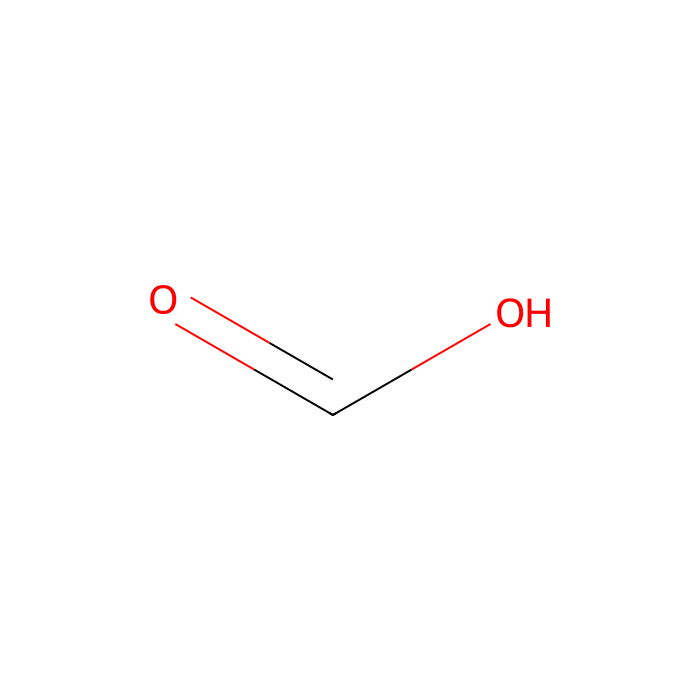
Formic Acid(FA) - 60% w/v , CAS No.64-18-6

CAS: 64-18-6 Cat. No.: F291755 분자식: CH2O2 분자량: 46.03 Beilstein Registry Number: 1209246 EC 번호: 200-579-1
주문 가능
등급 & 순도 60% w/v
Synonyms
FORMIC ACID [EP MONOGRAPH]|Acidum formicum|FORMICUM ACIDUM [HPUS]|Kyselina mravenci [Czech]|FORMIC ACID [INCI]|FORMIC ACID [HSDB]|Aminic acid|FORMIC ACID [VANDF]|FORMIC ACID [WHO-DD]|Formira|FORMIC ACID (USP-RS)|H-COOH|RCRA waste no. U123|Sybest|Acide formique|Add-F|Formic acid, natural|Acido formico [Italian]|Bilorin|Formicum acidum|FORMIC ACID [MART.]|formylate|Formic acid [UN1779] [Corrosive]|Acido formico|Pleo Form|FORMIC ACID (EMA EPAR VETERINARY)|Formic Acid Ampoules (LCMS Grade)|Formic acid (natural)|FORMIC ACID [FCC]|aminate|FORMIC ACID [FHFI]|Mierenzuur [Dutch]|VARROMED COMPONENT FORMIC ACID|FORMIC ACID (EP MONOGRAPH)|hydrogen carboxylate|Myrmicyl|Mierenzuur|Formic acid-D2, 95 wt% solution in D2O|C20:3|Provita Konquest|FORMIC ACID [EMA EPAR VETERINARY]|FORMIC ACID [MI]|Kwas metaniowy|Ameisensaeure|Ameisensaure|forrnic acid|Hydrogen carboxylic acid|Kwas metaniowy [Polish]|Methanoic acid monomer|Formylic acid|Collo-didax|HCOOH|methoic acid|RCRA waste number U123|Acide formique [French]|Ameisensaeure [German]|Collo-bueglatt|FORMIC ACID [USP-RS]|C1 acid|formic acid|Methanoic acid|Provita Hoofsure Endurance XL|ProvitaHoofsure Endurance|FORMIC ACID (MART.)
Storage
Room temperature
Shipped In
FedEx DG Service
★
크기
USA
독일 (EU)*
가격
수량
500ml
F291755-500ml
3 재고 있음
—

US$21.90

US$24.90
저장 US$3.00 (12.05%)
Enter a quantity for the sizes you want to add.

사양

동의어
FORMIC ACID [EP MONOGRAPH] | Acidum formicum | FORMICUM ACIDUM [HPUS] | Kyselina mravenci [Czech] | FORMIC ACID [INCI] | FORMIC ACID [HSDB] | Aminic acid | FORMIC ACID [VANDF] | FORMIC ACID [WHO-DD] | Formira | FORMIC ACID (USP-RS) | H-COOH | RCRA waste no. U123 | Sybest | Acide formique | Add-F | Formic acid, natural | Acido formico [Ita Show more
사양 및 순도
60% w/v
보관 조건
Room temperature
배송
FedEx DG Service
이름과 식별자
Pubchem Sid
Pubchem Sid Url
https://pubchem.ncbi.nlm.nih.gov/substance/528773578
SMILES
C(=O)O
IUPAC Name
formic acid
InChIKey
BDAGIHXWWSANSR-UHFFFAOYSA-N
InChI
1S/CH2O2/c2-1-3/h1H,(H,2,3)
이성체 SMILES
C(=O)O
WGK 독일
1
UN 번호
1779
포장 그룹
II
분자량
46.03
Beilstein
1209246
Reaxys
1209246
Reaxys-RN_link_address
https://www.reaxys.com/reaxys/secured/hopinto.do?context=S&query=IDE.XRN=1209246&ln=

고급 데이터

Taxonomic Classification

Taxonomy Tree

KingdomOrganic compounds
SuperclassOrganic acids and derivatives
분류Carboxylic acids and derivatives
SubclassCarboxylic acids
Intermediate Tree Nodes Not available
Direct ParentCarboxylic acids
Alternative Parents Monocarboxylic acids and derivatives  Organic oxides  Hydrocarbon derivatives  Carbonyl compounds  
Molecular FrameworkAliphatic acyclic compounds
Substituents Monocarboxylic acid or derivatives - Carboxylic acid - Organic oxygen compound - Organic oxide - Hydrocarbon derivative - Organooxygen compound - Carbonyl group - Aliphatic acyclic compound
설명This compound belongs to the class of organic compounds known as carboxylic acids. These are compounds containing a carboxylic acid group with the formula -C(=O)OH.
External Descriptors Straight chain fatty acids - Saturated fatty acids
3D 구조
상호 작용 화학 구조 모델


관련 대상(비인간)
Drosophila melanogaster (359 Activities)
Activity TypeRelationActivity valueUnitsAction TypeJournalPubMed IddoiAssay Aladdin ID
작용 메커니즘
인증서(CoA, COO, BSE/TSE 및 분석 차트)
C of A & Other Certificates(BSE/TSE, COO):
Analytical Chart:

Find and download the COA for your product by matching the lot number on the packaging.

1 results found

Lot NumberCertificate Type날짜항목
K2124217K2124217Certificate of AnalysisSep 28, 2025 F291755
화학 및 물리적 특성
굴절률1.3690 - 1.3730
발화점(°F)121.1 °F
발화점(°C)49.5 °C
끓는점(°C)100-101°C
녹는점(°C)8.2-8.4°C
분자량46.03
XLogP3-0.200
Hydrogen Bond Donor Count1
Hydrogen Bond Acceptor Count2
Rotatable Bond Count0
Exact Mass46.0055 Da
Monoisotopic Mass46.0055 Da
Topological Polar Surface Area37.300 Ų
Heavy Atom Count3
Formal Charge0
Complexity10.300
Isotope Atom Count0
Defined Atom Stereocenter Count0
Undefined Atom Stereocenter Count0
Defined Bond Stereocenter Count0
Undefined Bond Stereocenter Count0
The total count of all stereochemical bonds0
Covalently-Bonded Unit Count1
안전 및 위험(GHS)
픽토그램(들)
신호
Danger
위험 문구

H314:Causes severe skin burns and eye damage

주의 문구

P264:Wash hands [and …] thoroughly after handling.

P280:Wear protective gloves/protective clothing/eye protection/face protection.

P363:Wash contaminated clothing before reuse.

P301+P330+P331:IF SWALLOWED: Rinse mouth. Do NOT induce vomiting.

P303+P361+P353:IF ON SKIN (or hair): Take off Immediately all contaminated clothing. Rinse SKIN with water [or shower].

P405:Store locked up.

P501:Dispose of contents/container to an approved waste disposal plant.

P305+P351+P338+P310:IF IN EYES: Rinse cautiously with water for several minutes. If contact lenses are worn and can be easily removed, remove Contact lenses. Continue rinsing. Immediately call an emergency center/doctor.

WGK 독일
1
Reaxys
1209246
Reaxys-RN_link_address
https://www.reaxys.com/reaxys/secured/hopinto.do?context=S&query=IDE.XRN=1209246&ln=
분류
3(8)
메르크 지수
4241
자주 묻는 질문과 기사
Small-Molecule Inhibitors: A Practical Guide for Research Selection — A Minimal Evidence Chain and Scenario-Based Validation Framework (Including a Selection Matrix, Case Cards, and Product Tables 1–4)
A Practical Guide to Small-Molecule Chemical Probes: Concept Clarification, Causal Validation, and Experimental Selection (with Product Navigation and Tables A–D)
Secondary Effects Behind Chromatographic Peak Tailing and Unstable Peak Shapes: How Residual Silanols (Si–OH) Affect Basic Compounds, and the Shortest Troubleshooting/Remediation Path (with Product Navigation and Tables 1–3)
2-Methylpyridine–Borane (2-Picoline·BH₃) Reductive Amination Guide: Process Drivers for Replacing NaBH₃CN, the Practical Operating Window, and Scale-Up/Quench Close-Out Essentials (Including Product Tables 1–3)
16 Frequently Asked Questions About Nourseothricin
How Organic Acids “Stabilize a System”: Selection Logic via the pH Window, Salt Forms, and Metal-Ion Management (with a navigation guide to Tables A–E)
Amino Acid Oxidases: Oxygen-Dependent Oxidative Deamination Systems and Their Analytical and Applied Uses
Angiotensin-Converting Enzyme (ACE): A Review of Molecular Features, Catalytic Functions, and Research and Translational Applications
Chymosin: A Review of Molecular Features, Coagulation Kinetics, and Activity Evaluation
Phytase: Enzymological Properties, Mechanism of Action, and Applications in Feed and Food
Chlorophyll: Structural Features, Physicochemical Properties, and Key Points for Research and Industrial Applications
Azithromycin: Physicochemical Features, Mechanism of Action, and Key Points for Research Applications
Ferulic Acid: Structural Features, Preparation Routes, and Key Points for Research Applications
Paeonol: Physicochemical Features, Uses, and Key Points for Research Applications
Famotidine: Physicochemical Features, Mechanism of Action, and Key Points for Research Applications
Flavones: Structural Features, Physicochemical Properties, and Key Points for Research and Applications
Review of Chymotrypsin: Enzymological Properties, Catalytic Mechanism, and Research Applications
Methodological Studies on Glycoprotein Structural Characterization and Quality Attribute Analysis
Understanding Cbz (Benzyloxycarbonyl): Selection Logic and Practical Value of a Classical Amino Protecting Group
From the Logic of Deprotection to Protecting Group Choice: Differences Among Bn, PMB, and Dmb in Experimental Design
Research Framework for Multi-Enzyme Digestion Strategies and Optimization of Proteomic Coverage
Extraction Methods and Process Selection for Flavonoid Compounds
Liquid Polyisoprene: Material Characteristics, Application Directions, and Selection Considerations
Preparation Methods and Precautions for Silane Coupling Agent Primer Solutions
How to Troubleshoot Abnormal Impurities in Peptide Synthesis? Locating Process Issues Through Amino-Related Side Reactions
Porous Graphitic Carbon (PGC) Chromatography Columns: Creating New Selectivity for Challenging Separations through Molecular Shape and the π-Electron Cloud on the Graphitic Surface
Oxalate Metabolism and Degradation Detection Methods: Enzymatic Assays, Chromatography, and Enzymatic Degradation System Analysis
How to Select Thickeners for Strongly Acidic Cleaning Systems: Comparison of Thickening Mechanisms and Application Considerations for Fatty Amine Ethoxylates
Formation and Control of Carboxyl- and Hydroxyl-Related Impurities in Peptide Synthesis — Using Asp/Glu and Ser/Thr Residue Side Reactions as Examples
β-Hydroxybutyrate Detection Methods and Metabolic Significance: Comparative Applications of Enzymatic Assays, Blood Ketone Meters, and LC-MS
The Logic of Biomimetic Peptide Action in Skin: Sequence and Conformation, Skin Delivery, Stability, and Target Matching
Mechanistic Basis of Acetyl Hexapeptide-8 in the Management of Expression Lines: SNARE Complex Interference, Constraints on Percutaneous Delivery, and Combination Strategies
Citations of This Product
솔루션 계산기
리뷰

고객 리뷰

Shall we send you a message when we have discounts available?

Remind me later

Thank you! Please check your email inbox to confirm.

Oops! Notifications are disabled.