
Determine the necessary mass, volume, or concentration for preparing a solution.
| Activity Type | Activity Value -log(M) | Mechanism of Action | Activity Reference | Publications (PubMed IDs) |
|---|
Moligand™, 10mM in DMSO Moligand™ for sensitive chromatographic and analytical workflows requiring minimal baseline interference.
Store at -80°C Ships Dry ice packs + Cold packs Check lot-specific COA for exact specifications.
SDS, COA, datasheet, and spec sheet available for download. Lot-specific COA accessible via lot number lookup.
Cited in 0 peer-reviewed publications across chromatography, organic synthesis, and cross-coupling reactions.
Information
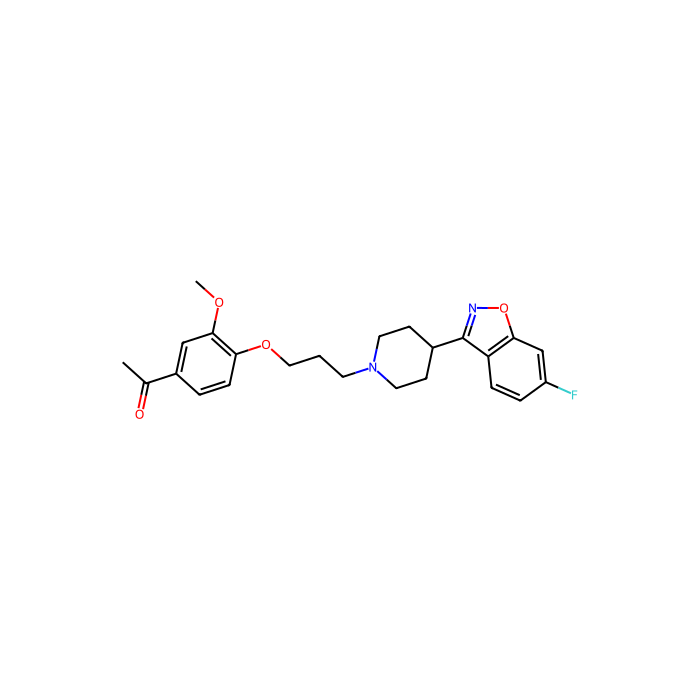
Iloperidone Iloperidone (HP873) is a dopamine (D2)/serotonin (5-HT2) receptor antagonist, used for the treatment of schizophrenia.
In vitro
Iloperidone displays high affinity (Ki < 10 nM) for norepinephrine alpha(1)-adrenoceptors, dopamine D(3) and serotonin 5-HT(2A) receptors. Iloperidone displays higher affinity for the dopamine D3 receptor (Ki = 7.1 nM) than for the dopamine D4 receptor (Ki = 25 nM). Iloperidone displays high affinity for the 5-HT6 and 5-HT7 receptors (Ki = 42.7 nM and 21.6 nM, respectively), and is found to have higher affinity for the 5-HT2A (Ki = 5.6 nM) than for the 5-HT2C receptor (Ki = 42.8 nM). Iloperidone significantly increases dopa accumulation, an index of dopamine turnover in response to D2 receptor blockade, at doses from 0.3 mg/kg to 10 mg/kg i.p. in the striatum and from 1 mg/kg to 10 mg/kg in the nucleus accumbens.
In vivo
Iloperidone exerts behavioral effects in pharmacological rats models of disrupted sensorimotor gating consistent with "atypical" antipsychotics, mediated by antagonism of dopaminergic and noradrenergic receptors. Iloperidone (1 and 3 mg/kg) prevents the PPI-disruptive effects of treatment with 1 mg/kg PCP. Iloperidone (0.3 mg/kg) prevents cirazoline-induced PPI deficits, independent of its effects on startle magnitude. Iloperidone (10 mg/kg) and Melperone (10 mg/kg) produce an equivalent or a smaller increase in DA release in the nucleus accumbens (NAC) of rats, respectively, compared to the mPFC, whereas none of them increase acetylcholine (ACh) release in the NAC.
Cell Data
cell lines:
Concentrations:
Incubation Time:
Powder Purity:≥99%
| ALogP | 4.1 |
|---|
| 이성체 SMILES | CC(=O)C1=CC(=C(C=C1)OCCCN2CCC(CC2)C3=NOC4=C3C=CC(=C4)F)OC |
|---|---|
| WGK 독일 | 1 |
| RTECS | KM5777850 |
| 분자량 | 426.48 |
| Reaxy-Rn | 7233425 |
| Reaxys-RN_link_address | https://www.reaxys.com/reaxys/secured/hopinto.do?context=S&query=IDE.XRN=7233425&ln= |
Comprehensive hazard, handling, storage, and regulatory compliance document.
Download SDS →Lot-specific quality data. Enter your lot number to retrieve the exact COA.
Look up COA →Full quality attributes and acceptance criteria for this grade.
View spec sheet →| Activity Type | Activity Value -log(M) | Mechanism of Action | Activity Reference | Publications (PubMed IDs) |
|---|
| Activity Type | Activity Value -log(M) | Mechanism of Action | Activity Reference | Publications (PubMed IDs) |
|---|
| Activity Type | Activity Value -log(M) | Mechanism of Action | Activity Reference | Publications (PubMed IDs) |
|---|
| Activity Type | Activity Value -log(M) | Mechanism of Action | Activity Reference | Publications (PubMed IDs) |
|---|
| Activity Type | Activity Value -log(M) | Mechanism of Action | Activity Reference | Publications (PubMed IDs) |
|---|
| 발화점(°F) | 48.2 °F |
|---|---|
| 발화점(°C) | 48.2°F |
| 녹는점(°C) | 118-120°C |
Our grade selection guide covers purity, stabilizer status, and application suitability for all variants in our catalog.
View Moligand™ grade guide →