
Determine the necessary mass, volume, or concentration for preparing a solution.
| Activity Type | Relation | Activity value | Units | Action Type | Journal | PubMed Id | doi | Assay Aladdin ID |
|---|
Moligand™, ≥99% Moligand™ for sensitive chromatographic and analytical workflows requiring minimal baseline interference.
Store at 2-8°C,Protected from light,Argon charged Ships Wet ice Check lot-specific COA for exact specifications.
SDS, COA, datasheet, and spec sheet available for download. Lot-specific COA accessible via lot number lookup.
Cited in 137 peer-reviewed publications across chromatography, organic synthesis, and cross-coupling reactions.
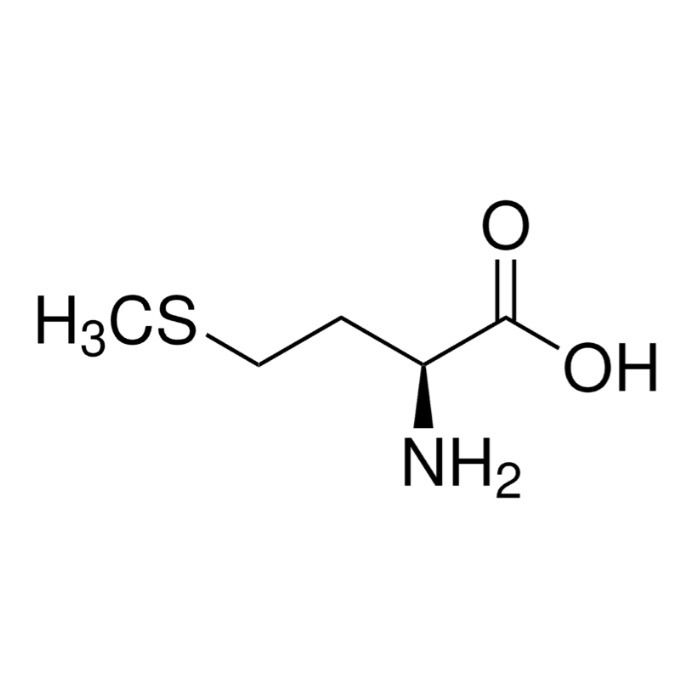
L-Methionine is an essential amino acid for human development, hepatoprotectant, acetominophen poisoning antidote, and urinary acidifier.
An essential amino acid
Application:
L-Methionine is used as an essential amino acid for human development and therapeutically acts as an antidote for acetaminophen poisoning. It serves as a chelating agent for heavy metals, as a flavoring agent and nutritional supplement for foods. It acts as a feed additive, vegetable oil enrichment and as a single cell protein. In addition to this, it is used as a hepatoprotectant and also acts as a lipotropic agent and prevents excess fat buildup in the liver.
Comprehensive hazard, handling, storage, and regulatory compliance document.
Download SDS →Lot-specific quality data. Enter your lot number to retrieve the exact COA.
Look up COA →Full quality attributes and acceptance criteria for this grade.
View spec sheet →Taxonomy Tree
| Kingdom | Organic compounds |
|---|---|
| Superclass | Organic acids and derivatives |
| 분류 | Carboxylic acids and derivatives |
| Subclass | Amino acids, peptides, and analogues |
| Intermediate Tree Nodes | Amino acids and derivatives - Alpha amino acids and derivatives |
| Direct Parent | Methionine and derivatives |
| Alternative Parents | L-alpha-amino acids Thia fatty acids Amino acids Sulfenyl compounds Monocarboxylic acids and derivatives Dialkylthioethers Carboxylic acids Organopnictogen compounds Organic oxides Monoalkylamines Hydrocarbon derivatives Carbonyl compounds |
| Molecular Framework | Aliphatic acyclic compounds |
| Substituents | Methionine or derivatives - Alpha-amino acid - L-alpha-amino acid - Thia fatty acid - Fatty acid - Fatty acyl - Amino acid - Carboxylic acid - Monocarboxylic acid or derivatives - Thioether - Sulfenyl compound - Dialkylthioether - Amine - Organic oxygen compound - Primary amine - Organosulfur compound - Organooxygen compound - Organonitrogen compound - Organic nitrogen compound - Primary aliphatic amine - Carbonyl group - Organopnictogen compound - Organic oxide - Hydrocarbon derivative - Aliphatic acyclic compound |
| 설명 | This compound belongs to the class of organic compounds known as methionine and derivatives. These are compounds containing methionine or a derivative thereof resulting from reaction of methionine at the amino group or the carboxy group, or from the replacement of any hydrogen of glycine by a heteroatom. |
| External Descriptors | Common amino acids |
| Activity Type | Relation | Activity value | Units | Action Type | Journal | PubMed Id | doi | Assay Aladdin ID |
|---|
| Activity Type | Relation | Activity value | Units | Action Type | Journal | PubMed Id | doi | Assay Aladdin ID |
|---|
| Activity Type | Relation | Activity value | Units | Action Type | Journal | PubMed Id | doi | Assay Aladdin ID |
|---|
| Activity Type | Relation | Activity value | Units | Action Type | Journal | PubMed Id | doi | Assay Aladdin ID |
|---|
| Activity Type | Relation | Activity value | Units | Action Type | Journal | PubMed Id | doi | Assay Aladdin ID |
|---|
| Activity Type | Relation | Activity value | Units | Action Type | Journal | PubMed Id | doi | Assay Aladdin ID |
|---|
| Activity Type | Relation | Activity value | Units | Action Type | Journal | PubMed Id | doi | Assay Aladdin ID |
|---|
| Activity Type | Relation | Activity value | Units | Action Type | Journal | PubMed Id | doi | Assay Aladdin ID |
|---|
| Activity Type | Relation | Activity value | Units | Action Type | Journal | PubMed Id | doi | Assay Aladdin ID |
|---|
| Activity Type | Relation | Activity value | Units | Action Type | Journal | PubMed Id | doi | Assay Aladdin ID |
|---|
| Activity Type | Relation | Activity value | Units | Action Type | Journal | PubMed Id | doi | Assay Aladdin ID |
|---|
| Activity Type | Relation | Activity value | Units | Action Type | Journal | PubMed Id | doi | Assay Aladdin ID |
|---|
| Activity Type | Relation | Activity value | Units | Action Type | Journal | PubMed Id | doi | Assay Aladdin ID |
|---|
| Activity Type | Relation | Activity value | Units | Action Type | Journal | PubMed Id | doi | Assay Aladdin ID |
|---|
| Activity Type | Relation | Activity value | Units | Action Type | Journal | PubMed Id | doi | Assay Aladdin ID |
|---|
| Activity Type | Relation | Activity value | Units | Action Type | Journal | PubMed Id | doi | Assay Aladdin ID |
|---|
| Activity Type | Relation | Activity value | Units | Action Type | Journal | PubMed Id | doi | Assay Aladdin ID |
|---|
| Activity Type | Relation | Activity value | Units | Action Type | Journal | PubMed Id | doi | Assay Aladdin ID |
|---|
| Activity Type | Relation | Activity value | Units | Action Type | Journal | PubMed Id | doi | Assay Aladdin ID |
|---|
| Activity Type | Relation | Activity value | Units | Action Type | Journal | PubMed Id | doi | Assay Aladdin ID |
|---|
| Activity Type | Relation | Activity value | Units | Action Type | Journal | PubMed Id | doi | Assay Aladdin ID |
|---|
| Activity Type | Relation | Activity value | Units | Action Type | Journal | PubMed Id | doi | Assay Aladdin ID |
|---|
| Activity Type | Relation | Activity value | Units | Action Type | Journal | PubMed Id | doi | Assay Aladdin ID |
|---|
| Activity Type | Relation | Activity value | Units | Action Type | Journal | PubMed Id | doi | Assay Aladdin ID |
|---|
| Activity Type | Relation | Activity value | Units | Action Type | Journal | PubMed Id | doi | Assay Aladdin ID |
|---|
| Activity Type | Relation | Activity value | Units | Action Type | Journal | PubMed Id | doi | Assay Aladdin ID |
|---|
| Activity Type | Relation | Activity value | Units | Action Type | Journal | PubMed Id | doi | Assay Aladdin ID |
|---|
| Activity Type | Relation | Activity value | Units | Action Type | Journal | PubMed Id | doi | Assay Aladdin ID |
|---|
| Activity Type | Relation | Activity value | Units | Action Type | Journal | PubMed Id | doi | Assay Aladdin ID |
|---|
| Activity Type | Relation | Activity value | Units | Action Type | Journal | PubMed Id | doi | Assay Aladdin ID |
|---|
| Activity Type | Relation | Activity value | Units | Action Type | Journal | PubMed Id | doi | Assay Aladdin ID |
|---|
| Activity Type | Relation | Activity value | Units | Action Type | Journal | PubMed Id | doi | Assay Aladdin ID |
|---|
| Activity Type | Relation | Activity value | Units | Action Type | Journal | PubMed Id | doi | Assay Aladdin ID |
|---|
| Activity Type | Relation | Activity value | Units | Action Type | Journal | PubMed Id | doi | Assay Aladdin ID |
|---|
| Activity Type | Relation | Activity value | Units | Action Type | Journal | PubMed Id | doi | Assay Aladdin ID |
|---|
| Activity Type | Relation | Activity value | Units | Action Type | Journal | PubMed Id | doi | Assay Aladdin ID |
|---|
| Activity Type | Relation | Activity value | Units | Action Type | Journal | PubMed Id | doi | Assay Aladdin ID |
|---|
| Activity Type | Relation | Activity value | Units | Action Type | Journal | PubMed Id | doi | Assay Aladdin ID |
|---|
| Activity Type | Relation | Activity value | Units | Action Type | Journal | PubMed Id | doi | Assay Aladdin ID |
|---|
| Activity Type | Relation | Activity value | Units | Action Type | Journal | PubMed Id | doi | Assay Aladdin ID |
|---|
Find and download the COA for your product by matching the lot number on the packaging.
| Lot Number | Certificate Type | 날짜 | 항목 |
|---|---|---|---|
 I2609752 | Certificate of Analysis | Sep 11, 2026 | M101130 |
| I2609753 | Certificate of Analysis | Sep 11, 2026 | M101130 |
| H2619336 | Certificate of Analysis | Aug 29, 2026 | M101130 |
| E2626440 | Certificate of Analysis | May 30, 2026 | M101130 |
| E2626428 | Certificate of Analysis | May 30, 2026 | M101130 |
| E2626426 | Certificate of Analysis | May 30, 2026 | M101130 |
| E2626425 | Certificate of Analysis | May 30, 2026 | M101130 |
| D2603364 | Certificate of Analysis | Apr 07, 2026 | M101130 |
| C2630501 | Certificate of Analysis | Apr 01, 2026 | M101130 |
| C2630514 | Certificate of Analysis | Apr 01, 2026 | M101130 |
| C2630516 | Certificate of Analysis | Apr 01, 2026 | M101130 |
| G2511386 | Certificate of Analysis | Jun 23, 2025 | M101130 |
| G2511385 | Certificate of Analysis | Jun 23, 2025 | M101130 |
| G2511384 | Certificate of Analysis | Jun 23, 2025 | M101130 |
| G2511387 | Certificate of Analysis | Jun 23, 2025 | M101130 |
| L2509073 | Certificate of Analysis | Jun 23, 2025 | M101130 |
| C2512515 | Certificate of Analysis | Jan 04, 2025 | M101130 |
| C2512516 | Certificate of Analysis | Jan 04, 2025 | M101130 |
| C2512517 | Certificate of Analysis | Jan 04, 2025 | M101130 |
| C2512519 | Certificate of Analysis | Jan 04, 2025 | M101130 |
| L2410511 | Certificate of Analysis | Nov 28, 2024 | M101130 |
| L2410512 | Certificate of Analysis | Nov 28, 2024 | M101130 |
| L2410513 | Certificate of Analysis | Nov 28, 2024 | M101130 |
| L2410514 | Certificate of Analysis | Nov 28, 2024 | M101130 |
| K2415556 | Certificate of Analysis | Jul 09, 2024 | M101130 |
| E2420307 | Certificate of Analysis | Apr 19, 2024 | M101130 |
| E2420306 | Certificate of Analysis | Apr 19, 2024 | M101130 |
| E2420305 | Certificate of Analysis | Apr 19, 2024 | M101130 |
| D2411297 | Certificate of Analysis | Apr 17, 2024 | M101130 |
| D2411296 | Certificate of Analysis | Apr 17, 2024 | M101130 |
| D2411298 | Certificate of Analysis | Apr 17, 2024 | M101130 |
| J2331554 | Certificate of Analysis | Oct 18, 2023 | M101130 |
| J2331551 | Certificate of Analysis | Oct 18, 2023 | M101130 |
| J2331552 | Certificate of Analysis | Oct 18, 2023 | M101130 |
| J2331553 | Certificate of Analysis | Oct 18, 2023 | M101130 |
| D2409045 | Certificate of Analysis | Oct 18, 2023 | M101130 |
| F2310318 | Certificate of Analysis | Jul 04, 2023 | M101130 |
| F2310317 | Certificate of Analysis | Jul 04, 2023 | M101130 |
| F2310314 | Certificate of Analysis | Jul 04, 2023 | M101130 |
| G2315931 | Certificate of Analysis | Jun 29, 2023 | M101130 |
| G2315924 | Certificate of Analysis | Jun 29, 2023 | M101130 |
| G2315300 | Certificate of Analysis | Jun 29, 2023 | M101130 |
| G2315296 | Certificate of Analysis | Jun 29, 2023 | M101130 |
| G2315932 | Certificate of Analysis | Jun 29, 2023 | M101130 |
| K2414184 | Certificate of Analysis | Jun 29, 2023 | M101130 |
| B2309423 | Certificate of Analysis | Dec 08, 2022 | M101130 |
| B2309430 | Certificate of Analysis | Dec 08, 2022 | M101130 |
| B2309455 | Certificate of Analysis | Dec 08, 2022 | M101130 |
| B2309458 | Certificate of Analysis | Dec 08, 2022 | M101130 |
| B2309460 | Certificate of Analysis | Dec 08, 2022 | M101130 |
| B2309463 | Certificate of Analysis | Dec 08, 2022 | M101130 |
| D2419030 | Certificate of Analysis | Dec 08, 2022 | M101130 |
| H2217440 | Certificate of Analysis | Jul 04, 2022 | M101130 |
| H2217438 | Certificate of Analysis | Jul 04, 2022 | M101130 |
| H2217416 | Certificate of Analysis | Jul 04, 2022 | M101130 |
| H2217415 | Certificate of Analysis | Jul 04, 2022 | M101130 |
| 용해성 | Soluble in 1M HCl (50 mg/ml), and water (56.6 mg/ml at 25 °C). Insoluble in ethanol, acetone, and ether. |
|---|---|
| 감도 | Light & Air sensitive. |
| 특정 회전[α] | 24° (C=8,HCl (1+1)) |
| 녹는점(°C) | 280-282°C |
| 분자량 | 149.210 g/mol |
| XLogP3 | -1.900 |
| Hydrogen Bond Donor Count | 2 |
| Hydrogen Bond Acceptor Count | 4 |
| Rotatable Bond Count | 4 |
| Exact Mass | 149.051 Da |
| Monoisotopic Mass | 149.051 Da |
| Topological Polar Surface Area | 88.600 Ų |
| Heavy Atom Count | 9 |
| Formal Charge | 0 |
| Complexity | 97.000 |
| Isotope Atom Count | 0 |
| Defined Atom Stereocenter Count | 1 |
| Undefined Atom Stereocenter Count | 0 |
| Defined Bond Stereocenter Count | 0 |
| Undefined Bond Stereocenter Count | 0 |
| The total count of all stereochemical bonds | 0 |
| Covalently-Bonded Unit Count | 1 |
No vendor-validated biological assay protocols are specified for this item. The following general, literature-based research procedures are common starting points; adjust to your system and consult primary sources.
These are non-binding starting points intended for experienced researchers. Always run small-scale pilots and appropriate controls.
The following summarizes literature knowledge of L-Methionine’s roles in biology; these are general properties of the molecule and not specific to any medical use.
Note: These roles are provided for biochemical context only. SKU M101130 is for research use only and not for clinical or nutritional applications.
L-Methionine itself is not a conventional buffering agent, but its acid–base groups impart limited buffering capacity near its pKa values and it is frequently used as an auxiliary component in aqueous systems.
For strong, stable buffering, choose established buffers (e.g., phosphate pH 6–8, HEPES pH 6.8–8.2, Tris pH 7–9) and use L-Met only as an additive.
Green chemistry considerations with L-Methionine focus less on replacing the substrate and more on optimizing solvent systems and coupling reagents in peptide/bioconjugation workflows.
Comparison (general):
Trade-offs:
Note: The substrate itself (L-Met) is a bio-derived feedstock and is generally benign; the main green impact lies in solvent/reagent selection.
This section summarizes literature/formulation roles; it does not imply suitability of SKU M101130 for any regulated use. Product is for research use only.
No therapeutic or clinical claims are made; selection and qualification for any regulated application must be based on your internal specifications and regulatory assessment.
Item-specific specifications are not listed in the product data; consult the CoA/Spec Sheet for definitive values. The following are literature/general properties for L-Methionine to aid method development:
Note: Values above are provided as general literature guidance, not item specifications for SKU M101130.
As a chiral, sulfur-containing α-amino acid, L-Methionine (H-Met-OH) is broadly useful in synthesis and biochemistry.
Practical tips:
General, literature-based conditions when working with L-Methionine (free acid) are summarized below. Optimize for your specific system.
Note: Yields, rates, and selectivity are system-dependent; consult the primary literature for your exact transformation and scale.
Hazard classifications and GHS details are not specified for this item; refer to the product SDS for authoritative safety information.
Always consult the SDS supplied with the lot for definitive hazard, exposure limits, and disposal guidance.
L-Methionine is a zwitterionic, hydrophilic amino acid; solvent choice is dominated by its acid–base behavior and the non-ionizable thioether side chain.
Always follow good laboratory practice and consult the CoA/SDS for lot-specific guidance.
L-Methionine (H-Met-OH) is the proteinogenic, sulfur-containing L-α-amino acid used as a building block in peptides and as a biochemical substrate.
L-Methionine (H-Met-OH) offers a versatile combination of functional handles: a nucleophilic amine, a carboxylic acid, and a thioether side chain, plus a defined L-stereocenter.
These utilities make L-Met a robust entry point for peptide chemistry, redox probes, and chiral synthesis under mild, aqueous-compatible conditions.
Not applicable. This product is a small-molecule amino acid, not an antibody or affinity reagent. No antigen/epitope or species reactivity applies. For biochemical selectivity toward enzymes or receptors, refer to the Biological Roles and Reaction & Applications sections for general context.
Our grade selection guide covers purity, stabilizer status, and application suitability for all variants in our catalog.
View Moligand™ grade guide →