
Determine the necessary mass, volume, or concentration for preparing a solution.
| Activity Type | Activity Value -log(M) | Mechanism of Action | Activity Reference | Publications (PubMed IDs) |
|---|
LHVS is a potent, non-selective, irreversible, cell-permeable cysteine protease and cathepsin inhibitor. LHVS decreases actin ring formation. LHVS inhibits T. gondii invasion with an IC 50 of 10 μM
In Vitro
LHVS (5 μM, 2 h) results in a 50% reduction of actin ring formation in wild-type osteoclasts when compared with untreated osteoclasts. LHVS acts in a dose-dependent manner on osteoclasts and at 5 μM, LHVS inhibits cathepsins K, L, S, and B. LHVS (1-5 nM) can inhibit specifically cathepsin S in HOM2 cells, leaving other cysteine proteases functionally active. LHVS impairs tachyzoite attachment by blocking the release of at least two key invasion proteins, MIC2 and M2AP, from the micronemes. LHVS (50 μM) selectively impairs microneme protein secretion. MCE has not independently confirmed the accuracy of these methods. They are for reference only.
In Vivo
LHVS (3-30 mg/kg, SC, once) shows anti-hyperalgesic effect in neuropathic rats. LHVS (30 nmol per rat, spinal delivery, daily) is antinociceptive in neuropathic rats. LHVS (1-50 nmol per rat, Intrathecal injection, daily) reverses established neuropathic mechanical hyperalgesia in 14-day neuropathic rats. MCE has not independently confirmed the accuracy of these methods. They are for reference only. Animal Model: Male Wistar rats (180-220 g)Dosage: 3-30 mg/kg Administration: SC, once Result: Produced a dose-dependent reversal of the mechanical hyperalgesia which lasted up to 3 h in neuropathic rats. In contrast, a single systemic administration of LHVS did not reverse mechanical allodynia in neuropathic rats. Animal Model: Male Wistar rats received a partial ligation of the left sciatic nerve (PNL)Dosage: 30 nmol per rat Administration: Spinal delivery, Daily Result: Failed to prevent the development of allodynia when continuous delivery from day 0 to day 7 post-PNL, but significantly reversed allodynia on day 7 post-PNL. In addition, the delivery of LHVS from day 7 to day 14 post-PNL significantly reversed established mechanical allodynia from day 8. Animal Model: Male Wistar rats received a partial ligation of the left sciatic nerve (PNL)Dosage: 1, 10 or 50 nmol per rat Administration: Intrathecal injection, Daily Result: Reduced established mechanical hyperalgesia. This effect was dose-dependent and remained significant until 3 h after administration of the highest dose.
Form:Solid
IC50& Target:cathepsin S cathepsin K cathepsin L Cathepsin B
| Activity Type | Activity Value -log(M) | Mechanism of Action | Activity Reference | Publications (PubMed IDs) |
|---|
| Activity Type | Activity Value -log(M) | Mechanism of Action | Activity Reference | Publications (PubMed IDs) |
|---|
| Activity Type | Activity Value -log(M) | Mechanism of Action | Activity Reference | Publications (PubMed IDs) |
|---|
| Activity Type | Activity Value -log(M) | Mechanism of Action | Activity Reference | Publications (PubMed IDs) |
|---|
| Activity Type | Relation | Activity value | Units | Action Type | Journal | PubMed Id | doi | Assay Aladdin ID |
|---|
| Activity Type | Relation | Activity value | Units | Action Type | Journal | PubMed Id | doi | Assay Aladdin ID |
|---|
| Activity Type | Relation | Activity value | Units | Action Type | Journal | PubMed Id | doi | Assay Aladdin ID |
|---|
| Activity Type | Relation | Activity value | Units | Action Type | Journal | PubMed Id | doi | Assay Aladdin ID |
|---|
| Activity Type | Relation | Activity value | Units | Action Type | Journal | PubMed Id | doi | Assay Aladdin ID |
|---|
| Activity Type | Relation | Activity value | Units | Action Type | Journal | PubMed Id | doi | Assay Aladdin ID |
|---|
| Activity Type | Relation | Activity value | Units | Action Type | Journal | PubMed Id | doi | Assay Aladdin ID |
|---|
| Activity Type | Relation | Activity value | Units | Action Type | Journal | PubMed Id | doi | Assay Aladdin ID |
|---|
| Activity Type | Relation | Activity value | Units | Action Type | Journal | PubMed Id | doi | Assay Aladdin ID |
|---|
| Activity Type | Relation | Activity value | Units | Action Type | Journal | PubMed Id | doi | Assay Aladdin ID |
|---|
| Activity Type | Relation | Activity value | Units | Action Type | Journal | PubMed Id | doi | Assay Aladdin ID |
|---|
| 용해성 | DMSO : 100 mg/mL (189.51 mM; Need ultrasonic) |
|---|
No vendor-validated application protocols are specified for this item. For research planning, consider the following general, literature-style procedure outlines (not product specifications):
Researchers should tailor parameters to their enzyme/cell system and consult primary literature. This information is provided solely as general guidance.
Note: The following describes research biology context; this product is for laboratory use only and not for any clinical or diagnostic application.
Practical note: Include vehicle-only controls and concentration–response designs to separate on-target biological effects from solvent or off-target impacts.
This product is not a buffering agent and is not used to control pH. However, buffer composition strongly influences its biochemical performance.
For standard buffer recipes, consult enzyme assay references specific to your target cathepsin.
As LHVS is a bioactive research tool (not a process solvent or commodity reagent), green chemistry considerations primarily concern solvent choice and waste minimization rather than replacing the molecule itself.
Trade-offs: Greener co-solvents or lower DMSO content can reduce solubility and apparent potency due to precipitation or binding artifacts. Validate solubility/assay performance during method development.
No pharmaceutical or therapeutic use is claimed or supported for this catalog item. It is offered strictly for research use only.
Context for formulation scientists (general information):
Item-specific specifications
Literature or general reference values for LHVS-type cathepsin inhibitors (informational only; not product specification):
Always rely on the item’s CoA/SDS for definitive physical data relevant to your lot.
Item-specific grade/purity: Not specified for this item; refer to CoA/Spec Sheet.
Context for researchers:
Conclusion: Consult the item’s CoA/SDS for definitive grade, purity, and characterization techniques used for your lot.
This product is primarily used as a biochemical tool compound rather than a synthetic reagent. Typical research applications (literature) include:
Note: Exact potencies vary by enzyme source, buffer, and temperature; consult primary literature for your target isoform.
Because LHVS is used as a biochemical inhibitor, the most relevant “conditions” are those for enzyme or cell-based assays rather than classical organic reactions. The following are literature-style general guidelines; optimize for your target system.
These parameters are starting points; validate with pilot studies and controls.
Authoritative safety information resides in the product SDS. The following guidance is general and for research laboratory risk assessment.
For peptidomimetic small molecules like LHVS, solvent choice is driven by solubility and assay compatibility.
Small comparison (general):
Item-specific storage and shipping:
General reconstitution guidance for small-molecule inhibitors (literature; not a specification):
Always refer to the lot-specific CoA and SDS for definitive instructions, and validate solution stability under your exact assay conditions.
Brief overview: LHVS is a research-grade small molecule widely cited as an irreversible cysteine protease (cathepsin) inhibitor. Identity details from our listing and literature are summarized below.
Item-specific identifiers (Product Data):
Structural features (literature, for reference only; not product specification):
Molecular formula and molecular weight: Not specified for this item; refer to CoA/Spec Sheet. (Literature values exist for specific LHVS stereochemical variants; consult primary references or PubChem CID 23648296 for a specific structure record.)
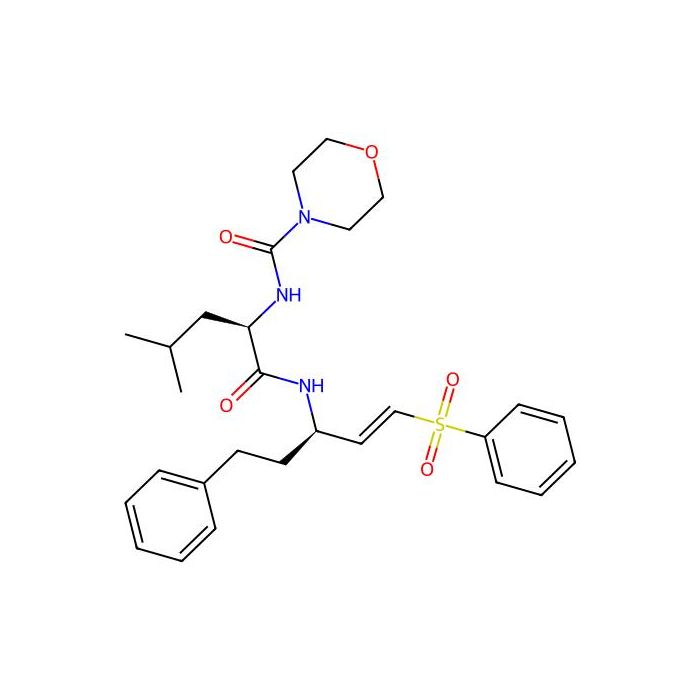
2D structure in words (literature): a linear peptidomimetic backbone terminating in a vinyl-sulfone electrophile, capped on the N-terminus by a morpholine-urea moiety and incorporating hydrophobic/aromatic side chains reminiscent of Leu and homophenylalanine.
This compound is intended as a biological tool, not as a general synthetic building block. Consequently, it is not typically employed as a reagent or intermediate in organic synthesis workflows.
General synthetic context (literature, for background only):
Recommendation: If your aim is to generate analogs or SAR series, consider custom synthesis or modular routes starting from amino acid derivatives and vinyl sulfone building blocks. LHVS as supplied is not designed for derivatization or further chemical transformation in standard synthetic schemes.
No target specificity data are provided for this catalog item. The following general note is for context only and is not a specification of this product: