MHC class I Mouse mAb - 1차 항체, specific to MHC class I, Mouse IgG2a

Cat. No.: Ab115274
주문 가능
등급 & 순도 Carrier Free ? Carrier-free — supplied without added carrier protein/stabilizer. Use when carriers (e.g. BSA) would interfere with conjugation or sensitive assays. Azide Free ? Azide-free — without sodium azide preservative. Use in conjugations, cell work, or assays where azide is toxic or inhibitory. Validated ? Validated grade — performance confirmed in defined applications before release. Use when you want documented assurance the reagent works as stated. PBS Only ? PBS-only formulation — supplied in phosphate-buffered saline with no other additives. Use when you need a clean PBS buffer free of stabilizers/carriers. ≥95%(SDS-PAGE) See COA
Application
Activation, Animal Model, Flow Cytometry, Functional Assay
Host species
마우스
Reactive species
마우스
Isotype
Mouse IgG2a
Clone Number
34-1-2S
Conjugation
Unconjugated
★
크기
USA
독일 (EU)*
가격
수량
10μg
Ab115274-10μg
재고 있음 ≥10
—
US$53.90
50μg
Ab115274-50μg
4 재고 있음
—
US$159.90
100μg
Ab115274-100μg
2 재고 있음
—
US$205.90
1mg
Ab115274-1mg
US 주문제작 · 2–4주 ·
—
US$1,179.90
Enter a quantity for the sizes you want to add.
🧪
이 등급을 선택하는 이유

Carrier Free,Azide Free,Validated,PBS Only,≥95%(SDS-PAGE),See COA Azide Free,Carrier Free,PBS Only,Validated 최소한의 기준선 간섭이 필요한 민감한 크로마토그래피 및 분석 워크플로우용.

🌡

보관 및 배송

Store at 2-8°C,Do not freeze Wet ice,Do not freeze 출고. 정확한 사양은 로트별 COA를 확인하세요.

📋

품질 문서

SDS, COA, 데이터시트, 사양서를 다운로드할 수 있습니다. 로트별 COA는 로트 번호 조회를 통해 확인할 수 있습니다.

📚

문헌적 근거

크로마토그래피, 유기 합성 및 교차 커플링 반응 분야의 동료 심사 논문 0편에서 인용되었습니다.

개요

Mouse anti Mouse MHC class I Antibody, Monoclonal (34-1-2S), could be used for Flow, in vivo activation of APCs and so on.
Application:
Flow: Use at an assay dependent concentration.
in vivo activation of APCs: Use at an assay dependent concentration.

사양

Product Name
MHC class I Mouse mAb - 1차 항체, specific to MHC class I, Mouse IgG2a
동의어
H-2D | H2-D | H2-K1 | K-f | H-2K | H2-K | H2-D1 | H-2K(d) | A-10 alpha chain | FLJ26655 | HLA class I histocompatibility antigen, A-1 alpha chain | HLA class I histocompatibility antigen, A-28 alpha chain | HLA class I histocompatibility antigen, A-9 alph
사양 및 순도
Carrier Free,Azide Free,Validated,PBS Only,≥95%(SDS-PAGE),See COA
숙주 종
마우스
특이성
MHC class I
면역원
BDF mouse spleen cells
변화
Unconjugated
등급
Azide Free, Carrier Free, PBS Only, Validated
아이소타입
Mouse IgG2a
라이트 체인 유형
kappa
SDS-PAGE
150 kDa
정화 방법
Protein G purified
집중력
See COA
Product Line
생물 제품
보관 및 배송
모양
Liquid
보관 조건
Store at 2-8°C,Do not freeze
배송
Wet ice,Do not freeze
안정성 및 스토리지
Shipped at 4°C. Store at 4°C long term (12 months). Do not freeze. Upon receipt, it is recommended to aliquot.
이미지

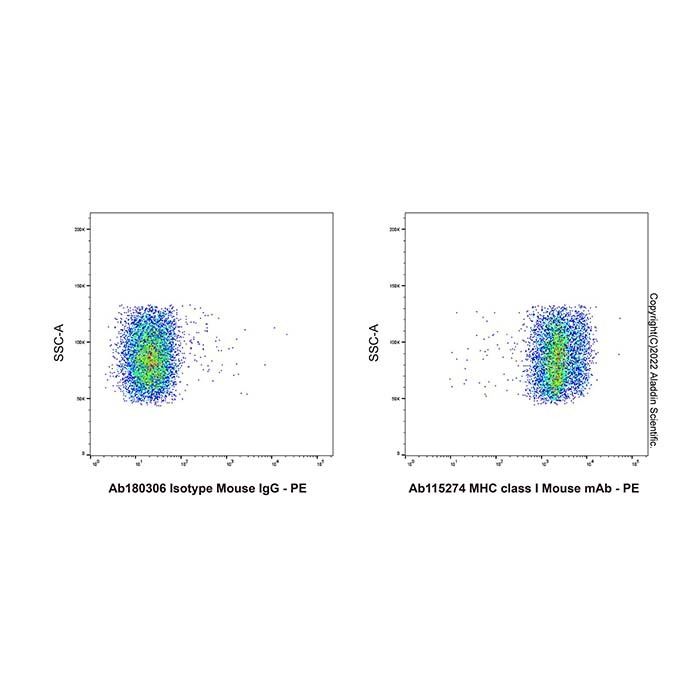
MHC class I Mouse mAb (Ab115274) - Flow Cytometry
Flow Cytometry analysis of mouse splenocytes cells labelling MHC class I with MHC class I Mouse mAb (Ab115274) conjugated with biotin (right panel) at 0.5 μg/mL for 1 hour at 4°C, compared with Mouse IgG Isotype Control Antibody (Biotin) (Ab180306) (left panel) and detected with SA-PE (rp156150).

MHC class I Mouse mAb (Ab115274) - Flow Cytometry
Flow Cytometry analysis of mouse splenocytes cells labelling MHC class I (red) with MHC class I Mouse mAb (Ab115274) conjugated with biotin at 0.5 μg/mL for 1 hour at 4°C, and detected with SA-PE (rp156150). Blue - Mouse IgG Isotype Control Antibody (Biotin) (Ab180306). Black - Unlabelled control, cells without incubation with primary antibody.

적용
적용
Dilution info
Flow Cytometry

Use at an assay dependent concentration.

in vivo activation of APCs

Use at an assay dependent concentration.

문서

📋 안전 데이터 시트(SDS)

위험성, 취급, 보관 및 규제 준수를 포괄하는 종합 문서.

<<<<<<< HEAD SDS 다운로드 → ======= SDS 다운로드 → >>>>>>> release248-p3

✅ 분석 성적서(COA)

로트별 품질 데이터. 로트 번호를 입력하여 정확한 COA를 확인하세요.

COA 조회 →

📊 데이터시트

제품 사양 및 응용 분야에 대한 빠른 참조 요약.

데이터시트 보기 →

🔬 사양서

이 등급의 전체 품질 특성 및 합격 기준.

사양서 보기 →

고급 데이터

인증서(CoA, COO, BSE/TSE 및 분석 차트)
C of A & Other Certificates(BSE/TSE, COO):
Analytical Chart:

Find and download the COA for your product by matching the lot number on the packaging.

3 results found

Lot NumberCertificate Type날짜항목
ZJ24F0607440ZJ24F0607440Certificate of AnalysisOct 08, 2026 Ab115274
ZJ24F0607441ZJ24F0607441Certificate of AnalysisOct 08, 2026 Ab115274
ZJ24F0607442ZJ24F0607442Certificate of AnalysisOct 08, 2026 Ab115274
자주 묻는 질문과 기사
솔루션 계산기
리뷰

고객 리뷰

Application Protocols

Tested applications, recommended dilutions, and positive controls are not provided in the Product Data for this item. The following are general best-practice outlines for monoclonal antibodies and should be empirically optimized; they do not constitute validated protocols for Ab115274.

General flow cytometry outline (no dilution specified):

  • Prepare single-cell suspensions, block Fc receptors as needed.
  • Incubate cells with primary antibody on ice or at 4°C to minimize internalization; wash thoroughly.
  • Detect with species-appropriate secondary antibody if unconjugated; include isotype and FMO controls.

General IF/IHC outline:

  • For surface MHC I, prefer minimal fixation or mild paraformaldehyde; optimize antigen retrieval for FFPE sections per clone requirements.
  • Block nonspecific binding; incubate with primary antibody; wash and detect with appropriate secondary.

General WB outline (clone-dependent):

  • Run reduced SDS-PAGE; transfer; block; incubate with primary antibody; detect using HRP- or fluorescence-tagged secondary. Confirm that the clone recognizes denatured epitopes before attempting WB.

Notes:

  • Because this product is carrier-free and azide-free, it can be directly conjugated. Perform buffer exchange into amine-free buffer for NHS-based chemistries.
  • Always include appropriate controls and perform titration to determine optimal working concentration for your system.
Biological Roles

Background on the target (literature/general knowledge):

  • MHC class I molecules are heterodimers consisting of a polymorphic heavy chain (HLA-A/B/C in human; H-2K/D/L in mouse) associated with β2-microglobulin. They present endogenously derived peptide antigens (typically 8–10 amino acids) to CD8+ T cells.
  • Biosynthesis and trafficking: Peptides generated by the proteasome are transported into the ER by TAP, loaded onto MHC I with the help of chaperones (calnexin, calreticulin, ERp57, tapasin), and then trafficked to the plasma membrane.
  • Functional roles: Immune surveillance, cytotoxic T lymphocyte activation, NK cell interactions via missing-self recognition, and modulation by interferons. Expression is nearly ubiquitous on nucleated cells, with levels tuned by cytokines and cellular stress.
  • Research utilities: Monitoring antigen presentation machinery integrity, studying viral immune evasion, evaluating cellular differentiation states, and quality control in cell manufacturing.

Note regarding this product: The antigen name is MHC class I (from Product Name). Species specificity, exact epitope, and cross-reactivity are not provided in the Product Data and should be verified using the CoA/Spec Sheet and internal controls for your system.

Buffer Applications

This antibody is supplied in PBS only (per Product Data). PBS is a widely used isotonic buffer for antibody storage, dilution, and assay workflows.

  • Typical PBS composition (literature, not item-specific): ~10 mM phosphate, 137 mM NaCl, 2.7 mM KCl, pH ~7.2–7.4. Exact composition for this item is not specified; refer to CoA/Spec Sheet.
  • Use cases:
    • Antibody storage and dilution for flow cytometry, IF, IHC, and ELISA.
    • Compatible with many blocking agents; when using a carrier-free antibody, select protein-free blockers or add blockers separately to avoid interference with conjugation or functional assays.
    • Avoid phosphate buffers with alkaline phosphatase detection systems; use TBS in those cases.
  • Additives (general practice; not present by default in this item):
    • For reduced adsorption: 0.01–0.05% Tween-20 or low levels of inert sugars/polyols can help, if compatible with your assay.
    • Antimicrobials: Since this product is azide-free, maintain sterility; if your protocol requires preservatives, add them only if compatible (e.g., ProClin or low azide levels), recognizing they may affect certain assays and live cells.

Always validate buffer compatibility with your detection chemistry and biological system.

Green Alternatives

Environmental considerations for antibody reagents center on preservative choice, buffer composition, and waste minimization rather than solvent substitution.

  • Azide-free advantage: Eliminates sodium azide, reducing acute aquatic toxicity and hazardous waste handling associated with azide-containing buffers.
  • PBS buffer: Phosphate-buffered saline is a benign, widely accepted aqueous system with minimal environmental impact compared to organic solvent–rich formulations.
  • Waste minimization (general best practice):
    • Use right-sized aliquots to reduce spoilage and biohazard waste.
    • Employ reusable, validated cold-chain packs instead of single-use ice where possible.
    • Avoid heavy-metal–containing preservatives or substrates in downstream assays when feasible.

Comparison (general):

  • Azide-containing antibody formulations: Longer bench stability but require hazardous waste segregation; azide can inhibit HRP and mitochondrial enzymes.
  • Azide-free (this product): Improved compatibility with live cells and enzymatic systems; requires stricter aseptic handling and refrigeration to prevent microbial growth.

No item-specific environmental certifications or metrics are provided; refer to institutional green lab guidelines for additional reductions in environmental footprint.

Pharmaceutical Uses

No clinical or therapeutic uses are claimed for this product. It is for research use only.

Relevant roles in pharmaceutical R&D and biomanufacturing (general, non-clinical):

  • In-process control assays: Monitoring MHC class I expression on cell substrates (e.g., producer cell lines) by flow cytometry.
  • Release/characterization testing (research-phase): Assessing antigen presentation status in engineered cells.
  • Mechanistic studies: Evaluating effects of cytokines or small molecules on MHC class I upregulation.
  • Reagent for bioassay development: As a capture or detection antibody in lab-scale immunoassays (pending validation for the specific format).

Regulatory notes:

  • Not GMP-qualified; no pharmacopeial monograph applies to this research reagent.
  • Endotoxin and bioburden limits, if needed for cell-based assays in regulated environments, must be verified via the product CoA or by in-house testing.

Any use in manufacturing or QC requires independent qualification/validation by the end user.

Physical Properties

Item-specific physical constants are not provided for this antibody preparation.

  • Appearance: Not specified for this item; refer to CoA/Spec Sheet.
  • Concentration: Not specified for this item; refer to CoA/Spec Sheet.
  • Buffer: PBS only (as provided in Product Data); detailed composition not specified for this item; refer to CoA/Spec Sheet.
  • Purity/grade: Carrier Free, Azide Free, Validated (see Quality & Grades tab).
  • Molecular weight: Not specified for this item; refer to CoA/Spec Sheet.
  • pH: Not specified for this item; refer to CoA/Spec Sheet.
  • Preservatives/stabilizers: None listed (Carrier Free, Azide Free); any additional excipients not specified for this item; refer to CoA/Spec Sheet.

Literature/general values for context (not item specifications):

  • Typical IgG MW: ~150 kDa for full-length IgG; fragments (Fab, F(ab')2) are smaller.
  • Typical pI range for mouse IgG subclasses: ~6–9.
  • Antibodies are non-volatile, non-flammable aqueous biopolymers; melting/boiling points are not meaningful in the conventional sense.
  • Solubility: Readily soluble in aqueous buffered saline; denature in strong chaotropes or extreme pH.

Note: Do not treat literature values as product specifications. For exact concentration, pH, and excipient profile of Ab115274, consult the product CoA/Spec Sheet.

Quality and Grades
  • Carrier Free: The formulation contains no protein carriers such as BSA, gelatin, or casein. Advantages include reduced background in functional assays, unimpeded conjugation/labeling (e.g., enzymes, fluorophores), and improved compatibility with biophysical analyses. Practical note: Without carrier proteins, low-concentration solutions may adsorb to plastic; pre-block surfaces or use low-bind plastics.
  • Azide Free: No sodium azide is present. Benefits include compatibility with live-cell staining, cell-based functional assays, and peroxidase-based detection systems without azide inhibition. Tradeoff: Lacking antimicrobial preservative necessitates strict aseptic technique and careful storage to avoid contamination.
  • Validated: The product has undergone internal validation by the manufacturer. Specific validation data and tested applications are not listed in the Product Data provided here; consult the CoA/Spec Sheet for details (e.g., tested species/applications, titer/affinity metrics).
  • PBS Only: Supplied in phosphate-buffered saline. Exact PBS composition (pH, ionic strength) is not specified for this item; refer to CoA/Spec Sheet.

Additional quality considerations (general guidance):

  • Endotoxin, aggregate content, and purity (% monomer) are critical for cell-based work; item-specific values are not provided here and should be checked on the CoA.
  • Lot-to-lot consistency: For monoclonals, clone-based production typically affords reproducible binding characteristics; nonetheless, confirm performance in your assay with small-scale pilot runs.
Reaction and Applications

As a mouse monoclonal antibody against MHC class I, this reagent is intended for immunochemical applications rather than synthetic chemical reactions.

Representative research applications (general guidance; not item-specific validations):

  • Flow cytometry: Detection/quantification of cell-surface MHC class I on mammalian cells; useful for monitoring antigen presentation status, interferon responses, or β2-microglobulin–dependent expression.
  • Immunofluorescence (IF): Surface or permeabilized staining to visualize MHC class I localization; optimize fixation/permeabilization to preserve extracellular epitopes if required.
  • Immunohistochemistry (IHC): Assessment of MHC class I distribution in tissue sections (FFPE vs frozen protocols may differ substantially; antigen retrieval conditions require optimization by clone).
  • Immunoprecipitation (IP): Enrichment of MHC class I complexes for downstream proteomics (epitope availability and affinity are clone-dependent).
  • Western blot (WB): Detection of denatured heavy chain (∼45 kDa) is clone-dependent; many anti-MHC I mAbs are primarily conformational—verify compatibility for WB.

Practical tips (general):

  • Because this product is carrier-free and azide-free, it is amenable to direct conjugation (e.g., NHS-ester dyes, enzymes). Perform buffer exchange to remove amines if using NHS chemistry.
  • Titrate antibody empirically for each application and cell/tissue type; include appropriate isotype controls and secondary antibodies (if using indirect detection).

Note: Specific tested applications for Ab115274 are not listed in the provided Product Data; consult the CoA/Spec Sheet.

Reaction Conditions

Classical chemical reaction conditions are not applicable to antibody use. For immunoassays and cell-based applications, conditions are assay-specific. General guidance (literature/best practice, not item-specific):

  • Temperature: Keep on ice or 2–8°C during setup; perform incubations commonly at 4°C or room temperature depending on assay (e.g., 30–60 min for flow cytometry at 4°C to limit internalization).
  • Buffers: PBS or TBS with appropriate blockers and surfactants; calcium/magnesium may be included or omitted based on cell handling requirements.
  • Conjugation: For direct labeling (e.g., NHS-ester dyes/enzymes), maintain pH ~8.3 and remove primary amines from the buffer by exchange into amine-free buffers (e.g., bicarbonate). These are general conditions; compatibility of this specific antibody with conjugation chemistries should be verified.

No tested application conditions are provided in the Product Data for Ab115274; consult the CoA/Spec Sheet and optimize empirically.

Safety and Handling

Safety classification details are not provided in the Product Data.

  • GHS classification, signal word, pictograms, and H-statements: Not specified for this item; refer to SDS.
  • Research use: For research use only (per Product Data). Not for diagnostic or therapeutic use.

General laboratory safety guidance for protein antibodies (literature/best practice):

  • PPE: Wear lab coat, gloves, and eye protection. Handle as a biological reagent under BSL-1 conditions unless your protocol dictates higher containment.
  • Avoid microbial contamination: Work aseptically; keep caps closed; if aliquoting, use sterile tools.
  • Chemical hazards: This lot is azide-free, removing sodium azide–related acute toxicity and heavy-metal azide formation risks in plumbing. Nevertheless, avoid ingestion, inhalation of aerosols, and contact with eyes/skin.
  • Incompatibilities: Avoid strong oxidizers, proteases, and extremes of pH or temperature that can denature proteins. Avoid repeated freeze–thaw (see Storage tab).
  • First aid (overview; defer to SDS): If skin/eye contact occurs, rinse with water. If inhaled as aerosol, move to fresh air. If ingested, rinse mouth. Seek medical advice if symptoms persist.
  • Spill response: Absorb aqueous spills with inert material, clean with detergent/water, disinfect surfaces as appropriate for biologicals.

Always consult the product SDS for authoritative hazard and handling information.

Solvent Selection

This is an aqueous protein reagent supplied in PBS. Organic solvent selection is generally not applicable.

  • Solvent system: Aqueous only. Do not dilute with organic solvents (e.g., methanol, DMSO) that can denature antibodies, unless your protocol specifically calls for controlled additions at low percentages.
  • Compatible diluents (general practice): Sterile PBS or Tris-buffered saline (TBS) with protein-free blockers as needed. For carrier-free antibodies, consider adding inert sugar/polyol stabilizers only if compatible with downstream applications (not provided in this item by default).
  • Surfactants: Trace nonionic surfactants (e.g., Tween-20 at 0.01–0.05%) can reduce surface adsorption in some assays; ensure they are compatible with your detection chemistry.
  • When to choose PBS vs alternatives (general/literature):
    • PBS: isotonic, good for mammalian cell staining and general immunoassays.
    • TBS: preferred for phospho-epitope or alkaline phosphatase detection workflows that can be phosphate-sensitive.

For this specific item, the buffer is PBS-only per Product Data; if a different buffer is required for your assay, perform a gentle buffer exchange (e.g., spin concentrator) under cold conditions to maintain antibody integrity.

Storage and Reconstitution
  • Storage conditions (from Product Data): Store at 2–8°C. Do not freeze.
  • Shipping (from Product Data): Shipped on wet ice. Do not freeze.

Handling guidance (general best practice for aqueous, carrier-free, azide-free antibodies):

  • Minimize time at room temperature; keep on ice during setup and promptly return to 2–8°C.
  • Avoid repeated vial openings and potential microbial contamination; work aseptically.
  • Do not freeze: Freezing can cause aggregation or loss of activity, especially without cryoprotectants.
  • Aliquoting: If frequent access is expected but freezing is prohibited, consider preparing several small, sterile working aliquots to minimize cumulative exposure; store all at 2–8°C and use within a defined in-lab shelf-life.
  • Light protection: If the antibody is or will be conjugated to light-sensitive dyes, protect from light.

Reconstitution/dilution:

  • Form supplied: Not specified for this item; refer to CoA/Spec Sheet. If provided as a liquid in PBS (as indicated by "PBS Only"), no reconstitution is needed.
  • For dilution or buffer exchange, use sterile, filtered PBS (or assay-appropriate buffer) under cold conditions. Avoid primary amines if planning NHS-ester conjugation.

Stability/shelf-life: Not specified for this item; refer to CoA/Spec Sheet and product label for expiration and post-opening stability guidance.

Structure and Identity

This product is a mouse monoclonal antibody directed against MHC class I, supplied as a PBS-only, carrier-free, azide-free solution.

  • SKU: Ab115274
  • Product name: MHC class I Mouse mAb
  • Analyte/antigen: MHC class I (Major Histocompatibility Complex, class I)
  • Antibody type: Monoclonal antibody (mAb)
  • Host: Mouse
  • Clone/isotype: Not specified for this item; refer to CoA/Spec Sheet.
  • Molecular formula: Not applicable to proteins in a meaningful way; not specified for this item; refer to CoA/Spec Sheet.
  • Molecular weight: Not specified for this item; refer to CoA/Spec Sheet.
  • SMILES/InChIKey/CID/CAS: Not applicable/not specified for protein biologics.

General structural description (literature/general knowledge):

  • Typical IgG structure is a Y-shaped heterotetramer (~150 kDa) comprising two heavy chains and two light chains linked by disulfide bonds, with variable regions forming the antigen-binding sites (Fab) and a constant Fc domain. The specific isotype (e.g., IgG1, IgG2a, etc.) and any subclass-dependent glycosylation are not specified for this item.
  • 2D description in words: two antigen-binding Fab arms recognizing epitopes on extracellular domains of MHC class I heavy chain (epitope not specified), and one Fc stem mediating Fc-dependent interactions (class/subclass not specified).

Note: Exact clone, epitope, and isotype details are item-specific and not supplied here; consult the CoA/Spec Sheet for definitive identity information.

Synthetic Utility

Not typically applicable. As a biological monoclonal antibody reagent, this product is not used as a synthetic building block or reagent in chemical transformations. For relevant information, see Reaction & Applications and Application Protocols for immunochemical assay use.

Target Specificity

Information restricted to Product Data only:

  • Antigen/Target: MHC class I (as stated in the Product Name)
  • Antibody type: Mouse monoclonal antibody
  • Clone: Not specified for this item; refer to CoA/Spec Sheet.
  • Species reactivity: Not specified for this item; refer to CoA/Spec Sheet.
  • Epitope: Not specified for this item; refer to CoA/Spec Sheet.
  • Cross-reactivity: Not specified for this item; refer to CoA/Spec Sheet.

For detailed specificity, blocking profiles, and validation data, please consult the CoA/Spec Sheet.

자주 묻는 질문

What is the purity of this product, and how is it determined?
This product is supplied at ≥95% purity, determined by SDS-PAGE. Lot-specific values are stated on the Certificate of Analysis.
How is this product shipped?
This product ships chilled on wet ice. Unpack on arrival and transfer it to the storage condition stated above.
What does Azide Free mean?
Azide Free indicates that the material has been processed and tested for specialty industrial processing. Specifications focus on the impurities that affect performance in that application — for example, metal content for electronics, particle size for batteries, refractive index for optics, or moisture content for moisture-sensitive processes.
What does Carrier Free mean?
Carrier Free indicates that the material has been processed and tested for specialty industrial processing. Specifications focus on the impurities that affect performance in that application — for example, metal content for electronics, particle size for batteries, refractive index for optics, or moisture content for moisture-sensitive processes.
How should this product be stored?
Store at 2–8 °C. Do not freeze. Freezing may cause irreversible damage to this material.
What documentation is provided?
Available product documentation, including Certificates of Analysis (COA), Safety Data Sheets (SDS), and specification sheets, is shown in the product document area. Document availability and access follow the current site policy.
Which species reactivity has this antibody been validated against?
Validated reactivity is listed on the PDP and on each lot's datasheet. We validate against the most commonly tested species for the target (MHC class I Mouse mAb); cross-reactivity in untested species may exist but is not guaranteed. Contact technical support for specific species inquiries.

등급 선택에 도움이 필요하신가요?

당사의 등급 선택 가이드는 카탈로그의 모든 변형 제품에 대해 순도, 안정제 상태 및 용도 적합성을 다룹니다.

Carrier Free 등급 가이드 보기 → Validated 등급 가이드 보기 → Azide Free 등급 가이드 보기 → PBS Only 등급 가이드 보기 →

관련 상품

Goat Anti-Mouse IgG H&L Antibody - 2차 항체, for ELISA,LF,GICA various applications, from Mouse, generated in Goat
Goat Anti-Mouse IgG H&L (HRP) - 2차 항체, for WB,ELISA,IHC-P various applications, from Mouse, generated in Goat, IgG
Mouse IgG - 아이소타입 대조 항체, generated in Rat, >95%, IgG
Rabbit Anti-Mouse IgG H&L (HRP) - 2차 항체, IgG
BALB/c Mouse IgG - 아이소타입 대조 항체, IgG
Rabbit Anti-Mouse IgG antibody - 2차 항체
Goat Anti-Mouse IgG H&L (FITC) - 2차 항체
Goat Anti-Mouse IgG H&L (TRITC) - 2차 항체
Goat Anti-Mouse IgG H&L Antibody - 2차 항체, Goat IgG
Goat Anti-Mouse IgG H&L (Cy5) - 2차 항체
Goat Anti-Mouse IgG H&L (HRP) - 2차 항체
Goat Anti-Mouse IgG H&L (Biotin) - 2차 항체
Rabbit Anti-Mouse IgG (HRP) - 2차 항체
Rabbit Anti-Mouse IgG (Biotin) - 2차 항체
Goat Anti-Mouse IgG H&L (HRP) - 2차 항체, Goat IgG
Goat Anti-Mouse IgG H&L (TRITC) - 2차 항체, Goat IgG
Goat Anti-Mouse IgG H&L (Biotin) - 2차 항체, Goat IgG
Goat Anti-Mouse IgG H&L (FITC) - 2차 항체, Goat IgG
Goat Anti-Mouse IgG H&L (Cy5) - 2차 항체, Goat IgG
Goat Anti-Mouse IgG H&L (PE) - 2차 항체, Goat IgG
Goat Anti-Mouse IgG H&L (APC) - 2차 항체, Goat IgG
Mouse IgG (Biotin) - 아이소타입 대조 항체, Mouse IgG
Mouse IgG (PE) - 아이소타입 대조 항체, Mouse IgG
Mouse IgG (APC) - 아이소타입 대조 항체, Mouse IgG
Mouse IgG (FITC) - 아이소타입 대조 항체, Mouse IgG
Mouse IgG2a-Fc - 아이소타입 대조 항체, Mouse IgG2a
Goat Anti-Mouse IgG H&L (Alkaline Phosphatase) - 2차 항체, Goat IgG
Goat Anti-Mouse IgG H&L (AF405) - 2차 항체, Goat IgG
Goat Anti-Mouse IgG H&L (AF647) - 2차 항체, Goat IgG
Mouse IgG2b-kappa, anti-Spike RBD - 아이소타입 대조 항체, specific to Spike RBD, Mouse IgG2b
Mouse IgG2a-kappa, anti-Spike RBD - 아이소타입 대조 항체, specific to Spike RBD, Mouse IgG2a
Mouse IgG3-kappa, anti-HEL - 아이소타입 대조 항체, specific to HEL, Mouse IgG3
Mouse IgG2c-kappa, anti-HEL - 아이소타입 대조 항체, specific to HEL, Mouse IgG2c
Mouse lgG2A(D265A)-kappa, anti-HEL - 아이소타입 대조 항체, specific to HEL, Mouse IgG2a(D265A)
Mouse IgG1(D265A)-kappa, anti-HEL - 아이소타입 대조 항체, specific to HEL, Mouse IgG1(D265A)
Mouse IgG (AF488) - 아이소타입 대조 항체, IgG
Mouse IgG (PerCP) - 아이소타입 대조 항체, IgG
Mouse IgG (AF405) - 아이소타입 대조 항체, IgG
Mouse IgG (AF647) - 아이소타입 대조 항체, IgG
Goat Anti-Mouse IgG H&L (AF555) - 2차 항체, specific to Mouse IgG, Goat IgG
Mouse IgG (AF700) - 아이소타입 대조 항체, IgG
Goat Anti-Mouse IgG H&L (AF700) - 2차 항체, specific to Mouse IgG, Goat IgG
Mouse IgG (PE-Cy5) - 아이소타입 대조 항체
Mouse IgG (PE-Cy7) - 아이소타입 대조 항체
마우스 IgG2b-카파, 항-E8L - 아이소타입 대조 항체, specific to E8L
마우스 IgG2a-카파, 항-A29L - 아이소타입 대조 항체, specific to A29L
MHC class I Mouse mAb (APC) - 1차 항체, specific to MHC class I
MHC class I Mouse mAb (AF647) - 1차 항체, specific to MHC class I
MHC class I Mouse mAb (Biotin) - 1차 항체, specific to MHC class I
MHC class I Mouse mAb (FITC) - 1차 항체, specific to MHC class I
Mouse IgG2c-kappa (AF647), anti-HEL - 아이소타입 대조 항체, specific to HEL
Mouse IgG2c-kappa (AF700), anti-HEL - 아이소타입 대조 항체, specific to HEL
Mouse IgG2c-kappa (AF405), anti-HEL - 아이소타입 대조 항체, specific to HEL
Mouse IgG2c-kappa (Biotin), anti-HEL - 아이소타입 대조 항체, specific to HEL
Mouse IgG2a-kappa (APC), anti-Spike RBD - 아이소타입 대조 항체, specific to Spike RBD
Mouse IgG2a-kappa (FITC), anti-Spike RBD - 아이소타입 대조 항체, specific to Spike RBD
Mouse IgG2a-kappa (AF700), anti-Spike RBD - 아이소타입 대조 항체, specific to Spike RBD
Mouse IgG2a-kappa (AF647), anti-Spike RBD - 아이소타입 대조 항체, specific to Spike RBD
Mouse IgG2a-kappa (AF555), anti-Spike RBD - 아이소타입 대조 항체, specific to Spike RBD
Mouse IgG2a-kappa (AF405), anti-Spike RBD - 아이소타입 대조 항체, specific to Spike RBD
Mouse IgG2c-kappa (FITC), anti-HEL - 아이소타입 대조 항체, specific to HEL
Mouse IgG2c-kappa (AF555), anti-HEL - 아이소타입 대조 항체, specific to HEL
Mouse IgG2c-kappa (APC), anti-HEL - 아이소타입 대조 항체, specific to HEL
Mouse IgG2c-kappa (PE), anti-HEL - 아이소타입 대조 항체, specific to HEL
Mouse IgG2a-kappa (Biotin), anti-Spike RBD - 아이소타입 대조 항체, specific to Spike RBD
Mouse IgG2a-Fc (Biotin) - 아이소타입 대조 항체
Mouse IgG2a-Fc (FITC) - 아이소타입 대조 항체
Mouse IgG (AF555) - 아이소타입 대조 항체
Mouse IgG2b-kappa (Biotin), anti-Spike RBD - 아이소타입 대조 항체, specific to Spike RBD
Mouse IgG2b-kappa (FITC), anti-Spike RBD - 아이소타입 대조 항체, specific to Spike RBD
Mouse IgG2b-kappa (APC), anti-Spike RBD - 아이소타입 대조 항체, specific to Spike RBD
Mouse IgG2b-kappa (APC-Cy7), anti-Spike RBD - 아이소타입 대조 항체, specific to Spike RBD
Goat Anti-Mouse IgG H&L (PE-Cy5) - 2차 항체, specific to Mouse IgG
Centrose patent anti-dysadherin (anti-Dysadherin) - 1차 항체, specific to FXYD5
Mouse IgG2a-kappa (AF405), anti-A29L - 아이소타입 대조 항체, specific to A29L
Mouse IgG2a-kappa (AF488), anti-A29L - 아이소타입 대조 항체, specific to A29L
Mouse IgG2a-kappa (AF647), anti-A29L - 아이소타입 대조 항체, specific to A29L
Mouse IgG2a-kappa (AF700), anti-A29L - 아이소타입 대조 항체, specific to A29L
Mouse IgG2a-kappa (Biotin), anti-A29L - 아이소타입 대조 항체, specific to A29L
Mouse IgG2a-kappa (FITC), anti-A29L - 아이소타입 대조 항체, specific to A29L
Mouse IgG3-kappa (Biotin), anti-HEL - 아이소타입 대조 항체, specific to HEL
Mouse IgG3-kappa (FITC), anti-HEL - 아이소타입 대조 항체, specific to HEL
Mouse IgG3-kappa (PE), anti-HEL - 아이소타입 대조 항체, specific to HEL
Mouse IgG3-kappa (AF488), anti-HEL - 아이소타입 대조 항체, specific to HEL
Mouse IgG3-kappa (APC), anti-HEL - 아이소타입 대조 항체, specific to HEL
Mouse IgG3-kappa (AF647), anti-HEL - 아이소타입 대조 항체, specific to HEL
Mouse IgG2b-kappa (AF555), anti-Spike RBD - 아이소타입 대조 항체, specific to Spike RBD
Goat Anti-Mouse IgG H&L (AF488) - 2차 항체
Goat Anti-Mouse IgG H&L (PE-Cy7) - 2차 항체
Mouse IgG (PE-Cy5.5) - 아이소타입 대조 항체
Goat Anti-Mouse IgG H&L (AF750) - 2차 항체
Mouse IgG2a-kappa (AF555), anti-A29L - 아이소타입 대조 항체, specific to A29L
Mouse IgG2a-kappa (PE-Cy5.5), anti-A29L - 아이소타입 대조 항체, specific to A29L
Goat Anti-Mouse IgG H&L (AF546) - 2차 항체
Goat Anti-Mouse IgG H&L (Oregon Green 488) - 2차 항체
Goat Anti-Mouse IgG H&L (Cy3) - 2차 항체
Mouse IgG2a-kappa (APC), anti-A29L - 아이소타입 대조 항체, specific to A29L
Mouse IgG3-kappa (AF555), anti-HEL - 아이소타입 대조 항체, specific to HEL
Mouse IgG (PE-AF647) - 아이소타입 대조 항체

Shall we send you a message when we have discounts available?

Remind me later

Thank you! Please check your email inbox to confirm.

Oops! Notifications are disabled.