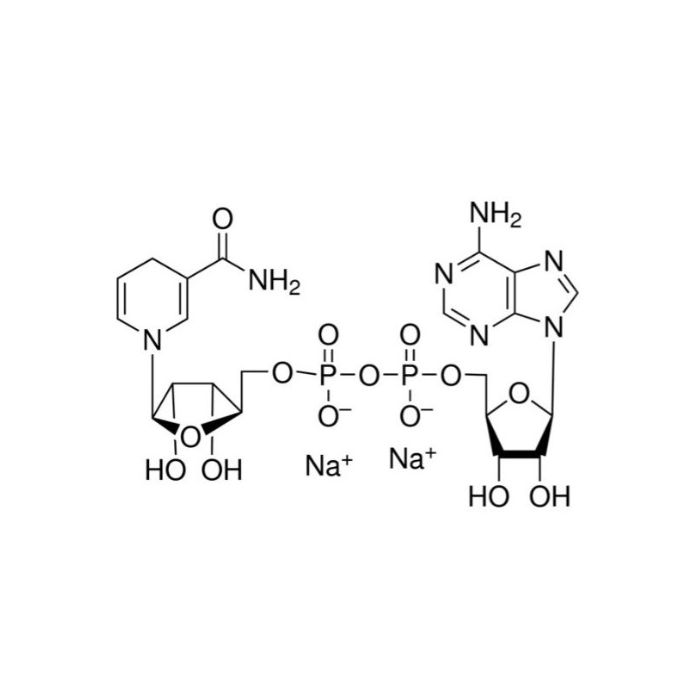
β-NADH - 10mM in DMSO , CAS No.606-68-8

CAS: 606-68-8 Cat. No.: N425025 분자식: C21H27N7Na2O14P2 분자량: 709.4 Beilstein Registry Number: 5230241 EC 번호: 210-123-3
주문 가능
GRADE & PURITY 10mM in DMSO
Synonyms
606-68-8|Disodium nicotinamide adenine dinucleotide|Disodium NADH|NADH disodium salt|beta-Nicotinamide Adenine Dinucleotide Disodium Salt|NADH, disodium salt hydrate|NADH (disodium salt)|8295030YNC|disodium;[[(2R,3S,4R,5R)-5-(6-aminopurin-9-yl)-3,4-dihydr
Storage
Store at -80°C
Shipped In
Dry ice packs + Cold packs
★
Size
USA
독일 (EU)*
Price
Qty
1ml
N425025-1ml
1 재고 있음
—
US$99.90
Enter a quantity for the sizes you want to add.
🧪
Why this grade

10mM in DMSO for sensitive chromatographic and analytical workflows requiring minimal baseline interference.

🌡

Storage & shipping

Store at -80°C Ships Dry ice packs + Cold packs Check lot-specific COA for exact specifications.

📋

Quality documents

SDS, COA, datasheet, and spec sheet available for download. Lot-specific COA accessible via lot number lookup.

📚

Literature proof

Cited in 36 peer-reviewed publications across chromatography, organic synthesis, and cross-coupling reactions.

개요

β-Nicotinamide adenine dinucleotide (NAD+) and β-Nicotinamide adenine dinucleotide, reduced (NADH) comprise a coenzyme redox pair (NAD+:NADH) involved in a wide range of enzyme catalyzed oxidation reduction reactions. In addition to its redox function, NAD+/NADH is a donor of ADP-ribose units in ADP-ribosylaton (ADP-ribosyltransferases; poly(ADP-ribose) polymerases ) reactions and a precursor of cyclic ADP-ribose (ADP-ribosyl cyclases).
As a reagent, NADH can be used in enzyme cycling assays to amplify detection of activity of biologically relevant enzymes or metabolites present in low concentrations.

Specifications

동의어
606-68-8 | Disodium nicotinamide adenine dinucleotide | Disodium NADH | NADH disodium salt | beta-Nicotinamide Adenine Dinucleotide Disodium Salt | NADH, disodium salt hydrate | NADH (disodium salt) | 8295030YNC | disodium;[[(2R,3S,4R,5R)-5-(6-aminopurin-9-yl)-3,4-dihydr
사양 및 순도
10mM in DMSO
보관 조건
Store at -80°C
배송
Dry ice packs + Cold packs
이 제품은 콜드 체인 배송이 필요합니다.지상 및 기타 경제 서비스는 사용할 수 없습니다.
이름과 식별자
Pubchem Sid
Pubchem Sid Url
https://pubchem.ncbi.nlm.nih.gov/substance/528775803
정식 스마일
C1C=CN(C=C1C(=O)N)C2C(C(C(O2)COP(=O)([O-])OP(=O)([O-])OCC3C(C(C(O3)N4C=NC5=C(N=CN=C54)N)O)O)O)O.[Na+].[Na+]
IUPAC Name
disodium;[[(2R,3S,4R,5R)-5-(6-aminopurin-9-yl)-3,4-dihydroxyoxolan-2-yl]methoxy-oxidophosphoryl] [(2R,3S,4R,5R)-5-(3-carbamoyl-4H-pyridin-1-yl)-3,4-dihydroxyoxolan-2-yl]methyl phosphate
InChIKey
QRGNQKGQENGQSE-WUEGHLCSSA-L
INCHI
1S/C21H29N7O14P2.2Na/c22-17-12-19(25-7-24-17)28(8-26-12)21-16(32)14(30)11(41-21)6-39-44(36,37)42-43(34,35)38-5-10-13(29)15(31)20(40-10)27-3-1-2-9(4-27)18(23)33;;/h1,3-4,7-8,10-11,13-16,20-21,29-32H,2,5-6H2,(H2,23,33)(H,34,35)(H,36,37)(H2,22,24,25);;/q;2*+1/p-2/t10-,11-,13-,14-,15-,16-,20-,21-;;/m1../s1
이성체 SMILES
C1C=CN(C=C1C(=O)N)[C@H]2[C@@H]([C@@H]([C@H](O2)COP(=O)([O-])OP(=O)([O-])OC[C@@H]3[C@H]([C@H]([C@@H](O3)N4C=NC5=C(N=CN=C54)N)O)O)O)O.[Na+].[Na+]
WGK 독일
3
대체 CAS
58-68-4
분자량
709.4
Beilstein
5230241
Reaxy-Rn
5230241

Documentation

📋 Safety Data Sheet (SDS)

Comprehensive hazard, handling, storage, and regulatory compliance document.

Download SDS →

✅ Certificate of Analysis (COA)

Lot-specific quality data. Enter your lot number to retrieve the exact COA.

Look up COA →

📊 Datasheet

Quick-reference summary of product specifications and applications.

View datasheet →

🔬 Specification Sheet

Full quality attributes and acceptance criteria for this grade.

View spec sheet →

Advanced Data

Taxonomic Classification

Taxonomy Tree

KingdomOrganic compounds
SuperclassNucleosides, nucleotides, and analogues
분류(5'->5')-dinucleotides
SubclassNot available
Intermediate Tree Nodes Not available
Direct Parent(5'->5')-dinucleotides
Alternative Parents Purine nucleotide sugars  Purine ribonucleoside diphosphates  Purine ribonucleoside monophosphates  Nicotinamide nucleotides  Pentose phosphates  Glycosylamines  6-aminopurines  Monosaccharide phosphates  N-substituted nicotinamides  Organic pyrophosphates  Aminopyrimidines and derivatives  Dihydropyridines  Alkyl phosphates  Imidolactams  N-substituted imidazoles  Vinylogous amides  Heteroaromatic compounds  Tetrahydrofurans  Amino acids and derivatives  Secondary alcohols  Primary carboxylic acid amides  Oxacyclic compounds  Enamines  Azacyclic compounds  Organopnictogen compounds  Hydrocarbon derivatives  Primary amines  Carbonyl compounds  Organic oxides  Organic zwitterions  Organic sodium salts  
Molecular FrameworkAromatic heteropolycyclic compounds
Substituents (5'->5')-dinucleotide - Purine nucleotide sugar - Purine ribonucleoside diphosphate - Purine ribonucleoside monophosphate - Nicotinamide-nucleotide - Pentose phosphate - Pentose-5-phosphate - Glycosyl compound - N-glycosyl compound - 6-aminopurine - Monosaccharide phosphate - N-substituted nicotinamide - Organic pyrophosphate - Imidazopyrimidine - Purine - Aminopyrimidine - Dihydropyridine - Alkyl phosphate - Hydropyridine - Pyrimidine - Monosaccharide - N-substituted imidazole - Organic phosphoric acid derivative - Imidolactam - Phosphoric acid ester - Azole - Tetrahydrofuran - Imidazole - Heteroaromatic compound - Vinylogous amide - Primary carboxylic acid amide - Carboxamide group - Amino acid or derivatives - Secondary alcohol - Carboxylic acid derivative - Enamine - Oxacycle - Organic alkali metal salt - Organoheterocyclic compound - Azacycle - Primary amine - Amine - Alcohol - Organic sodium salt - Organic nitrogen compound - Organic zwitterion - Hydrocarbon derivative - Organic oxide - Carbonyl group - Organic salt - Organooxygen compound - Organic oxygen compound - Organopnictogen compound - Organonitrogen compound - Aromatic heteropolycyclic compound
설명This compound belongs to the class of organic compounds known as (5'->5')-dinucleotides. These are dinucleotides where the two bases are connected via a (5'->5')-phosphodiester linkage.
External Descriptors Not available
3D 구조
상호 작용 화학 구조 모델


인증서(CoA, COO, BSE/TSE 및 분석 차트)
C of A & Other Certificates(BSE/TSE, COO):
Analytical Chart:
화학 및 물리적 특성
감도Air Sensitive,Heat Sensitive
분자량709.400 g/mol
XLogP3
Hydrogen Bond Donor Count6
Hydrogen Bond Acceptor Count19
Rotatable Bond Count11
Exact Mass709.089 Da
Monoisotopic Mass709.089 Da
Topological Polar Surface Area323.000 Ų
Heavy Atom Count46
Formal Charge0
Complexity1210.000
Isotope Atom Count0
Defined Atom Stereocenter Count8
Undefined Atom Stereocenter Count0
Defined Bond Stereocenter Count0
Undefined Bond Stereocenter Count0
The total count of all stereochemical bonds0
Covalently-Bonded Unit Count3
자주 묻는 질문과 기사
NADH vs NADPH: Homologous coenzymes with distinct functional specialization
Niacin (Vitamin B3): Structural Features, Metabolic Roles, and Application Landscape
CCK-8 (WST-8) Colorimetric Cell Viability Assay: Principles, Experimental Design, and Typical Applications
Vitamins, Coenzymes, and Enzymes: A Metabolic Synergy Network and Its Disease Associations
NAD (Nicotinamide Adenine Dinucleotide): From a Metabolic Coenzyme to Homeostatic Regulation and Application Targets
Diaphorase: NAD(P)H-Dependent Electron-Transfer Activity and Its Applications in Detection and Research
A Panoramic Guide to Purines and Research Reagent Selection: Structural Hierarchy, Classification Map, Three Metabolic Pathways, and Typical Applications
Pyridine Research Selection Roadmap: Structural Features, Reaction Logic, and a Classification Navigator for Reagents/Building Blocks/Reference Standards (Tables 1–6)
Cellular Electron Transfer Networks and Mechanisms of Metabolism-Signaling Coupling
Acetyl-Group Metabolic Enzyme Network and In Vitro Enzymology Analysis
Metabolic Basis and Research Framework of Glycerol Utilization and Metabolic Reprogramming
Enzymatic Hydroxylation Mechanism of Salicylate Conversion to Catechol
Comparison of Urea Detection Methods: Reaction Mechanisms, Interference Factors, and Application Scenarios of the Urease Method and Diacetyl Monoxime Method
Oxalate Metabolism and Degradation Detection Methods: Enzymatic Assays, Chromatography, and Enzymatic Degradation System Analysis
What Is Synthetic Biology? The Industrialization Pathway from Upstream Reagent Toolchains to Biomanufacturing Applications
TCA Cycle Metabolite Detection Methods and Result Interpretation
β-Hydroxybutyrate Detection Methods and Metabolic Significance: Comparative Applications of Enzymatic Assays, Blood Ketone Meters, and LC-MS
Metabolic Functions and Experimental Detection of the Glycerol-3-Phosphate Pathway: Glycolysis, Glycerolipid Synthesis, and Mitochondrial Shuttle
Functional Roles of Auxiliary Enzymes in Enzyme-Coupled Colorimetric Reactions: Mutarotase, Oxidases, Peroxidases, and Dehydrogenases
How Coenzyme Q10 Acts on the Skin: Mitochondrial Electron Transfer, Antioxidant Protection of Membrane Lipids, and Lipid-Carrier Delivery
Structural Characteristics of Ergothioneine, OCTN1-Mediated Uptake by Skin Cells, and Antioxidant Mechanisms
Structural and Functional Differences Between Idebenone and Coenzyme Q10: From Side-Chain Structure to Redox Cycling and Mitochondrial Electron Transport
Citations of This Product
솔루션 계산기
리뷰

고객 리뷰

Shall we send you a message when we have discounts available?

Remind me later

Thank you! Please check your email inbox to confirm.

Oops! Notifications are disabled.