
Determine the necessary mass, volume, or concentration for preparing a solution.
이 등급을 선택하는 이유
Ph.Eur., ≥65% Ph.Eur. 최소한의 기준선 간섭이 필요한 민감한 크로마토그래피 및 분석 워크플로우용.
보관 및 배송
Protected from light,Store at -20°C,Argon charged Ice chest + Ice pads 출고. 정확한 사양은 로트별 COA를 확인하세요.
품질 문서
SDS, COA, 데이터시트, 사양서를 다운로드할 수 있습니다. 로트별 COA는 로트 번호 조회를 통해 확인할 수 있습니다.
문헌적 근거
크로마토그래피, 유기 합성 및 교차 커플링 반응 분야의 동료 심사 논문 2359편에서 인용되었습니다.
개요
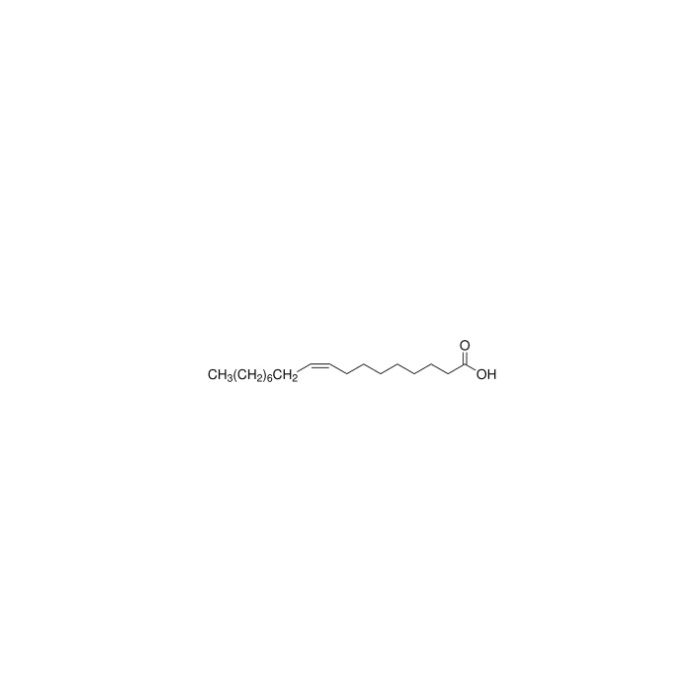
Oleic acid (OA) is a type of fatty acid. OA, as a surfactant, is widely used for the stabilization of magnetic nanoparticles synthesized by the traditional co-precipitation method. Monodisperse magnetite nanoparticles coated with oleic acid (OA) (diameters = 7 and 19 nm) were prepared.
Application
Oleic acid can be used to prepare 10-hydroxyoctadecanoic acid and methyl 10-hydroxyoctadecanoic acid.
사양
사양 및 순도
Ph.Eur., ≥65%
보관 조건
Protected from light,Store at -20°C,Argon charged
배송
Ice chest + Ice pads
이 제품은 콜드 체인 배송이 필요합니다.지상 및 기타 경제 서비스는 사용할 수 없습니다.
등급
Ph.Eur.
순수함
≥65%
이름과 식별자
정식 스마일
CCCCCCCCC=CCCCCCCCC(=O)O
IUPAC Name
(Z)-octadec-9-enoic acid
InChIKey
ZQPPMHVWECSIRJ-KTKRTIGZSA-N
INCHI
1S/C18H34O2/c1-2-3-4-5-6-7-8-9-10-11-12-13-14-15-16-17-18(19)20/h9-10H,2-8,11-17H2,1H3,(H,19,20)/b10-9-
이성체 SMILES
CCCCCCCC/C=C\CCCCCCCC(=O)O
WGK 독일
1
RTECS
RG2275000
분자량
282.46
Beilstein
1726542
Reaxy-Rn
1726541
Reaxys-RN_link_address
https://www.reaxys.com/reaxys/secured/hopinto.do?context=S&query=IDE.XRN=1726541&ln=
문서
📋 안전 데이터 시트(SDS)
위험성, 취급, 보관 및 규제 준수를 포괄하는 종합 문서.
<<<<<<< HEAD SDS 다운로드 → ======= SDS 다운로드 → >>>>>>> release248-p3고급 데이터
Taxonomic Classification
Taxonomy Tree
- Kingdom Organic compounds
- Superclass Lipids and lipid-like molecules
- 분류 Fatty Acyls
- Subclass Fatty acids and conjugates
- 분류 Fatty Acyls
- Superclass Lipids and lipid-like molecules
| Kingdom | Organic compounds |
|---|---|
| Superclass | Lipids and lipid-like molecules |
| 분류 | Fatty Acyls |
| Subclass | Fatty acids and conjugates |
| Intermediate Tree Nodes | Not available |
| Direct Parent | Long-chain fatty acids |
| Alternative Parents | Unsaturated fatty acids Straight chain fatty acids Monocarboxylic acids and derivatives Carboxylic acids Organic oxides Hydrocarbon derivatives Carbonyl compounds |
| Molecular Framework | Aliphatic acyclic compounds |
| Substituents | Long-chain fatty acid - Unsaturated fatty acid - Straight chain fatty acid - Monocarboxylic acid or derivatives - Carboxylic acid - Carboxylic acid derivative - Organic oxygen compound - Organic oxide - Hydrocarbon derivative - Organooxygen compound - Carbonyl group - Aliphatic acyclic compound |
| 설명 | This compound belongs to the class of organic compounds known as long-chain fatty acids. These are fatty acids with an aliphatic tail that contains between 13 and 21 carbon atoms. |
| External Descriptors | Unsaturated fatty acids |
3D 구조
상호 작용 화학 구조 모델
인증서(CoA, COO, BSE/TSE 및 분석 차트)
C of A & Other Certificates(BSE/TSE, COO):
Analytical Chart:
Find and download the COA for your product by matching the lot number on the packaging.
| Lot Number | Certificate Type | 날짜 | 항목 |
|---|---|---|---|
 I2609121 | Certificate of Analysis | Sep 16, 2026 | O1456057 |
| I2609122 | Certificate of Analysis | Sep 16, 2026 | O1456057 |
| J2509072 | Certificate of Analysis | Oct 14, 2025 | O1456057 |
| J2509089 | Certificate of Analysis | Oct 14, 2025 | O1456057 |
화학 및 물리적 특성
| 감도 | Light sensitive;Air sensitive;Heat sensitive |
|---|---|
| 굴절률 | 1.459 |
| 발화점(°F) | >235.4 °F |
| 발화점(°C) | 113 °C |
| 끓는점(°C) | 194-195°C/1.2mmHg |
| 녹는점(°C) | 13-14°C |
자주 묻는 질문과 기사
Review of the Structural Characteristics, Biological Functions, and Application Advances of Lycopene
Citations of This Product
솔루션 계산기
리뷰
고객 리뷰
자주 묻는 질문
What is the purity of this product?
This product is supplied at ≥65% purity (chemical assay). Lot-specific values are stated on the Certificate of Analysis.
What does Ph.Eur. mean?
Ph.Eur. indicates that the material complies with the published monographs of the relevant pharmacopoeia (Ph.Eur.). Specifications include identity, assay, impurity limits, residual solvents and other tests defined in the monograph. Ph.Eur.-compliant material is suitable for pharmacopoeia-compliant pharmaceutical use, including pharmaceutical manufacturing, QC and regulatory submission.
How should this product be stored?
Store at ?20 °C, protected from light, under argon. It is supplied under an argon blanket; reseal under inert gas after each use.
How is this product shipped?
This product ships in an insulated container with ice pads. Unpack on arrival and transfer it to the storage condition stated above.
What are the CAS number, molecular formula and molecular weight?
The CAS Number is 112-80-1, the molecular formula is C18H34O2, and the molecular weight is 282.46 g/mol. InChIKey ZQPPMHVWECSIRJ-KTKRTIGZSA-N.
What documentation is provided?
Available product documentation, including Certificates of Analysis (COA), Safety Data Sheets (SDS), and specification sheets, is shown in the product document area. Document availability and access follow the current site policy.
Remind me later
Products are supplied to verified businesses, institutions, and qualified professionals for research and development use only. Not for use in humans, animals, diagnosis, or therapy.
Copyright © 2023–present Aladdin Scientific Corporation. All rights reserved.