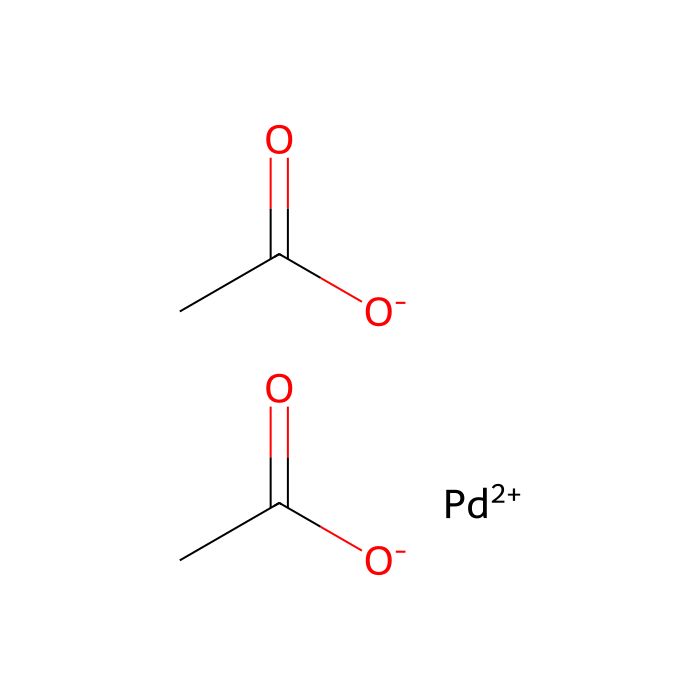
Palladium acetate - AR, Pd 46.0 - 48.0 % , CAS No.3375-31-3

CAS: 3375-31-3 Cat. No.: P100486 분자식: C4H6O4Pd 분자량: 224.51 Beilstein Registry Number: 6086766 EC 번호: 222-164-4
주문 가능
등급 & 순도 AR ? Analytical Reagent grade — high-purity chemicals meeting strict assay limits for lab analysis. Use when accuracy matters and trace impurities could skew results. Pd 46.0 - 48.0 %
Synonyms
Palladium (II) acetate | SR-01000389719 | EU-0040175 | BCP05504 | Palladium(II) acetate | palladium-(II) acetate | UNII-0LTG3460Y5 | Bis(acetato)palladium | Acetic Acid Palladium(II) Salt | AMY1789 | AC-677 | Diacetatopalladium | Acetic acid palladium sal
Storage
Room temperature,Desiccated
Shipped In
Normal
★
크기
USA
독일 (EU)*
가격
수량
100mg
P100486-100mg
2 재고 있음
—
US$19.90
200mg
P100486-200mg
3 재고 있음
—
US$32.90
1g
P100486-1g
3 재고 있음
—
US$129.90
5g
P100486-5g
3 재고 있음
—
US$579.90
10g
P100486-10g
2 재고 있음
—
US$1,049.90
Enter a quantity for the sizes you want to add.
🧪
이 등급을 선택하는 이유

AR, Pd 46.0 - 48.0 % AR 최소한의 기준선 간섭이 필요한 민감한 크로마토그래피 및 분석 워크플로우용.

🌡

보관 및 배송

Room temperature,Desiccated Normal 출고. 정확한 사양은 로트별 COA를 확인하세요.

📋

품질 문서

SDS, COA, 데이터시트, 사양서를 다운로드할 수 있습니다. 로트별 COA는 로트 번호 조회를 통해 확인할 수 있습니다.

📚

문헌적 근거

크로마토그래피, 유기 합성 및 교차 커플링 반응 분야의 동료 심사 논문 159편에서 인용되었습니다.

개요

Product class
M-O, Homogeneous Catalysts, Acetate Ligands


Reaction type
Cross Coupling Reactions with Arenes, CH-Activation, Carbonylation, Mizoroki Heck Coupling Reaction, Sonogashira-Hagihara Coupling Reaction, Suzuki-Miyaura Coupling Reaction, Oxidation


Chemical properties

Chemical formula

C12H18O12Pd3

Empirical formula

[Pd(OAc)2]3

Molecular weight

673.53

Metal

Pd

Theoretical metal content

47

Physical state

powder

Color

red brown

Applications & references

Synthesis of 2-(4-{2-[(2R)-2-Cyclopentyl-5-(5,7-dimethyl-[1,2,4]triazolo[1,5-a]pyrimidin-2-ylmethyl)-4-hydroxy-6-oxo-3,6-dihydro-2H-pyran-2-yl]-ethyl}-2-fluoro-phenyl)-2-methyl-propionitrile on multikilogram scale using a merging Heck coupling reaction. Compound is an inhibitor of the hepatitis C viral polymerase (HCVP) enzyme.


Reference: Org. Proc. Res. Dev. 2006, 10, 814. (DOI: 10.1021/op0600761)


Reductive carbonylation of aryl halides as an alternative and mild route for the introduction of aldehyde functionality, which is mostly desired for fine chemical and pharmaceutical intermediates to open up the wide range of further possible transformations.


Reference: Org. Proc. Res. Dev. 2007, 11, 39. (DOI: 10.1021/op060193w)


Synthesis of the pyrazolopyridinone-based p38 mitogen-activated protein kinase inhibitor including a Suzuki coupling reaction. p38 MAP kinases are intercellular serine/threonine kinases which certainly regulate the production and action of several pro-inflammatory mediators. They are also involved in disease states such as rheumatoid arthritis, Crohn’s diseases and psoriasis.


Reference: Org. Proc. Res. Dev. 2011, 15, 31. (DOI: 10.1021/op100205s)


Efficient hydroformylation of aryl triflates.

Reference: Synthesis 1996, 470 (DOI: 10.1055/s-1996-4246)


Deacetylation-Diazotation-Heck-Sequence: Carbon-Carbon bond formation with acetanilides as formal leaving groups


Reference: Adv. Synth. Catal. 2013, 355, 463 (DOI: 10.1002/adsc.201200929)


Deacetylation-Diazotation-Suzuki-Sequence: Carbon-Carbon bond formation with acetanilides as formal leaving groups.


Reference: Adv. Synth. Catal. 2013, 355, 463 (DOI: 10.1002/adsc.201200929)


Deacetylation-Diazotation-[2+2+1]-Cycloaddition:


Reference: Adv. Synth. Catal. 2013, 355, 463 (DOI: 10.1002/adsc.201200929)

사양

동의어
Palladium (II) acetate | SR-01000389719 | EU-0040175 | BCP05504 | Palladium(II) acetate | palladium-(II) acetate | UNII-0LTG3460Y5 | Bis(acetato)palladium | Acetic Acid Palladium(II) Salt | AMY1789 | AC-677 | Diacetatopalladium | Acetic acid palladium sal
사양 및 순도
AR, Pd 46.0 - 48.0 %
법률 정보
Product of Umicore
보관 조건
Room temperature,Desiccated
배송
Normal
등급
AR
Product Line
P100486-100mg
이름과 식별자
Pubchem Sid
Pubchem Sid Url
https://pubchem.ncbi.nlm.nih.gov/substance/508816758
정식 스마일
CC(=O)[O-].CC(=O)[O-].[Pd+2]
IUPAC Name
palladium(2+);diacetate
InChIKey
YJVFFLUZDVXJQI-UHFFFAOYSA-L
INCHI
1S/2C2H4O2.Pd/c2*1-2(3)4;/h2*1H3,(H,3,4);/q;;+2/p-2
이성체 SMILES
CC(=O)[O-].CC(=O)[O-].[Pd+2]
WGK 독일
3
RTECS
AJ1900000
UN 번호
3077
포장 그룹
III
분자량
224.51
Beilstein
6086766
Reaxy-Rn
3602276
Reaxys-RN_link_address
https://www.reaxys.com/reaxys/secured/hopinto.do?context=S&query=IDE.XRN=3602276&ln=

문서

📋 안전 데이터 시트(SDS)

위험성, 취급, 보관 및 규제 준수를 포괄하는 종합 문서.

<<<<<<< HEAD SDS 다운로드 → ======= SDS 다운로드 → >>>>>>> release248-p3

✅ 분석 성적서(COA)

로트별 품질 데이터. 로트 번호를 입력하여 정확한 COA를 확인하세요.

COA 조회 →

📊 데이터시트

제품 사양 및 응용 분야에 대한 빠른 참조 요약.

데이터시트 보기 →

🔬 사양서

이 등급의 전체 품질 특성 및 합격 기준.

사양서 보기 →

고급 데이터

Taxonomic Classification

Taxonomy Tree

KingdomOrganic compounds
SuperclassOrganic acids and derivatives
분류Carboxylic acids and derivatives
SubclassCarboxylic acids
Intermediate Tree Nodes Not available
Direct ParentCarboxylic acids
Alternative Parents Monocarboxylic acids and derivatives  Organic salts  Organic oxides  Hydrocarbon derivatives  Carbonyl compounds  
Molecular FrameworkNot available
Substituents Monocarboxylic acid or derivatives - Carboxylic acid - Organic oxygen compound - Organic oxide - Hydrocarbon derivative - Organic salt - Organooxygen compound - Carbonyl group - Aliphatic acyclic compound
설명This compound belongs to the class of organic compounds known as carboxylic acids. These are compounds containing a carboxylic acid group with the formula -C(=O)OH.
External Descriptors Not available
3D 구조
상호 작용 화학 구조 모델


인증서(CoA, COO, BSE/TSE 및 분석 차트)
C of A & Other Certificates(BSE/TSE, COO):
Analytical Chart:

Find and download the COA for your product by matching the lot number on the packaging.

32 results found

Lot NumberCertificate Type날짜항목
K2208468K2208468Certificate of AnalysisAug 03, 2026 P100486
K2208463K2208463Certificate of AnalysisAug 03, 2026 P100486
B2628585B2628585Certificate of AnalysisMar 19, 2026 P100486
B2628586B2628586Certificate of AnalysisMar 19, 2026 P100486
B2628608B2628608Certificate of AnalysisMar 19, 2026 P100486
B2628611B2628611Certificate of AnalysisMar 19, 2026 P100486
J2623034J2623034Certificate of AnalysisMar 19, 2026 P100486
J2614019J2614019Certificate of AnalysisMar 19, 2026 P100486
F2215223F2215223Certificate of AnalysisMar 18, 2026 P100486
F2215224F2215224Certificate of AnalysisMar 18, 2026 P100486
L2524126L2524126Certificate of AnalysisDec 30, 2025 P100486
L2501110L2501110Certificate of AnalysisDec 03, 2025 P100486
L2102652L2102652Certificate of AnalysisSep 09, 2025 P100486
L2102651L2102651Certificate of AnalysisSep 09, 2025 P100486
L2102649L2102649Certificate of AnalysisSep 09, 2025 P100486
A2111413A2111413Certificate of AnalysisNov 13, 2024 P100486
A2111412A2111412Certificate of AnalysisNov 13, 2024 P100486
J2417693J2417693Certificate of AnalysisJul 16, 2024 P100486
J2417692J2417692Certificate of AnalysisJun 27, 2024 P100486
J2417281J2417281Certificate of AnalysisJun 27, 2024 P100486
J2417691J2417691Certificate of AnalysisJun 27, 2024 P100486
I2005009I2005009Certificate of AnalysisJun 17, 2024 P100486
I2005008I2005008Certificate of AnalysisJun 17, 2024 P100486
I2005007I2005007Certificate of AnalysisJun 17, 2024 P100486
D2422101D2422101Certificate of AnalysisApr 29, 2024 P100486
B2423057B2423057Certificate of AnalysisFeb 27, 2024 P100486
J2325039J2325039Certificate of AnalysisOct 27, 2023 P100486
I2405041I2405041Certificate of AnalysisDec 11, 2021 P100486
F2215235F2215235Certificate of AnalysisDec 11, 2021 P100486
F2215222F2215222Certificate of AnalysisDec 11, 2021 P100486
E2509020E2509020Certificate of AnalysisDec 11, 2021 P100486
A2509120A2509120Certificate of AnalysisDec 11, 2021 P100486
화학 및 물리적 특성
용해성Soluble in Acetone
녹는점(°C)216.3-223.7°C
분자량224.510 g/mol
XLogP3
Hydrogen Bond Donor Count0
Hydrogen Bond Acceptor Count4
Rotatable Bond Count0
Exact Mass223.93 Da
Monoisotopic Mass223.93 Da
Topological Polar Surface Area80.300 Ų
Heavy Atom Count9
Formal Charge0
Complexity25.500
Isotope Atom Count0
Defined Atom Stereocenter Count0
Undefined Atom Stereocenter Count0
Defined Bond Stereocenter Count0
Undefined Bond Stereocenter Count0
The total count of all stereochemical bonds0
Covalently-Bonded Unit Count3
자주 묻는 질문과 기사
Basic Concepts about Catalysts
Interleukins - the communications arm of the immune response
Acrylonitrile
N-Fluoro-2,4,6-trimethylpyridinium triflate
White Catalyst
PMHS, Polymethylhydrosiloxane
One-Stop Handbook for Palladium-Catalyzed Reactions: Catalytic Cycles, Deactivation Troubleshooting, Ligand/Precatalyst Selection, and an Aladdin Reference List
From Piperidine to Pyridine: The “Most Common N-Heterocycle” Shift in FDA Small-Molecule New Drugs (2013–2023) and a Selection Guide (Tables 1–4)
A Practical Guide to Organozinc Reagents for Synthesis (Organozinc Reagents): Structural Features, Key Reactions, and a Practical Selection Navigation (Including Aladdin Product Tables)
Selection Guide to Precious-Metal Salts & Precursors: From Speciation to a Reproducible Starting Point (with Product Navigator and Tables 1–3)
Transition-Metal Salts/Precursor Selection Guide: How “Different Salts of the Same Metal” Start from Different Chemical Realities—and How to Reproduce Results (including a Selection Navigator and Product Tables 1–5)
Make “Aryl Chlorides + Low Pd Loading + Scale-Up Reproducibility” Reliable: The Initiation and Durability Logic of Pd–NHC (Palladium–N-Heterocyclic Carbene) Cross-Coupling (with Selection Navigation and Product Tables)
Choosing Boron Sources to Make Reactions Robust: How Boronic Acids, Boronate Esters, BF₃K Salts, and MIDA Improve Suzuki–Miyaura Start-Up and Scale-Up Reproducibility (with Product Tables 1–5)
How to Make the Suzuki–Miyaura Reaction Robust: Pinpoint the Bottleneck and Lock in a Reproducible Operating Window (with Selection Navigation and Product Tables 1–5)
How to Construct Nitriles: Route Selection Across Direct Introduction, Precursor Dehydration, Oxidation/Dehydrogenation, and Cyanide-Free Processes
Experimental Selection Logic for C-C Bond Construction: Understanding Fragment Coupling, Carbonyl Chain Extension, Olefination, and Late-Stage Bond-Forming Pathways by Bond-Forming Task
Reaction Selection in Small-Molecule Synthesis: From Transformation-Type Assessment to Experimental Route Screening
Experimental Selection Logic for Transition-Metal-Catalyzed C–H Functionalization: When It Is Worth Pursuing and How to Assess Site Selectivity and Conditions
Experimental Decision-Making for Cross-Coupling Reactions: Target Bond Type, Substrate Combination, and Catalytic System Selection
Deoxyfluorination of Hydroxyalkyl-Substituted Aryl/Alkenyl Boronates: C–F Bond Construction and C–B Bond Retention via a BF3K Intermediate
CTSOBt Benzotriazole–Sulfonate Coupling Reagent: Carboxylic Acid Activation and Synthetic Application Value
Medicinal Chemistry Design of the Indazole Scaffold: Tautomerism, Molecular Recognition, Substitution-Site Design, and Synthetic Strategies
Where Does the Selectivity in Piperidine C–H Functionalization Come From? — Nitrogen Effects, Chair Conformations, and Four Classes of Key Intermediates
Air Decomposition of Solid Sodium Methoxide and Sodium Ethoxide—Effects on Cross-Coupling Reaction Optimization and Reproducibility
Citations of This Product
솔루션 계산기
리뷰

고객 리뷰

Shall we send you a message when we have discounts available?

Remind me later

Thank you! Please check your email inbox to confirm.

Oops! Notifications are disabled.