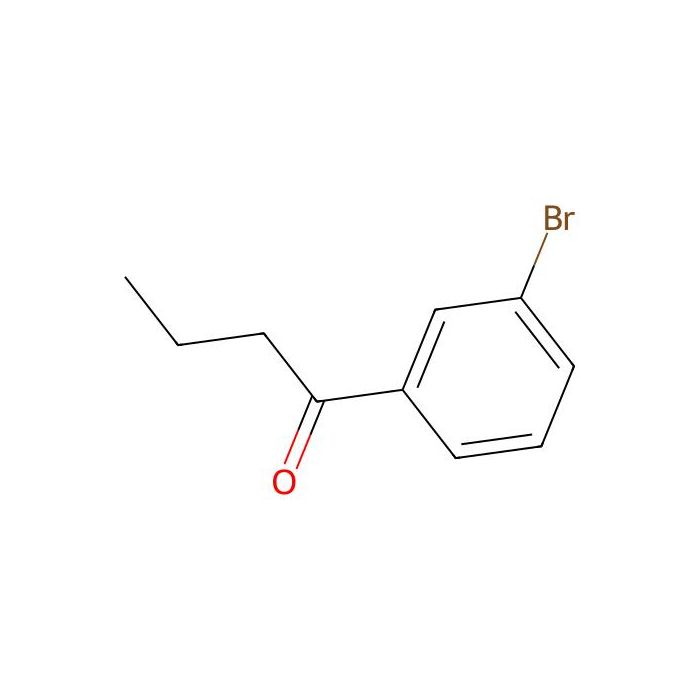
This compound belongs to the class of organic compounds known as alkyl-phenylketones. These are aromatic compounds containing a ketone substituted by one alkyl group, and a phenyl group.
External Descriptors
Not available
1. Djoumbou Feunang Y, Eisner R, Knox C, Chepelev L, Hastings J, Owen G, Fahy E, Steinbeck C, Subramanian S, Bolton E, Greiner R, and Wishart DS. ClassyFire: Automated Chemical Classification With A Comprehensive, Computable Taxonomy. Journal of Cheminformatics, 2016, 8:61.
Zertifikate (CoA, COO, BSE/TSE und Analyse-Diagramm)
C of A & Other Certificates(BSE/TSE, COO):
Analytical Chart:
Chemische und physikalische Eigenschaften
Molekulargewicht
227.100 g/mol
XLogP3
3.100
Hydrogen Bond Donor Count
0
Hydrogen Bond Acceptor Count
1
Rotatable Bond Count
3
Exact Mass
225.999 Da
Monoisotopic Mass
225.999 Da
Topological Polar Surface Area
17.100 Ų
Heavy Atom Count
12
Formal Charge
0
Complexity
156.000
Isotope Atom Count
0
Defined Atom Stereocenter Count
0
Undefined Atom Stereocenter Count
0
Defined Bond Stereocenter Count
0
Undefined Bond Stereocenter Count
0
The total count of all stereochemical bonds
0
Covalently-Bonded Unit Count
1
Lösungsrechner
Molarity Calculator
Determine the necessary mass, volume, or concentration for preparing a solution.
Dilution Calculator
Determine the dilution needed to prepare a stock solution.
Reconstitution Calculator
Bewertungen
Kundenbewertungen
Application Protocols
Not applicable. No validated bioassay or immunoassay protocols are associated with this small-molecule intermediate.
For chemical applications, follow standard organic synthesis protocols provided in the Reaction Conditions and Synthetic Utility sections and consult primary literature for detailed procedures.
Biological Roles
This compound is a synthetic organic intermediate and does not have recognized endogenous biological roles.
General context (literature):
Aryl alkyl ketones can interact with biological membranes due to hydrophobicity; however, 1-(3-bromophenyl)butan-1-one is intended for laboratory research and chemical synthesis only.
No known participation in metabolic pathways or biochemical signaling has been established for this specific structure.
Practical note:
Any bioassay use should be exploratory and controlled; ensure appropriate DMSO or solvent controls due to low aqueous solubility.
No medical or clinical claims are made; product is supplied strictly for research use.
Buffer Applications
Not typically applicable. 1-(3-Bromophenyl)butan-1-one is a hydrophobic organic building block and is not used to prepare aqueous buffer systems.
If dissolution in aqueous media is needed for assays, consider:
Preparing concentrated DMSO or EtOH stock solutions and diluting into buffer with vigorous mixing, keeping final organic content low (≤1–2% v/v) to avoid precipitation.
Using surfactants or cyclodextrin carriers only if appropriate for the experimental design.
Green Alternatives
Greener practices focus on solvent and catalyst choices when using 1-(3-bromophenyl)butan-1-one, as the molecule itself is a fixed intermediate.
Solvent optimization (literature/general):
Prefer EtOAc, 2-MeTHF, MeTHF/water, or toluene over chlorinated solvents where feasible. For Suzuki couplings, water/dioxane or water/ethanol mixtures can be effective with suitable ligands.
For reductions, choose isopropanol as both solvent and hydrogen donor in transfer hydrogenation (e.g., Ru- or Ir-catalyzed) to avoid metal hydrides.
Catalysis and energy:
Employ ligand-optimized Pd catalysts at ppm levels or Ni catalysis for cross-coupling to reduce precious metal loadings.
Microwave or flow chemistry may cut reaction times and improve heat/mass transfer, reducing energy input and improving safety for exothermic steps.
Workup/waste minimization:
Favor aqueous base workups over stoichiometric inorganic salts where possible; implement in-line scavengers for Pd/Ni to reduce metal content.
Replace silica-heavy chromatography with crystallization or precipitation-induced purification when the product’s polarity enables it.
Comparison snapshot (general trade-offs):
2-MeTHF vs THF: 2-MeTHF is bio-derived and less miscible with water (easier separations) but can have peroxide concerns similar to THF; drying can be slower.
EtOAc vs DCM: EtOAc is less toxic and biodegradable but has higher bp and can co-elute impurities differently; may require process tuning.
Pharmaceutical Uses
No excipient or formulation role is indicated for this item.
General industry context (literature):
Aryl bromoketones like 1-(3-bromophenyl)butan-1-one may serve as intermediates in multi-step syntheses during discovery or process chemistry due to their dual reactivity (aryl bromide and ketone). They are not typical as approved excipients.
Regulatory listings (e.g., pharmacopeial monographs) are not commonly available for such niche intermediates; process-specific quality targets (residual metals/solvents, impurities) are set case-by-case.
Practical guidance:
When used in a synthetic route toward an API, ensure trace metal and residual solvent levels meet program-specific thresholds; adopt appropriate ICH Q3-aligned controls. No therapeutic claims are made.
Physical Properties
Item-specific specifications: Not specified for this item; refer to CoA/Spec Sheet.
Literature/general expectations for the compound class (aryl alkyl ketones with m-bromo substituent):
Physical state/appearance (literature): Often a colorless to pale yellow liquid or low-melting solid depending on purity and temperature; aromatic odor typical of aryl ketones.
Boiling point / melting point: Specific values for this exact isomer are not cited here; consult primary references or CoA. Aryl bromoketones of similar size typically boil in the 250–300 °C range at ambient pressure (literature, compound-class guidance).
Density: Typically higher than non-brominated analogs due to Br; exact value not compiled here.
Solubility (general): Low in water; miscible with many organic solvents (e.g., DCM, THF, EtOAc, toluene, ethers, alcohols) (literature/class behavior).
LogP: Expected moderate to high hydrophobicity due to aryl/alkyl and bromo substituent (literature trend).
Refractive index: Often elevated relative to non-halogenated analogs; exact value not compiled.
Practical handling notes (general):
Dry material can be important for enolate chemistry; brief drying over molecular sieves (3Å/4Å) for solutions is common practice (literature guidance).
For analytical purposes, GC or HPLC with UV detection at 254 nm typically gives strong signals due to the aryl chromophore (general observation).
Quality and Grades
Item-specific grade/purity: Not specified for this item; refer to CoA/Spec Sheet.
Guidance on interpreting grades (general):
Analytical/AR grade: Typically suitable for qualitative/quantitative analysis; tighter impurity specs.
Synthesis grade: Appropriate for most synthetic transformations; impurity levels acceptable for preparative work.
HPLC grade solvents/reagents: Low UV background; relevant if compound is used as mobile phase additive or analyte standard (less typical here).
Stabilizers/inhibitors: None indicated for this product. If inhibitor-free material is critical (e.g., for photochemistry or sensitive organometallic steps), verify by CoA.
Quality control suggestions (general for aryl ketones):
Identity: 1H/13C NMR (diagnostic carbonyl at ~195–200 ppm; benzylic/α-CH2 at ~2.9–3.4 ppm), IR (C=O ~1680–1710 cm−1), and MS (m/z pattern showing Br isotopic doublet, M/M+2).
Purity: GC or HPLC assay; check for aldehyde, over-alkylated, or debrominated impurities. Residual solvents by GC-HS when necessary.
Water: Karl Fischer if moisture-sensitive chemistry is planned.
For definitive specifications and acceptance criteria, use the lot-specific CoA/Spec Sheet.
Reaction and Applications
This molecule is a versatile bifunctional building block featuring both an aryl bromide (cross-coupling handle) and an enolizable aryl alkyl ketone (carbonyl chemistry). Representative uses (literature/general):
Aryl bromide transformations:
Suzuki–Miyaura coupling: Formation of 3-arylpropiophenones from aryl boronic acids. Pd(PPh3)4 or Pd2(dba)3/XPhos; bases like K2CO3, Cs2CO3; solvents dioxane/H2O, toluene, or THF.
Buchwald–Hartwig amination: Introduction of anilines or amines at the 3-position; BrettPhos or RuPhos ligands under Pd catalysis.
Sonogashira coupling: Access to meta-alkynylated propiophenones, useful for further cyclizations; use Pd/Cu co-catalysis or copper-free protocols.
Lithium–halogen exchange: With n-BuLi at low temperature to generate 3-lithiophenyl ketone intermediates for formylation or electrophile capture (observe compatibility with the ketone; often protect as ketimine or use directed metalation strategies).
Carbonyl/α-carbon chemistry:
Reduction: NaBH4/Luche to the corresponding secondary alcohol; catalytic hydrogenation (Raney Ni, Pd/C) reduces C=O under pressure.
Oxime/hydrazone formation: With hydroxylamine or hydrazines; precursors to Wolff–Kishner or Beckmann pathways.
Enolate alkylation/halogenation: LDA or NaHMDS to form the kinetic enolate; α-alkylation, α-halogenation, or aldol condensations.
Baeyer–Villiger oxidation: Conversion to the corresponding aromatic ester (migration preferences apply).
Utility in materials/medchem synthesis (general):
Used as a convergent intermediate to introduce meta substitution into aromatic scaffolds while modulating lipophilicity and electronics via the ketone. No medical/clinical claims implied.
Practical tips: Protect or transiently mask the carbonyl when employing highly basic metalation; for couplings, the carbonyl generally survives standard Pd/Ni conditions.
Reaction Conditions
Representative literature-style conditions for transformations of aryl bromoketones (general guidance; adjust per substrate and scale):
Catalyst: Pd(PPh3)2Cl2 (1–2 mol%) + CuI (5–10 mol%) or copper-free systems with bulky ligands.
Base: Et3N, i-Pr2NH.
Solvent: THF, DMF, or toluene.
Temp: 50–80 °C, 2–8 h.
Carbonyl reduction to alcohol:
NaBH4: MeOH or EtOH, 0–25 °C, 0.5–2 h.
Luche (NaBH4, CeCl3): Preferential 1,2-reduction in protic solvents.
Catalytic hydrogenation: Pd/C (5–10 wt%), 1–5 bar H2, EtOH, 25–50 °C.
Enolate alkylation:
Base: LDA (1.1–1.5 equiv) in THF at −78 to −20 °C; then electrophile (alkyl halide). Quench at ≤0 °C.
These are generalized conditions derived from analogous aryl bromoketone literature and should be optimized experimentally.
Safety and Handling
Item-specific hazard classifications: Not specified for this item; refer to SDS.
Signal Word: Not specified for this item; refer to SDS.
H-Statements: Not specified for this item; refer to SDS.
GHS Classification: Not specified for this item; refer to SDS.
Pictograms: Not specified for this item; refer to SDS.
General safety guidance for aryl bromoketones (literature/experience-based; not a substitute for SDS):
Irritation: May cause skin/eye/respiratory irritation; avoid inhalation of vapors and contact with skin/eyes.
PPE: Lab coat, safety glasses or goggles, nitrile gloves; work in a fume hood. Use splash protection when scaling up.
Incompatibilities: Strong oxidizers (risk of exotherm), strong bases/acids (can promote side reactions such as aldol or halogen–metal exchange), and strong nucleophiles that may attack the carbonyl or effect substitution on the aryl bromide under forcing conditions.
Thermal decomposition: Combustion may produce HBr and brominated aromatics; ensure good ventilation and have appropriate fire extinguishing media (CO2, dry chemical, foam) available.
Spill/first aid (overview): Absorb small spills with inert material; avoid discharge to drains. In case of contact, rinse with water for ≥15 min; if inhaled, move to fresh air and seek medical attention as needed.
Peroxide formation: Not a common hazard for ketones of this type (unlike ethers), but routine periodic inspection is good practice.
Always consult the product-specific SDS for authoritative and complete safety information.
Solvent Selection
As a moderately polar, hydrophobic aryl alkyl ketone, 1-(3-bromophenyl)butan-1-one dissolves well in common organic solvents and poorly in water.
Polarity/miscibility (general behavior):
Good solubility: DCM, chloroform, toluene, THF, EtOAc, acetone, MTBE/ethers, alcohols (MeOH/EtOH/i-PrOH) to varying extents.
Limited solubility: Water.
Typical choices by operation (general guidance):
Extraction/workup: DCM or EtOAc versus aqueous media provide robust phase separation; toluene/heptane useful for nonpolar washes or crystallization trials.
Enolate chemistry/α-functionalization: Anhydrous THF, toluene, or DME under inert atmosphere; add co-solvent like HMPA substitute (DMPU) when stronger polarization needed (observe safety for polar aprotics).
Cross-coupling on aryl bromide: Dioxane, THF, toluene, or mixed aqueous-organic (e.g., dioxane/H2O) depending on base and catalyst.
Reductions (NaBH4/Luche): Alcoholic solvents (MeOH/EtOH/i-PrOH) or biphasic systems; for chemoselectivity, consider CeCl3 for Luche conditions (alcoholic medium).
Brief comparison (literature properties of solvents):
THF (ε ≈ 7.6): Good for organometallic/enolate formation; low boiling (66 °C) aids removal.
Toluene (ε ≈ 2.4): Nonpolar, high bp (111 °C), good for high-temp couplings.
1,4-Dioxane (ε ≈ 2.2): Common in Suzuki; blends with water; higher bp (101 °C).
EtOAc (ε ≈ 6): Versatile for workups and chromatography; greener than chlorinated solvents.
Storage and Reconstitution
Item-specific storage and shipping:
Storage Conditions: Room temperature (per Product Data).
Shipped In: Not specified for this item; refer to CoA/Spec Sheet.
General storage guidance (for aryl bromoketones):
Store tightly closed in a dry, well-ventilated place, away from light and heat sources. An amber glass bottle is preferred to minimize photodegradation.
If frequent opening is expected, consider an inert gas blanket (N2/Ar) to limit oxidation/hydrolysis, particularly in humid environments.
Avoid prolonged contact with strong bases/acids and oxidizers. Keep desiccant nearby if humidity control is needed.
Reconstitution/solution preparation:
Readily prepared stock solutions in DCM, THF, toluene, EtOAc, MeOH/EtOH, or DMSO. Filter through a PTFE syringe filter (0.45 μm) if particulates are present.
For bioassays, prepare concentrated DMSO stocks (e.g., 10–100 mM) and dilute into aqueous buffers keeping final DMSO low (≤1–2% v/v) to avoid precipitation.
Stability notes (general):
Ketones of this class are typically stable at ambient conditions for extended periods when sealed and protected from moisture/light. Verify integrity by NMR/GC before critical uses.
Structure and Identity
A meta-brominated aryl alkyl ketone combining an electrophilic aryl bromide with a butan-1-one carbonyl, offering two orthogonal handles for synthesis.
Item-specific identifiers (from Product Data):
SKU: B952918
Product Name: 1-(3-Bromophenyl)butan-1-one
CAS: 207994-95-4
PubChem CID: 18417701
InChIKey: 407088 (as provided)
SMILES: Not specified for this item; refer to CoA/Spec Sheet.
Molecular Formula: Not specified for this item; refer to CoA/Spec Sheet.
Molecular Weight: Not specified for this item; refer to CoA/Spec Sheet.
Literature/computed identifiers and features (for reference; not item specifications):
Common name alignment: Often described as m-bromopropiophenone (propiophenone core, meta-bromo substituent).
Expected formula (literature): C9H9BrO
Calculated MW (literature): ~213.07 g/mol
Representative SMILES (literature): CCC(=O)c1cccc(Br)c1 (one of several equivalent forms)
Structural description (general chemistry):
Core: Monosubstituted benzene bearing a meta-bromine and a propiophenone (butan-1-one) side chain.
Functional groups: Aryl bromide (for cross-coupling/halogen–metal exchange) and an aryl aliphatic ketone (enolizable, reducible, convertible to oxime/hydrazone).
Stereochemistry: None (achiral); enolization possible at the α-methylene of the butanone moiety.
2D structure in words: A benzene ring with Br at the 3-position relative to a carbonyl-bearing ethyl chain (Ph–CO–CH2–CH3), i.e., meta-brominated propiophenone.
Synthetic Utility
The molecule offers a powerful combination of handles for divergent synthesis.
Aryl bromide handle (meta to the acyl chain):
Cross-coupling manifold: Suzuki (C–C), Buchwald–Hartwig (C–N), Sonogashira (C–C≡C), Negishi/Kumada (C–C) enable rapid diversification of the 3-position.
Directed metalation strategies: Though bromine assists lithiation, the adjacent carbonyl can influence regioselectivity; protecting the carbonyl (ketal/imine) helps withstand strong bases.
Ketone handle (butan-1-one side chain):
Enolate chemistry: α-alkylation/acylation, aldol condensations, and α-heteroatom installation (Cl/Br/I, SR) using LDA/NaHMDS or softer bases for thermodynamic control.
Redox: Chemoselective reduction to secondary alcohols; chemoselective oxidation of α-positions or Baeyer–Villiger to esters.
Derivatizations: Oxime/hydrazone formation, Wolff–Kishner or Clemmensen reductions to homologated alkylbenzenes.
Retrosynthetic value:
Accessible via Friedel–Crafts acylation (or acyl chloride routes) onto m-bromobenzene or by bromination of a propiophenone followed by positional control; conversely, it is a node to reach multiple 3-substituted propiophenone analogs.
Selectivity considerations:
Cross-coupling typically tolerates ketones; strong bases for metal–halogen exchange risk carbonyl addition. Use temperature control and protective groups as needed.
Overall, 1-(3-bromophenyl)butan-1-one functions as a flexible intermediate to build meta-substituted aryl frameworks with tunable side chains.
Target Specificity
Not applicable. This product is a small-molecule chemical intermediate and not a biological affinity reagent. No antigen/epitope/clone/isotype information applies.
Wir verwenden Cookies, um die ordnungsgemäße Funktion der Website sicherzustellen und, soweit zulässig, Ihr Nutzererlebnis zu verbessern. Sie können Ihre Einstellungen jederzeit unter „Einstellungen“ verwalten. Weitere Informationen finden Sie in unserer Cookie-Richtlinie.
Dürfen wir Sie über Rabattaktionen informieren?
Später erinnern
Vielen Dank! Bitte überprüfen Sie Ihren E-Mail-Posteingang, um zu bestätigen.
Products are supplied to verified businesses, institutions, and qualified professionals for research and development use only. Not for use in humans, animals, diagnosis, or therapy.