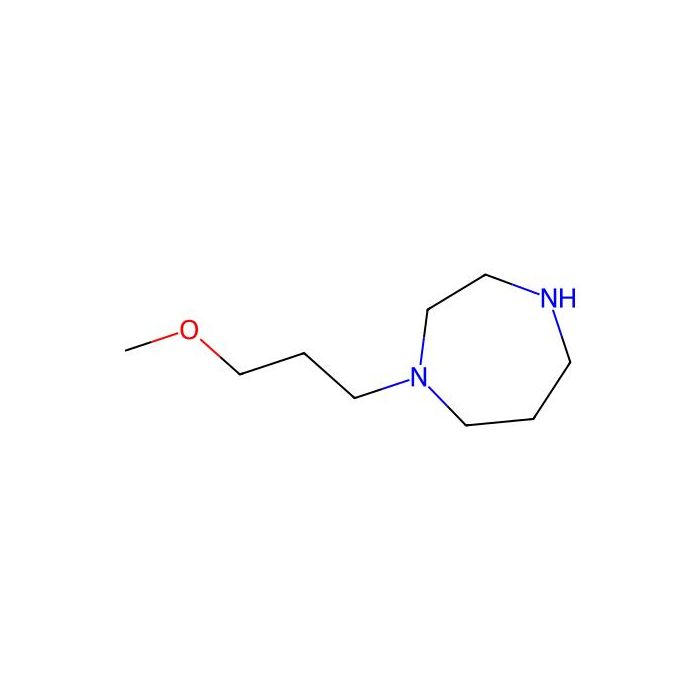
This compound belongs to the class of organic compounds known as 1,4-diazepanes. These are diazepanes having the two nitrogen atoms at position 1 and 4 of the diazepane ring.
External Descriptors
Not available
1. Djoumbou Feunang Y, Eisner R, Knox C, Chepelev L, Hastings J, Owen G, Fahy E, Steinbeck C, Subramanian S, Bolton E, Greiner R, and Wishart DS. ClassyFire: Automated Chemical Classification With A Comprehensive, Computable Taxonomy. Journal of Cheminformatics, 2016, 8:61.
Zertifikate (CoA, COO, BSE/TSE und Analyse-Diagramm)
C of A & Other Certificates(BSE/TSE, COO):
Analytical Chart:
Chemische und physikalische Eigenschaften
Molekulargewicht
172.270 g/mol
XLogP3
0.200
Hydrogen Bond Donor Count
1
Hydrogen Bond Acceptor Count
3
Rotatable Bond Count
4
Exact Mass
172.158 Da
Monoisotopic Mass
172.158 Da
Topological Polar Surface Area
24.500 Ų
Heavy Atom Count
12
Formal Charge
0
Complexity
109.000
Isotope Atom Count
0
Defined Atom Stereocenter Count
0
Undefined Atom Stereocenter Count
0
Defined Bond Stereocenter Count
0
Undefined Bond Stereocenter Count
0
The total count of all stereochemical bonds
0
Covalently-Bonded Unit Count
1
Lösungsrechner
Molarity Calculator
Determine the necessary mass, volume, or concentration for preparing a solution.
Dilution Calculator
Determine the dilution needed to prepare a stock solution.
Reconstitution Calculator
Bewertungen
Kundenbewertungen
Application Protocols
No vendor-validated biological application protocols (e.g., WB, IHC, IF, FC) are associated with this small-molecule reagent. For synthetic use, follow standard organic chemistry protocols as outlined under Reaction Conditions and Synthetic Utility.
If employing in materials or bioassay development, establish internal SOPs for dilution, handling, and disposal based on your specific use case and the SDS.
Biological Roles
This product is supplied strictly for research use. No biological role or function is assigned for this catalog item.
General context (literature): Aliphatic polyamines can interact with biological macromolecules via electrostatic and hydrogen-bonding interactions when protonated; however, specific transport, metabolism, or enzymatic interactions are highly structure-dependent and not established for this exact compound in our product data.
Use in life-science workflows: Such amines may be explored as components in materials, surface modifiers, or as intermediates to prepare probes or ligands. Any biological testing should be performed under appropriate institutional approvals and is outside the scope of this product description.
No clinical or in vivo claims are made or implied.
Buffer Applications
Not typically used as a defined buffer system. While polyamines can exhibit buffering capacity around their pKa values when present as mixtures of free base and conjugate acid, this compound is not a standard buffer reagent with an established pH range or formulation.
For pH adjustments or ionic strength control, use validated buffers (e.g., phosphate, HEPES, Tris). If using this amine in a research context where buffering is ancillary, verify pH stability and compatibility empirically.
No item-specific buffer formulations or pKa data are provided; consult primary literature if exploring bespoke buffering systems.
Green Alternatives
As a nitrogenous building block rather than a process solvent, “green alternatives” center on how it is used and processed rather than replacing the molecule itself.
Solvent choices: Prefer bio-derived or lower-toxicity solvents when feasible (2-MeTHF over THF; CPME or EtOAc over DCM; water/MeOH mixtures for salt manipulations). Avoid chlorinated solvents unless necessary for selectivity.
Workups and isolation: Isolate as a benign mineral acid salt (e.g., citrate, acetate, or HCl) to reduce VOC emissions from solvent-intensive distillations. Employ antisolvent crystallization instead of chromatographic purification when possible.
Bases and reagents: For acylations/alkylations, use inorganic carbonates or weak organic bases before resorting to strong, hazardous bases. Explore enzymatic or biocatalytic routes for selective N-functionalizations where compatible (literature/general).
Process intensification: Conduct reactions at higher substrate concentrations in flow or with solvent recycling to cut E-factors. Apply in situ scavengers and solid-supported reagents to minimize solvent use in purifications.
Illustrative comparison (general guidance):
THF vs 2-MeTHF: similar polarity; 2-MeTHF is partially bio-based and has improved safety profile; tradeoff is slightly higher boiling point and water miscibility nuances.
DCM vs EtOAc/CPME: EtOAc/CPME are less problematic environmentally; may require longer reaction times or different bases to maintain selectivity.
Note: No item-specific green certification or manufacturing route is specified; consult CoA/SDS and your sustainability guidelines.
Pharmaceutical Uses
No pharmacopeial status, excipient role, or GMP grade is specified for this item. It is offered for research use only.
General context (non-clinical): Tertiary/secondary amines and diazepane scaffolds can serve as intermediates in the synthesis of candidate molecules or ionizable auxiliaries in process development. Any application toward pharmaceutical manufacturing would require independent qualification, impurity control, and regulatory assessment not covered by this listing.
Formulation note: Amines form crystalline acid addition salts that can improve handling and purification in discovery workflows; however, no specific salt forms are provided for this item.
Always consult your QA/QC and regulatory teams before using research-grade reagents in regulated environments.
Physical Properties
Appearance: Not specified for this item; refer to CoA/Spec Sheet.
Grade/Purity: Not specified for this item; refer to CoA/Spec Sheet.
Molecular weight / formula: Not specified for this item; refer to CoA/Spec Sheet.
• Literature/computed for the neutral free base consistent with the name: MW ~173.28 g/mol; formula C9H21N2O (literature/computed).
Boiling point, melting point, density, refractive index: Not specified for this item; refer to CoA/Spec Sheet.
Solubility: Not specified for this item; refer to CoA/Spec Sheet.
• Literature expectation: Dialkylated diazepanes with an ether arm are generally miscible with polar organics (MeOH, EtOH, MeCN, acetone) and display high water solubility in protonated form due to two basic nitrogens (literature/general).
pKa (conjugate acids): Literature values for analogous 1,4-diazepanes show two basic sites with pKaH typically in the ~9–11 range depending on substitution; N-alkylation and a terminal ether modestly modulate basicity (literature/general; indicative only).
LogP/LogD: Not specified for this item; refer to CoA/Spec Sheet.
• Literature expectation: Neutral base logP low-to-moderate due to one ether and two amines; logD strongly decreases under acidic conditions (protonation) (literature/general).
Note: Item-specific physicochemical specifications (e.g., water content, UV cutoff, residual metals) are not provided here; consult the product CoA/SDS for definitive values.
Quality and Grades
Grade/Purity: Not specified for this item; refer to CoA/Spec Sheet for assay, impurity profile, and any stabilizers.
What to expect: For amine building blocks, typical quality documentation includes identity confirmation (1H/13C NMR, MS), assay (%), residual solvents, and where relevant, titratable amine value and water content (Karl Fischer). UV absorbance specifications may be included when intended for chromatographic applications; if not listed, no assumption should be made.
Stabilizers: Not specified for this item; refer to CoA/Spec Sheet. Most secondary/tertiary aliphatic amines do not require added stabilizers; if added, stabilizers should be disclosed on the CoA and may affect certain reactions (e.g., acid scavenging efficiency).
Trace metals/ionic contaminants: Not specified for this item; refer to CoA/Spec Sheet. For catalysis-sensitive applications (e.g., cross-coupling ligand screening), verify metal content.
Identity & lot traceability: Use provided CAS (1183783-04-1) and catalog SKU (M953769) for procurement and documentation. For regulated workflows, retain CoA and lot-specific spectral data as part of your batch records.
Reaction and Applications
1-(3-Methoxypropyl)-1,4-diazepane is a versatile polyamine/ether scaffold. The two ring nitrogens provide differential reactivity (tertiary vs secondary), while the terminal ether enhances solubility and can act as a weak coordinating site.
Acylation and carbamoylation: The secondary ring nitrogen (N4) can be selectively acylated (acid chlorides, anhydrides, CDI-activated acids) to give amides/carbamates. Good base solubility in polar aprotic solvents favors clean conversions.
Alkylation/quaternization: N-alkylation at the secondary N with alkyl halides (SN2, using K2CO3/Na2CO3 or stronger bases) affords tertiary amines; exhaustive alkylation furnishes ammonium salts (phase-transfer catalysts or ionic intermediates).
Salt formation: Readily forms crystalline mineral acid salts (HCl, HBr, H2SO4), facilitating purification, isolation, and handling. Salts also modulate solubility for downstream transformations.
Reductive amination: As a nucleophile toward aldehydes/ketones (via iminium formation, then reduction with NaBH3CN, NaBH(OAc)3, or catalytic hydrogenation) to introduce additional substituents on the secondary nitrogen.
Metal complexation/ligating behavior: Polydentate nature (two nitrogens + ether oxygen) can chelate transition metals in homogeneous catalysis or materials assembly (literature/general). Useful in screening catalyst ligands where flexible bite angles are desired.
Protecting/anchoring strategies: The 3-methoxypropyl arm can be elaborated (e.g., demethylation to 3-hydroxypropyl under vigorous conditions, or conversion to mesylate/tosylate for further substitution) enabling tethering to supports or intramolecular cyclizations.
Applications context: Building block for heterocycle-functionalized libraries, ion-exchange resin modifiers, and polarity-tuned organic superbases in synthesis (literature/general).
Reaction Conditions
General literature-guidance for amine functionalization with a 1,4-diazepane scaffold:
N-Acylation (secondary N):
Solvent: DCM, THF/2-MeTHF, or MeCN.
Base: Et3N, DIPEA, or Na2CO3 (aqueous biphasic) as acid scavengers.
Reagents: Acyl chlorides/anhydrides; CDI-activated acids for milder conditions.
Temp/Time: 0–25 °C, 0.5–6 h (monitor by TLC/LC-MS). Yields typically high with controlled stoichiometry (literature/general).
Reductive amination (secondary N → tertiary N):
Solvent: MeOH, EtOH, or DCE/MeOH.
Conditions: Carbonyl (1.0 eq), amine (1.2–2.0 eq), NaBH3CN or NaBH(OAc)3 (1.5–2.0 eq) at pH 5–6 (AcOH) for 2–16 h; or H2 (1–5 bar) with Pd/C at RT–40 °C (literature/general).
N-Alkylation (SN2):
Solvent: DMF, MeCN, or 2-MeTHF.
Base: K2CO3/Cs2CO3; optionally KI as catalyst.
Alkylating agents: Primary halides, mesylates, or tosylates.
Temp/Time: 25–80 °C, 2–18 h. Minimize over-alkylation by stoichiometry and time control (literature/general).
Quaternization: Reaction with MeI, MeOTf, benzyl halides in MeCN/acetone at 0–25 °C affords ammonium salts rapidly (literature/general).
Salt formation/crystallization: Dissolve free base in ether/EtOAc and add HCl in dioxane or gaseous HCl to precipitate the hydrochloride; wash and dry under vacuum.
Note: The above are general literature conditions for similar amines; optimize for your substrate, and consult primary sources. Item-specific parameters are not provided.
Safety and Handling
GHS classification, signal word, pictograms, H-statements: Not specified for this item; refer to SDS for authoritative hazard classification.
General hazards (literature/general for aliphatic polyamines): Can be irritating to skin, eyes, and respiratory tract; amines may cause burns at higher concentrations. Amines may form salts with acids and can absorb CO2 from air over time.
Personal protective equipment (PPE): Use lab coat, chemical-resistant gloves (e.g., nitrile), and splash goggles. Handle in a fume hood to minimize inhalation exposure to vapors/aerosols.
First aid (general guidance):
Skin: Remove contaminated clothing; rinse with water for ≥15 min. Seek medical advice if irritation persists.
Eyes: Rinse cautiously with water for several minutes; remove contact lenses if present and easy to do; continue rinsing and obtain medical attention.
Inhalation: Move to fresh air; monitor breathing; seek medical attention if symptoms occur.
Ingestion: Rinse mouth; do not induce vomiting; seek medical advice.
Incompatibilities (general): Strong acids (rapid salt formation, exotherm), acid chlorides/anhydrides (acylation), strong oxidizers (potential exotherm), isocyanates, epoxides, and carbonyl activators. Copper/bronze may discolor with amines; use compatible materials (glass, PTFE, stainless steel).
Handling tips: Keep containers tightly closed to limit CO2 uptake and moisture. Purge with inert gas for moisture-sensitive uses. Avoid aerosol formation.
Fire safety: Aliphatic amines are combustible; use standard Class B extinguishing media (dry chemical, CO2, foam). Combustion can produce NOx and CO/CO2.
Always defer to the product SDS and your institutional EHS procedures for definitive safety measures.
Solvent Selection
This compound is a polar, polyfunctional organic base (two amines + one ether), typically compatible with many polar media. Select solvents based on target use (as reagent, base, or ligand) and on downstream isolation strategy.
Polarity class (general): Polar, basic; expected high polarity when protonated. Miscibility generally favorable with protic (MeOH, EtOH) and aprotic polar solvents (MeCN, DMF, DMSO). Hydrocarbon miscibility may be limited unless paired with co-solvents.
Aqueous handling: The conjugate acid salts are highly water soluble. For biphasic catalysis or extraction, pH control dictates partitioning: protonation drives to aqueous phase; basification extracts the free base into organic solvents (EtOAc/MTBE/CH2Cl2) if sufficiently hydrophobic.
When to choose common solvents (general):
MeOH/EtOH: Dissolve both free base and salts; suitable for reductive amination workups or ion-exchange steps.
MeCN/THF/2-MeTHF: Good for acylation/alkylation where anhydrous conditions are preferred.
DMF/DMSO: Useful for SN2 alkylations or coupling reactions at moderate temperatures; facilitate solubilization of inorganic bases/salts.
DCM/EtOAc/MTBE: For extractions or acylation where lower polarity is beneficial; free base form partitions better.
Removal: Amines may streak on silica; deactivation (1–2% Et3N in eluent) or switch to neutral alumina. For crystallization, isolate as an acid salt (e.g., HCl) to enhance solid formation.
Drying: If water-sensitive reactions follow, dry the amine over K2CO3 or molecular sieves and handle under inert gas.
Storage and Reconstitution
Storage conditions: Room temperature (as specified). Store in a tightly sealed container in a cool, dry, well-ventilated place. Protect from strong acids/oxidants. For moisture- or CO2-sensitive operations, consider storing under inert gas.
Shipped in: Not specified for this item; refer to CoA/Spec Sheet.
Form supplied / reconstitution: Typically supplied as a neat liquid or as received; no reconstitution is necessary unless supplied as a solid salt, in which case dissolve in a compatible solvent (e.g., MeOH, MeCN, water for salts) at desired concentration.
Shelf life: Not specified for this item; refer to CoA/Spec Sheet. Check periodically for discoloration or formation of salts (viscosity change) if the container is exposed to air.
Freeze–thaw: Not generally applicable to small-molecule amines; if preparing stock solutions, store aliquots to avoid repeated opening. Aqueous salt solutions are best kept refrigerated for extended stability and monitored for microbial growth.
Always consult the product CoA/SDS for definitive handling and storage recommendations. For research use only.
Structure and Identity
A substituted 1,4-diazepane featuring a seven-membered saturated heterocycle with two ring nitrogens (positions 1 and 4). At N1, a 3-methoxypropyl substituent confers an ether terminus; N4 remains a secondary amine.
Product name (catalog): 1-(3-Methoxypropyl)-1,4-diazepane (SKU: M953769)
CAS: 1183783-04-1
Category: Life Science research reagent (研究用; Research Use Only)
InChIKey (as provided): 34881
SMILES: Not specified for this item; refer to CoA/Spec Sheet.
• Note: A reasonable structure-consistent SMILES for literature/reference use is: COCCCN1CCCNCC1 (literature/structure-derived; not an item specification).
Molecular formula: Not specified for this item; refer to CoA/Spec Sheet.
• Literature/computed for the neutral free base consistent with the name: C9H21N2O (literature/computed).
Molecular weight: Not specified for this item; refer to CoA/Spec Sheet.
• Literature/computed for C9H21N2O: ~173.28 g/mol (literature/computed).
Structural features (descriptive):
Ring system: Saturated 1,4-diazepane (seven-membered) with two endocyclic nitrogens.
Substitution pattern: N1 bears a linear 3-methoxypropyl chain (–CH2–CH2–CH2–O–CH3), introducing an ether functionality; N4 is a secondary amine center.
Functional groups: Secondary amine (ring N4), tertiary amine center at N1 due to N-alkylation, and a terminal alkyl methyl ether.
Stereochemistry: No stereocenters; achiral as named.
2D sketch in words: A seven-membered N–(CH2)3–N ring; one nitrogen (N1) extends to –CH2–CH2–CH2–O–CH3.
Synthetic Utility
1-(3-Methoxypropyl)-1,4-diazepane combines a flexible diazepane ring with a polar ether arm, creating a tunable, bidentate/tridentate nucleophile and ligand.
Key reactivity handles:
Secondary amine (N4): Nucleophilic substitution (SN2 alkylation), acylation (amide formation), carbamate/urea synthesis (with chloroformates/isocyanates), imine/enamine chemistry (reductive amination). Regioselectivity can be steered by base strength and protecting strategies.
Tertiary amine (N1): Serves as a non-nucleophilic base in some contexts; quaternization yields ammonium salts for phase-transfer or ionic liquid precursors.
Ether terminus: Can be transformed by activation of the adjacent methylene (via mesylate/tosylate formation after O-demethylation) or by ether cleavage under strong Lewis/Brønsted acidic conditions (literature/general). Alternatively, it modulates solvent compatibility without engaging in side-reactions under many conditions.
Strategic roles:
Scaffold for SAR libraries: Rapid diversification at N4 enables focused libraries around a solubility-enhancing core.
Ligand/organocatalyst platform: The diazepane–ether motif offers chelation and microenvironment effects; salts can tune acidity/basicity and phase behavior.
Protection/derivatization: Temporary conversion to amide/carbamate can direct selectivity on subsequent N-alkylations, then be removed under standard conditions (hydrogenolysis or basic hydrolysis depending on protecting group).
Practical tips:
Control protonation state to direct chemoselectivity; employ mild bases (K2CO3) for selective N-alkylation. Quench acylations with buffered aqueous workups to avoid over-acylation or hydrolysis.
Target Specificity
Not applicable. This product is a small-molecule amine building block, not a biological targeting reagent or antibody. No antigen, epitope, species reactivity, clone, or isotype information is relevant or provided.
Wir verwenden Cookies, um die ordnungsgemäße Funktion der Website sicherzustellen und, soweit zulässig, Ihr Nutzererlebnis zu verbessern. Sie können Ihre Einstellungen jederzeit unter „Einstellungen“ verwalten. Weitere Informationen finden Sie in unserer Cookie-Richtlinie.
Dürfen wir Sie über Rabattaktionen informieren?
Später erinnern
Vielen Dank! Bitte überprüfen Sie Ihren E-Mail-Posteingang, um zu bestätigen.
Products are supplied to verified businesses, institutions, and qualified professionals for research and development use only. Not for use in humans, animals, diagnosis, or therapy.