Determine the necessary mass, volume, or concentration for preparing a solution.
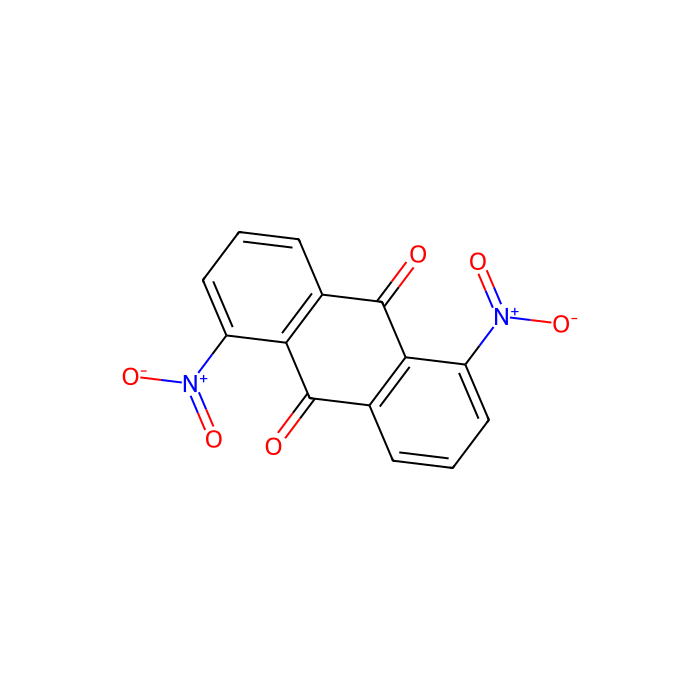
1,5-Dinitroanthraquinone is formed as one of the products during the nitration of anthraquinone.
Application:
1,5-Dinitroanthraquinone has been used in a study to understand the effect of its oxygenous substituents on the color ratio, when it is a part of spectral flare compositions. It may be used to prepare 3,4,7,8-tetrabromo-1,5-dinitroanthraquinone via bromination using molecular bromine and nitric acid as a co-reagent
Taxonomy Tree
| Kingdom | Organic compounds |
|---|---|
| Superclass | Benzenoids |
| Klasse | Anthracenes |
| Subclass | Anthraquinones |
| Intermediate Tree Nodes | Not available |
| Direct Parent | Anthraquinones |
| Alternative Parents | Nitronaphthalenes Nitroaromatic compounds Aryl ketones Propargyl-type 1,3-dipolar organic compounds Organic oxoazanium compounds Organopnictogen compounds Organonitrogen compounds Organic oxides Hydrocarbon derivatives |
| Molecular Framework | Aromatic homopolycyclic compounds |
| Substituents | 9,10-anthraquinone - Anthraquinone - 1-nitronaphthalene - Nitroaromatic compound - Aryl ketone - Ketone - C-nitro compound - Organic nitro compound - Organic oxoazanium - Allyl-type 1,3-dipolar organic compound - Propargyl-type 1,3-dipolar organic compound - Organic 1,3-dipolar compound - Organonitrogen compound - Organic nitrogen compound - Hydrocarbon derivative - Organic oxide - Organooxygen compound - Organic oxygen compound - Organopnictogen compound - Aromatic homopolycyclic compound |
| Beschreibung | This compound belongs to the class of organic compounds known as anthraquinones. These are organic compounds containing either anthracene-9,10-quinone, 1,4-anthraquinone, or 1,2-anthraquinone. |
| External Descriptors | Not available |
Find and download the COA for your product by matching the lot number on the packaging.
| Lot Number | Certificate Type | Datum | Artikel |
|---|---|---|---|
| Certificate of Analysis | May 21, 2025 | D134444 | |
| Certificate of Analysis | Mar 04, 2025 | D134444 | |
| Certificate of Analysis | Mar 04, 2025 | D134444 | |
| Certificate of Analysis | Mar 04, 2025 | D134444 | |
| Certificate of Analysis | Mar 04, 2025 | D134444 | |
| Certificate of Analysis | Mar 04, 2025 | D134444 | |
| Certificate of Analysis | Mar 04, 2025 | D134444 | |
| Certificate of Analysis | Apr 04, 2023 | D134444 |
| Molekulargewicht | 298.21 |
|---|---|
| XLogP3 | 2.500 |
| Hydrogen Bond Donor Count | 0 |
| Hydrogen Bond Acceptor Count | 6 |
| Rotatable Bond Count | 0 |
| Exact Mass | 298.023 Da |
| Monoisotopic Mass | 298.023 Da |
| Topological Polar Surface Area | 126.000 Ų |
| Heavy Atom Count | 22 |
| Formal Charge | 0 |
| Complexity | 488.000 |
| Isotope Atom Count | 0 |
| Defined Atom Stereocenter Count | 0 |
| Undefined Atom Stereocenter Count | 0 |
| Defined Bond Stereocenter Count | 0 |
| Undefined Bond Stereocenter Count | 0 |
| The total count of all stereochemical bonds | 0 |
| Covalently-Bonded Unit Count | 1 |
H319:Causes serious eye irritation
P280:Wear protective gloves/protective clothing/eye protection/face protection.
P305+P351+P338:IF IN EYES: Rinse cautiously with water for several minutes. Remove contact lenses if present and easy to do - continue rinsing.
P264+P265:Wash hands [and …] thoroughly after handling. Do not touch eyes.
P337+P317:If eye irritation persists: Get medical help.