Determine the necessary mass, volume, or concentration for preparing a solution.
Standard for GC Standard for GC for sensitive chromatographic and analytical workflows requiring minimal baseline interference.
Room temperature,Argon charged Ships Normal Check lot-specific COA for exact specifications.
SDS, COA, datasheet, and spec sheet available for download. Lot-specific COA accessible via lot number lookup.
Cited in 123 peer-reviewed publications across chromatography, organic synthesis, and cross-coupling reactions.
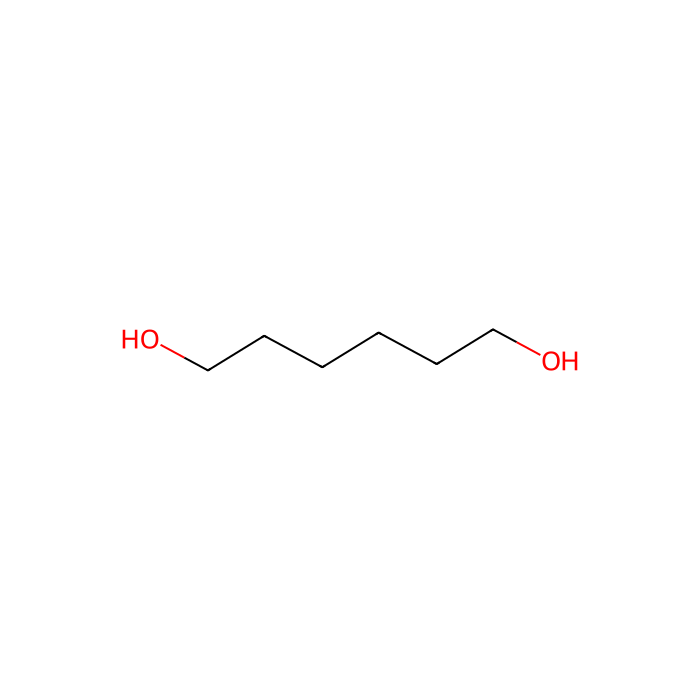
1,6-hexanediol is a versatile chemical compound commonly used in the polymer industry. It is used as a building block or monomer for the synthesis of various polymers and polymer-based materials. For instance, it can be used in the production of polyesters, polyurethanes, and polyamides, among others. These polymers find applications in a wide range of industries, including automotive, textiles, coatings, adhesives, and sealants.
Application
1,6-Hexanediol can be used for a variety of applications such as: a structure-directing agent for the synthesis of ZSM-5 zeolite; a solvent for titanium tetra-isopropoxide to form titanium oxide (TiO2) nanocrystals; a phase change material in combination with lauric acid for thermal energy storage applications; 1,6-hexanediol can also be used in the synthesis of a specific type of biopolymer called poly(3-hydroxybutyrate-co-4-hydroxybutyrate) (PHB4HB) which is used for some medical applications. It is also used as a component in the formulation of the gel polymer electrolyte. It may act as a crosslinking agent or a plasticizer to facilitate the formation of a stable and conductive gel polymer electrolyte for sodium metal batteries.
Comprehensive hazard, handling, storage, and regulatory compliance document.
Download SDS →Lot-specific quality data. Enter your lot number to retrieve the exact COA.
Look up COA →Full quality attributes and acceptance criteria for this grade.
View spec sheet →Taxonomy Tree
| Kingdom | Organic compounds |
|---|---|
| Superclass | Lipids and lipid-like molecules |
| Klasse | Fatty Acyls |
| Subclass | Fatty alcohols |
| Intermediate Tree Nodes | Not available |
| Direct Parent | Fatty alcohols |
| Alternative Parents | Primary alcohols Hydrocarbon derivatives |
| Molecular Framework | Aliphatic acyclic compounds |
| Substituents | Fatty alcohol - Organic oxygen compound - Hydrocarbon derivative - Primary alcohol - Organooxygen compound - Alcohol - Aliphatic acyclic compound |
| Beschreibung | This compound belongs to the class of organic compounds known as fatty alcohols. These are aliphatic alcohols consisting of a chain of a least six carbon atoms. |
| External Descriptors | primary alcohol - diol |
Find and download the COA for your product by matching the lot number on the packaging.
| Lot Number | Certificate Type | Datum | Artikel |
|---|---|---|---|
| Certificate of Analysis | Jun 25, 2026 | H103707 | |
| Certificate of Analysis | Feb 06, 2026 | H103707 | |
| Certificate of Analysis | Jun 10, 2025 | H103707 | |
| Certificate of Analysis | Mar 11, 2025 | H103707 | |
| Certificate of Analysis | Jan 08, 2024 | H103707 | |
| Certificate of Analysis | Jan 12, 2023 | H103707 | |
| Certificate of Analysis | Jan 27, 2022 | H103707 |
| Empfindlichkeit | Moisture sensitive |
|---|---|
| Brechungsindex | 1.4579 |
| Flammpunkt (°F) | 215.06℉ |
| Flammpunkt (°C) | 101.7℃ |
| Siedepunkt (°C) | 208°C |
| Schmelzpunkt (°C) | 42.8°C |
| Molekulargewicht | 118.170 g/mol |
| XLogP3 | 0.300 |
| Hydrogen Bond Donor Count | 2 |
| Hydrogen Bond Acceptor Count | 2 |
| Rotatable Bond Count | 5 |
| Exact Mass | 118.099 Da |
| Monoisotopic Mass | 118.099 Da |
| Topological Polar Surface Area | 40.500 Ų |
| Heavy Atom Count | 8 |
| Formal Charge | 0 |
| Complexity | 31.500 |
| Isotope Atom Count | 0 |
| Defined Atom Stereocenter Count | 0 |
| Undefined Atom Stereocenter Count | 0 |
| Defined Bond Stereocenter Count | 0 |
| Undefined Bond Stereocenter Count | 0 |
| The total count of all stereochemical bonds | 0 |
| Covalently-Bonded Unit Count | 1 |
Our grade selection guide covers purity, stabilizer status, and application suitability for all variants in our catalog.
View Standard for GC grade guide →