≥95% for sensitive chromatographic and analytical workflows requiring minimal baseline interference.
🌡
Storage & shipping
Room temperature Ships Check lot-specific COA for exact specifications.
📋
Quality documents
SDS, COA, datasheet, and spec sheet available for download. Lot-specific COA accessible via lot number lookup.
📚
Literature proof
Cited in 0 peer-reviewed publications across chromatography, organic synthesis, and cross-coupling reactions.
Übersicht
Application:
This coupling agent is an "hydrophobic ether" and gives very good results in the non-covalent immobilization (hydrophobic and pi stacking interactions) of proteins like antibodies.
Zertifikate (CoA, COO, BSE/TSE und Analyse-Diagramm)
C of A & Other Certificates(BSE/TSE, COO):
Analytical Chart:
Chemische und physikalische Eigenschaften
Flammpunkt (°F)
Not applicable
Flammpunkt (°C)
Not applicable
Siedepunkt (°C)
150-155°/ 302 - 311 °F@ 0.04mmHg
Lösungsrechner
Molarity Calculator
Determine the necessary mass, volume, or concentration for preparing a solution.
Dilution Calculator
Determine the dilution needed to prepare a stock solution.
Reconstitution Calculator
Bewertungen
Kundenbewertungen
Application Protocols
No vendor-validated bioassay protocols are provided for this item. For materials applications, users typically adopt one of the following general workflows (literature/general):
Solution-phase silanization: Clean → immerse in 0.5–2% v/v solution in dry toluene/heptane (with controlled water and acetic acid if desired) → rinse → cure 110–150 C.
Vapor-phase deposition: Clean → expose to silane vapor under reduced pressure at 80–120 C → post-cure.
Post-functionalization (optional): Treat coated surface with nucleophile for SNAr on the perfluoroaryl ring → rinse/anneal.
Please adjust concentrations, times, and temperatures based on substrate, equipment, and desired film properties. Validate by contact-angle and surface spectroscopy. For research use only.
Biological Roles
This product is a materials-science silane coupling agent and is not a biomolecule. It does not have intrinsic biological roles, metabolic functions, or signaling activity in standard biochemical pathways.
Any interactions with biological systems would arise from its surface properties (e.g., low surface energy) when used to modify substrates, which can reduce protein and cell adhesion (materials behavior; literature/general).
For cell- or biointerface-related studies, users typically evaluate biocompatibility and fouling resistance empirically on the final coated surface rather than relying on inherent biological roles.
No medical or clinical uses are claimed. For research use only.
Buffer Applications
Not typically applicable. This is not a buffering reagent and is not used to prepare or control pH in aqueous buffers.
If aqueous processing is required (e.g., sol–gel or hydrolysis steps), buffer components are sometimes used catalytically (e.g., dilute acetic acid) to control hydrolysis/condensation kinetics; however, the silane itself is not a buffer (literature/general).
Green Alternatives
While fluorinated silanes deliver exceptional low-surface-energy coatings, greener choices can reduce environmental and health burdens. Selection should balance performance with sustainability.
Comparison (literature/general):
11-Pentafluorophenoxyundecyltriethoxysilane
Performance: Very high water/oil contact angles; chemically robust films.
Concerns: Fluorinated aromatics have persistence concerns; toluene/CH2Cl2 often used as solvents.
Performance: High hydrophobicity (lower oleophobicity vs fluorinated).
Benefits: No organofluorine content; similar deposition workflows.
Short-chain fluoroalkyl silanes with PFPE backbones (lower fluorine content per area)
Performance: Good oleophobicity; sometimes better flexibility.
Consideration: Still fluorinated; assess life-cycle.
Solvent choices
Replace toluene/CH2Cl2 with heptane, cyclohexane, 2-MeTHF, CPME, or dimethyl carbonate when compatible. These offer lower toxicity/photochemical smog potential (Green Chem. guides; literature/general).
Best practices for greener processing:
Use vapor-phase deposition to eliminate solvents and reduce waste.
Recover and dry solvents for reuse; control humidity to minimize batch failures.
Apply only the minimum concentration/time needed to reach target contact angle and coverage.
Pharmaceutical Uses
Not typically applicable as a pharmaceutical ingredient. This reagent is intended for research and materials/coatings applications.
Possible roles in R&D settings (non-clinical, literature/general):
Surface treatment of containers or device components to impart anti-fouling or low-adhesion properties during formulation development and analytical workflows.
Functionalization of silica or oxide fillers used in experimental composite materials.
No excipient monograph status or pharmacopeial listings are provided for this item. For research use only.
Physical Properties
Item-specific specifications are not provided in the product data. Do not use the following as specifications; they are general/literature expectations for similar alkyltrialkoxysilanes and are given solely for planning purposes.
Physical state/appearance: Not specified for this item; refer to CoA/Spec Sheet. Similar long-chain trialkoxysilanes are typically colorless to pale yellow liquids (literature/general).
Boiling point: Not specified for this item; refer to CoA/Spec Sheet. Long-chain trialkoxysilanes often decompose/hydrolyze before atmospheric distillation; vacuum handling is customary (literature/general).
Density (20–25 C): Not specified for this item; refer to CoA/Spec Sheet. Typical range for alkyltrialkoxysilanes is ~0.95–1.05 g/mL (literature/general).
Refractive index (nD 20): Not specified for this item; refer to CoA/Spec Sheet. Many analogs fall in 1.42–1.46 (literature/general).
Solubility: Miscible with common aprotic organics (toluene, heptane, CH2Cl2, THF). Reacts slowly with water and lower alcohols via hydrolysis/transetherification (literature/general).
Hydrolysis: Trialkoxysilanes hydrolyze to silanols, liberating ethanol; subsequent condensation forms siloxane networks (literature/general).
Vapor pressure: Expected low at ambient temperature due to high molecular weight (literature/general).
Partitioning: The perfluoroaryl end group and long alkyl chain confer very low polarity and low surface energy (literature/general).
Quality and Grades
Grade/purity: Not specified for this item; refer to CoA/Spec Sheet for actual assay, impurity profile, water content, and stabilizers (if any).
What grade means for this class (general):
For surface-modification silanes, key quality attributes include hydrolyzable alkoxy content, low water content, and minimal pre-condensed siloxanes. These directly affect monolayer quality and reproducibility.
Chromatographic grades (if offered) ensure lower UV background and fewer organic impurities, beneficial for optical coatings or analytical applications.
Stabilizers: Not specified for this item; refer to CoA/Spec Sheet. Some silanes are supplied with trace acid or base to control hydrolysis rate; presence/absence of stabilizer impacts bath lifetime and film morphology (general guidance).
Recommended QC checks before use (best practice):
Verify water by Karl Fischer on the neat reagent or working solvent.
29Si/13C NMR or GC/MS to assess oligomerization and residual ethanol/ethoxy content.
Contact-angle measurement on a test substrate to confirm coating performance (advancing water contact angle expected to be high due to fluorinated terminus; literature/general).
Reaction and Applications
Primary use: surface functionalization (silanization) of hydroxylated substrates with a fluorinated, low-surface-energy terminus.
Substrates: Glass, Si/SiO2, Al2O3, TiO2, ITO, and silica nanoparticles; also adheres to many metal oxides and hydroxylated polymer surfaces (literature/general).
Mechanism (general):
Hydrolysis of Si(OEt)3 → silanols; condensation with surface –OH yields covalent Si–O–Si bonds. Lateral siloxane crosslinking increases film robustness.
Functional outcome of pentafluorophenoxy cap:
Provides a fluorinated aryl ether surface with very low surface energy, enhancing water/oil repellency and anti-smudge characteristics.
The electron-deficient C6F5 ring can undergo SNAr post-functionalization at ring-fluorine positions with strong nucleophiles (e.g., amines, thiols) to create patterned or derivatized surfaces (literature/general).
Representative applications (materials science):
Anti-fouling/anti-stiction monolayers for MEMS and microfluidics.
Release layers for soft lithography and nanoimprint.
Hydrophobic modification of fillers/pigments; dispersion control in fluoropolymer matrices.
Barrier and optical coatings where low refractive index and high contact angle are desired.
Practical guidance:
Clean/activate surfaces (UV‑ozone or oxygen plasma) immediately before silanization.
Optimize silane concentration (0.5–2% v/v), water content, and time to avoid multilayers/particulates.
Post‑cure at 110–150 C to drive condensation and improve durability (literature/general).
Reaction Conditions
The following are general, literature-based conditions for silanization and post-functionalization; they are not item-specific specifications.
Substrate preparation: Clean glass/SiO2 by piranha (caution), UV‑ozone (15–30 min), or O2 plasma (1–5 min). Rinse/dry; use promptly to preserve surface –OH density.
Solution-phase silanization (literature/general):
Solvent: Anhydrous toluene or heptane.
Concentration: 0.5–2.0% v/v silane.
Water: 0–1% v/v (controlled). Optionally pre-hydrolyze with 0.1–0.5% v/v acetic acid for 5–15 min.
Temperature/time: 20–80 C for 15–120 min (lower T for monolayers; higher T for partial crosslinking).
Rinse: Same solvent, then isopropanol or ethanol; dry under nitrogen.
Cure: 110–150 C for 30–60 min to strengthen Si–O–Si bonds and remove residual ethoxy/ethanol.
Vapor-phase deposition (literature/general):
Load cleaned substrates in a dry chamber with a small reservoir of silane.
Pressure/temperature: 1–20 mbar, 80–120 C, 0.5–3 h.
Post-cure as above.
Post-grafting SNAr on C6F5 (optional; literature/general):
Nucleophile: Primary amines or thiolates (0.05–0.5 M) in polar aprotic solvent (DMF/DMSO) with base.
Temperature/time: 25–80 C, 1–12 h, depending on substitution pattern desired.
Rinse thoroughly and anneal gently (60–80 C) to remove physisorbed species.
Quality checks: Contact angle, XPS (F 1s, Si 2p), AFM for morphology.
Safety and Handling
GHS classification, signal word, pictograms, and H-statements: Not specified for this item; consult the product SDS for authoritative safety information.
General hazards (literature/general for trialkoxysilanes):
Moisture-reactive: Hydrolyzes with water to silanols and releases ethanol; may lead to exotherm and condensation/gelation.
Flammability: Solutions and released ethanol are flammable. Avoid ignition sources.
Irritation: Vapors/mists can irritate eyes, skin, and respiratory tract.
PPE and engineering controls:
Use in a fume hood. Wear safety glasses or face shield, lab coat, and chemically resistant gloves (e.g., nitrile). For larger-scale work, consider splash goggles and an apron.
Handling practices:
Work under dry conditions; minimize ambient humidity exposure. Keep containers tightly closed. Use anhydrous, oxygen-free solvents when making deposition solutions.
Avoid contact with acids/bases unless intentionally catalyzing hydrolysis; uncontrolled catalysis can cause rapid gelation.
Eye/skin contact: Rinse with water for ≥15 minutes; remove contaminated clothing. Seek medical attention if irritation persists.
Inhalation: Move to fresh air; support breathing as needed.
Ingestion: Rinse mouth; do not induce vomiting; seek medical advice.
Spill/cleanup: Absorb with inert material, keep away from moisture, place in a flammable‑waste container. Decontaminate with aqueous alcoholic solution only in controlled waste treatment (literature/general).
Solvent Selection
This reagent is a hydrophobic trialkoxysilane; solvent choice controls hydrolysis/condensation kinetics and film quality.
Polarity/miscibility (general):
Soluble in nonpolar and moderately polar aprotic solvents (heptane, isooctane, toluene, xylene, CH2Cl2, THF). Poorly soluble in water; reacts slowly with protic solvents.
Typical choices by process:
Solution-phase silanization: Anhydrous toluene or heptane (0.5–2% v/v silane). Add controlled water (e.g., 0.1–1% v/v) and catalytic acetic acid for pre-hydrolysis when targeting uniform films (literature/general).
Spin/spray coating: Heptane, isopar, or cyclohexane minimize streaking and enable rapid evaporation.
Vapor-phase deposition (VPD): Neat vapor under reduced pressure; solvent-free process for ultra-uniform monolayers.
Sol–gel formulations: Alcohols (EtOH/iPrOH) are used deliberately as reactants/solvents under controlled acid catalysis; note faster hydrolysis (literature/general).
Selection tradeoffs:
Toluene improves solubility and wetting on glass but is less green; heptane has lower toxicity and drying load.
CH2Cl2 enables low-temperature processing but is volatile and regulated.
THF is miscible with water and can accelerate hydrolysis; control water content carefully.
Practical tips:
Dry solvents to ≤50 ppm water (process target; literature/general) for monolayer work.
Degas to remove CO2, which can affect surface charge on silica.
Use PTFE or glass vessels to avoid adventitious nucleophiles from metals.
Storage and Reconstitution
Storage temperature: Room temperature (per product data). Store in a cool, dry place away from moisture and ignition sources.
Container: Keep tightly sealed in amber glass or compatible container with PTFE-lined cap to limit moisture ingress and light exposure (general best practice).
Atmosphere: If possible, blanket with dry nitrogen or argon after opening. Include desiccant in secondary containment (general guidance).
Stability considerations (literature/general): Trialkoxysilanes slowly hydrolyze on exposure to ambient humidity, generating ethanol and higher siloxanes. Minimize bottle headspace humidity; recap promptly.
Solution preparation: Use anhydrous, oxygen-free solvents. For monolayer baths, prepare fresh daily or validate stability; discard if turbidity/gelation appears.
Reconstitution: Not applicable (supplied neat). If received as a solidified or viscous mass at low temperature, warm gently to ambient and mix thoroughly before dispensing (do not heat in closed container).
Shipping: Not specified for this item; refer to CoA/Spec Sheet and SDS for transport conditions and classifications.
Research Use Note: For research use only.
Structure and Identity
Item name: 11-Pentafluorophenoxyundecyltriethoxysilane (silane coupling agent with a fluorinated aryl ether terminus)
CAS: 1197981-13-7
CID: 99738222
InChIKey: 431840 (supplier record provided; full standard InChIKey not specified)
SMILES: Not specified for this item; refer to CoA/Spec Sheet.
Molecular formula: Not specified for this item; refer to CoA/Spec Sheet.
Molecular weight: Not specified for this item; refer to CoA/Spec Sheet.
Structural features (general/interpretive):
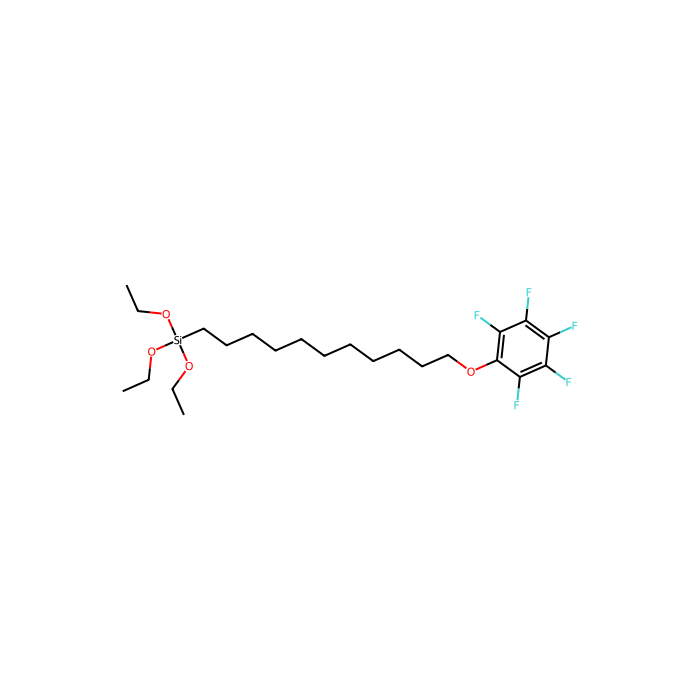
Comprises a trialkoxysilane headgroup, Si(OEt)3, capable of hydrolysis/condensation to form Si–O–Si linkages with hydroxylated surfaces (glass, SiO2, metal oxides).
A linear undecyl (–(CH2)11–) tether connects the silane to a terminal pentafluorophenoxy (C6F5–O–) moiety.
Functional groups: trialkoxysilane (hydrolyzable), ether (aryl–O–alkyl), perfluoroaryl ring (electron-deficient, amenable to SNAr on ring fluorines; literature/general).
2D description: from left to right, a pentafluorophenyl ring bonded through oxygen to an 11‑carbon saturated chain, terminating at silicon bearing three ethoxy substituents.
Stereochemistry: none (all centers achiral).
Synthetic Utility
Although primarily a surface-modification agent, the molecule offers distinct synthetic handles (literature/general):
Trialkoxysilane: Hydrolyzes to silanols and covalently anchors to hydroxylated inorganic surfaces via Si–O–Si bonds. Enables robust monolayers and thin films.
Undecyl spacer: Provides conformational freedom and reduces steric/electronic coupling between substrate and terminal group, improving packing and surface organization.
Pentafluorophenoxy terminus:
The electron-poor C6F5 ring is susceptible to nucleophilic aromatic substitution (SNAr) at para/ortho positions, allowing post-grafting derivatization with amines/thiolates to introduce functional groups on surfaces.
The aryl–O– linkage is stable under many conditions, lending chemical resistance; however, strong nucleophiles at elevated temperature can effect ring substitution.
In retrosynthetic planning for surface chemistry:
Use this silane to introduce a latent, reactive perfluoroaryl platform on oxides; subsequent SNAr installs application-specific functionality without re-exposing the substrate to silanization conditions.
Combine with patterning (photolithography or microcontact printing) for spatially resolved chemistries.
Complementary reagents:
Acid catalysts (acetic acid) for hydrolysis control, base-free to minimize premature condensation.
Co-silanes (e.g., methyl- or phenylsilanes) to tune surface density and wettability by mixed-monolayer strategies.
Target Specificity
Not applicable. This product is not a biological targeting reagent (e.g., antibody, ligand, or inhibitor). No antigen/epitope specificity, clone, isotype, or species reactivity applies.
Wir verwenden Cookies, um die ordnungsgemäße Funktion der Website sicherzustellen und, soweit zulässig, Ihr Nutzererlebnis zu verbessern. Sie können Ihre Einstellungen jederzeit unter „Einstellungen“ verwalten. Weitere Informationen finden Sie in unserer Cookie-Richtlinie.
Shall we send you a message when we have discounts available?
Remind me later
Thank you! Please check your email inbox to confirm.
Products are supplied to verified businesses, institutions, and qualified professionals for research and development use only. Not for use in humans, animals, diagnosis, or therapy.