GRADE & PURITYMoligand™?Moligand™ — Aladdin's line of ligands and bioactive small molecules. Use for receptor, pathway, and binding studies needing defined small-molecule tools.≥95%
This compound belongs to the class of organic compounds known as medium-chain hydroxy acids and derivatives. These are hydroxy acids with a 6 to 12 carbon atoms long side chain.
External Descriptors
Hydroxy fatty acids
1. Djoumbou Feunang Y, Eisner R, Knox C, Chepelev L, Hastings J, Owen G, Fahy E, Steinbeck C, Subramanian S, Bolton E, Greiner R, and Wishart DS. ClassyFire: Automated Chemical Classification With A Comprehensive, Computable Taxonomy. Journal of Cheminformatics, 2016, 8:61.
1.Yang Yang, Fuwei Yang, Xiaotian Shan, Jiamin Xu, Wenjie Fang, Juan Zhou, Lipeng Qiu, Jinghua Chen. (2021) Fabrication of pH/Reduction Sensitive Polyethylene Glycol-Based Micelles for Enhanced Intracellular Drug Release. Pharmaceutics, 13 (9):(1464). [PMID:34575539][10.3390/pharmaceutics13091464]
2.Miaomiao Long, Shenhuan Liu, Xiaotian Shan, Jing Mao, Fuwei Yang, Xiaoyu Wu, Lipeng Qiu, Jinghua Chen. (2020) Self-assembly of pH-sensitive micelles for enhanced delivery of doxorubicin to melanoma cells. JOURNAL OF DRUG DELIVERY SCIENCE AND TECHNOLOGY, [PMID:][10.1016/j.jddst.2020.101859]
Lösungsrechner
Molarity Calculator
Determine the necessary mass, volume, or concentration for preparing a solution.
Dilution Calculator
Determine the dilution needed to prepare a stock solution.
Reconstitution Calculator
Bewertungen
Kundenbewertungen
Application Protocols
No vendor-validated biological assay protocols are provided for this item. Typical laboratory uses involve synthetic transformations and materials preparation.
General starting points (non-validated, for research only):
Stock preparation: Dissolve in DMSO (e.g., 100 mg/mL) or ethanol (10–100 mg/mL); warm gently and vortex. For aqueous systems, neutralize to the sodium/potassium salt.
Esterification test: Combine with an alcohol (3–5 equiv), catalytic p-TsOH, and reflux with water removal; monitor by TLC/GC.
Amide coupling screen: Activate with EDC (1.2 equiv) and HOBt/DMAP in DMF or DCM at 0–25 °C; quench and analyze by LC-MS.
These are generic starting conditions; adapt to your specific target chemistry.
Biological Roles
General biochemistry (literature; no clinical claims)
Metabolic context: 12-Hydroxydodecanoic acid is an ω-hydroxylated derivative of lauric acid. In fatty acid metabolism, ω-hydroxylation (often CYP450-mediated) can yield ω-hydroxy acids that undergo further oxidation to dicarboxylic acids (e.g., dodecanedioic acid), feeding β-oxidation from both ends.
Structural motifs: ω-Hydroxy acids are building blocks in plant cutin and suberin biopolymers, where long aliphatic chains with terminal hydroxyls and carboxylates crosslink to form protective barriers.
Biophysical properties: Amphiphilic molecules of this class can associate with membranes, micelles, or proteins via hydrophobic interactions while presenting ionizable headgroups; salt formation alters aggregation and transport.
Enzymatic transformations: Alcohol dehydrogenases and dehydrogenase/oxidase cascades can interconvert ω-hydroxy acids and ω-oxo/diacid species; lipases catalyze selective esterification/polymerization involving the hydroxyl and carboxylate termini.
These biological notes are provided for context in biochemical research and materials biology; they do not imply suitability for any medical or diagnostic use.
Buffer Applications
This compound is not a buffering reagent and is not typically used to make classical biological buffers. In aqueous systems it is handled as a fatty acid or its carboxylate salt:
To solubilize in aqueous media, partially or fully neutralize to the sodium/potassium salt (pH ~7.5–8.5). The resulting carboxylate can be used in micellar or mixed solvent systems.
For pH-sensitive studies, use a separate buffering system (e.g., phosphate, Tris, HEPES) and introduce this compound via an organic cosolvent or as a pre-formed salt.
Refer to solvent selection and application sections for practical dissolution guidance.
Green Alternatives
Context
As a solid building block, the “green” dimension centers on solvent choice and feedstock sourcing rather than substituting the molecule itself.
Solvent and process improvements (general)
Replace chlorinated solvents in esterifications/couplings with 2-MeTHF or ethyl acetate when feasible; both often dissolve ω-hydroxy acids adequately at mild warming.
Use catalytic, dehydrative esterifications (e.g., PTSA or solid acids) under azeotropic removal rather than stoichiometric reagents.
Favor enzymatic esterification/lactonization (lipases) in solvent-free or green solvents when compatible.
Bio-based sourcing
12-Hydroxydodecanoic acid can, in principle, be prepared from renewable fatty resources via selective oxidation/hydroxylation of lauric acid or via microbial ω-oxidation routes (literature). Assess vendor sourcing if biobased content is a priority.
Comparison snapshot (general)
DCM vs. 2-MeTHF: Similar solvency for many couplings; 2-MeTHF is bio-derived and has better safety/eco profile but absorbs more water (dry accordingly).
DMF/DMSO vs. Cyrene/propylene carbonate: Greener dipolar aprotics may work for dissolving and coupling; verify reactivity and work-up practicality.
Trade-offs: Greener solvents may alter solubility and reaction rates; confirm by small-scale screening and adjust temperature or catalyst loading as needed.
Pharmaceutical Uses
No pharmacopeial status or excipient grade is specified for this item. This product is offered for research use only.
General formulation research context (no therapeutic claims):
Fatty acid derivatives like 12-hydroxydodecanoic acid are explored as hydrophobic spacers or pro-moieties in conjugates (e.g., ester/amide linkages) to modulate physicochemical properties in discovery research.
As an amphiphile, salts/esters can aid in forming self-assembled systems (micelles, nanoemulsions) in formulation studies. Choice of counterion (e.g., Na+, organic amines) impacts solubility and CMC-like behavior.
For analytical development, derivatization (methyl/ethyl ester) simplifies GC analysis of related fatty substrates.
For any regulated or preclinical use, obtain grade-appropriate material and full regulatory documentation. This listing provides neither and is not intended for clinical applications.
Physical Properties
Item-specific (from Product Data)
Appearance: Not specified for this item; refer to CoA/Spec Sheet.
Molecular formula: Not specified for this item; refer to CoA/Spec Sheet.
Molecular weight: Not specified for this item; refer to CoA/Spec Sheet.
Approximate formula and MW (literature): C12H24O3; 216.32 g/mol.
Phase/state: Typically a low-melting solid or waxy solid among C12 fatty acid derivatives (literature).
Solubility: Sparingly soluble in water as the free acid; readily soluble in polar organic solvents (methanol, ethanol, acetone, ethyl acetate, THF) and in DMSO/DMF; forms water-soluble salts with bases (NaOH, KOH, amines) (literature).
Acid-base: Monoprotic carboxylic acid (pKa for related medium-chain fatty acids ~4.8–5.0; terminal alcohol pKa far higher and non-ionizing under neutral conditions) (literature, approximate).
Partitioning: Amphiphilic; expected high logP as free acid; ionization (as carboxylate) enhances aqueous solubility (literature, qualitative).
General interpretation for use
The bifunctional termini allow selective dissolution strategies: use mild base (0.01–0.1 M) to prepare soluble carboxylate salts for aqueous or mixed aqueous-organic systems; employ anhydrous polar aprotic solvents for coupling reactions. Avoid prolonged heating above melting point in air to limit oxidative discoloration (general guidance).
Quality and Grades
Item-specific (from Product Data)
Grade/Purity: Moligand™
What this means in practice (general guidance)
Moligand™ denotes a research-grade small-molecule building block line suitable for synthetic chemistry, ligand design, and materials workflows. In the absence of a numeric purity or stabilizer listing, application-specific suitability (e.g., for polymerization, coupling, or materials screening) should be verified by the end user.
Specifications not listed for this item
Numeric purity, stabilizers/inhibitors, moisture level, residual solvents, metals, UV cutoff: Not specified for this item; refer to CoA/Spec Sheet.
Quality considerations for 12-hydroxydodecanoic acid (general)
Typical QC tests for such materials include NMR (confirming terminal –CH2OH and –COOH), IR (broad O–H; C=O near ~1700 cm−1), GC/LC for organic impurities, acid value, hydroxyl value, and water by Karl Fischer.
For coupling/polymerization use: trace acids/bases, residual peroxides, and water can influence reaction rates and molecular weight development; if critical, pre-dry under vacuum and confirm by applicable assays.
Always consult the lot-specific CoA to confirm suitability for regulated or highly sensitive applications.
Reaction and Applications
Research and manufacturing uses (general; expand-from-manufacturer text)
Bifunctional monomer: The terminal –OH/–CO2H pattern enables step-growth polycondensation to poly(ω-hydroxy acids) and polyesters; useful in sustainable materials and coatings.
Macrocyclization: Intramolecular esterification affords 12-membered ω-lactones; Yamaguchi or Mitsunobu-type cyclizations can improve efficiency.
Derivatization platform: Forms esters, carbonates, carbamates (via the alcohol), and amides/acyl chlorides (via the acid). Useful for surfactant-like architectures and telechelic polymer precursors.
Oxidation/reduction: ω-Oxidation to dodecanedioic acid; selective reduction of the acid to 1,12-dodecanediol or conversion to aldehydes for further elaboration.
Surface modification: Grafting onto oxides or polymers via ester/amide linkages for hydrophobic spacing with terminal functionality.
Practical tips
Selective protection: Protect the alcohol (e.g., TBDMS, TBS, benzyl) during acid activation to prevent oligomerization; or temporarily mask the acid as a methyl/benzyl ester for alcohol-selective transformations.
Coupling: EDC·HCl or DIC with catalytic DMAP for esterification in DCM/DMF; add HOBt/HOAt equivalents for amide formation (where appropriate safety controls for azabenzotriazoles are in place).
Cyclization: For macro-lactonization, employ high dilution (≤10 mM) and mixed anhydride activation (e.g., 2,4,6-trichlorobenzoyl chloride) to suppress polymerization.
Work-up: Acid-base toggling provides convenient phase and solubility control; salts wash out into water, free acids precipitate on acidification.
All uses are for research and laboratory synthesis only.
Reaction Conditions
General literature guidance (illustrative; not item specifications)
Fischer esterification (acid → ester): ROH (solvent/reagent), catalytic p-TsOH or H2SO4, reflux (MeOH 65 °C; EtOH 78 °C). Remove water (Dean–Stark if using toluene) to drive conversion. Typical times 2–24 h depending on alcohol and acidity.
Carbodiimide coupling (acid → ester/amide): EDC·HCl (1.1–1.5 equiv) or DIC in DCM/DMF (0.1–0.5 M), with DMAP (0.05–0.1 equiv) for esters or HOBt/HOAt analogs for amides. 0–25 °C to ambient; 1–16 h. Protect the –OH as needed to avoid oligomerization.
Acid chloride formation: SOCl2 (2–4 equiv) with a catalytic DMF drop in DCM or neat; 0–25 °C to gentle reflux until gas evolution ceases (1–3 h). Quench carefully; avoid exposure of free –OH unless intramolecular acylation is desired.
Macro-lactonization (Yamaguchi): 2,4,6-trichlorobenzoyl chloride (1.2–1.5 equiv), Et3N (2–3 equiv), catalytic DMAP, toluene/THF, high dilution (≤10 mM), 0–25 °C to 80 °C; 4–24 h. Work-up to remove acid chloride byproducts.
Oxidation of –CH2OH to –CO2H: TEMPO (1–5 mol%), NaOCl (bleach) and NaClO2 (Pinnick-like) in biphasic buffers (pH ~6–7) at 0–25 °C; or KMnO4 under controlled conditions. Monitor to avoid over-oxidation/cleavage.
Enzymatic polymerization: Candida antarctica lipase B (CALB), bulk or in green solvents (2-MeTHF), 40–80 °C under reduced pressure to remove water/alcohol byproducts; hours to days depending on target MW.
Note: Reaction temperatures, times, and stoichiometries should be optimized for scale, solvent, and purity of starting materials.
Safety and Handling
Item-specific hazard data (from Product Data)
Signal word: Not specified for this item; refer to SDS.
H-statements: Not specified for this item; refer to SDS.
GHS classification and pictograms: Not specified for this item; refer to SDS.
General safety guidance for ω-hydroxy fatty acids (literature/general)
Likely hazards: May cause skin/eye irritation and respiratory irritation to dust/aerosols. Not known as acutely toxic but handle as a laboratory chemical.
PPE: Laboratory coat, safety glasses or chemical splash goggles, and appropriate gloves (e.g., nitrile). Use in a fume hood when weighing to minimize dust inhalation.
Handling: Avoid dust generation. Do not breathe dust. Prevent contact with strong oxidizers and strong bases/acids unless such conditions are intended for the procedure.
Incompatibilities: Strong oxidizing agents (risk of exothermic reaction); strong bases will form soaps and can promote emulsions; acylating agents may react vigorously with the alcohol/acid groups.
First aid (overview; consult SDS):
Inhalation: Move to fresh air; seek medical attention if symptoms persist.
Skin: Wash with soap and water. Remove contaminated clothing.
Eyes: Rinse cautiously with water for several minutes; remove contact lenses if present and easy to do.
Ingestion: Rinse mouth; seek medical advice.
Fire safety: Combustible organic solid; use CO2, dry chemical, or foam. Combustion may produce CO/CO2.
Waste: Dispose in accordance with local regulations; avoid release to the environment.
Always consult the product’s SDS for authoritative and current hazard information.
Miscibility: Insoluble or sparingly soluble in water as the free acid; good solubility in alcohols (MeOH, EtOH, iPrOH), acetone/MEK, ethyl acetate, THF, dioxane, and polar aprotics (DMSO, DMF). Forms water-soluble carboxylate salts in basic media.
Practical choices
Stock solutions: DMSO (50–200 mg/mL) or ethanol (10–100 mg/mL), depending on downstream use. Warm gently (30–40 °C) and vortex to aid dissolution; avoid prolonged heating.
Aqueous work: Dissolve by neutralizing to pH ~7.5–8.5 with NaOH/KOH or volatile bases (e.g., NH4OH, TEA) to make the carboxylate; back-acidify for precipitation if needed.
Coupling/derivatization: Use anhydrous solvents (DCM, DMF, THF, MeCN) with molecular sieves or dry agents for carbodiimide or mixed-anhydride activations.
When to choose alternatives
If water-only systems are required, consider using the sodium/potassium salt of 12-hydroxydodecanoic acid for improved solubility.
For greener processing, bio-based solvents (2-MeTHF, Cyrene, ethyl lactate) may dissolve the acid adequately depending on temperature; verify solubility empirically.
EtOH/MeOH: greener, volatile; support Fischer esterifications directly.
THF/2-MeTHF: good for coupling; may require mild warming; water-sensitive protocols benefit from their dryness.
Storage and Reconstitution
Item-specific (from Product Data)
Storage conditions: Room temperature
Shipped in: Normal
General handling guidance (complementary)
Keep container tightly closed in a dry, well-ventilated place. Minimize exposure to moisture to avoid hydrolytic side reactions during extended storage and to maintain accurate mass on weighing.
If long-term storage is planned, consider protecting from light and air (store under nitrogen/argon) to limit slow oxidation/discoloration typical of fatty derivatives.
Before sensitive couplings, optional pre-drying under high vacuum (e.g., 40–50 °C, several hours) can reduce residual moisture.
Reconstitution/dissolution (general)
Organic stocks: Prepare in DMSO, ethanol, THF, or acetone at convenient concentrations. Warm gently (30–40 °C) and sonicate if needed.
Aqueous use: Neutralize to the corresponding sodium/potassium salt with standardized base; adjust pH carefully to target range.
Always refer to the lot-specific CoA/SDS for definitive handling, stability, and storage instructions.
Structure and Identity
Item-specific (from Product Data)
SKU: H193629
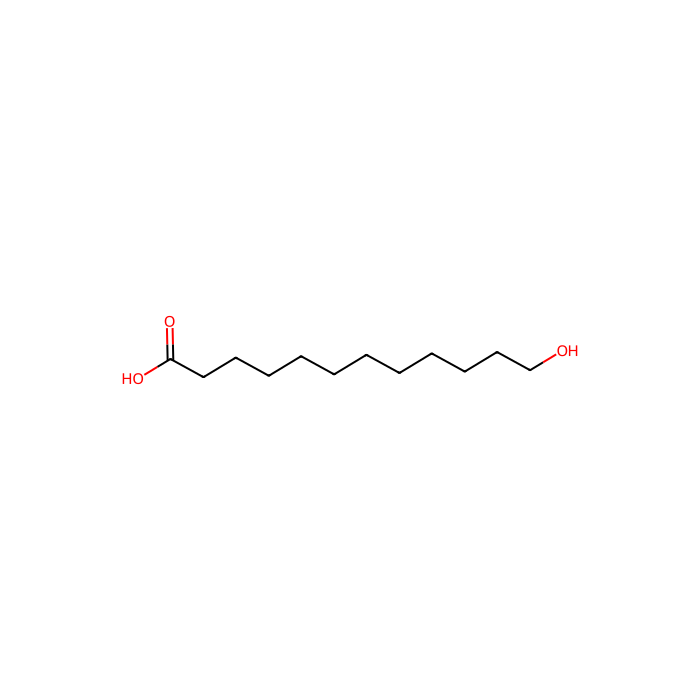
Product name: 12-Hydroxydodecanoic acid
CAS: 505-95-3
PubChem CID: 79034
InChIKey: Not specified for this item; refer to CoA/Spec Sheet.
SMILES: Not specified for this item; refer to CoA/Spec Sheet.
Computed/Literature identifiers and description (for reference; not item specifications)
Common synonym: 12-hydroxylauroic acid; ω-hydroxylauric acid (literature)
Structural features: A linear C12 aliphatic chain bearing a terminal carboxylic acid (C1) and a terminal primary alcohol (C12), i.e., an ω-hydroxy fatty acid. No rings, no stereocenters, and no additional heteroatoms beyond O.
2D description: HO–CH2–(CH2)10–C(=O)OH; polar functional groups at both termini separated by a hydrophobic methylene spacer, giving amphiphilic character.
General chemistry notes
Functional groups: primary alcohol and carboxylic acid enable bifunctional derivatization (esters, amides, acyl chlorides, carbonates, lactones). The ω-layout supports macrocyclization to 12-membered lactones and step-growth polycondensation into poly(ω-hydroxy acids).
Synthetic Utility
Functional group handles
Carboxylic acid (acyl donor): Convert to acid chlorides (SOCl2, oxalyl chloride) for amide/ester formation; activate with EDC/DIC or via mixed anhydrides for milder conditions.
Primary alcohol (nucleophile): Esterify/carbonylate to give carbonates/carbamates; transform to halides/tosylates/mesylates as ω-leaving groups.
Key transformations (general)
Macro-lactonization: Intramolecular esterification yielding a 12-membered lactone; use Yamaguchi conditions (2,4,6-trichlorobenzoyl chloride, DMAP, toluene) or Shiina anhydride protocols at high dilution.
Step-growth polymerization: Self-condensation (alcohol + acid) or co-polymerization with diols/diacids to generate polyesters/copolyesters; enzymatic catalysis (CALB) enables milder, greener routes.
Chain-end elaboration: Convert –CH2OH to –CHO/–CO2H (Swern/TEMPO-NaOCl/oxone-mediated) to access dodecanedioic acid or ω-aldehydes for Wittig/aldol elaboration.
Surfactant synthesis: Partial esterification or amide formation with hydrophilic heads (PEG, amino alcohols) yields nonionic/zwitterionic amphiphiles.
Telechelic intermediates: From the alcohol, form ω-bromide/iodide (via Ms/Ts + SN2) to introduce diverse termini and build ABA-type architectures.
Selectivity and protection
Protect the more reactive terminus depending on the target: benzyl or methyl esters for acid masking; TBS/TBDPS for the alcohol. Orthogonality facilitates sequential build-outs.
This versatility makes 12-hydroxydodecanoic acid a robust spacer and monomer in organic synthesis and materials chemistry.
Target Specificity
Not applicable. This product is a small-molecule chemical building block, not a biological targeting reagent or antibody. No antigen/epitope, clone, or species reactivity information applies.
Wir verwenden Cookies, um die ordnungsgemäße Funktion der Website sicherzustellen und, soweit zulässig, Ihr Nutzererlebnis zu verbessern. Sie können Ihre Einstellungen jederzeit unter „Einstellungen“ verwalten. Weitere Informationen finden Sie in unserer Cookie-Richtlinie.
Shall we send you a message when we have discounts available?
Remind me later
Thank you! Please check your email inbox to confirm.
Products are supplied to verified businesses, institutions, and qualified professionals for research and development use only. Not for use in humans, animals, diagnosis, or therapy.

 B2308617