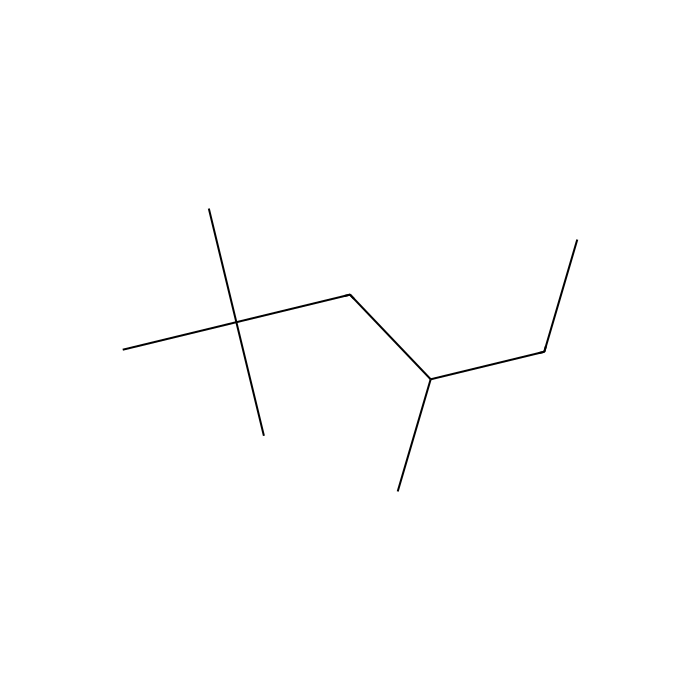
This compound belongs to the class of organic compounds known as branched alkanes. These are acyclic branched hydrocarbons having the general formula CnH2n+2.
External Descriptors
Hydrocarbons
1. Djoumbou Feunang Y, Eisner R, Knox C, Chepelev L, Hastings J, Owen G, Fahy E, Steinbeck C, Subramanian S, Bolton E, Greiner R, and Wishart DS. ClassyFire: Automated Chemical Classification With A Comprehensive, Computable Taxonomy. Journal of Cheminformatics, 2016, 8:61.
Zertifikate (CoA, COO, BSE/TSE und Analyse-Diagramm)
C of A & Other Certificates(BSE/TSE, COO):
Analytical Chart:
Chemische und physikalische Eigenschaften
Brechungsindex
n20/D 1.403
Flammpunkt (°F)
55.4 °F
Flammpunkt (°C)
13°C(lit.)
Siedepunkt (°C)
126°C
Molekulargewicht
128.250 g/mol
XLogP3
4.400
Hydrogen Bond Donor Count
0
Hydrogen Bond Acceptor Count
0
Rotatable Bond Count
3
Exact Mass
128.157 Da
Monoisotopic Mass
128.157 Da
Topological Polar Surface Area
0.000 Ų
Heavy Atom Count
9
Formal Charge
0
Complexity
66.600
Isotope Atom Count
0
Defined Atom Stereocenter Count
0
Undefined Atom Stereocenter Count
1
Defined Bond Stereocenter Count
0
Undefined Bond Stereocenter Count
0
The total count of all stereochemical bonds
0
Covalently-Bonded Unit Count
1
Lösungsrechner
Molarity Calculator
Determine the necessary mass, volume, or concentration for preparing a solution.
Dilution Calculator
Determine the dilution needed to prepare a stock solution.
Reconstitution Calculator
Bewertungen
Kundenbewertungen
Application Protocols
No item-specific, validated application protocols are provided for this SKU. Usage is method-dependent. For solvent/diluent applications:
General handling: Charge to a dry reactor or flask under ambient atmosphere or inert gas as needed. For heating above 120 °C, use reflux condenser or closed system with pressure relief.
Degassing (optional): Bubble N2/Ar for 10–20 minutes if oxygen-sensitive chemistry is planned.
Drying (optional): Pass through a short plug of activated alumina or briefly contact with 3 Å sieves if stringent dryness is required.
Removal: Concentrate by rotary evaporation with elevated bath temperature and reduced pressure; finish under high vacuum if necessary.
For analytical uses (general):
GC studies: Use as received from a clean hydrocarbon-compatible vial; verify purity and absence of aromatics/oxygenates by a quick GC-FID run before use as a reference or diluent.
Always adapt to the specific reaction/analysis SOP and consult the SDS.
Biological Roles
No item-specific biological data are provided. General background (literature; not product-specific):
Natural occurrence: Branched C9 alkanes are minor constituents of petroleum fractions and can appear in trace amounts in plant waxes and environmental hydrocarbon mixtures.
Biodegradation: Certain alkane-degrading microbes (e.g., AlkB monooxygenase pathways) can oxidize medium-chain alkanes. Branched substrates degrade more slowly than linear analogs due to steric effects.
Bioaccumulation potential: High hydrophobicity (logP ~4.5–5.2, literature) suggests a propensity for partitioning into lipid phases, though rapid volatilization can limit persistence in some compartments.
Toxicology context: Saturated alkanes generally exhibit low acute systemic toxicity but pose aspiration hazards and can depress the CNS at high vapor concentrations. These are general hydrocarbon observations; consult the SDS for this item.
Use limitation from Product Data: For research use only. Not for human or veterinary use.
Buffer Applications
This compound is a nonpolar hydrocarbon and is not used to prepare aqueous buffers or pH-controlled systems. If a nonpolar phase is needed in a biphasic reaction or extraction, refer instead to the Solvent Selection and Reaction & Applications sections for guidance on use as a hydrocarbon diluent.
Green Alternatives
Perspective (general; not product-specific): 2,2,4-Trimethylhexane is a volatile petrochemical hydrocarbon. Greener solvent selection weighs human health, flammability, environmental persistence, and life-cycle impacts.
Comparison highlights:
Hydrocarbon choices
Heptane (n- or iso-): Similar nonpolarity with lower bp; often favored in solvent selection guides (better worker exposure profile vs hexane neurotoxicity; still flammable VOC).
Isoparaffinic mixtures (ISOPAR fluids): Narrow-cut, low-aromatic hydrocarbon blends with controlled impurity profiles; lower toxicity than aromatic solvents; still fossil-derived.
Bio-derived ethers and esters
2-Methyltetrahydrofuran (2-MeTHF): Bio-based, higher polarity and broad solvency; forms peroxides and is more reactive than alkanes; often recommended green alternative to toluene/THF, not a direct replacement for purely nonpolar media.
Cyclopentyl methyl ether (CPME): Reduced peroxide tendency vs THF; broader solvency than alkanes; still flammable.
When feasible, surfactant-enabled aqueous media or supercritical CO2 can displace hydrocarbons; applicability depends on substrate polarity and process constraints.
Trade-offs:
Replacing a nonpolar alkane with a greener ether/ester may improve sustainability but can alter reaction selectivity, coordination, and safety (peroxide formation, pressure build). Any substitution should be supported by small-scale screening and solvent effect studies.
Pharmaceutical Uses
No pharmacopeial status, excipient grade, or GMP suitability is specified for this item; refer to CoA/Spec Sheet if such information is required.
General context (literature; not product-specific):
Saturated isoparaffinic hydrocarbons are sometimes used as process solvents or cleaning agents in pharmaceutical manufacturing due to their chemical inertness and low polarity. Use is governed by ICH Q3C (residual solvents) and internal risk assessments.
Highly refined isoparaffins are used as carriers in topical/cosmetic formulations; pharmaceutical application requires stringent control of aromatic content, volatility profile, and impurity limits.
For finished dosage forms, any hydrocarbon solvent use must be justified by toxicological limits and validated removal; branched C9 alkanes are typically classified among aliphatic hydrocarbons with exposure limits.
Important: This product is labeled for research use only and is not intended for human or veterinary applications.
Physical Properties
Note: No item-specific specifications are provided. Values below are literature/general for 2,2,4-trimethylhexane or closely related isononane isomers and are not the product specification.
Physical state/appearance: Not specified for this item; refer to CoA/Spec Sheet.
Boiling point: Typically ~150–160 °C at 1 atm (literature for branched C9 alkanes).
Melting point: Typically well below 0 °C (often < −70 °C) (literature for branched C9 alkanes).
Density (20–25 °C): Roughly 0.72–0.75 g/mL (literature range for isononanes).
Refractive index n20 D: Typically ~1.390–1.404 (literature).
Vapor pressure (25 °C): On the order of a few mmHg (literature; varies by isomer and temperature).
Log10(Kow): High hydrophobicity; logP typically ~4.5–5.2 (literature for C9 branched alkanes).
Water solubility: Very low, generally <1 mg/L (literature for C9 alkanes).
Polarity/proticity: Nonpolar, aprotic; dielectric constant expected to be very low (literature for alkanes).
Practical implications (general):
Very poor solvent for polar/ionic species; good diluent for highly nonpolar solutes and for hydrocarbon-phase processes.
Moderate boiling range supports use as a higher-bp alternative to hexane/heptane when extended reflux at >120 °C is desirable without aromatic content.
Quality and Grades
Item-specific grade/purity: Not specified for this item; refer to CoA/Spec Sheet.
General guidance for hydrocarbon solvent grades (context; not product-specific):
Analytical/GC grade: Tight controls on non-volatile residue and low oxygenated/aromatic impurities; suitable for chromatographic reference work and method development.
HPLC/UV grade: Not typically applicable to saturated alkanes for UV-detected HPLC due to minimal UV absorbance; however, “low residue/low fluorescence” specifications may be offered for special applications.
Dry (anhydrous) grades: For nonpolar alkanes, water content is inherently low, but Karl Fischer moisture may still be specified for moisture-critical applications. Absent explicit values, assume no special drying.
Peroxide specification: Not applicable to saturated alkanes (do not form peroxides readily).
Stabilizers: Typically none required for saturated alkanes; any listed stabilizer would be application-driven. None are specified for this item.
Recommendation: Consult the product’s CoA/Spec Sheet for lot-specific purity assay, GC area % of isomer, moisture, non-volatile residue, and any residual aromatic content, especially if using as a diluent standard, combustion surrogate, or extraction solvent.
Reaction and Applications
General uses for a branched C9 alkane (literature; not product-specific):
Inert hydrocarbon diluent: Suitable for reactions requiring chemically inert, non-coordinating, low-polarity media at elevated temperatures (up to its reflux). Examples include some radical reactions, hydrosilylation screenings, and polymerizations where an inert aliphatic phase is desired.
Thermal studies and combustion research: Branched isononanes are used as surrogates to probe ignition delay, octane/cetane behavior, heat release, and sooting tendencies in engines and fundamental combustion apparatus.
Materials handling: Useful for dissolving or swelling highly hydrophobic matrices (e.g., polyolefins, waxes, greases) at elevated temperature.
Phase behavior experiments: Hydrocarbon-rich phase in LLE experiments or partitioning studies for hydrophobes.
Practical notes:
Drying/degassing: Alkanes carry little dissolved water but can be sparged with inert gas to remove oxygen if radical inhibition is a concern. Molecular sieves are generally unnecessary for water removal.
Workup: Low polarity simplifies aqueous workups; however, removal may require higher bath temperatures or time due to higher bp relative to hexanes. Rotary evaporation under reduced pressure is recommended.
Inertness: Resistant to acids/bases and many reagents, but can undergo radical-mediated C–H activation under forcing conditions. Avoid strong oxidants.
Limitations:
Poor solvent for polar or coordinating substrates; limited utility for organometallics that require donor solvents. Not suitable where precise UV transparency is critical at low wavelengths (though alkanes are generally UV-clean, they absorb weakly at very short UV).
Reaction Conditions
General guidance (literature; not product-specific specifications):
Solvent role: Use as an inert, nonpolar reaction medium or diluent. Typical temperature range spans ambient to reflux (~150–160 °C). For pressure operations above normal bp, ensure appropriate pressure-rated equipment.
Atmosphere: Air-stable as a solvent, but oxygen exclusion may be advisable for radical or sensitive organometallic chemistry; sparge with nitrogen/argon as needed.
Dryness: Water content in alkanes is intrinsically low; additional drying rarely impacts outcomes for hydrocarbon-phase reactions. If critical, pass through activated alumina or contact with 3 Å sieves briefly.
Workup and removal: Due to its higher bp, removal may require reduced pressure (e.g., <50 mbar) and/or elevated bath temperatures (≥50–60 °C). Final traces can be chased with a lighter hydrocarbon rinse.
Compatibility: Stable with bases, non-oxidizing acids, and many catalysts that tolerate nonpolar media. Avoid strong oxidants and high-energy radical initiators unless intended.
Typical applications: Radical polymerizations (as inert diluent), hydrosilylation screenings, thermal rearrangements that prefer non-coordinating media. Yields and times are system-dependent; consult specific literature for reaction-class parameters.
Safety note: Treat as a flammable solvent; implement grounding/bonding during charging and nitrogen blanketing where appropriate. Verify heat removal given the low heat capacity and low thermal conductivity typical of alkanes.
Safety and Handling
Item-specific hazard details (GHS signal word, pictograms, H-statements, classification) are not provided in the Product Data. Refer to the Aladdin Scientific SDS for authoritative and up-to-date safety information for this SKU.
General hydrocarbon safety guidance (literature/general; not product-specific):
Likely hazards: Flammable liquid and vapor; may form combustible vapor-air mixtures. Aspiration hazard is common for low-viscosity hydrocarbons. Inhalation of high concentrations may cause CNS depression (dizziness, headache). Skin defatting/irritation possible upon prolonged contact.
Incompatibilities: Strong oxidizers (risk of exothermic reaction). Avoid open flames, hot surfaces, and static discharge sources. Typically chemically inert toward bases/acids under ambient conditions.
PPE: Use chemical-resistant gloves (e.g., nitrile), safety glasses or splash goggles, and lab coat. Employ flame-resistant lab practices when large volumes are handled. Use in a fume hood to control vapors.
Handling: Ground/bond containers during transfer. Use only non-sparking tools. Keep containers tightly closed when not in use to minimize vapor release.
First aid (overview): Move to fresh air if inhaled; rinse skin with soap/water for exposure; flush eyes with water; if swallowed, do NOT induce vomiting—seek medical attention. Follow SDS.
Fire-fighting: Use foam, dry chemical, or CO2. Water spray/fog for cooling only. Vapors may travel to ignition source.
Storage per Product Data: Room temperature. Store in a flammables-rated cabinet, away from oxidizers and ignition sources. Shipped via FedEx DG Service (dangerous goods).
Solvent Selection
Role and profile (general for branched C9 alkane):
Polarity class: Nonpolar, aprotic; Hildebrand solubility parameter typical of alkanes. Very low dielectric constant.
Miscibility: Immiscible with water; miscible with most nonpolar organics (alkanes, cycloalkanes, many ethers) and sparingly with moderately polar solvents depending on ratio.
Use scenarios:
Hydrocarbon-phase diluent for nonpolar substrates, organosilicon and hydrophobic polymer handling.
Alternative to hexane/heptane when a higher boiling range (~150–160 °C, literature) is beneficial to maintain elevated reflux without aromatics.
Calibration or method development where a branched C9 standard is relevant (e.g., studying volatility, branching effects).
Comparison (general):
Versus n-hexane/heptane: Much higher bp and lower volatility; better for high-temp reflux, slower evaporation; similar nonpolarity but slightly different solvency due to branching.
Versus toluene: Comparable bp window but non-aromatic and lower UV absorbance; poorer solvency for moderately polar solutes.
Versus isooctane (2,2,4-trimethylpentane): Higher bp and viscosity; reduced volatility; similar chemical inertness.
Selection tips:
Choose 2,2,4-trimethylhexane for nonpolar systems needing prolonged heating with minimal aromatic content. For faster evaporation or chromatography mobile phases, lighter alkanes may be preferable. For better solubility of polar substrates, consider ethers or aromatics.
Storage and Reconstitution
Storage conditions (from Product Data): Store at room temperature.
Shipping (from Product Data): Shipped via FedEx DG Service (dangerous goods).
Container: Keep tightly closed in original container with hydrocarbon-compatible cap/liner. Store in a flammables cabinet away from heat, sparks, open flames, and oxidizers.
Light/moisture sensitivity: Not particularly light- or moisture-sensitive as a saturated hydrocarbon; nevertheless, minimize headspace oxygen and moisture ingress to maintain purity for sensitive applications.
Reconstitution: Not applicable; supplied neat. If cold storage leads to increased viscosity, warm gently to ambient before use.
Stability: Saturated alkanes are generally stable; no tendency to form peroxides. Avoid prolonged exposure to high temperatures or UV in the presence of oxygen to prevent trace oxidative byproducts.
For research use only (from Product Data). Refer to the product’s CoA/Spec Sheet for any lot-specific guidance on storage life and handling.
Structure and Identity
Brief description: 2,2,4-Trimethylhexane is a highly branched C9 iso-alkane (a saturated hydrocarbon) with three methyl substituents on a hexane backbone, giving a compact, hydrophobic structure with no heteroatoms or unsaturation.
Item-specific identifiers (from Product Data)
CAS: 16747-26-5
SKU: T161698
InChIKey: Not specified for this item; refer to CoA/Spec Sheet. (Product Data field appears truncated as “4394”.)
SMILES: Not specified for this item; refer to CoA/Spec Sheet.
Literature/computed identity data (general reference; not item-specific specifications)
Common formula: C9H20 (literature)
Average molecular weight: ~128.26 g/mol (literature)
Substitution pattern: Geminal dimethyl at C-2 and an additional methyl at C-4 on a hexane chain.
2D description in words: A six-carbon main chain with two methyl groups attached to carbon-2 and one methyl group attached to carbon-4; no rings, no heteroatoms, no stereocenters.
Topology: Highly branched, compact hydrocarbon with low polarizability relative to aromatics and very low polarity.
Synthetic Utility
As a fully saturated, branched alkane, 2,2,4-trimethylhexane is chemically inert in most laboratory transformations, which defines its utility as a medium rather than a reagent.
Inert medium: Provides a nonpolar, non-coordinating environment, useful for reactions sensitive to donor solvents or aromatics. Elevated reflux temperatures (~150–160 °C, literature) allow thermal driving force beyond hexane/heptane while avoiding aromatic solvents.
Extraction/partitioning: Serves as a strongly hydrophobic organic phase to separate highly lipophilic compounds from aqueous media. Branching can subtly affect solubility compared to n-alkanes of similar carbon number.
Calibration/reference: Branched alkanes are employed to study volatility, vapor–liquid equilibria, and GC behavior; selecting a defined isomer can aid in understanding branching effects compared with n-nonane or isooctane.
Reactivity considerations: Will not engage in nucleophilic/electrophilic substitutions or additions; C–H bonds can be activated only under harsh radical, photochemical, or catalytic C–H activation conditions (not typical for routine synthesis). Resistant to peroxide formation.
When to choose it:
Need for a hydrocarbon diluent with higher bp than hexanes and without aromatic content.
Screening solvent effects where steric bulk of the medium may influence diffusion or micromixing in polymerization and radical processes.
Target Specificity
Not applicable. This product is a small-molecule hydrocarbon solvent/diluent and is not an affinity reagent, biologic, or targeted chemical probe. No antigen/epitope, clone, or species reactivity information applies.
Wir verwenden Cookies, um die ordnungsgemäße Funktion der Website sicherzustellen und, soweit zulässig, Ihr Nutzererlebnis zu verbessern. Sie können Ihre Einstellungen jederzeit unter „Einstellungen“ verwalten. Weitere Informationen finden Sie in unserer Cookie-Richtlinie.
Shall we send you a message when we have discounts available?
Remind me later
Thank you! Please check your email inbox to confirm.
Products are supplied to verified businesses, institutions, and qualified professionals for research and development use only. Not for use in humans, animals, diagnosis, or therapy.