Zertifikate (CoA, COO, BSE/TSE und Analyse-Diagramm)
C of A & Other Certificates(BSE/TSE, COO):
Analytical Chart:
Chemische und physikalische Eigenschaften
Molekulargewicht
217.690 g/mol
XLogP3
Hydrogen Bond Donor Count
2
Hydrogen Bond Acceptor Count
3
Rotatable Bond Count
5
Exact Mass
217.087 Da
Monoisotopic Mass
217.087 Da
Topological Polar Surface Area
44.500 Ų
Heavy Atom Count
14
Formal Charge
0
Complexity
130.000
Isotope Atom Count
0
Defined Atom Stereocenter Count
0
Undefined Atom Stereocenter Count
0
Defined Bond Stereocenter Count
0
Undefined Bond Stereocenter Count
0
The total count of all stereochemical bonds
0
Covalently-Bonded Unit Count
2
Lösungsrechner
Molarity Calculator
Determine the necessary mass, volume, or concentration for preparing a solution.
Dilution Calculator
Determine the dilution needed to prepare a stock solution.
Reconstitution Calculator
Bewertungen
Kundenbewertungen
Application Protocols
No biological assay protocols (WB, IHC, IF, FC) are applicable to this small-molecule reagent. For chemical use, see the Reaction Conditions and Synthetic Utility sections for setup guidance (e.g., basification to free amine, coupling conditions, or cross-coupling parameters).
Biological Roles
This product is a small-molecule organic salt used for chemical synthesis; it is not a biomolecule and has no established physiological role.
Endogenous role: None known (aromatic amine with ether substituent; synthetic in origin).
Research relevance: The ortho-ethoxyethoxy motif can be used to tune lipophilicity and solubility of probe molecules or polymer conjugates. Aniline derivatives often serve as precursors to dyes, linkers, or heterocycles used in chemical biology.
Functional handles: The aniline nitrogen allows formation of amides, ureas, sulfonamides, and diazonium intermediates that can be grafted onto surfaces or biomolecule mimics (purely in vitro).
No clinical or therapeutic claims are made. For any biological assay use, ensure appropriate purification, counterion exchange, and residual solvent controls. Verify compatibility with assay media, especially considering potential protonation state and ionic strength effects introduced by the HCl counterion.
Buffer Applications
This compound is not a buffering reagent and is not typically used to prepare pH buffer systems. If included in aqueous formulations, its anilinium chloride form will contribute to ionic strength and may slightly affect pH depending on concentration, but it does not provide a defined buffering range.
For buffer preparation needs, select established systems (e.g., phosphate, acetate, Tris) and incorporate this compound only as a solute or reactant as required by your experimental design.
Green Alternatives
Greener practice focuses on solvent and base selection rather than changing the substrate itself.
Greener choices (literature/general):
Solvents: Prefer water/ethanol/2-MeTHF over DMF/DMSO/CH2Cl2 when feasible. For amide couplings, MeTHF or CPME can often replace chlorinated solvents; for extractions, EtOAc over DCM.
Coupling reagents: Consider DIC + Oxyma as a safer alternative to HATU/HBTU (reduced explosivity concerns), or enzymatic amidation in aqueous media where appropriate.
Bases: Use carbonate bases (K2CO3, Na2CO3) or aqueous ammonia to free the base instead of strong, hazardous bases when compatible.
Energy efficiency: Exploit microwave or flow methods to reduce time/energy; room-temperature couplings where possible.
Trade-offs:
Water/alcohol media may require phase-transfer or surfactants and can complicate workups.
2-MeTHF/CPME offer better sustainability but have different peroxide formation profiles—monitor peroxide content routinely.
Quick comparison (general):
DMF/DMSO: high solvency, difficult removal, regulatory concerns.
2-MeTHF/EtOAc/EtOH: renewable or lower-impact, easier workup, sometimes reduced solubility for salts—liberate the free base first.
Note: No greener “substitute molecule” is indicated; adaptations target the process (solvent/base/reagent) while retaining 2-(2-ethoxyethoxy)aniline as the functional building block.
Pharmaceutical Uses
No pharmacopeial status or excipient role is specified for this item. It is supplied for research use only and is typically employed as a synthetic intermediate in discovery chemistry.
Formulation/manufacturing context (general):
Salt form advantages: The hydrochloride salt often provides improved solid-state stability, crystallinity, and accurate dosing relative to volatile free bases during process development.
Derivatization: The aniline can be elaborated to amides/ureas/sulfonamides as part of structure–activity exploration. The ortho ethoxyethoxy chain can modulate solubility and permeation surrogates in physicochemical profiling.
Analytical considerations: For LC–MS or stability studies, monitor chloride content, counterion exchange, and salt disproportionation in mixed solvents.
No therapeutic or clinical claims are made. For any work approaching regulated development, define impurity profiles, residual solvents, and polymorph/salt screening under applicable quality frameworks.
Physical Properties
Appearance: Not specified for this item; refer to CoA/Spec Sheet.
Melting point (MP): Not specified for this item; refer to CoA/Spec Sheet.
Boiling point (BP): Not applicable to the salt (decomposes before boiling under ambient pressure; general expectation for anilinium HCl salts; literature/general).
Density: Not specified for this item; refer to CoA/Spec Sheet.
Refractive index: Not applicable to solid salts; Not specified for this item; refer to CoA/Spec Sheet.
pKa (anilinium conjugate acid, general): pKa of anilinium in water ~4.6–5.2 (literature, depends on substituents); ortho ether substituent may slightly modulate basicity.
LogP (free base, estimated): Moderate polarity expected due to ether chain; precise value Not specified for this item; consult literature or calculate for the free base.
Solubility (general expectations):
Water: Anilinium hydrochloride salts are typically water-soluble; specific value Not specified for this item.
Alcohols (MeOH, EtOH): Good solubility likely (literature/general for anilinium salts).
Aprotic solvents (DCM, EtOAc): Free base forms dissolve better than salts; salt solubility variable (general guidance).
Note: Use the Certificate of Analysis for lot-specific physical constants. Values above are literature/computed guidance and not product specifications.
Quality and Grades
Grade/Purity: Not specified for this item; refer to CoA/Spec Sheet.
Interpretation and implications (general):
If supplied as a standard research-grade small molecule, quality typically supports synthetic use and method development. For chromatography-critical applications, verify UV-absorbing impurities and residual solvents via CoA.
Where a salt form is provided (here, hydrochloride), this commonly ensures improved handling stability and weighed accuracy versus the free base (reduced volatility, more crystalline). It also simplifies stoichiometry in acid–base workups.
If your application demands low metal content, residual solvent limits, or tight water content, request the full Specification Sheet. Item-specific limits (e.g., water, metals, UV cut-off) are Not specified for this item.
For analytical uses (HPLC standards, LC–MS), confirm that residual inorganic counterions (Cl−) and water content meet your method needs. Drying conditions and salt equivalency may be necessary to report accurately.
Documentation:
Review the batch CoA for exact assay, identification, loss on drying, and chromatographic purity. Where applicable, confirm counterion content (chloride assay) to calculate free-base equivalents.
Reaction and Applications
As an ortho-alkoxyethoxy-substituted anilinium salt, this reagent serves as a versatile building block for functionalized anilines and downstream heterocycles.
Representative applications (literature/general):
Amide formation: Convert to the free base in situ with an organic base and couple with acyl chlorides, anhydrides, or coupling reagents (HATU, EDCI) to access anilide derivatives bearing a solubilizing o-(2-ethoxyethoxy) group.
Urea/carbamate synthesis: Reaction with isocyanates or chloroformates (after basification) affords ureas/carbamates, useful as pharmacophore precursors.
Diazotization → Sandmeyer/azo: The aniline functionality (as free base) can be diazotized (NaNO2/HCl, 0–5 °C) enabling Sandmeyer halogenations, phenol formation, or azo coupling.
Buchwald–Hartwig amination: Acts as the amine partner for C–N cross-coupling onto aryl halides/triflates. The ortho ether chain can modulate electronics/solubility.
Electrophilic aromatic substitution (EAS): The anilide derivative (or protected aniline) directs ortho/para EAS; existing ortho substituent may bias regiochemistry and block one site.
Protection strategies: If needed, protect the aniline as acyl/BOC/sulfonyl derivative; the HCl salt simplifies handling prior to protection.
Practical notes:
Neutralize HCl with a non-nucleophilic base at the outset of reactions requiring the free amine.
The ether chain improves solubility in polar organics, aiding high-concentration reactions.
Minimize prolonged strong acid exposure to avoid ether cleavage; the aryl–O–(CH2)2–OEt chain is generally stable under neutral to mildly basic conditions.
Reaction Conditions
General literature guidance for typical transformations involving anilinium hydrochlorides (optimize per substrate):
Liberation of free base: Suspend the salt in an organic solvent (e.g., EtOAc, MTBE, or DCM), wash with saturated NaHCO3 or K2CO3 to basify (pH > 10), separate organic layer, dry, and use immediately. Alternatively, add DIPEA/Et3N directly in reaction solvent.
Amide coupling:
Solvent: DMF, DCM, MeCN, 2-MeTHF.
Reagents: HATU/HBTU/EDC·HCl + base (DIPEA, 2–4 equiv) or acyl chloride (1.0–1.2 equiv) + base.
Temp: 0–25 °C (acyl chloride) or 20–40 °C (carbodiimide/HATU).
Time: 1–16 h. Typical isolated yields for anilides: 60–95% (literature range).
Buchwald–Hartwig amination:
Catalyst: Pd2(dba)3 (1–2 mol%) with ligand (XPhos, BINAP), or precatalysts.
Base: NaOtBu, K3PO4, Cs2CO3 (2–3 equiv).
Solvent: toluene, dioxane, 2-MeTHF, DME (use free base; if starting from HCl salt, add extra base to neutralize HCl).
Temp: 80–110 °C; 4–24 h. Typical yields: 50–90% (substrate-dependent).
Diazotization:
Medium: HCl(aq) (2–6 M), NaNO2 at 0–5 °C; generate diazonium in situ.
Follow with Sandmeyer (CuX) or azo coupling at 0–25 °C.
Notes:
Salt neutralization generates Et3N·HCl or inorganic salts—plan filtration/extractions accordingly.
Protect the ether chain from strong acid or high-temperature acidic media to avoid cleavage.
Safety and Handling
Safety information in the product data is not specified; consult the SDS for authoritative guidance. The following are general precautions for anilinium hydrochloride salts and aryl amines:
GHS/Classification: Not specified for this item; refer to SDS.
Hazard statements/Pictograms/Signal word: Not specified for this item; refer to SDS.
General handling guidance (literature/general):
Toxicity/Irritation: Aromatic amine salts may be harmful if swallowed and can cause skin/eye irritation. Avoid inhalation of dust.
PPE: Wear lab coat, safety glasses or face shield, and suitable gloves (e.g., nitrile). Use in a fume hood to minimize inhalation exposure.
Incompatibilities: Strong oxidizers; strong bases (will liberate free base and HCl). Avoid contact with acyl chlorides/isocyanates without proper control due to exothermic neutralization and potential reactive hazards.
Peroxide formation: Not applicable to the salt itself; however, common organic solvents used with this reagent (e.g., ethers) can form peroxides—test/replace solvents as appropriate.
First aid (overview):
Inhalation: Move to fresh air; seek medical advice if symptoms persist.
Skin contact: Wash with soap/water; remove contaminated clothing.
Eye contact: Rinse cautiously with water for several minutes; seek medical attention.
Ingestion: Rinse mouth; do not induce vomiting; get medical advice.
Spill response: Avoid dust formation; sweep up with minimal dust, collect in suitable container for disposal. Neutralize residues appropriately.
Always defer to the product’s SDS and institutional protocols.
Solvent Selection
This product is an anilinium hydrochloride salt, which generally displays greater solubility in polar protic and highly polar aprotic media.
Polarity class (general): Ionic organic salt; best in polar media.
Likely good solvents (literature/general): Water, methanol, ethanol, isopropanol; DMF and DMSO for stock solutions or coupling reactions. Specific solubility Not specified for this item.
Variable/limited solvents: Moderately polar aprotics (MeCN, EtOAc) may dissolve partially; chlorinated solvents (DCM, CHCl3) often dissolve the free base better than the HCl salt.
Free-base strategy: If nonpolar solvents are required (e.g., for cross-coupling), first liberate the free base with a non-nucleophilic base (e.g., Na2CO3, K2CO3, DIPEA) and extract into the organic phase.
Selection guidance:
For amide formations using acid chlorides or activated esters, dissolve in pyridine, triethylamine, DMF, or DCM with base, to both solubilize and neutralize HCl in situ.
For SNAr or Buchwald–Hartwig aminations, employ DMSO/DMF/2-MeTHF with base to convert the salt to the amine during the reaction.
Comparison (general):
Water/MeOH: rapid dissolution; easy workup but may require concentration.
DMSO/DMF: excellent solubility; high boiling—plan for extraction or precipitation.
2-MeTHF/EtOAc: use after basification to free base for better solubility.
Shipped in: Not specified for this item; refer to CoA/Spec Sheet.
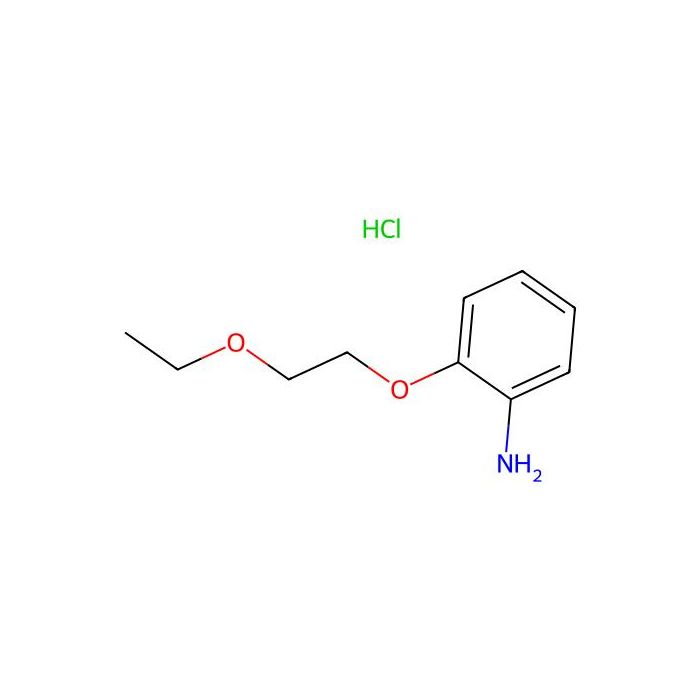
Form: Hydrochloride salt of 2-(2-ethoxyethoxy)aniline.
Handling and reconstitution (general):
Keep container tightly closed, protected from moisture. Although HCl salts are typically less volatile than free bases, limit prolonged air exposure to avoid hygroscopic uptake and discoloration.
For solution preparation, dissolve in MeOH, EtOH, H2O, DMF, or DMSO as appropriate. Specific solubility limits are Not specified for this item; prepare a small test solution to verify concentration.
To obtain the free base, treat an aqueous or biphasic mixture with carbonate or organic base and extract into an organic solvent (EtOAc, MTBE, DCM). Use the free base promptly to minimize oxidative darkening typical of anilines.
Avoid strong oxidants and strong mineral acids at elevated temperature (potential ether cleavage).
If long-term storage is planned, consider amber container and inert headspace to mitigate oxidative degradation of the aniline moiety.
Administrative:
Research Use Only (from product data). Consult the SDS for additional storage incompatibilities and stability information.
Structure and Identity
2-(2-Ethoxyethoxy)aniline hydrochloride is an anilinium chloride salt bearing an ortho-(2-ethoxyethoxy) substituent on the benzene ring.
2D description: A para-disubstitution is absent; the –NH3+ and –O–CH2–CH2–OEt are adjacent (ortho) on the ring; the oxyethylene chain terminates in an ethoxy group, imparting moderate polarity with ether functionality.
Synthetic Utility
Key reactivity centers make this salt a practical linchpin in aromatic synthesis:
Nucleophilic nitrogen (after basification):
Formation of amides (acyl chlorides/anhydrides/couplings), ureas/carbamates, and sulfonamides.
Buchwald–Hartwig coupling with aryl (pseudo)halides under Pd catalysis to forge C–N bonds.
Diazonium chemistry: Aniline → diazonium salts enabling Sandmeyer-type substitutions, azo coupling to phenols/anilines, or fluorination via Selectfluor/Et3N·3HF routes (literature-dependent).
Aromatic ring: Directed EAS from the anilide/protected aniline; existing ortho substituent blocks one site and can influence regioselectivity in further substitution.
Ether chain stability: The o-(2-ethoxyethoxy) group is generally stable to bases/nucleophiles but avoid strong acidic cleavage; it improves solubility and can act as a polar appendage in fragment growth.
Retrosynthetic value:
Serves as a late-stage amine for convergent assembly where the polar ether chain aids handling and purification.
Salt form simplifies weighing and storage; convert to the free base as needed just-in-time to minimize oxidative discoloration common to free anilines.
Target Specificity
Not applicable. This product is a small-molecule chemical reagent and is not an antibody, enzyme, or targeted biological. No target, epitope, clone, or isotype information applies.
Wir verwenden Cookies, um die ordnungsgemäße Funktion der Website sicherzustellen und, soweit zulässig, Ihr Nutzererlebnis zu verbessern. Sie können Ihre Einstellungen jederzeit unter „Einstellungen“ verwalten. Weitere Informationen finden Sie in unserer Cookie-Richtlinie.
Shall we send you a message when we have discounts available?
Remind me later
Thank you! Please check your email inbox to confirm.
Products are supplied to verified businesses, institutions, and qualified professionals for research and development use only. Not for use in humans, animals, diagnosis, or therapy.