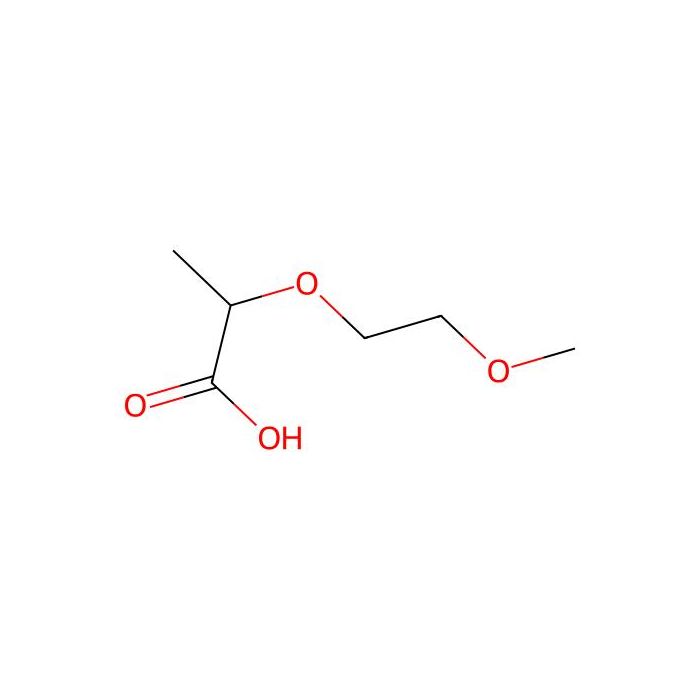
This compound belongs to the class of organic compounds known as carboxylic acids. These are compounds containing a carboxylic acid group with the formula -C(=O)OH.
External Descriptors
monocarboxylic acid - ether
1. Djoumbou Feunang Y, Eisner R, Knox C, Chepelev L, Hastings J, Owen G, Fahy E, Steinbeck C, Subramanian S, Bolton E, Greiner R, and Wishart DS. ClassyFire: Automated Chemical Classification With A Comprehensive, Computable Taxonomy. Journal of Cheminformatics, 2016, 8:61.
Zertifikate (CoA, COO, BSE/TSE und Analyse-Diagramm)
C of A & Other Certificates(BSE/TSE, COO):
Analytical Chart:
Chemische und physikalische Eigenschaften
Molekulargewicht
148.160 g/mol
XLogP3
-0.100
Hydrogen Bond Donor Count
1
Hydrogen Bond Acceptor Count
4
Rotatable Bond Count
5
Exact Mass
148.074 Da
Monoisotopic Mass
148.074 Da
Topological Polar Surface Area
55.800 Ų
Heavy Atom Count
10
Formal Charge
0
Complexity
102.000
Isotope Atom Count
0
Defined Atom Stereocenter Count
0
Undefined Atom Stereocenter Count
1
Defined Bond Stereocenter Count
0
Undefined Bond Stereocenter Count
0
The total count of all stereochemical bonds
0
Covalently-Bonded Unit Count
1
Lösungsrechner
Molarity Calculator
Determine the necessary mass, volume, or concentration for preparing a solution.
Dilution Calculator
Determine the dilution needed to prepare a stock solution.
Reconstitution Calculator
Bewertungen
Kundenbewertungen
Application Protocols
No standardized bioassay or immunoassay protocols are associated with this small-molecule reagent. For synthetic applications, follow general coupling/esterification procedures as outlined under Reaction Conditions, adjusting solvent, base, and reagent ratios based on substrate solubility and reactivity.
Biological Roles
No specific endogenous biological role is established for 2-(2-methoxyethoxy)propanoic acid.
Classification: Small synthetic α-alkoxy carboxylic acid bearing a PEG-like ether side chain.
Biochemical relevance (general): α-Alkoxy acids resemble lactic-acid-type scaffolds but the 2-methoxyethoxy appendage is non-natural. Such motifs are used in medicinal chemistry to adjust polarity, hydrogen-bonding patterns, and solubility of targets via amide/ester incorporation.
Conjugation utility: The carboxyl group enables formation of amide/ester linkages to peptides, proteins (via lysine hydroxyl/amine handles after activation), or polymers for tuning hydrophilicity.
Metabolic considerations (general literature): Carboxylic acids can form acyl-CoA intermediates or undergo β-oxidation-like pathways if bioavailable; ethers typically persist metabolically relative to esters. These are general observations; no item-specific or clinical claims are made.
Research-only note: This product is supplied strictly for research use, not for diagnostic or therapeutic applications.
Buffer Applications
This compound is not a standard laboratory buffer. As a monocarboxylic acid with a carboxyl pKa typically in the ~3.5–4.0 range (literature for α-alkoxy acids), it offers only limited buffering capacity.
Practical use: Could serve as a component in low-pH buffer systems around pH ~3.5–4.0, but conventional buffers (citrate, acetate, formate) are preferred for robustness, cost, and validated behavior.
Recommendation: Use established buffer systems for chromatography, electrophoresis, or bioprocessing. Reserve this compound for its role as a synthetic building block where its hydrophilic side chain is advantageous.
Green Alternatives
Greener practice with this reagent centers on solvent and coupling choices rather than replacing the substrate itself.
Replace DMF/DMAc with MeCN, 2-MeTHF, EtOAc, or propylene carbonate where feasible.
Use water or water–ethanol mixtures for salt formation or enzymatic esterifications.
Coupling reagents:
Favor EDC•HCl (water-compatible, generates urea byproduct) over DCC (sensitizer; difficult to remove dicyclohexylurea).
Explore DMTMM or CDI for cellulose/polysaccharide acylations in greener media.
Energy efficiency: Many couplings proceed at ambient temperature; avoid unnecessary heating.
Concise comparison (general guidance):
Traditional: DMF + DCC/DMAP for Steglich esterification (effective, but hazardous waste and sensitizers).
Greener: MeCN or 2-MeTHF with EDC/DMAP or catalytic Sc(OTf)3; aqueous EDC/NHS for bioconjugation; or enzymatic lipase-catalyzed esterification in green solvents.
Trade-offs:
Greener solvents can impact solubility of some substrates; confirm dissolution and rate.
Water-rich systems increase hydrolysis of activated esters—optimize pH (7.5–8.3) and add reagents last to minimize waste.
Waste minimization:
Use stoichiometric balance and in situ activation (acid chloride or NHS ester generation just-in-time) to reduce decomposition.
Recover solvents via distillation; segregate urea byproducts for proper disposal.
Pharmaceutical Uses
No pharmacopeial status or excipient designation is provided in the Product Data. Accordingly, this compound should be considered a research-grade building block only.
Potential roles in pharmaceutical research (general, non-clinical):
Polarity-tuning acyl group: Installation as an amide/ester can modulate lipophilicity, aqueous solubility, and plasma protein binding in lead optimization.
PEG-mimetic side chain: The 2-methoxyethoxy group introduces local hydrophilicity without full PEGylation, sometimes improving solubility while maintaining permeability in small molecules.
Pro-moiety studies: As an acyl donor, it can be explored in prodrug research to adjust physicochemical properties. Any such use remains strictly preclinical/research.
Analytical reference: Potentially useful as a method-development analyte for LC-MS profiling of α-alkoxy acyl fragments.
Important limitations:
No medical, diagnostic, or therapeutic claims are made for this product.
Quality attributes such as residual solvents, metals, optical purity, and microbiological limits are not specified; consult the CoA if considering regulated applications.
Physical Properties
Item-specific physical specifications are not provided in the Product Data.
Appearance: Not specified for this item; refer to CoA/Spec Sheet.
Density: Not specified for this item; refer to CoA/Spec Sheet.
Refractive index: Not specified for this item; refer to CoA/Spec Sheet.
Melting/boiling point: Not specified for this item; refer to CoA/Spec Sheet.
Solubility (qualitative): Expected to be highly soluble in polar organic solvents (MeOH, EtOH, MeCN) and miscible or at least freely soluble in water due to the 2-methoxyethoxy group (literature/structure-based expectation). Actual item solubility: Not specified; confirm experimentally.
pKa: Carboxyl pKa typically ~3.5–4.0 for α-alkoxy carboxylic acids (literature, by analogy to lactic acid pKa 3.86). Exact value for this specific compound not specified.
LogP/logD: Expected low to moderate hydrophilicity (estimated logP near 0; literature/predicted). Not item-specific.
Vapor pressure: Not specified for this item; refer to CoA/Spec Sheet.
Hygroscopicity: Carboxylic acids with PEG-like side chains may be hygroscopic (general observation). Item-specific behavior not specified; minimize moisture exposure.
Notes for practitioners:
The PEG-like ether chain typically enhances aqueous compatibility; measure pH-dependent solubility if using for bioconjugation or in water-rich media.
If chromatographing, the polar ether chain can cause broadening on normal-phase silica; reversed-phase or polar-modified stationary phases often give better peak shape (general guidance).
Quality and Grades
Item-specific grade/purity is not stated in the Product Data.
Grade/purity: Not specified for this item; refer to CoA/Spec Sheet.
Stabilizers/inhibitors: Not specified for this item; refer to CoA/Spec Sheet.
Guidance on grades (general context):
Research-grade organics typically emphasize assay by NMR/GC/HPLC and control of residual solvents and water. For coupling chemistry, low water content is valuable; if water content is critical, request Karl Fischer data on the lot CoA.
If supplied as racemate, optical purity is not applicable. If a chiral grade (R or S) is desired, specify e.e./d.r. requirements; verify by chiral HPLC.
UV/LC applications: If used as a reference or for LC-MS method development, contaminants with UV absorbance can interfere; HPLC-grade or LC-MS grade reagents reduce background. For this item, such a designation is not provided.
Quality considerations specific to this motif:
Residual acidic/neutral impurities can affect downstream coupling (amide/ester formation). Review CoA for acid value, assay, and residual solvents.
If trace metals are relevant (e.g., in photocatalysis or organometallic steps), request metals screening. Not specified for this item; refer to CoA/Spec Sheet.
Reaction and Applications
This α-alkoxy acid serves as a hydrophilic acylating building block for introducing a 2-methoxyethoxy (–OCH2CH2OCH3) side chain via amide or ester linkages.
Representative uses (literature/general):
Amide couplings: Convert to amides with primary/secondary amines using EDCI/HOBt, HATU/HOAt, or PyBOP in DMF/MeCN with DIPEA or NMM. The resulting amides embed a PEG-like appendage to modulate solubility, permeability, and protein binding.
Esterifications: Fischer esterification (acid-catalyzed in MeOH/ROH), Steglich esterification (DCC/DMAP, CH2Cl2), or via acid chloride to tag polyols or install cleavable linkers.
Acid chloride formation: Oxalyl chloride, thionyl chloride, or Ghosez reagent to generate the corresponding 2-(2-methoxyethoxy)propionyl chloride for acylations of alcohols/amines under milder conditions.
Mixed anhydrides/activated esters: p-Nitrophenyl or NHS esters for bioconjugation; the ether chain enhances water compatibility of the activated species (use freshly prepared, cold, and anhydrous).
Asymmetric synthesis: The α-stereocenter allows chiral pool or resolution strategies. If enantioenriched material is required, perform chiral HPLC or salt resolution on amide/amine derivatives.
Polymer/biomaterial modification: Introduce hydrophilic side chains onto polymers, peptides, or small molecules to tune LCST, reduce aggregation, or alter HPLC retention (general application).
Umpolung/α-functionalization: The α-alkoxy motif stabilizes cationic intermediates; α-halogenation or oxidative α-functionalization can proceed under mild conditions (literature precedents for α-alkoxy acids).
Practical notes:
Control moisture during carbodiimide couplings to limit N-acylureas. Use base scavengers and short reaction times.
For aqueous bioconjugations, prepare NHS esters and couple at pH 7.5–8.3 to balance amine reactivity and hydrolysis.
Reaction Conditions
General, literature-based guidance for common derivatizations of 2-(2-methoxyethoxy)propanoic acid; not item-specific specifications.
Amide couplings:
Solvent: DMF, MeCN, DCM/DMF; greener options include MeCN or 2-MeTHF when substrates are soluble.
Reagents: EDCI/HOBt (or Oxyma), HATU, PyBOP, T3P; base DIPEA or NMM (2–3 equiv typical in literature).
Temperature/time: 20–25°C, 1–16 h depending on substrate nucleophilicity.
Notes: Use Oxyma/HOAt to suppress racemization if handling enantioenriched acid.
Esterifications:
Steglich: DCC (1.1–1.5 equiv), catalytic DMAP (0.05–0.2 equiv), CH2Cl2, 0–25°C, 2–18 h. Filter off DCU.
Fischer: ROH solvent, catalytic H2SO4 or p-TsOH, reflux; remove water (Dean–Stark if applicable).
Acid chloride route: SOCl2 or (COCl)2 (1.5–3 equiv) with catalytic DMF, CH2Cl2, 0–25°C, then add alcohol/amine and base at 0–10°C.
Activation to NHS ester:
Reagents: NHS (1.1–1.5 equiv) + EDCI (1.1–1.5 equiv), DMF/MeCN, 0–25°C, protected from moisture; couple promptly in pH 7.5–8.3 buffer.
Workup/purification:
Acid/base washes to remove coupling reagents; reversed-phase or normal-phase chromatography depending on product polarity.
These ranges are typical literature conditions. Optimize stoichiometry, temperature, and solvent for the specific substrate set and scale.
Safety and Handling
Safety classifications are not provided in the Product Data for this item. Always consult the SDS for authoritative information.
GHS signal word, hazard statements, pictograms: Not specified for this item; refer to SDS.
General laboratory precautions for small organic acids (general guidance):
PPE: Wear lab coat, safety glasses, and appropriate chemically resistant gloves (e.g., nitrile). Use in a fume hood to avoid inhalation of vapors/aerosols.
Handling: Avoid contact with skin and eyes. Prevent inhalation of mists. The carboxylic acid functionality can be irritating; the ether chain can enhance skin penetration—clean spills promptly.
Skin/eye: Rinse with water for ≥15 min; remove contaminated clothing; seek medical attention if irritation persists.
Inhalation: Move to fresh air; get medical attention if symptoms occur.
Ingestion: Rinse mouth; do not induce vomiting; seek medical attention.
Fire safety: Organic compound; use CO2, dry chemical, or foam. Combustion may produce CO/CO2.
Special risks: Not an ether solvent, but peroxide formation is not a typical concern for this acid. The compound may be hygroscopic; keep container tightly closed to maintain assay integrity.
Disposal: Follow local regulations for organic acid waste; neutralize under controlled conditions if appropriate.
Solvent Selection
As a small α-alkoxy carboxylic acid with a PEG-like side chain, this compound is polar and generally compatible with aqueous and polar organic media.
Less polar organics: Limited solubility in EtOAc; poor in hydrocarbons (hexanes, toluene) due to polarity.
When to choose water vs organic:
Aqueous work: For bioconjugation or salt formation, adjust pH 7–9 to form the carboxylate and enhance solubility; buffer capacity near pKa is limited.
Coupling reactions: Use anhydrous polar aprotics (DMF, DCM/DMF, MeCN) with carbodiimides or uronium reagents; add base (DIPEA) to neutralize HCl/HOBt acids.
Comparison (general):
2-(2-methoxyethoxy)propanoic acid vs lactic acid: Greater organic solvent compatibility and typically higher solubility in mixed aqueous/organic media due to the ether chain.
vs long-chain carboxylic acids: Much better behavior in polar phases and improved handling in peptide coupling media.
Practical tips:
Pre-dry solvents when water-sensitive downstream transformations are planned.
If using in RP-HPLC mobile phases as an additive or analyte, favor water/MeCN or water/MeOH systems; the ether chain often yields sharp peaks on C18.
Storage and Reconstitution
Storage conditions: Room temperature (Product Data). Store tightly closed in a dry, well-ventilated place. Protect from moisture to maintain assay and prevent unintended salt formation.
Container: Use amber glass if prolonged storage to minimize any light-catalyzed degradation (general precaution); ensure PTFE-lined caps for acids.
Stability: Item-specific stability data are not provided. For long-term storage, consider cool, dry conditions and minimize headspace; inert gas blanket is a prudent general practice.
Aqueous media: Dissolve directly in water; adjust pH with NaOH or TEA to form the carboxylate if needed for higher concentrations.
Filtration: 0.2 µm PTFE or PVDF syringe filters recommended for solution clarification.
Freeze–thaw: Not typically required. If preparing stock solutions for repeated use, aliquot to minimize atmospheric moisture uptake and hydrolysis of any activated intermediates.
Shipping: Not specified for this item; refer to CoA/Spec Sheet. General expectation is ambient shipment for non-volatile organic acids.
Research Use Note: For research use only (Product Data).
Structure and Identity
A compact, α-alkoxy carboxylic acid combining a propanoic acid backbone with a hydrophilic 2-methoxyethoxy substituent at C2; useful as a polarity-modulating building block.
Product name: 2-(2-methoxyethoxy)propanoic Acid
CAS: 200617-09-0 (Product Data)
CID: 9815219 (Product Data)
InChIKey: 161621 (Product Data)
SMILES: CC(C(=O)O)OCCOC (literature/computed; stereochemistry not specified)
Core: Propanoic acid (–CH3–CH–CO2H) with the carboxyl at C1.
Substituent at C2: An ether chain –O–CH2–CH2–O–CH3 (2-methoxyethoxy), yielding an α-alkoxy acid.
Functional groups: One carboxylic acid (acidic, H-bond donor/acceptor) and a diether motif (H-bond acceptors; increases polarity and aqueous compatibility).
Stereochemistry: No configuration specified; the α-center can exist as R/S. Unless noted otherwise, material may be racemic.
Key identifiers summary:
Class: α-alkoxy carboxylic acid; PEG-like side chain (–O–CH2–CH2–O–CH3).
Handles for derivatization: Carboxyl (for amide/ester formation); ether oxygens (coordination/solvation effects, but typically nonreactive).
Synthetic Utility
The combination of a reactive carboxyl group and a solubilizing 2-methoxyethoxy substituent makes this acid a versatile handle for constructing polar amides/esters and for probing SAR around α-alkoxy motifs.
Key transformations (literature/general):
Amide formation: EDCI/HOBt, HATU, T3P, or PyBOP couplings in DMF/MeCN with DIPEA or NMM. The product amides often exhibit improved solubility vs. straight-chain analogs.
Ester formation: Steglich (DCC/DMAP), Fischer (acid-catalyzed in ROH), or acid chloride routes for alcohol acylation. Useful to functionalize polyols, carbohydrates, or PEG fragments.
Acid chloride: Oxalyl chloride (cat. DMF) or SOCl2 affords the acyl chloride; use cold, dry conditions to minimize racemization at the α-stereocenter if enantioenriched material is used.
NHS/pNP esters: Activation enables bioconjugation to lysine or surface amines in aqueous buffers (pH 7.5–8.3), leveraging the hydrophilic ether chain for better handling.
α-Functionalization: Electrophilic halogenation or oxidation at the α-position may be facilitated by the α-alkoxy substituent’s stabilization of cationic/oxocarbenium-like intermediates.
Protecting group strategies: The ether side chain is generally stable to many conditions; choose reagents that avoid ether cleavage (e.g., avoid strong Lewis acids or BBr3).
Practical considerations:
Dry reaction media reduce byproduct formation in carbodiimide couplings.
If chiral information matters, minimize base strength/temperature and reaction time to suppress epimerization at C2.
Target Specificity
Not applicable. This product is a small-molecule organic acid, not an antibody, enzyme, or targeted biological reagent. No antigen, epitope, or species reactivity data apply.
Wir verwenden Cookies, um die ordnungsgemäße Funktion der Website sicherzustellen und, soweit zulässig, Ihr Nutzererlebnis zu verbessern. Sie können Ihre Einstellungen jederzeit unter „Einstellungen“ verwalten. Weitere Informationen finden Sie in unserer Cookie-Richtlinie.
Shall we send you a message when we have discounts available?
Remind me later
Thank you! Please check your email inbox to confirm.
Products are supplied to verified businesses, institutions, and qualified professionals for research and development use only. Not for use in humans, animals, diagnosis, or therapy.