Determine the necessary mass, volume, or concentration for preparing a solution.
Taxonomy Tree
| Kingdom | Organic compounds |
|---|---|
| Superclass | Alkaloids and derivatives |
| Klasse | Not available |
| Subclass | Not available |
| Intermediate Tree Nodes | Not available |
| Direct Parent | Alkaloids and derivatives |
| Alternative Parents | Aralkylamines Piperidines Benzene and substituted derivatives Dialkylamines Azacyclic compounds Hydrocarbon derivatives |
| Molecular Framework | Aromatic heteromonocyclic compounds |
| Substituents | Alkaloid or derivatives - Aralkylamine - Benzenoid - Piperidine - Monocyclic benzene moiety - Azacycle - Organoheterocyclic compound - Secondary amine - Secondary aliphatic amine - Organic nitrogen compound - Hydrocarbon derivative - Organonitrogen compound - Amine - Aromatic heteromonocyclic compound |
| Beschreibung | This compound belongs to the class of organic compounds known as alkaloids and derivatives. These are naturally occurring chemical compounds that contain mostly basic nitrogen atoms. This group also includes some related compounds with neutral and even weakly acidic properties. Also some synthetic compounds of similar structure are attributed to alkaloids. In addition to carbon, hydrogen and nitrogen, alkaloids may also contain oxygen, sulfur and more rarely other elements such as chlorine, bromine, and phosphorus. |
| External Descriptors | Not available |
| Molekulargewicht | 189.3 |
|---|---|
| XLogP3 | 3.000 |
| Hydrogen Bond Donor Count | 1 |
| Hydrogen Bond Acceptor Count | 1 |
| Rotatable Bond Count | 3 |
| Exact Mass | 189.152 Da |
| Monoisotopic Mass | 189.152 Da |
| Topological Polar Surface Area | 12.000 Ų |
| Heavy Atom Count | 14 |
| Formal Charge | 0 |
| Complexity | 149.000 |
| Isotope Atom Count | 0 |
| Defined Atom Stereocenter Count | 0 |
| Undefined Atom Stereocenter Count | 1 |
| Defined Bond Stereocenter Count | 0 |
| Undefined Bond Stereocenter Count | 0 |
| The total count of all stereochemical bonds | 0 |
| Covalently-Bonded Unit Count | 1 |
H302:Harmful if swallowed
H315:Causes skin irritation
H319:Causes serious eye irritation
H335:May cause respiratory irritation
P261:Avoid breathing dust/fume/gas/mist/vapors/spray.
P264:Wash hands [and …] thoroughly after handling.
P270:Do not eat, drink or smoke when using this product.
P271:Use only outdoors or in a well-ventilated area.
P280:Wear protective gloves/protective clothing/eye protection/face protection.
P321:Specific treatment (see ... on this label).
P330:Rinse mouth.
P302+P352:IF ON SKIN: wash with plenty of water.
P304+P340:IF INHALED: Remove person to fresh air and keep comfortable for breathing.
P305+P351+P338:IF IN EYES: Rinse cautiously with water for several minutes. Remove contact lenses if present and easy to do - continue rinsing.
P362+P364:Take off contaminated clothing and wash it before reuse.
P405:Store locked up.
P403+P233:Store in a well-ventilated place. Keep container tightly closed.
P501:Dispose of contents/container to an approved waste disposal plant.
P264+P265:Wash hands [and …] thoroughly after handling. Do not touch eyes.
P301+P317:IF SWALLOWED: Get medical help.
P337+P317:If eye irritation persists: Get medical help.
P332+P317:If skin irritation occurs: Get medical help.
P319:Get medical help if you feel unwell.
No application protocols (e.g., WB, IHC, IF, FC) apply to this small-molecule building block. For synthetic procedures, see the Reaction Conditions and Synthetic Utility sections for general laboratory guidance.
This product is intended for research use as a chemical building block; no biological activity or clinical utility is claimed for the item itself.
Item-specific biological roles, targets, or activities are not specified for this product. Any use in biological experiments should be as a research chemical with appropriate controls and safety measures.
2-(2-Phenylethyl)piperidine is not a conventional buffering reagent. While secondary amines can exhibit buffering capacity near the pKa of their conjugate acids (piperidine pKaH ~11, literature), this compound is typically used as a synthetic building block rather than as a buffer component.
Although 2-(2-Phenylethyl)piperidine is a target building block rather than a solvent, greener choices can be made in the processes that use it.
Comparison snapshot (typical)
Note: Validate substitutions on small scale to confirm kinetics/selectivity.
No excipient or pharmacopeial status is specified for this item; it is supplied for research use only.
No therapeutic or clinical claims are made for this product. For GMP or compendial needs, consult appropriate suppliers and pharmacopeial monographs for the specific derivative of interest.
Item-specific physico-chemical specifications (bp, mp, density, refractive index, etc.) are not provided in the Product Data.
Item-specific values
Literature/typical information for related 2-substituted piperidines (for general guidance only)
Note: For precise, item-specific physical constants and analytical limits, consult the product CoA/Spec Sheet.
Use 2-(2-Phenylethyl)piperidine as a versatile secondary amine scaffold and nucleophile.
General guidance for common transformations of 2-(2-Phenylethyl)piperidine (literature-based; optimize per substrate):
Notes
Always defer to the Aladdin SDS for this specific item.
This product is a building-block amine, not a solvent. Solvent selection considerations below pertain to using 2-(2-Phenylethyl)piperidine in reactions or purifications.
Research Use Only: For research use only; not for human or veterinary use.
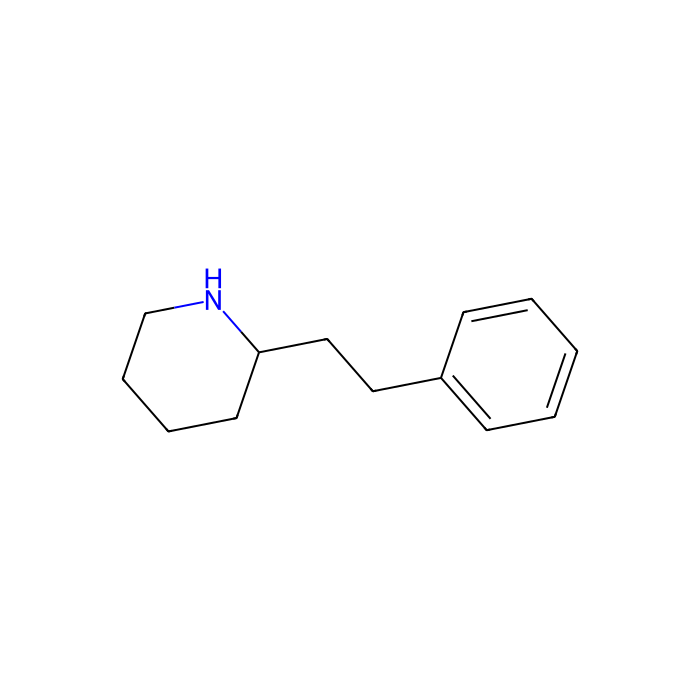
Brief description: 2-(2-Phenylethyl)piperidine is a secondary cyclic amine (piperidine) bearing a phenethyl substituent at the 2-position of the ring, creating a stereogenic center at C-2 (racemic unless otherwise specified).
Key reactivity derives from the secondary amine and the benzylic positions of the phenethyl substituent.
Not applicable. This product is a small-molecule amine building block, not a biological macromolecule or antibody. No target, epitope, clone, or isotype information applies.