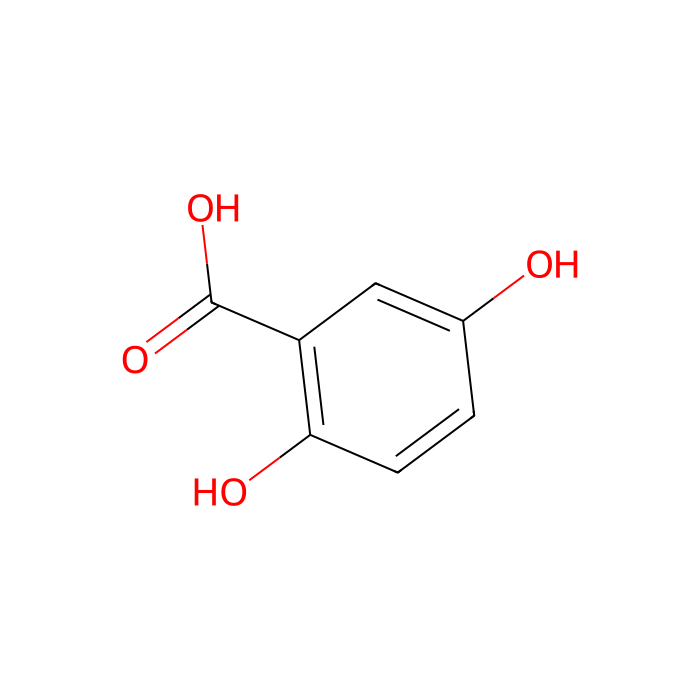
2,5-Dihydroxybenzoic acid - for synthesis , CAS No.490-79-9

CAS: 490-79-9 Cat. No.: D432752 Summenformel: C7H6O4 Molekulargewicht: 154.12 Beilstein Registry Number: 10(4)1441 EG-Nummer: 207-718-5
Zu bestellen verfügbar
QUALITÄT & REINHEIT for Synthesis ? Synthesis grade — practical purity for chemical synthesis and preparative work. Use as a cost-effective reagent when analytical purity isn't required.
Synonyms
Benzoic acid, 2,5-dihydroxy-|Casate sodium|Hydroquinonecarboxylic acid|Gentinatre|gentisic acid|Gentisinic acid|GENTISATE SODIUM|GENTISIC ACID [II]|gentisic acid (2,5-dihydroxybenzoic acid)|5-Hydroxysalicylic acid|5-hydroxy-Salicylic acid|Acido gentisico|Acidum gentisicum|Gentisan|GENTISIC ACID [MI]|Gentisinate|Gentisod|2,5dihydroxybenzoic acid|2,5-DIHYDROXYBENZOIC ACID|2,5-dihydroxy-benzoic acid|Sodium-Gent|Casate|3,6-dihydroxybenzoic acid|2,5-Dihydroxybenzoate, VI|GENOP|Kyselina gentisinova [Czech]|Nagentis|Gentidol|Gentisic acid [INN]|Kyselina 2,5-dihydroxybenzoova|2,5-Dioxybenzoate|Gentisate|3,6-Dihydroxybenzoate|Acidum gentisicum [INN-Latin]|Gentasol|Salicylic acid, 5-hydroxy-|Acido gentisico [INN-Spanish]|gentisicacid|Gensigon|2,5-Dioxybenzoic acid|MESALAZINE IMPURITY G [EP IMPURITY]|Nagent|2,5,dihydroxybenzoic acid|2,5-Dhba|Acide gentisique|Gabail|Legential|5-hydroxy-Salicylate|Acido 2,5-diidrossibenzoico|GENTISIC ACID [WHO-DD]|2,5-Dihydroxy benzoic acid|BENZOIC ACID,2,5-DIHYDROXY|Kyselina gentisinova|Carboxyhydroquinone|Dihydroxybenzoicacid|GTQ|Acido 2,5-diidrossibenzoico [Italian]|Acide gentisique [INN-French]|Kyselina 2,5-dihydroxybenzoova [Czech]|Gentalpin
Storage
Room temperature
Shipped In
Normal
★
Größe
Deutschland (EU)
USA*
Preis
Menge
50g
D432752-50g
Auf Bestellung · 8–12 Wochen

130,07€

152,64€
Speichern 22,56 € (14.78%)
250g
D432752-250g
Auf Bestellung · 8–12 Wochen

497,13€

581,30€
Speichern 84,17 € (14.48%)
Enter a quantity for the sizes you want to add.

Übersicht

Application

2,5-Dihydroxybenzoic acid for synthesis. CAS 490-79-9, molar mass 154.12 g/mol.

Spezifikationen

Synonyme
Benzoic acid, 2,5-dihydroxy- | Casate sodium | Hydroquinonecarboxylic acid | Gentinatre | gentisic acid | Gentisinic acid | GENTISATE SODIUM | GENTISIC ACID [II] | gentisic acid (2,5-dihydroxybenzoic acid) | 5-Hydroxysalicylic acid | 5-hydroxy-Salicylic acid | Acido gentisico | Acidum gentisicum | Gentisan | GENTISIC ACID [MI] | Gentisina Show more
Spezifikationen & Reinheit
for synthesis
Storage
Room temperature
Verschickt in
Normal
Note
zur Synthese
Namen und Kennungen
SMILES
C1=CC(=C(C=C1O)C(=O)O)O
IUPAC Name
2,5-dihydroxybenzoic acid
InChIKey
WXTMDXOMEHJXQO-UHFFFAOYSA-N
InChI
1S/C7H6O4/c8-4-1-2-6(9)5(3-4)7(10)11/h1-3,8-9H,(H,10,11)
Isomere SMILES
C1=CC(=C(C=C1O)C(=O)O)O
WGK Deutschland
3
RTECS
LY3850000
Molekulargewicht
154.12
Beilstein
10(4)1441
Reaxys
2209119
Reaxys-RN_link_address
https://www.reaxys.com/reaxys/secured/hopinto.do?context=S&query=IDE.XRN=2209119&ln=

Erweiterte Daten

Taxonomic Classification

Taxonomy Tree

KingdomOrganic compounds
SuperclassBenzenoids
KlasseBenzene and substituted derivatives
SubclassBenzoic acids and derivatives
Intermediate Tree Nodes Not available
Direct ParentHydroxybenzoic acid derivatives
Alternative Parents Salicylic acids  Benzoic acids  Hydroquinones  Benzoyl derivatives  1-hydroxy-2-unsubstituted benzenoids  Vinylogous acids  Monocarboxylic acids and derivatives  Carboxylic acids  Organooxygen compounds  Organic oxides  Hydrocarbon derivatives  
Molecular FrameworkAromatic homomonocyclic compounds
Substituents Dihydroxybenzoic acid - Salicylic acid - Salicylic acid or derivatives - Hydroxybenzoic acid - Benzoic acid - Benzoyl - Hydroquinone - 1-hydroxy-2-unsubstituted benzenoid - Phenol - Vinylogous acid - Carboxylic acid derivative - Carboxylic acid - Monocarboxylic acid or derivatives - Organic oxygen compound - Hydrocarbon derivative - Organooxygen compound - Organic oxide - Aromatic homomonocyclic compound
BeschreibungThis compound belongs to the class of organic compounds known as hydroxybenzoic acid derivatives. These are compounds containing a hydroxybenzoic acid (or a derivative), which is a benzene ring bearing a carboxyl and a hydroxyl groups.
External Descriptors dihydroxybenzoic acid
3D-Struktur
Interaktives chemisches Strukturmodell


Zugehörige Ziele (menschlich)
F2 Tclin Thrombin (11687 Activities)
Activity TypeRelationActivity valueUnitsAction TypeJournalPubMed IddoiAssay Aladdin ID
CA2 Tclin Carbonic anhydrase II (17698 Activities)
Activity TypeRelationActivity valueUnitsAction TypeJournalPubMed IddoiAssay Aladdin ID
ESR1 Tclin Estrogen receptor alpha (17718 Activities)
Activity TypeRelationActivity valueUnitsAction TypeJournalPubMed IddoiAssay Aladdin ID
PGR Tclin Progesterone receptor (8562 Activities)
Activity TypeRelationActivity valueUnitsAction TypeJournalPubMed IddoiAssay Aladdin ID
CHRM2 Tclin Muscarinic acetylcholine receptor M2 (10671 Activities)
Activity TypeRelationActivity valueUnitsAction TypeJournalPubMed IddoiAssay Aladdin ID
HTR1A Tclin Serotonin 1a (5-HT1a) receptor (14969 Activities)
Activity TypeRelationActivity valueUnitsAction TypeJournalPubMed IddoiAssay Aladdin ID
ADRA2A Tclin Alpha-2a adrenergic receptor (9450 Activities)
Activity TypeRelationActivity valueUnitsAction TypeJournalPubMed IddoiAssay Aladdin ID
ALOX5 Tclin Arachidonate 5-lipoxygenase (6568 Activities)
Activity TypeRelationActivity valueUnitsAction TypeJournalPubMed IddoiAssay Aladdin ID
AR Tclin Androgen Receptor (11781 Activities)
Activity TypeRelationActivity valueUnitsAction TypeJournalPubMed IddoiAssay Aladdin ID
CHRM1 Tclin Muscarinic acetylcholine receptor M1 (12690 Activities)
Activity TypeRelationActivity valueUnitsAction TypeJournalPubMed IddoiAssay Aladdin ID
TYR Tclin Tyrosinase (717 Activities)
Activity TypeRelationActivity valueUnitsAction TypeJournalPubMed IddoiAssay Aladdin ID
MAOA Tclin Monoamine oxidase A (11911 Activities)
Activity TypeRelationActivity valueUnitsAction TypeJournalPubMed IddoiAssay Aladdin ID
DRD1 Tclin Dopamine D1 receptor (9720 Activities)
Activity TypeRelationActivity valueUnitsAction TypeJournalPubMed IddoiAssay Aladdin ID
ACHE Tclin Acetylcholinesterase (18204 Activities)
Activity TypeRelationActivity valueUnitsAction TypeJournalPubMed IddoiAssay Aladdin ID
PTGS1 Tclin Cyclooxygenase-1 (9233 Activities)
Activity TypeRelationActivity valueUnitsAction TypeJournalPubMed IddoiAssay Aladdin ID
SLC6A2 Tclin Norepinephrine transporter (10102 Activities)
Activity TypeRelationActivity valueUnitsAction TypeJournalPubMed IddoiAssay Aladdin ID
SLC6A4 Tclin Serotonin transporter (12625 Activities)
Activity TypeRelationActivity valueUnitsAction TypeJournalPubMed IddoiAssay Aladdin ID
ADRA1A Tclin Alpha-1a adrenergic receptor (8359 Activities)
Activity TypeRelationActivity valueUnitsAction TypeJournalPubMed IddoiAssay Aladdin ID
PTGS2 Tclin Cyclooxygenase-2 (13999 Activities)
Activity TypeRelationActivity valueUnitsAction TypeJournalPubMed IddoiAssay Aladdin ID
OPRM1 Tclin Mu opioid receptor (19785 Activities)
Activity TypeRelationActivity valueUnitsAction TypeJournalPubMed IddoiAssay Aladdin ID
DRD3 Tclin Dopamine D3 receptor (14368 Activities)
Activity TypeRelationActivity valueUnitsAction TypeJournalPubMed IddoiAssay Aladdin ID
SLC6A3 Tclin Dopamine transporter (10535 Activities)
Activity TypeRelationActivity valueUnitsAction TypeJournalPubMed IddoiAssay Aladdin ID
SLC18A2 Tclin Synaptic vesicular amine transporter (118 Activities)
Activity TypeRelationActivity valueUnitsAction TypeJournalPubMed IddoiAssay Aladdin ID
KCNH2 Tclin HERG (29587 Activities)
Activity TypeRelationActivity valueUnitsAction TypeJournalPubMed IddoiAssay Aladdin ID
PDE3A Tclin Phosphodiesterase 3A (3309 Activities)
Activity TypeRelationActivity valueUnitsAction TypeJournalPubMed IddoiAssay Aladdin ID
HTR2B Tclin Serotonin 2b (5-HT2b) receptor (10323 Activities)
Activity TypeRelationActivity valueUnitsAction TypeJournalPubMed IddoiAssay Aladdin ID
TBXA2R Tclin Thromboxane A2 receptor (5717 Activities)
Activity TypeRelationActivity valueUnitsAction TypeJournalPubMed IddoiAssay Aladdin ID
PDE4A Tclin Phosphodiesterase 4A (1943 Activities)
Activity TypeRelationActivity valueUnitsAction TypeJournalPubMed IddoiAssay Aladdin ID
ADORA3 Tchem Adenosine A3 receptor (15931 Activities)
Activity TypeRelationActivity valueUnitsAction TypeJournalPubMed IddoiAssay Aladdin ID
CA1 Tclin Carbonic anhydrase I (13240 Activities)
Activity TypeRelationActivity valueUnitsAction TypeJournalPubMed IddoiAssay Aladdin ID
HRH3 Tclin Histamine H3 receptor (10389 Activities)
Activity TypeRelationActivity valueUnitsAction TypeJournalPubMed IddoiAssay Aladdin ID
KDR Tclin Vascular endothelial growth factor receptor 2 (20924 Activities)
Activity TypeRelationActivity valueUnitsAction TypeJournalPubMed IddoiAssay Aladdin ID
CA14 Tclin Carbonic anhydrase XIV (1305 Activities)
Activity TypeRelationActivity valueUnitsAction TypeJournalPubMed IddoiAssay Aladdin ID
MMP3 Tchem Matrix metalloproteinase 3 (3433 Activities)
Activity TypeRelationActivity valueUnitsAction TypeJournalPubMed IddoiAssay Aladdin ID
MMP8 Tchem Matrix metalloproteinase 8 (1942 Activities)
Activity TypeRelationActivity valueUnitsAction TypeJournalPubMed IddoiAssay Aladdin ID
CA12 Tclin Carbonic anhydrase XII (6231 Activities)
Activity TypeRelationActivity valueUnitsAction TypeJournalPubMed IddoiAssay Aladdin ID
CA9 Tclin Carbonic anhydrase IX (8255 Activities)
Activity TypeRelationActivity valueUnitsAction TypeJournalPubMed IddoiAssay Aladdin ID
MMP1 Tchem Matrix metalloproteinase-1 (7046 Activities)
Activity TypeRelationActivity valueUnitsAction TypeJournalPubMed IddoiAssay Aladdin ID
HEK293 (82097 Activities)
Activity TypeRelationActivity valueUnitsAction TypeJournalPubMed IddoiAssay Aladdin ID
POLI Tchem DNA polymerase iota (116820 Activities)
Activity TypeRelationActivity valueUnitsAction TypeJournalPubMed IddoiAssay Aladdin ID
ABCB11 Tchem Bile salt export pump (2311 Activities)
Activity TypeRelationActivity valueUnitsAction TypeJournalPubMed IddoiAssay Aladdin ID
SLCO1B1 Tchem Solute carrier organic anion transporter family member 1B1 (2672 Activities)
Activity TypeRelationActivity valueUnitsAction TypeJournalPubMed IddoiAssay Aladdin ID
CBX1 Tbio Chromobox protein homolog 1 (92434 Activities)
Activity TypeRelationActivity valueUnitsAction TypeJournalPubMed IddoiAssay Aladdin ID
SLCO1B3 Tchem Solute carrier organic anion transporter family member 1B3 (2517 Activities)
Activity TypeRelationActivity valueUnitsAction TypeJournalPubMed IddoiAssay Aladdin ID
SLC26A4 Tbio Pendrin (86 Activities)
Activity TypeRelationActivity valueUnitsAction TypeJournalPubMed IddoiAssay Aladdin ID
Zugehörige Ziele (nicht menschlich)
Ca7 Carbonic anhydrase VII (3 Activities)
Activity TypeRelationActivity valueUnitsAction TypeJournalPubMed IddoiAssay Aladdin ID
Nos2 Nitric oxide synthase, inducible (3573 Activities)
Activity TypeRelationActivity valueUnitsAction TypeJournalPubMed IddoiAssay Aladdin ID
Mmp2 Matrix metalloproteinase-2 (12 Activities)
Activity TypeRelationActivity valueUnitsAction TypeJournalPubMed IddoiAssay Aladdin ID
Ptpn1 Protein-tyrosine phosphatase 1B (270 Activities)
Activity TypeRelationActivity valueUnitsAction TypeJournalPubMed IddoiAssay Aladdin ID
Mmp9 Matrix metalloproteinase 9 (38 Activities)
Activity TypeRelationActivity valueUnitsAction TypeJournalPubMed IddoiAssay Aladdin ID
Trypanosoma cruzi (99888 Activities)
Activity TypeRelationActivity valueUnitsAction TypeJournalPubMed IddoiAssay Aladdin ID
J774 (3120 Activities)
Activity TypeRelationActivity valueUnitsAction TypeJournalPubMed IddoiAssay Aladdin ID
lef Anthrax lethal factor (7585 Activities)
Activity TypeRelationActivity valueUnitsAction TypeJournalPubMed IddoiAssay Aladdin ID
Txnrd1 Thioredoxin reductase 1, cytoplasmic (45279 Activities)
Activity TypeRelationActivity valueUnitsAction TypeJournalPubMed IddoiAssay Aladdin ID
SARS-CoV-2 (38078 Activities)
Activity TypeRelationActivity valueUnitsAction TypeJournalPubMed IddoiAssay Aladdin ID
Wirkungsmechanismen
Zertifikate (CoA, COO, BSE/TSE und Analyse-Diagramm)
C of A & Other Certificates(BSE/TSE, COO):
Analytical Chart:
Chemische und physikalische Eigenschaften
Schmelzpunkt (°C)200-205°C
Molekulargewicht154.12
XLogP31.600
Hydrogen Bond Donor Count3
Hydrogen Bond Acceptor Count4
Rotatable Bond Count1
Exact Mass154.027 Da
Monoisotopic Mass154.027 Da
Topological Polar Surface Area77.800 Ų
Heavy Atom Count11
Formal Charge0
Complexity157.000
Isotope Atom Count0
Defined Atom Stereocenter Count0
Undefined Atom Stereocenter Count0
Defined Bond Stereocenter Count0
Undefined Bond Stereocenter Count0
The total count of all stereochemical bonds0
Covalently-Bonded Unit Count1
Sicherheit und Gefahren (GHS)
Piktogramm(e)
Signal
Warning
Gefahrenhinweise

H302:Harmful if swallowed

H315:Causes skin irritation

H319:Causes serious eye irritation

H335:May cause respiratory irritation

Sicherheitshinweise

P261:Avoid breathing dust/fume/gas/mist/vapors/spray.

P264:Wash hands [and …] thoroughly after handling.

P270:Do not eat, drink or smoke when using this product.

P271:Use only outdoors or in a well-ventilated area.

P280:Wear protective gloves/protective clothing/eye protection/face protection.

P321:Specific treatment (see ... on this label).

P330:Rinse mouth.

P302+P352:IF ON SKIN: wash with plenty of water.

P304+P340:IF INHALED: Remove person to fresh air and keep comfortable for breathing.

P305+P351+P338:IF IN EYES: Rinse cautiously with water for several minutes. Remove contact lenses if present and easy to do - continue rinsing.

P362+P364:Take off contaminated clothing and wash it before reuse.

P405:Store locked up.

P403+P233:Store in a well-ventilated place. Keep container tightly closed.

P501:Dispose of contents/container to an approved waste disposal plant.

P264+P265:Wash hands [and …] thoroughly after handling. Do not touch eyes.

P301+P317:IF SWALLOWED: Get medical help.

P337+P317:If eye irritation persists: Get medical help.

P332+P317:If skin irritation occurs: Get medical help.

P319:Get medical help if you feel unwell.

WGK Deutschland
3
RTECS
LY3850000
Reaxys
2209119
Reaxys-RN_link_address
https://www.reaxys.com/reaxys/secured/hopinto.do?context=S&query=IDE.XRN=2209119&ln=
Merck-Index
4398
FAQs und Artikel
Citations of This Product
Lösungsrechner
Bewertungen

Kundenbewertungen

Application Protocols

Item-specific tested applications: Not specified for this item; refer to CoA/Spec Sheet.

General, literature-based protocol examples (for research use only)

  • MALDI-TOF matrix preparation (typical):
    • Prepare a saturated solution of 2,5-DHB in 50–70% acetonitrile or methanol in water with 0.1% TFA.
    • Filter (0.2 µm) and use fresh. Mix analyte and matrix 1:1 to 1:10 (v/v) depending on analyte class; spot 0.5–1 µL and air-dry.
    • Optimize crystal morphology by adjusting solvent ratio and spotting technique (dried-droplet, thin-layer, or seeded).
  • O-alkylation workup (example):
    • Quench reaction with water, extract with EtOAc, wash organic layer with brine, dry (Na2SO4), concentrate, and purify by silica gel chromatography using gradient EtOAc/hexanes.

Note: The above are general literature practices and not validated protocols for this specific catalog item. Validate and optimize for your system.

Biological Roles

Literature context (no clinical claims)

  • Endogenous/metabolic role: 2,5-Dihydroxybenzoic acid (gentisic acid) is a known Phase I/II metabolite of salicylic acid and aspirin in humans and other organisms, formed via hydroxylation and conjugation pathways.
  • Plant biology: Gentisic acid has been observed as a signaling-related phenolic in certain plant defense responses and as a component of phenolic metabolic networks.
  • Redox chemistry: As a dihydroxybenzoic acid, it exhibits radical-scavenging and metal-chelation behaviors that underpin its use as a model antioxidant in biochemical assays.
  • Enzyme interactions: Gentisate 1,2-dioxygenase and related enzymes catalyze ring-cleavage of gentisate in microbial catabolism, making it a useful substrate/standard in enzymology.

Analytical/biochemical utilities

  • Standard/reference material: Employed as a calibration compound and matrix (DHB) in MALDI-TOF MS for biomolecules, especially glycoconjugates and lipids.
  • Complexation studies: Serves as a bidentate ligand to probe metal-binding in proteins and small-molecule systems.

Notes

  • The above reflects general biochemical knowledge/literature. Item-specific biological testing or certification is not provided in the Product Data and should be verified by end-users as needed.
Buffer Applications

Applicability

  • 2,5-Dihydroxybenzoic acid is not a standard buffering agent in biochemical or analytical buffers.

General guidance (literature)

  • As a weak acid (pKa1 ~3), it can contribute limited buffering capacity in the acidic range (approximately pH 2–4), but conventional buffers (e.g., citrate, acetate, phosphate) provide superior capacity and defined compositions.
  • For MALDI sample prep, DHB is typically dissolved in mixed organic/aqueous solvents with a small amount of acid (e.g., 0.1% TFA) rather than used as a buffer per se.

Recommendation

  • For buffer preparation needs, choose established buffering systems appropriate to the target pH. Use 2,5-dihydroxybenzoic acid primarily as a reagent/matrix rather than a buffer component.
Green Alternatives

Context

  • As a solid reagent/matrix, its “greenness” relates to sourcing, solvent choices for its use, and alternatives for specific applications (e.g., MALDI matrices), rather than replacing it as a bulk solvent.

MALDI matrix alternatives (literature comparison)

  • 2,5-DHB vs α-cyano-4-hydroxycinnamic acid (HCCA): HCCA often gives higher sensitivity for peptides; DHB is more forgiving for heterogeneous samples and carbohydrates. Toxicological profiles are similar; solvent systems overlap (MeOH/ACN–water).
  • 2,5-DHB vs sinapinic acid (SA): SA is preferred for large proteins; DHB tends to work better for glycopeptides and lipids. Both are low-volatility solids used at low mass loadings; waste impact is dominated by solvent choice.

Greener practice recommendations

  • Use water-rich solvent systems (e.g., 50–70% water with ACN or MeOH) when feasible to reduce VOCs.
  • Minimize matrix excess; employ micro-spotting/printing to lower waste.
  • Favor alcohols (EtOH) over higher-toxicity solvents; avoid chlorinated solvents for recrystallization or cleaning.
  • Implement solvent recycling for ACN/MeOH in high-throughput facilities.

Synthesis/derivatization context

  • For esterification or coupling, consider EDC·HCl with catalytic DMAP in aqueous/MeCN biphasic systems instead of DCC (easier waste handling).
  • Where possible, use carbonate bases (K2CO3) and green dipolar aprotics (e.g., Cyrene, propylene carbonate) as co-solvents, validating performance experimentally.
Pharmaceutical Uses

Scope and limitations

  • No pharmacopeial status, excipient designation, or GMP specifications are provided in the Product Data for this item (Grade: for Synthesis). It is not offered as a pharmaceutical excipient or API.

Literature/formulation context (no therapeutic claims)

  • Gentisic acid has been studied as an antioxidant/chelating phenolic in formulation research and as a reference standard related to salicylate metabolism. Such uses require appropriate grade, impurity control, and regulatory compliance not implied by this listing.

Practical note

  • For any use in regulated manufacturing or as an excipient/standard, source materials with pharmacopeial compliance (e.g., USP/Ph.Eur.), validated impurity profiles, and full GMP documentation. This product is for research use only.
Physical Properties

Item-specific specifications

  • Appearance: Not specified for this item; refer to CoA/Spec Sheet.
  • Any numeric specifications (mp, water content, metals, UV cutoff, etc.): Not specified for this item; refer to CoA/Spec Sheet.

Literature/general values (not item specifications)

  • State: Solid, crystalline (literature)
  • Melting point: ~200–205 °C (often reported with partial decomposition) (literature)
  • Boiling point: Not applicable; decomposes before boiling at ambient pressure (literature)
  • pKa values: pKa1 (carboxyl) ~2.9–3.0; pKa2 (phenolic) ~10.0–10.3 (literature)
  • LogP (octanol/water): ~1.0–1.2 (literature)
  • Aqueous solubility: low at neutral pH; markedly higher in basic solution due to formation of gentisate anion (literature)
  • Solubility in organics: soluble in polar protic and aprotic solvents (e.g., ethanol, methanol, DMSO, DMF) with heating or at moderate concentrations (literature)

Practical notes (general)

  • The intramolecular H-bond between the 2-OH and –CO2H can influence crystallinity and melting behavior.
  • For quantitative work, confirm exact values for the specific lot on the CoA/Spec Sheet and consult the SDS for thermal stability/decomposition details.
Quality and Grades

Item-specific grade

  • Grade: for Synthesis (as provided)

What “for Synthesis” typically implies (general guidance)

  • Intended for general laboratory and synthetic use where high purity is needed for reactions and material preparation, but without the low-UV background, metal content guarantees, or trace analyses associated with specialty grades (e.g., HPLC, LC–MS, semiconductor).
  • Suitable for routine organic transformations, derivatizations (esterification, etherification), and as a matrix component in analytical workflows when end-user QC is acceptable.

What is NOT claimed for this item

  • No specific assay/purity percentage, residual solvent profile, metal limits, water content, bioburden/endotoxin, or stabilizer content are provided in the Product Data.
  • Therefore, any such parameters are: Not specified for this item; refer to CoA/Spec Sheet.

Practical quality notes

  • For sensitive applications (e.g., trace analysis, LC–MS, catalyst-poison–sensitive reactions), consider further purification (recrystallization, charcoal treatment) or source a higher grade with documented trace specifications.
  • For reproducibility, record lot numbers and consult the CoA for that lot’s assay and impurity profile.
Reaction and Applications

Key application domains (literature)

  • MALDI-TOF MS matrix: 2,5-Dihydroxybenzoic acid (DHB) is a widely used matrix for peptides, glycoproteins, lipids, and oligosaccharides owing to efficient proton transfer and soft desorption/ionization.
  • Chelation/coordination chemistry: The ortho-phenol/carboxylate motif forms bidentate chelates; gentisate ligands are used to model metalloenzyme active sites and prepare metal–organic complexes.
  • Antioxidant/phenolic chemistry studies: The catechol-like reactivity (though 2,5- vs 1,2-dihydroxy) supports radical-scavenging and redox investigations in polymer and food chemistry (research context).

Transformations and derivatizations (synthetic utility)

  • Esterification: Fischer conditions (ROH, H2SO4, heat) or DCC/EDC with catalytic DMAP afford alkyl aryl gentisates; useful as protected forms or for volatility enhancement.
  • O-Alkylation: Williamson ether synthesis of one or both phenols (e.g., MeI, BnBr) under basic conditions (K2CO3/NaH in DMF) to tune solubility/electronics.
  • Amide coupling: Activation of the acid (SOCl2/oxalyl chloride or carbodiimide) enables gentisamide derivatives; protect phenols when necessary.
  • Electrophilic aromatic substitution: The phenolic OH groups direct to ortho/para positions; strategic halogenation or nitration allows entry to cross-coupling manifolds (Suzuki, Buchwald–Hartwig after amination).

Practical tips

  • For MALDI uses, prepare fresh solutions, filter (0.2 µm), and optimize matrix-to-analyte ratios.
  • In base-mediated O-alkylations, exclude water and control temperature to avoid over-alkylation and carbonate side reactions.
  • Consider protecting-group strategies (e.g., methyl/benzyl ethers) when installing acid chlorides or performing metalations.
Reaction Conditions

General conditions (literature; illustrative only)

  • Fischer esterification: 2,5-DHBA (1.0 eq), ROH (as solvent), catalytic H2SO4 (1–5 mol%), reflux 4–16 h; remove water (Dean–Stark for higher alcohols or azeotrope with toluene). Workup by neutralization and extraction.
  • Carbodiimide coupling (ester or amide): 2,5-DHBA (1.0 eq), alcohol or amine (1.1–1.5 eq), DCC or EDC·HCl (1.1–1.5 eq), DMAP (5–10 mol%), solvent (DCM/DMF), 0 °C to rt then 12–24 h. Filter urea byproducts; purify by chromatography/recrystallization.
  • O-alkylation (Williamson): 2,5-DHBA (1.0 eq), base (K2CO3, 2.0–3.0 eq or NaH, 1.5–2.0 eq), alkyl halide (1.2–1.5 eq), dry DMF or acetone, 0–25 °C to 50 °C, 2–12 h. Monitor for mono- vs di-alkylated products.
  • Acid chloride formation: SOCl2 (3–5 eq) with catalytic DMF, solvent-free or DCM, 0 °C to reflux 1–3 h; protect phenols if selectivity is required. Remove excess reagent under reduced pressure; quench cautiously.
  • Electrophilic substitution: For bromination, NBS or Br2 in AcOH or DMF at 0–25 °C; regioselectivity influenced by phenolic protection pattern.

Notes

  • Dry, oxygen-free conditions may be beneficial for base-promoted reactions to minimize side oxidations of phenolic moieties.
  • Always confirm compatibility of conditions with unprotected phenols; consider stepwise protection/deprotection to control selectivity and yield.
Safety and Handling

Item-specific hazard information

  • GHS Classification: Not specified for this item; refer to SDS.
  • Signal word / H-statements / Pictograms: Not specified for this item; refer to SDS.

General safety considerations (literature/typical for aromatic dihydroxybenzoic acids)

  • Expected hazards: May cause skin, eye, and respiratory irritation; dust can be irritating. Avoid inhalation of particulates.
  • Personal protective equipment: Lab coat, safety glasses or goggles, and suitable gloves (e.g., nitrile). Use a dust mask or work in a fume hood if dust generation is possible.
  • Handling: Minimize dust formation; avoid contact with strong oxidizers. Phenolic/acidic functional groups can react with strong bases to form salts—handle exotherms accordingly.
  • Incompatibilities: Strong oxidizing agents; strong bases (will form salts); reactive acid chlorides/anhydrides if derivatizing in situ.
  • First aid (overview):
    • Inhalation: Move to fresh air; seek medical attention if symptoms persist.
    • Skin/eye contact: Rinse with plenty of water for at least 15 minutes; remove contaminated clothing; seek medical advice if irritation persists.
    • Ingestion: Rinse mouth; do not induce vomiting; seek medical attention.
  • Fire safety: Organic solid; may burn if involved in a fire. Use CO2, dry chemical, or foam. Decomposition may produce irritant fumes.
  • Always consult the product SDS for authoritative, lot- and supplier-specific hazard and response information.
Solvent Selection

Applicability

  • This product is a solid aromatic carboxylic acid; “solvent selection” pertains to dissolving it for reaction, purification, or analytical preparation rather than choosing it as a reaction solvent.

General solvent behavior (literature)

  • Polarity/ionization: Weak acid (pKa1 ~3). Aqueous solubility is limited at neutral pH but increases dramatically above pH ~4–5 due to gentisate anion formation.
  • Protic solvents: Methanol, ethanol, isopropanol—good dissolution with heating; compatible with Fischer esterification.
  • Polar aprotic: DMSO, DMF, NMP—excellent solvating power at room temperature; often preferred for O-alkylation (Williamson) and peptide-coupling–type activations.
  • Aqueous buffers: Use mildly basic buffers (e.g., phosphate, pH 7.5–8.0) or add stoichiometric base (NaHCO3/Na2CO3) to generate the soluble salt.

Selection tips

  • For MALDI matrix solutions, typical solvents include methanol/water or acetonitrile/water with 0.1% TFA (literature); adjust based on analyte.
  • For esterifications, use the corresponding alcohol as solvent with catalytic acid and a water-removal strategy (Dean–Stark if using higher alcohols or toluene co-solvent).
  • For O-alkylation, dry DMF or DMSO with K2CO3/Na2CO3 or NaH; keep water content low to maintain base strength.

Quick comparison (general)

  • Water (neutral): poor solubility
  • Water (basic): high solubility (salt)
  • MeOH/EtOH: moderate–high with heat
  • DMSO/DMF: high at RT
Storage and Reconstitution

Item-specific storage/shipping

  • Storage conditions: Room temperature (as provided)
  • Shipped in: Normal (as provided)

General storage guidance

  • Keep tightly closed in a dry, well-ventilated place. Protect from excessive humidity and prolonged exposure to light.
  • Segregate from strong oxidizers and strong bases.

Reconstitution and solution preparation (general)

  • Solubility: Readily soluble in DMSO and DMF; soluble in methanol/ethanol with warming; highly soluble in aqueous base (e.g., 0.1–0.5 M NaOH) forming gentisate salts.
  • Suggested stock solutions:
    • 100–500 mg/mL in DMSO (room temperature) for synthetic use; dilute into reaction medium as needed.
    • 10–20 mg/mL in 50–70% ACN or MeOH in water with 0.1% TFA for MALDI matrix solutions (prepare fresh; filter 0.2 µm).
  • Filtration: Use 0.2 µm PTFE or PVDF filters for organic solutions.

Stability of solutions

  • Aqueous basic solutions are stable for short-term use but may undergo slow oxidation; prepare fresh when possible.
  • Organic stock solutions (DMSO/DMF/alcohols) are best prepared fresh; if storage is required, keep at 2–8 °C, protected from light, and verify by analytical QC before use.

For any lot-specific limits or stabilizers: Not specified for this item; refer to CoA/Spec Sheet.

Structure and Identity

Item-specific (from Product Data)

  • SKU: D432752
  • Product name: 2,5-Dihydroxybenzoic acid
  • CAS: 490-79-9
  • PubChem CID: 3469
  • InChIKey: 410795 (as provided)
  • Grade/Purity: for Synthesis
  • Storage: Room temperature; Shipped in: Normal
  • Molecular formula: Not specified for this item; refer to CoA/Spec Sheet.
  • Molecular weight: Not specified for this item; refer to CoA/Spec Sheet.
  • SMILES: Not specified for this item; refer to CoA/Spec Sheet.

Literature/computed identity (for reference only)

  • Common name: Gentisic acid; 2,5-DHBA
  • Molecular formula (literature): C7H6O4
  • Molecular weight (literature): 154.12 g/mol
  • Representative SMILES (literature): O=C(O)c1cc(O)cc(O)c1
  • Typical InChIKey (literature): JEFFOZVVQGJAFG-UHFFFAOYSA-N

Structural description (general chemistry)

  • Aromatic benzoic acid core bearing two phenolic hydroxyls at the 2- and 5-positions relative to the carboxyl group (ortho and meta to –CO2H, para to each other across the ring).
  • Functional groups: one carboxylic acid (–CO2H), two phenols (–OH). The adjacent 2-OH and –CO2H provide an intramolecular H-bond donor/acceptor motif and a bidentate chelation site.
  • Planar, conjugated ring system; strong ortho/para activation by phenolic OHs, with –CO2H deactivating/Meta-directing effects; net reactivity depends on substitution pattern and conditions.
Synthetic Utility

Reactivity profile (general)

  • Functional groups: Carboxylic acid and two phenolic OH groups provide multiple handles for orthogonal protection/derivatization and metal coordination.
  • Directing effects: Phenolic OH groups activate the ring and direct electrophiles ortho/para; the –CO2H deactivates and directs meta. The combined pattern enables regioselective substitution strategies.

Common transformations

  • Carboxyl group: Esterification (Fischer; DCC/EDC/DMAP), amidation (via acid chloride or carbodiimide), conversion to acyl chloride (SOCl2, oxalyl chloride) followed by acylations; Curtius/Schmidt-type rearrangements after appropriate activation.
  • Phenolic OH: O-alkylation/acylation (Williamson with alkyl halides or Mitsunobu for challenging substrates); protection as methyl/benzyl ethers or silyl ethers; oxidative coupling under controlled conditions.
  • Aromatic ring: Halogenation/nitration for subsequent cross-coupling (Suzuki, Sonogashira after iodination/bromination); directed ortho-metalation becomes feasible after phenol protection.

Strategic value

  • As a chelating, electron-rich salicylic-acid analogue, it is a useful starting point for ligands, polyphenolic scaffolds, and functional materials (e.g., metal–organic complexes, polymers) and serves as a robust MALDI matrix precursor for tailored matrices via ester/ether modification.
Target Specificity

Not applicable to this product type.

  • This listing is a small-molecule reagent, not a biological targeting reagent (e.g., antibody, enzyme inhibitor with defined protein selectivity panel). No target/epitope specificity data are provided in the Product Data.

Häufig gestellte Fragen

What does for synthesis mean?
for synthesis indicates that the material has been processed and tested for specialty industrial processing. Specifications focus on the impurities that affect performance in that application — for example, metal content for electronics, particle size for batteries, refractive index for optics, or moisture content for moisture-sensitive processes.
How should this product be stored?
Store at room temperature.
How is this product shipped?
This product ships under standard ambient conditions. No temperature-controlled packaging is required.
What are the CAS number, molecular formula and molecular weight?
The CAS Number is 490-79-9, the molecular formula is C7H6O4, and the molecular weight is 154.12 g/mol. InChIKey WXTMDXOMEHJXQO-UHFFFAOYSA-N.
What documentation is provided?
Available product documentation, including Certificates of Analysis (COA), Safety Data Sheets (SDS), and specification sheets, is shown in the product document area. Document availability and access follow the current site policy.

Dürfen wir Sie über Rabattaktionen informieren?

Später erinnern

Vielen Dank! Bitte überprüfen Sie Ihren E-Mail-Posteingang, um zu bestätigen.

Hoppla! Benachrichtigungen sind deaktiviert.