Determine the necessary mass, volume, or concentration for preparing a solution.
Taxonomy Tree
| Kingdom | Organic compounds |
|---|---|
| Superclass | Benzenoids |
| Klasse | Phenols |
| Subclass | Halophenols |
| Intermediate Tree Nodes | Chlorophenols |
| Direct Parent | P-chlorophenols |
| Alternative Parents | O-bromophenols Chlorobenzenes Bromobenzenes Aryl chlorides Aryl bromides Organooxygen compounds Organochlorides Organobromides Hydrocarbon derivatives |
| Molecular Framework | Aromatic homomonocyclic compounds |
| Substituents | 4-chlorophenol - 2-bromophenol - Bromobenzene - Chlorobenzene - Halobenzene - Aryl bromide - Aryl chloride - Aryl halide - Monocyclic benzene moiety - Hydrocarbon derivative - Organic oxygen compound - Organooxygen compound - Organochloride - Organohalogen compound - Organobromide - Aromatic homomonocyclic compound |
| Beschreibung | This compound belongs to the class of organic compounds known as p-chlorophenols. These are chlorophenols carrying a iodine at the C4 position of the benzene ring. |
| External Descriptors | Not available |
Find and download the COA for your product by matching the lot number on the packaging.
| Lot Number | Certificate Type | Datum | Artikel |
|---|---|---|---|
| Certificate of Analysis | Apr 03, 2026 | D185024 | |
| Certificate of Analysis | Jun 20, 2025 | D185024 | |
| Certificate of Analysis | Nov 07, 2024 | D185024 | |
| Certificate of Analysis | Nov 07, 2024 | D185024 | |
| Certificate of Analysis | Nov 07, 2024 | D185024 | |
| Certificate of Analysis | Nov 07, 2024 | D185024 | |
| Certificate of Analysis | Nov 07, 2024 | D185024 |
| Molekulargewicht | 286.35 |
|---|---|
| XLogP3 | 4.400 |
| Hydrogen Bond Donor Count | 1 |
| Hydrogen Bond Acceptor Count | 1 |
| Rotatable Bond Count | 0 |
| Exact Mass | 285.822 Da |
| Monoisotopic Mass | 283.824 Da |
| Topological Polar Surface Area | 20.200 Ų |
| Heavy Atom Count | 10 |
| Formal Charge | 0 |
| Complexity | 110.000 |
| Isotope Atom Count | 0 |
| Defined Atom Stereocenter Count | 0 |
| Undefined Atom Stereocenter Count | 0 |
| Defined Bond Stereocenter Count | 0 |
| Undefined Bond Stereocenter Count | 0 |
| The total count of all stereochemical bonds | 0 |
| Covalently-Bonded Unit Count | 1 |
H302:Harmful if swallowed
H312:Harmful in contact with skin
H315:Causes skin irritation
H319:Causes serious eye irritation
H331:Toxic if inhaled
H335:May cause respiratory irritation
P261:Avoid breathing dust/fume/gas/mist/vapors/spray.
P264:Wash hands [and …] thoroughly after handling.
P270:Do not eat, drink or smoke when using this product.
P271:Use only outdoors or in a well-ventilated area.
P280:Wear protective gloves/protective clothing/eye protection/face protection.
P321:Specific treatment (see ... on this label).
P330:Rinse mouth.
P302+P352:IF ON SKIN: wash with plenty of water.
P304+P340:IF INHALED: Remove person to fresh air and keep comfortable for breathing.
P305+P351+P338:IF IN EYES: Rinse cautiously with water for several minutes. Remove contact lenses if present and easy to do - continue rinsing.
P362+P364:Take off contaminated clothing and wash it before reuse.
P405:Store locked up.
P403+P233:Store in a well-ventilated place. Keep container tightly closed.
P501:Dispose of contents/container to an approved waste disposal plant.
P264+P265:Wash hands [and …] thoroughly after handling. Do not touch eyes.
P301+P317:IF SWALLOWED: Get medical help.
P317:Get emergency medical help.
P337+P317:If eye irritation persists: Get medical help.
P332+P317:If skin irritation occurs: Get medical help.
P316:Get emergency medical help immediately.
P319:Get medical help if you feel unwell.
No application protocols are specified for this item; refer to CoA/Spec Sheet.
General laboratory guidance (non-specific):
These are illustrative practices for small-molecule synthesis and are not validated protocols for this specific SKU.
Item-specific biological data: Not specified for this item; for research use only.
General context (literature; not item-specific claims):
Use in biochemical research:
No medical, diagnostic, or therapeutic uses are implied; this material is supplied strictly for research and laboratory applications.
This compound is not a buffering agent and is not typically used to prepare biological buffers. Its limited water solubility and phenolic acidity (pKa in the phenol range) make it unsuitable as a defined buffer component.
Practical note:
For buffer preparation needs, refer to dedicated buffer systems (HEPES, phosphate, Tris, MOPS, etc.).
Green chemistry considerations for using 2,6-dibromo-4-chlorophenol focus on solvent/catalyst choices and minimizing halogenated waste, as the substrate itself is inherently halogen-rich.
Substrate alternatives:
Greener solvent choices (literature guidance):
Catalysis and process:
Waste minimization:
Comparison (illustrative; not exhaustive):
No pharmacopeial/excipient status or formulation role is specified for this item; refer to CoA/Spec Sheet if needed.
General comments (non-clinical, not item-specific):
Item-specific physical specifications (this lot):
Literature/general reference values (not item specifications):
Always confirm operational properties (mp, purity, solubility in your solvent system) with small-scale tests and consult the CoA/Spec Sheet for lot-specific data.
Guidance on typical grades for building-block reagents (general information):
Stabilizers/inhibitors:
Quality control recommendations (practical):
As a tri-halogenated phenol, 2,6-dibromo-4-chlorophenol is a versatile electrophilic building block enabling stepwise functionalization of the aryl bromides followed by the less reactive aryl chloride.
Key application areas (literature/general):
Strategic value:
General literature guidance for common transformations (optimize per substrate; not item-specific specifications):
Suzuki–Miyaura coupling at Ar–Br:
Buchwald–Hartwig amination (targeting Ar–Br first):
Sonogashira coupling (terminal alkynes):
Williamson ether synthesis (O-alkylation):
Halogen–lithium exchange:
Workup/purification tips:
Item-specific GHS information provided: Not specified for this item; refer to SDS for authoritative classification.
General safety considerations for halogenated phenols (literature/analog-based; not item-specific):
Always consult the current SDS for this SKU for definitive hazard, GHS pictograms, and response statements.
Although 2,6-dibromo-4-chlorophenol is a solid, solvent choice is crucial for dissolution, reactions, and purification.
Always verify compatibility of solvent with base, catalyst, and downstream purification.
Always consult the lot-specific CoA/SDS for any additional handling or storage constraints.
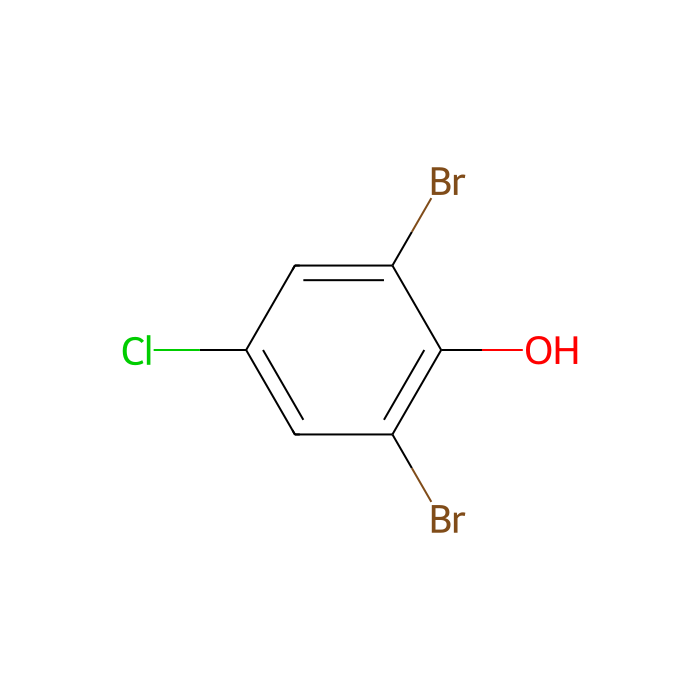
A halogenated phenolic building block featuring two bromine atoms ortho to the hydroxyl and a chlorine para to the hydroxyl on a benzene ring.
Notes:
Functional group set and reactivity:
Representative transformations (literature):
Retrosynthetic value:
Not applicable. This product is a small-molecule chemical building block and is not an antibody, enzyme, or biological that exhibits target/epitope specificity. No target-related information is provided in the Product Data.