Determine the necessary mass, volume, or concentration for preparing a solution.
Product introduction
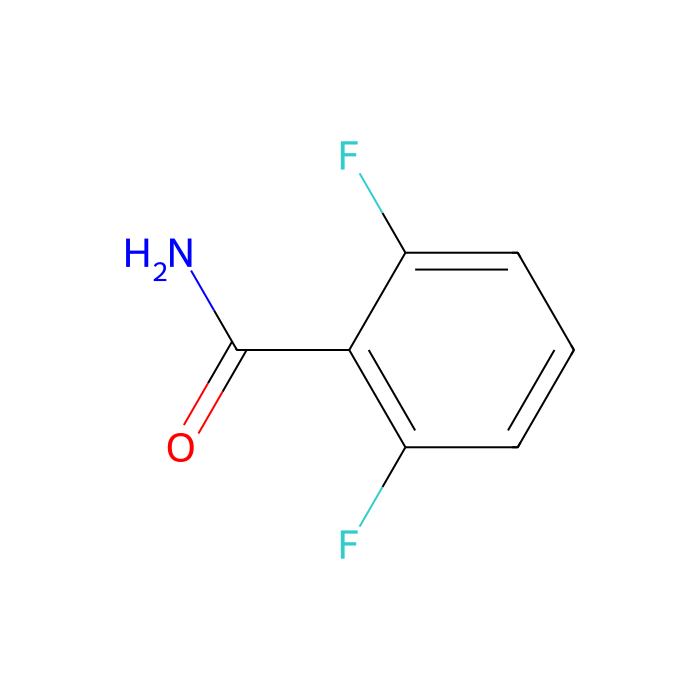
2,6-Difluorobenzamide is a major metabolite of pesticide diflubenzuron and has been quantitated by HPLC/diode-array method.
Taxonomy Tree
| Kingdom | Organic compounds |
|---|---|
| Superclass | Benzenoids |
| Klasse | Benzene and substituted derivatives |
| Subclass | Benzoic acids and derivatives |
| Intermediate Tree Nodes | Halobenzoic acids and derivatives |
| Direct Parent | 2-halobenzoic acids and derivatives |
| Alternative Parents | Benzamides Benzoyl derivatives Fluorobenzenes Aryl fluorides Vinylogous halides Primary carboxylic acid amides Organopnictogen compounds Organooxygen compounds Organonitrogen compounds Organofluorides Organic oxides Hydrocarbon derivatives |
| Molecular Framework | Aromatic homomonocyclic compounds |
| Substituents | 2-halobenzoic acid or derivatives - Benzamide - Benzoyl - Fluorobenzene - Halobenzene - Aryl fluoride - Aryl halide - Vinylogous halide - Carboxamide group - Primary carboxylic acid amide - Carboxylic acid derivative - Organofluoride - Organohalogen compound - Organic nitrogen compound - Hydrocarbon derivative - Organic oxide - Organopnictogen compound - Organic oxygen compound - Organonitrogen compound - Organooxygen compound - Aromatic homomonocyclic compound |
| Beschreibung | This compound belongs to the class of organic compounds known as 2-halobenzoic acids and derivatives. These are benzoic acids or derivatives carrying a halogen atom at the 2-position of the benzene ring. |
| External Descriptors | Not available |
Find and download the COA for your product by matching the lot number on the packaging.
| Lot Number | Certificate Type | Datum | Artikel |
|---|---|---|---|
| Certificate of Analysis | Sep 07, 2026 | D110181 | |
| Certificate of Analysis | Sep 01, 2026 | D110181 | |
| Certificate of Analysis | May 20, 2026 | D110181 | |
| Certificate of Analysis | May 20, 2026 | D110181 | |
| Certificate of Analysis | May 20, 2026 | D110181 | |
| Certificate of Analysis | May 20, 2026 | D110181 | |
| Certificate of Analysis | Jan 22, 2024 | D110181 | |
| Certificate of Analysis | Feb 03, 2023 | D110181 | |
| Certificate of Analysis | Jun 15, 2022 | D110181 |
| Löslichkeit | ethanol: soluble 5%, clear to turbid, colorless to light yellow |
|---|---|
| Schmelzpunkt (°C) | 145°C |
| Molekulargewicht | 157.12 |
| XLogP3 | 0.300 |
| Hydrogen Bond Donor Count | 1 |
| Hydrogen Bond Acceptor Count | 3 |
| Rotatable Bond Count | 1 |
| Exact Mass | 157.034 Da |
| Monoisotopic Mass | 157.034 Da |
| Topological Polar Surface Area | 43.100 Ų |
| Heavy Atom Count | 11 |
| Formal Charge | 0 |
| Complexity | 153.000 |
| Isotope Atom Count | 0 |
| Defined Atom Stereocenter Count | 0 |
| Undefined Atom Stereocenter Count | 0 |
| Defined Bond Stereocenter Count | 0 |
| Undefined Bond Stereocenter Count | 0 |
| The total count of all stereochemical bonds | 0 |
| Covalently-Bonded Unit Count | 1 |
H302:Harmful if swallowed
H315:Causes skin irritation
H319:Causes serious eye irritation
H332:Harmful if inhaled
H335:May cause respiratory irritation
P261:Avoid breathing dust/fume/gas/mist/vapors/spray.
P264:Wash hands [and …] thoroughly after handling.
P270:Do not eat, drink or smoke when using this product.
P271:Use only outdoors or in a well-ventilated area.
P280:Wear protective gloves/protective clothing/eye protection/face protection.
P321:Specific treatment (see ... on this label).
P330:Rinse mouth.
P302+P352:IF ON SKIN: wash with plenty of water.
P304+P340:IF INHALED: Remove person to fresh air and keep comfortable for breathing.
P305+P351+P338:IF IN EYES: Rinse cautiously with water for several minutes. Remove contact lenses if present and easy to do - continue rinsing.
P362+P364:Take off contaminated clothing and wash it before reuse.
P405:Store locked up.
P403+P233:Store in a well-ventilated place. Keep container tightly closed.
P501:Dispose of contents/container to an approved waste disposal plant.
P264+P265:Wash hands [and …] thoroughly after handling. Do not touch eyes.
P301+P317:IF SWALLOWED: Get medical help.
P317:Get emergency medical help.
P337+P317:If eye irritation persists: Get medical help.
P332+P317:If skin irritation occurs: Get medical help.
P319:Get medical help if you feel unwell.
No application protocols are validated or provided for this specific item (e.g., WB, IHC, IF, FC are not applicable to a small-molecule building block).
For any specialized method, develop and validate internally under your laboratory’s QA procedures.
This product is supplied strictly for research and laboratory use. No biological activity, pharmacology, or clinical utility is claimed for this catalog item.
Item-specific (Product Data): Research Use Only.
Literature/general context:
Practical note: If used in biochemical assays (e.g., as a negative control scaffold), ensure compound purity and remove residual reagents/solvents that might confound biological readouts. Record exact solvent and concentration (e.g., DMSO percentage) for reproducibility. Any cell-based or enzymatic work should include appropriate DMSO-only controls and orthogonal analytical confirmation of compound integrity.
2,6-Difluorobenzamide is not a buffering reagent and is not typically used to prepare biological or analytical buffer systems.
For canonical buffer recipes, refer to standard laboratory references; this product does not substitute for dedicated buffering agents.
Opportunities to improve the sustainability profile when working with 2,6-difluorobenzamide focus on solvent choice and reagent selection, as the substrate itself is a halogenated aromatic whose intrinsic green profile is fixed.
Solvent choices (green vs conventional; literature/general):
Reagent alternatives:
Process considerations:
Trade-offs: Greener solvents can affect rates/selectivity and may complicate isolation due to high boiling points; pilot small-scale trials are recommended.
No pharmacopeial status, excipient role, or clinical application is specified for this item. It is offered for research use only and is best considered a synthetic intermediate or medicinal chemistry scaffold.
Item-specific (Product Data): Grade/purity not specified; no pharmacopoeial monograph indicated.
Literature/general context:
Regulatory note: For any GMP or clinical manufacturing intent, source material must be qualified to appropriate compendial or bespoke specifications. This catalog item is not represented as GMP-grade.
Item-specific values (specifications) have not been provided for this catalog entry. Refer to the product’s CoA/Spec Sheet for verified numerical specifications.
Item-specific (Product Data):
Literature/general expectations for 2,6-difluorinated benzamides (not item specifications):
Important: Do not treat literature descriptions as product specifications. For precise values (mp, bp, density, refractive index, UV cutoff, water/peroxide/metal content, etc.), consult the current CoA/Spec Sheet for SKU D110181.
The Product Data do not specify a grade or purity for this item. For quantitative acceptance criteria (assay, residual solvents, trace metals, UV cutoff, water content), refer to the CoA/Spec Sheet that accompanies each lot.
Item-specific (Product Data):
Interpreting common grades (general guidance):
Stabilizers and additives:
Recommended user QC (general):
2,6-Difluorobenzamide serves as a versatile intermediate and building block, with the amide acting as both a functional handle and a directing group, and the ortho-difluoro pattern modulating reactivity and sterics.
Synthetic intermediate roles (literature/general):
Effects of difluoro substitution:
Practical tips:
The following conditions are general literature guidance for transformations of aromatic primary amides and may require optimization for 2,6-difluorobenzamide. They are not specifications for this product.
Hofmann rearrangement to 2,6-difluoroaniline (literature example):
Dehydration to 2,6-difluorobenzonitrile:
Hydrolysis to 2,6-difluorobenzoic acid:
Metalation/electrophile trapping (advanced):
Monitoring: LC-MS, 1H/13C NMR, and 19F NMR (distinct ortho-F signals facilitate conversion tracking). Always run small-scale trials before scale-up.
Safety classifications (GHS, pictograms, H-statements, signal word) are not provided in the Product Data for this item. Always consult the product’s SDS for authoritative hazard and precautionary information.
Item-specific (Product Data):
General handling guidance for aromatic amides (literature/best practice):
Note: Specific exposure limits, environmental hazards, or chronic toxicity information must be taken from the official SDS for this SKU.
As an aromatic primary amide, 2,6-difluorobenzamide typically exhibits limited aqueous solubility but dissolves in polar organic media.
Item-specific (Product Data): No solvent recommendations are specified; verify solubility empirically for your lot.
Literature/general guidance for benzamide derivatives:
Practical selection tips:
Note: Always confirm chemical compatibility of the solvent with the intended transformation and downstream analysis.
Item-specific (Product Data):
General storage guidance for aromatic amides (best practice):
Reconstitution/preparation of solutions (general):
Note: Exact stability-in-solution and maximum recommended storage times are not specified for this item; consult the CoA/SDS and perform small-scale stability checks under your conditions.
A difluorinated benzamide scaffold useful as an aromatic amide building block and intermediate.
Notes:
The combination of an anilide-type amide and ortho,ortho-difluoro substitution provides a handle for multiple divergent transformations and for modulating sterics/electronics in aromatic chemistry.
Transformations from the amide (literature/general):
Ring functionalization context:
Practical notes:
Not applicable. This product is a small organic building block, not a biological macromolecule or affinity reagent. No antigen/epitope/clone/isotype information is associated with this catalog item.