This compound belongs to the class of organic compounds known as benzoyl derivatives. These are organic compounds containing an acyl moiety of benzoic acid with the formula (C6H5CO-).
External Descriptors
Not available
1. Djoumbou Feunang Y, Eisner R, Knox C, Chepelev L, Hastings J, Owen G, Fahy E, Steinbeck C, Subramanian S, Bolton E, Greiner R, and Wishart DS. ClassyFire: Automated Chemical Classification With A Comprehensive, Computable Taxonomy. Journal of Cheminformatics, 2016, 8:61.
Determine the necessary mass, volume, or concentration for preparing a solution.
Dilution Calculator
Determine the dilution needed to prepare a stock solution.
Reconstitution Calculator
Bewertungen
Kundenbewertungen
Application Protocols
Not applicable. No immunoassay or biochemical kit applications (e.g., WB, IHC, IF, FC) are defined for this small-molecule reagent.
Practical note
For synthetic applications, refer to the Reaction Conditions, Reaction & Applications, and Synthetic Utility sections for literature-based procedural guidance and optimization tips.
Biological Roles
This compound is a synthetic aromatic aldehyde, not a natural metabolite. It is primarily used as a chemical building block in research chemistry.
General biochemical considerations (literature; not product-specific)
Aromatic aldehydes can form reversible Schiff bases with primary amines in biomolecules (e.g., lysine), potentially modifying proteins in vitro; this underlies reductive amination workflows but also motivates cautious handling in biological settings.
The presence of an aryl bromide increases hydrophobicity and may enhance nonspecific membrane partitioning, but no defined biological pathway involvement is known for this specific structure.
Not known to serve as a cofactor, nutrient, or signaling molecule in standard biochemical pathways.
Use context
Employed as an intermediate en route to more complex scaffolds that may have biological activity; any biological evaluation pertains to downstream products, not to this reagent itself.
No medical or clinical claims are made; for research use only (as noted in Product Data).
Buffer Applications
This product is a hydrophobic aromatic aldehyde and is not used as a buffering agent. It does not participate in acid/base equilibria within the physiological pH range suitable for buffer preparation.
Practical note
When reactions are conducted in biphasic aqueous/organic systems (e.g., Suzuki couplings), aqueous buffers may be used to control pH for catalyst/base compatibility; however, the aldehyde itself is not a buffer component.
For any aqueous handling, limit exposure time to reduce hydrolysis/oxidation of the aldehyde and to avoid undesired side reactions.
Green Alternatives
Solvent substitutions (literature guidance)
Replace chlorinated solvents (e.g., DCM, CHCl3) with greener options where feasible: toluene, ethyl acetate, 2-MeTHF, CPME, or dimethyl carbonate for extractions and reactions.
In Suzuki couplings, aqueous ethanol, propylene carbonate, or water–tolerant ethers (2-MeTHF) can reduce VOC impact and facilitate phase separation.
Workup/waste minimization
Favor solvent systems enabling direct crystallization or telescoping to avoid intermediate isolations of sensitive aldehydes.
Segregate halogenated waste streams; switch to non-halogenated media when compatible to cut halogenated waste volumes.
Catalyst and reagent choices
Use ligand-enabled, low-Pd-loadings or Ni-catalyzed couplings to reduce precious metal use; heterogeneous Pd/C under transfer hydrogenation conditions for certain reductive steps can be greener than hydride reagents.
Oxidations: Pinnick (NaClO2) or O2-catalyzed variants can be preferable to stoichiometric chromium oxidants.
Comparative snapshot (general)
THF vs 2-MeTHF: 2-MeTHF is bio-based, less miscible with water, and often allows easier separations; THF forms peroxides and is fossil-derived.
DCM vs EtOAc/toluene: EtOAc and toluene have better EHS profiles; DCM offers superior solvency but higher toxicity and environmental burden.
Note: Selection must balance EHS gains with chemoselectivity for the aldehyde and aryl bromide; always verify performance at small scale.
Pharmaceutical Uses
Role in pharma R&D/manufacturing (general; not product-specific)
Functions as a versatile intermediate for structure–activity relationship (SAR) exploration: the aldehyde enables diversity via reductive amination/olefination, and the aryl bromide provides an entry to rapidly install aryl/alkenyl/alkyl motifs via cross-coupling.
Can be incorporated into API synthesis routes as a late-stage functional handle, allowing orthogonal elaboration under mild conditions.
Formulation/excipient status
Not used as an excipient; not a pharmacopoeial buffer or solvent. Handling is limited to synthetic steps in drug substance development.
Process considerations (general)
Protect the aldehyde (e.g., acetal) during base-intensive cross-couplings to minimize impurity formation; deprotect under mild acidic conditions compatible with GMP operations.
Control residual palladium when couplings are used in GMP settings; plan for metal scavenging and appropriate in-process controls.
Stability: store under inert atmosphere (aligns with Product Data: Argon charged) to mitigate oxidation to the corresponding benzoic acid impurity; monitor by HPLC or GC.
No therapeutic claims are made; this reagent is for research and manufacturing use only.
Physical Properties
Item-specific (from Product Data)
Appearance: Not specified for this item; refer to CoA/Spec Sheet.
Physical constants (BP, MP, density, refractive index, UV cutoff, water/peroxide/metal limits): Not specified for this item; refer to CoA/Spec Sheet.
Literature/general properties of substituted benzaldehydes (for reference; not product specifications)
State/volatility: Many bromo-substituted benzaldehydes are low-melting solids or high-boiling liquids with low vapor pressure. Ortho halogenation can raise melting/boiling points relative to unsubstituted benzaldehyde due to increased molecular weight and halogen polarizability.
Solubility profile: Poorly soluble in water; readily soluble in common organic solvents (e.g., dichloromethane, chloroform, toluene, THF, ethyl acetate, acetonitrile, alcohols). Aldehydes can undergo hydration in strongly aqueous/basic media.
Spectroscopic signatures (typical, literature):
IR: strong C=O stretch of aromatic aldehydes typically ~1690–1725 cm−1; aldehydic C–H bands near ~2720–2820 cm−1 (Fermi doublet).
13C NMR: carbonyl carbon typically ~190–195 ppm; ipso carbons deshielded by Br.
Partitioning: Aryl bromide/methyl substitution generally increases lipophilicity (logP elevated relative to benzaldehyde), aiding extraction into nonpolar solvents.
Handling-related physical behavior (general)
Aldehydes may slowly oxidize to the corresponding carboxylic acid upon air exposure; exclude air/moisture for best stability (aligns with argon-charged storage in Product Data).
Quality and Grades
Item-specific (from Product Data)
Grade/Purity: Not specified for this item; refer to CoA/Spec Sheet.
Interpreting common grades (general guidance; not product-specific)
Analytical/Reagent grade: suitable for most synthetic applications; typical impurity controls for routine analysis.
High-purity/99%+: preferred for fine organic synthesis and medicinal chemistry to minimize impurity-related side reactions (e.g., background aldol, acid-catalyzed polymerization).
HPLC grade solvents vs reagents: for reagents like aryl aldehydes, “HPLC grade” is uncommon; however, low-UV-absorbing solvents are relevant when this compound is used as an analyte or standard.
Stabilizers/inhibitors: Aromatic aldehydes generally do not require radical inhibitors, but they benefit from storage under inert gas to suppress slow air oxidation to the benzoic acid derivative. The Product Data specifies Argon-charged storage, which aligns with best practice.
Quality considerations specific to aryl aldehydes (general)
Peroxide content: not typically relevant (more pertinent to ethers); still, check solvents for peroxides when performing sensitive reactions.
Acid content: trace benzoic acid analog may form over time; a quick pre-use check by TLC/GC is recommended after prolonged storage.
Water content: moisture can accelerate side reactions; dry solvents and handle under inert atmosphere for moisture-sensitive transformations (e.g., Wittig/HWE).
Reaction and Applications
This bifunctional building block offers two orthogonal handles: an electrophilic aryl bromide for cross-coupling and a reactive aldehyde for carbonyl chemistry.
Cross-coupling on the aryl bromide (literature)
Suzuki–Miyaura to access 2-aryl-4-methylbenzaldehydes; Pd(0/II) catalysts with base (K2CO3, K3PO4) in toluene/dioxane/H2O. Ortho bromide typically couples efficiently; aldehyde generally tolerated under mild/basic conditions—protect if sensitive downstream.
Stille/Negishi/Kumada: conversion to diverse aryl/alkenyl/alkyl derivatives using organostannanes, -zincs, or -magnesium reagents; control to avoid 1,2-addition of organometallics to the aldehyde (protect as acetal if necessary).
Buchwald–Hartwig amination: install anilines under Pd catalysis; employ mild bases and lower temperatures to preserve aldehyde.
Reductive amination to benzylamines; chemoselective reducing agents (NaBH3CN, NaBH(OAc)3) in aprotic solvents.
Nucleophilic additions (Grignard/organolithium) to form secondary alcohols; protect the aldehyde or perform lithium–halogen exchange carefully to avoid ortho-metalation/debromination.
Oxidation to the corresponding benzoic acid derivative (e.g., with MnO2 or Pinnick) while retaining the aryl bromide for subsequent coupling.
Practical tips
Given susceptibility of aldehydes to air oxidation, store and handle under inert gas (matches Product Data: Argon charged).
For cross-couplings, consider transient protection of the aldehyde as an acetal to prevent base- or nucleophile-induced side reactions; deprotect under mild aqueous acid.
Monitor for protodebromination at elevated temperatures; choose catalyst/ligand to mitigate (e.g., bulky biaryl phosphines).
Reaction Conditions
Literature guidance (general; typical conditions—optimize per substrate and scale):
Suzuki–Miyaura coupling at the aryl bromide
Catalyst: Pd(PPh3)4 (1–3 mol%) or Pd2(dba)3 (1 mol%) with SPhos/XPhos (2–4 mol%).
Base: K2CO3 or K3PO4 (2–3 equiv).
Solvent: toluene/dioxane/H2O (e.g., 3:1:1) or 2-MeTHF/H2O.
Temperature/time: 80–100 C, 2–12 h. Protect aldehyde as needed.
Buchwald–Hartwig amination
Catalyst: Pd2(dba)3 (1 mol%) with BINAP or BrettPhos; base: NaOtBu or Cs2CO3.
Solvent: toluene, dioxane.
Temperature: 80–110 C; monitor for aldehyde sensitivity.
Wittig olefination (to styrenes)
Reagent: stabilized or semi-stabilized ylides generated from phosphonium salts with NaH/NaHMDS.
Solvent: THF or toluene, anhydrous; 0–25 C (stabilized ylides) to reflux (non-stabilized) depending on E/Z target.
Reductive amination
Conditions: amine (1.1–1.5 equiv), AcOH (0.2–0.5 equiv) to aid iminium formation; NaBH3CN or NaBH(OAc)3 (1.2–1.5 equiv).
Solvent: MeOH, DCE, THF, or MeCN; 0–25 C, 1–6 h.
Oxidation of aldehyde to acid (retaining C–Br)
Pinnick oxidation: NaClO2 (1.5–2 equiv), NaH2PO4 buffer, tert-butanol/H2O; 0–25 C.
Workup/handling tips
Maintain inert atmosphere (argon/nitrogen) to suppress aldehyde oxidation (aligns with Product Data).
Avoid strong bases at high temperature without protection—can lead to Cannizzaro-like side processes or aldehyde degradation; monitor by TLC/LCMS.
Safety and Handling
Item-specific hazard information (from Product Data)
Signal Word: Not specified for this item; refer to SDS.
H-Statements: Not specified for this item; refer to SDS.
GHS Classification/Pictograms: Not specified for this item; refer to SDS.
General safety guidance for aromatic aldehydes and aryl bromides (literature; not product-specific)
Likely hazards: skin/eye irritation; respiratory irritation from vapors; harmful if swallowed. Aldehydes can be sensitizers in some cases. Avoid inhalation of vapors and contact with skin/eyes.
PPE: use chemical-resistant gloves (e.g., nitrile), lab coat, safety glasses or splash goggles. Employ fume hood during weighing, transfers, and reactions.
First aid (overview; defer to SDS):
Inhalation: move to fresh air; seek medical attention if symptoms persist.
Skin contact: remove contaminated clothing; wash with soap/water.
Eye contact: rinse cautiously with water for at least 15 minutes; seek medical attention.
Ingestion: rinse mouth; do not induce vomiting; seek medical attention.
Incompatibilities: strong oxidizers (risk of over-oxidation to acid), strong bases (aldol-type side reactions; Cannizzaro in non-enolizable aldehydes—less applicable here due to enolizable ring), strong reducing agents (may reduce C=O or debrominate). Avoid prolonged exposure to air/oxygen and light to minimize oxidation.
Always consult the product SDS for authoritative, product-specific safety information.
Solvent Selection
Solubility/miscibility (general for brominated benzaldehydes)
Highly soluble in chlorinated solvents (DCM, chloroform), aromatic solvents (toluene, xylene), ethers (THF, MTBE, CPME), and moderately to highly soluble in polar aprotic media (DMF, DMSO, MeCN). Poorly soluble in water; immiscible as a separate organic phase.
Polarity and dielectric environment
As a moderately polar, largely nonionizable molecule, reactions at the aldehyde are well supported in aprotic media; cross-couplings on the aryl bromide tolerate mixed aqueous/organic systems when using appropriate bases.
Choosing a medium by transformation (literature guidance)
Nucleophilic additions/reductions to the aldehyde: THF, Et2O, or toluene under anhydrous conditions; for hydride reductions, alcohols (MeOH/EtOH) or THF are common.
Wittig/Horner–Wadsworth–Emmons: anhydrous THF, toluene, or DMF; base such as NaHMDS/KOtBu or NaH depending on ylide/phosphonate.
Suzuki–Miyaura: toluene, dioxane, or MeOH/THF with water co-solvent; bases K2CO3, K3PO4, Cs2CO3.
Reductive amination: MeOH/EtOH, THF, or MeCN with mild acid catalysis; hydrogenation or silane-based reductants.
General guidance for aromatic aldehydes (supportive best practices)
Inert atmosphere: Maintain argon or nitrogen blanket to minimize oxidation to the corresponding benzoic acid; purge headspace after each use.
Light/moisture: Store in amber, tightly sealed containers; minimize moisture exposure. Use dry syringes or spatulas.
Stability checks: After prolonged storage, verify purity by TLC/GC/HPLC; if minor acid has formed, a quick alkaline wash (if compatible) during workup can remove it.
If solid or viscous at RT (varies by substitution pattern; not specified for this item)
Gentle warming to ambient or slightly above can aid handling. Do not overheat; avoid prolonged exposure to air when warmed.
Solution preparation (general)
Dissolves readily in common organic solvents (e.g., DCM, THF, toluene, EtOAc, MeCN). Prepare stock solutions under inert gas; for moisture-sensitive reactions, use anhydrous, oxygen-free solvents.
Avoid repeated freeze–thaw cycles of stock solutions; aliquot if long-term storage is anticipated.
For definitive storage stability and any item-specific limits, consult the product CoA/Spec Sheet and SDS.
Structure and Identity
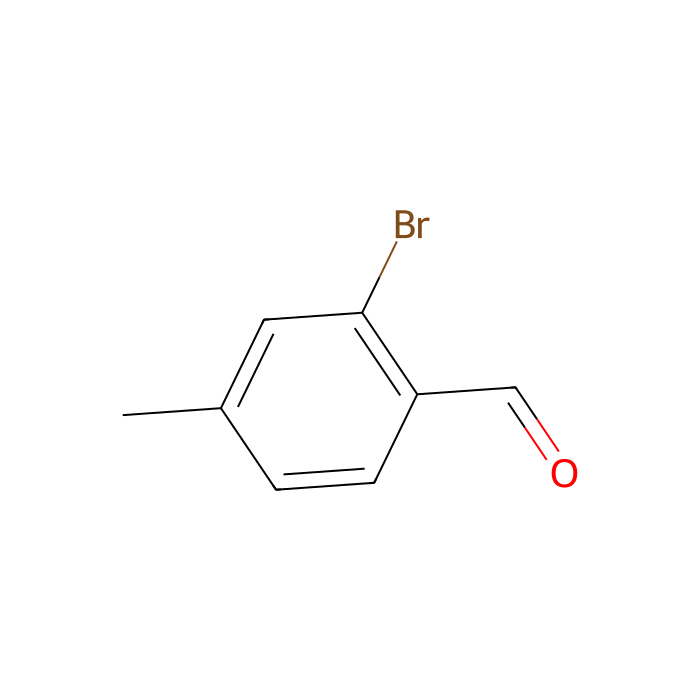
Brief description: 2-Bromo-4-methylbenzaldehyde is an ortho-brominated, para-methyl–substituted benzaldehyde, combining an electrophilic aryl bromide with a reactive aldehyde function.
Item-specific (from Product Data)
CAS: 824-54-4
InChIKey: 229208
Molecular Formula: Not specified for this item; refer to CoA/Spec Sheet.
Molecular Weight: Not specified for this item; refer to CoA/Spec Sheet.
SMILES: Not specified for this item; refer to CoA/Spec Sheet.
Literature/computed (for reference only; not product specifications)
Structural features: one benzene ring bearing an aldehyde (–CHO) at C1, a bromine at the ortho position (C2), and a methyl group at the para position (C4) relative to the formyl carbon.
2D structure described in words (general)
A planar aromatic ring. The formyl carbon (sp2) is directly attached to the ring; the aldehyde carbonyl is conjugated with the ring, enhancing electrophilicity.
Bromine (ortho) increases aryl C–Br reactivity in cross-coupling while exerting an ortho-directing, deactivating effect in SEAr. The para methyl is weakly activating and ortho/para directing, subtly modulating ring electronics.
No stereocenters; molecule is achiral.
Functional groups
Aromatic aldehyde (electrophilic carbonyl)
Aryl bromide (cross-coupling handle)
Alkyl substituent (methyl) influencing lipophilicity and directing effects.
Synthetic Utility
Orthogonal functionality
Aryl bromide: reliable handle for Pd/Ni-catalyzed cross-couplings (Suzuki, Stille, Negishi, Kumada, Heck). Ortho positioning relative to the aldehyde can enable directed ortho-metalation strategies for further functionalization after appropriate protection of the carbonyl.
Aldehyde: platform for C–C bond formation (Wittig/HWE/Julia olefinations), C–N formation (reductive amination/urea formation post-oxime), and C–O formation (acetalization, hemiacetal chemistry).
Retrosynthetic advantages (literature)
Enables convergent synthesis: install the aryl partner via coupling, then diversify the benzylic position through aldehyde chemistry, or vice versa.
The para-methyl substituent can tune electronics and sterics, influencing coupling rates and directing selectivity in electrophilic aromatic substitution when used upstream.
Selectivity tactics
Chemoselective reductions: choose NaBH(OAc)3/NaBH3CN for iminium reduction without affecting aryl bromide; avoid strong hydrides (LiAlH4) when C–Br integrity is required.
Temporary protection: convert the aldehyde to acetals (ethylene glycol, p-TsOH, Dean–Stark) for stability under basic or nucleophilic conditions; deprotect in aqueous acid.
Avoid lithium–halogen exchange when the aldehyde is free; use milder metalation strategies or protect/convert prior to exchange.
Derivatization examples (general)
Suzuki coupling with (hetero)aryl boronic acids → 2,4-disubstituted benzaldehydes.
Wittig olefination → 4-methyl-2-bromostyrenes for further functionalization (e.g., Heck, hydroboration).
Target Specificity
Not applicable. This product is a small-molecule organic reagent (aryl aldehyde) and does not possess biological target specificity such as antigen/epitope binding, clone, isotype, or species reactivity. For target-focused content, see antibody or biochemical probe listings.
Wir verwenden Cookies, um die ordnungsgemäße Funktion der Website sicherzustellen und, soweit zulässig, Ihr Nutzererlebnis zu verbessern. Sie können Ihre Einstellungen jederzeit unter „Einstellungen“ verwalten. Weitere Informationen finden Sie in unserer Cookie-Richtlinie.
Dürfen wir Sie über Rabattaktionen informieren?
Später erinnern
Vielen Dank! Bitte überprüfen Sie Ihren E-Mail-Posteingang, um zu bestätigen.
Products are supplied to verified businesses, institutions, and qualified professionals for research and development use only. Not for use in humans, animals, diagnosis, or therapy.

 I1906014