This compound belongs to the class of organic compounds known as chlorobenzenes. These are compounds containing one or more chlorine atoms attached to a benzene moiety.
External Descriptors
Not available
1. Djoumbou Feunang Y, Eisner R, Knox C, Chepelev L, Hastings J, Owen G, Fahy E, Steinbeck C, Subramanian S, Bolton E, Greiner R, and Wishart DS. ClassyFire: Automated Chemical Classification With A Comprehensive, Computable Taxonomy. Journal of Cheminformatics, 2016, 8:61.
Determine the necessary mass, volume, or concentration for preparing a solution.
Dilution Calculator
Determine the dilution needed to prepare a stock solution.
Reconstitution Calculator
Bewertungen
Kundenbewertungen
Application Protocols
Not applicable. No antibody or assay application protocols (e.g., WB, IHC, IF, FC) are associated with this small-molecule reagent. For practical synthetic use, refer to the Reaction Conditions and Reaction & Applications sections for representative procedures and conditions. If preparing analytical solutions, typical practice is to dissolve an accurately weighed amount in DMSO or MeOH to make a stock solution (e.g., 10–100 mM), then dilute as required for reaction screening or in vitro assays, ensuring complete dissolution and compatibility with the assay medium.
Biological Roles
Item-specific biological data: Not specified for this item; refer to primary literature if required.
General context (literature/general; no medical claims):
Amidoxime functionality is a recognized bioisostere and synthetic handle in medicinal chemistry. The N–O bond enables prodrug strategies, where enzymatic reduction can unmask an amidine in vivo; this concept informs discovery workflows but requires rigorous ADME/tox evaluation in research settings.
The 2-chloro substituent is a synthetically useful handle rather than a biological motif; it supports late-stage diversification of aromatic scaffolds for SAR exploration (e.g., via cross-coupling to tune polarity, aromatic electronics, and steric bulk).
Physicochemical implications: Relative to the parent amidine, the amidoxime is less basic and may show improved passive permeability in model systems (literature), aiding in in vitro assay development and structure–property studies.
Binding considerations: The amidoxime can act as a bidentate H-bond donor/acceptor; in biomimetic recognition studies it can chelate metal ions or engage in dual H-bonding to polar residues, though such interactions are highly context-dependent and target-specific.
Caution: Any biological testing should adhere strictly to research-use-only restrictions. No clinical or diagnostic use is intended or implied.
Buffer Applications
This compound is not a buffer reagent and is not typically used to prepare biochemical buffer systems. As an organic building block (amidoxime), it lacks defined acid–base pairs suited for precise pH buffering over a narrow range. For practical use, focus on the Reaction & Applications, Synthetic Utility, and Reaction Conditions sections. If preparing assay solutions, dissolve the compound in an appropriate organic solvent (e.g., DMSO) and dilute into a biologically compatible buffer while monitoring for precipitation and pH drift.
Green Alternatives
Greener solvent choices for common transformations (literature/general guidance):
| Transformation | Conventional choice | Greener alternative(s) | Notes/Tradeoffs |
|---|---|---|---|
| N–O reduction to amidine | DMF/AcOH, THF | EtOH, i-PrOH, water–alcohol mixtures | Protic media support metal reductions (Zn, Fe) and simplify workup; watch solubility. |
| Oxadiazole cyclodehydration | DCM, DMF with DCC | EtOAc, 2-MeTHF, Me-THF with EDCI | Safer solvents; carbodiimide choice impacts urea waste; EDCI is water-soluble. |
| O-alkylation | DMF, NMP | Acetonitrile, 2-MeTHF, CPME | Lower toxicity/boiling point; may require longer times or phase-transfer catalysis. |
| Cross-coupling on Ar–Cl | Dioxane/toluene | 2-MeTHF, CPME, green alcohols | Ensure ligand/base set compatible with greener solvent environment. |
Waste minimization and energy:
Favor catalytic hydrogenation (H2, Pd/C) over stoichiometric metal reductions where functional-group tolerance allows; it reduces metal salt waste.
Employ aqueous micellar catalysis (e.g., surfactant media) for C–C/C–N couplings to reduce organic solvent use (growing literature base for aryl chlorides).
Safer reagents and processing:
Replace POCl3/SOCl2 cyclodehydrations with dehydrative couplings using EDCI or CDI where feasible.
Utilize flow chemistry for exothermic steps (alkylations, reductions) to improve heat/mass transfer and reduce solvent volumes.
Lifecycle considerations:
Select alcohols and esters with favorable environmental profiles (EtOH, EtOAc). Recover and recycle polar aprotics where used (DMF reclamation under validated protocols).
Pharmaceutical Uses
Item-specific pharmacopeial status: Not specified for this item; refer to CoA/Spec Sheet.
General roles in pharmaceutical process chemistry (no therapeutic claims):
Intermediate: Aromatic amidoximes serve as precursors to amidines and 1,2,4-oxadiazoles, motifs frequently encountered in discovery and development pipelines. The ortho-chloro handle facilitates modular diversification late in synthesis.
Enabling chemistry: Using amidoximes to access amidines can avoid harsh Pinner conditions from nitriles and enable milder, higher-yielding routes compatible with sensitive functionalities.
Salt formation: Although amidoximes are less basic than amidines, both free base and salt forms may be leveraged to tune crystallinity and processability during API intermediate isolation (general guidance).
Formulation/excipient role: None typically. This is a synthetic building block, not an excipient.
Quality considerations in GMP-adjacent settings:
Control of residual metals and reagents after N–O reductions or cross-couplings (ICH Q3D, Q3C) is essential if material enters a regulated supply chain.
Robust impurity fate-and-purge strategies should address potential O-/N-alkylation isomers, over-reduced byproducts, and ureide residues from carbodiimide couplings.
Solid form: Evaluate polymorphism/solvate formation where isolation via crystallization is used; amidoximes can form strong solvate adducts through H-bonding.
Physical Properties
Item-specific properties (from Product Data):
Appearance: Not specified for this item; refer to CoA/Spec Sheet.
Molecular weight: Not specified for this item; refer to CoA/Spec Sheet.
Common/literature expectations for 2-chloro-N-hydroxybenzimidamide and related amidoximes (informational, not item specifications):
Physical state: Typically a crystalline solid for substituted benzamidoximes due to strong intermolecular H-bonding networks.
Polarity and hydrogen bonding: High HBD/HBA count; often shows moderate to high polarity and limited volatility.
Solubility profile: Sparingly soluble in water at neutral pH; improved solubility in polar aprotic organic solvents (e.g., DMSO, DMF, NMP) and in alcohols (MeOH, EtOH). Solubility can increase in mildly acidic/basic aqueous media due to protonation/deprotonation equilibria of the amidoxime functionality.
Acid–base behavior: Amidoximes are amphoteric; pKa values vary with ring substituents. The phenyl amidoxime family typically exhibits one acidic proton (on –NOH) and one basic site (imine nitrogen), enabling salt formation (literature).
Thermal behavior: Often exhibit a defined melting point; decomposition can occur upon prolonged heating or strong acid/base treatment due to N–O bond lability (literature). Exact BP/MP for this specific compound is not listed here.
Unspecified item-specific parameters (report as needed in regulated workflows):
Melting point, boiling point, density, refractive index, UV cutoff, water content, residual metals: Not specified for this item; refer to CoA/Spec Sheet.
Quality and Grades
Item-specific grade/purity: Not specified for this item; refer to CoA/Spec Sheet.
How to interpret grades (general guidance for professional users):
Research grade: Suitable for synthetic chemistry and discovery workflows; impurity profiles may not be optimized for trace analysis.
Analytical/HPLC grade (if specified): Emphasizes low non-volatile residue and low UV background for analytical use.
Purity reporting: For heteroatom-rich building blocks like amidoximes, residual moisture and inorganic salts (from neutralization) can influence assay. Verify by 1H NMR, 13C NMR, HRMS, and CHN; Karl Fischer moisture and residual solvent screening (GC) are recommended for sensitive applications.
Stabilizers/additives:
None are specified for this item. If stabilizers were used (e.g., to protect N–O functionality), they would be disclosed on the CoA. Absence of such note typically implies neat material.
Batch-specific documentation:
Request CoA for: assay method and result, identity confirmation (NMR/HRMS), chromatographic purity (HPLC/GC), residual solvents (ICH Q3C), and water content if relevant to your process.
Practical tip:
Owing to hydrogen bonding, amidoximes may retain trace solvent/water and can present broadened NMR signals. Gentle drying under high vacuum at ambient temperature is often adequate; avoid elevated temperatures if purity is already within specification.
Reaction and Applications
Role: 2-Chloro-N-hydroxybenzimidamide is a halogenated aromatic amidoxime, widely used as a versatile intermediate in heterocycle synthesis and in the preparation of amidines.
Conversion to amidines: Selective N–O bond reduction (e.g., Zn/AcOH, TiCl3, catalytic hydrogenation, or metal hydrides under controlled conditions) affords the corresponding 2-chlorobenzamidine. This is a key route to guanidine/amidine pharmacophores.
1,2,4-Oxadiazole construction: Condensation/cyclodehydration of amidoximes with carboxylic acid derivatives (acid chlorides, anhydrides, or activated acids with DCC/EDC) yields 1,2,4-oxadiazoles. The ortho-chloro group remains available for subsequent cross-coupling.
O-/N-alkylation and rearrangements: O-alkylation of amidoximes (e.g., with alkyl halides or sulfonates) followed by base- or heat-induced O→N acyl/alkyl transfer can generate N-alkyl amidines (Curtis-like or Pinner-type variants, depending on conditions).
Cross-coupling leveraging Ar–Cl: After installing the desired heterocycle or amidine, the ortho-chloro substituent enables Pd-catalyzed Buchwald–Hartwig amination, Suzuki–Miyaura, or Negishi couplings (with appropriate ligand systems for aryl chlorides).
Practical tips:
Chemoselectivity: Control O- vs N-alkylation via base strength, counterion, and solvent (polar aprotic for O-selectivity; phase-transfer or less polar conditions can alter outcomes).
Protecting strategies: The amidoxime N–O can be masked transiently by O-acylation to guide reactivity; subsequent deprotection via hydrolysis or reduction is routine.
Workup: Metal-mediated reductions (Zn/AcOH) benefit from careful filtration over Celite and chelation washes (EDTA) to remove residual metals prior to downstream cross-coupling.
Reaction Conditions
N–O bond reduction to amidine (literature/general):
Zn/AcOH or Fe/AcOH: 0.5–2.0 equiv metal, RT to 60 °C, 1–6 h; solvents MeOH/EtOH/AcOH mixtures or EtOH alone with catalytic AcOH. Workup by filtration and basification; typical good to excellent yields reported for aryl amidoximes.
Catalytic hydrogenation: H2 (1–5 bar), Pd/C (5–10 wt%), MeOH/EtOH at RT–50 °C, 2–12 h; monitor to avoid overreduction of aryl chloride (choose catalyst/pressure accordingly).
TiCl3/THF–H2O: Stoichiometric Ti(III) for chemoselective N–O cleavage at 0–25 °C; quench carefully to remove Ti residues.
1,2,4-Oxadiazole formation:
From carboxylic acids: EDCI (1.1–1.5 equiv), catalytic DMAP, solvent EtOAc/MeCN, 0–25 °C activation, then heat 60–100 °C to cyclize (or employ CDI); 50–85% yields typical in literature.
From acid chlorides/anhydrides: Base (NEt3 or pyridine), DCM/MeCN, 0–25 °C for acylation, followed by dehydrative cyclization with POCl3 or SOCl2 under controlled conditions (use greener variants where possible).
O-alkylation to O-alkyl amidoximes:
Base: K2CO3/Cs2CO3 (1.5–2.0 equiv), solvent DMF/MeCN/2-MeTHF, alkyl halide (1.1–1.5 equiv), 0–25 °C to RT, 1–12 h. Minimize water to favor O- over N-alkylation.
Cross-coupling on the aryl chloride (post-transformation):
Suzuki–Miyaura: Pd2(dba)3 (1–2 mol%) with SPhos/XPhos (2–4 mol%), base K3PO4 or Cs2CO3, 2-MeTHF/toluene–water, 60–90 °C, 2–16 h.
Buchwald–Hartwig: Pd(OAc)2 (1–2 mol%) with BrettPhos/XPhos, NaOtBu or K3PO4, CPME/2-MeTHF, 80–110 °C.
Notes:
Protect or convert the amidoxime as needed to avoid interference in metal-catalyzed couplings (e.g., transient O-acylation). Always validate conditions for the specific substrate.
Safety and Handling
GHS information (item-specific):
Signal word: Not specified for this item; refer to SDS.
Hazard statements (H-codes): Not specified for this item; refer to SDS.
Pictograms and GHS classification: Not specified for this item; refer to SDS.
General hazards and precautions for aromatic amidoximes (literature/general guidance; consult SDS for authoritative data):
Irritation/sensitization: Amidoximes can be irritating to skin, eyes, and respiratory tract. Avoid dust formation and inhalation.
N–O bond reactivity: The amidoxime N–O bond can be sensitive to strong reducing agents and dehydrating conditions; handle away from strong oxidizers/reductants unless used intentionally in synthesis.
Thermal/chemical stability: Typically stable at ambient conditions; avoid strong acids/bases and prolonged heating that may promote rearrangement or decomposition.
PPE and handling:
Wear lab coat, safety goggles, and appropriate chemical-resistant gloves (e.g., nitrile). Use a fume hood to minimize inhalation and exposure.
Prevent contact with incompatible materials (strong acids/bases, oxidizing agents, strong dehydrating agents like POCl3) outside controlled reaction setups.
First-aid overview (general):
Inhalation: Move to fresh air; seek medical attention if symptoms persist.
Skin/eye contact: Rinse with copious water for at least 15 minutes; remove contaminated clothing; seek medical evaluation for persistent irritation.
Ingestion: Rinse mouth, do not induce vomiting; seek medical advice.
Storage from Product Data:
Store desiccated, protected from light, at room temperature. Ship under normal conditions. Always keep container tightly closed and clearly labeled.
Solvent Selection
Compound type: Polar, hydrogen-bonding solid (aromatic amidoxime) with limited aqueous solubility at neutral pH.
Good: DMSO, DMF, DMAc, NMP (high polarity, strong H-bond accepting solvents). Alcohols (MeOH, EtOH, i-PrOH) often dissolve at modest concentrations.
Moderate: Acetonitrile and ethyl acetate may dissolve upon warming or at low loadings.
Poor: Nonpolar hydrocarbons (hexanes, heptane) and chlorinated solvents (DCM, CHCl3) typically show limited solubility unless co-solvented with a polar component.
Aqueous systems: Solubility may improve under mildly acidic (to protonate the imine N) or basic (to deprotonate –NOH) conditions; beware of hydrolysis/reaction under strong conditions.
Selection guidance by use-case:
Reactions: Choose polar aprotic media (DMF, DMSO, NMP) for O-alkylation, acylation, or cyclodehydration steps. For reductions to amidines, protic co-solvents (MeOH/EtOH) with metal reductants can be advantageous.
Purification: Recrystallization from alcohol/ethyl acetate mixtures or by antisolvent addition can be effective. For chromatography, use polar eluents (EtOAc/MeOH/hexanes gradients) and add 0.1–1% NEt3 or AcOH to minimize tailing due to H-bonding.
Comparison note:
Versus less polar anilides, amidoximes demand higher polarity solvents for dissolution. Where possible, employ greener choices such as EtOAc, MeOH, or 2-MeTHF blends for processing stages.
Storage and Reconstitution
Item-specific storage (from Product Data):
Store at room temperature, desiccated, protected from light. Shipped under normal conditions.
Container and atmosphere:
Keep tightly closed in an amber or foil-wrapped container to minimize light exposure. Consider storing under inert gas (N2/Ar) after first opening to limit moisture uptake and oxidative changes, especially if long-term storage is anticipated.
Stability considerations (general/literature):
Amidoximes are generally stable solids under ambient conditions but can slowly absorb moisture due to hydrogen bonding capacity. Avoid prolonged exposure to strong acids/bases or dehydrating agents unless used intentionally in synthesis.
Reconstitution/dissolution guidance (practical, not item specifications):
Preferred solvents: DMSO, DMF, or MeOH/EtOH. Start with a small volume and sonicate or gently warm (≤40 °C) to achieve dissolution. For aqueous work, prepare a concentrated stock in DMSO or MeOH and dilute into buffer with vigorous mixing; monitor for precipitation.
Working concentrations: Common stock levels are 10–100 mM for screening; filter through 0.22 µm PTFE/RC if particulate is present.
Freeze–thaw and aliquoting:
For solution stocks, prepare single-use aliquots and store at 2–8 °C (short term, days) or −20 °C (longer term, weeks). Avoid repeated freeze–thaw cycles.
Disposal:
Dispose of unused material and solutions according to institutional hazardous waste protocols for organic nitrogen-containing compounds; segregate halogenated waste where applicable.
Structure and Identity
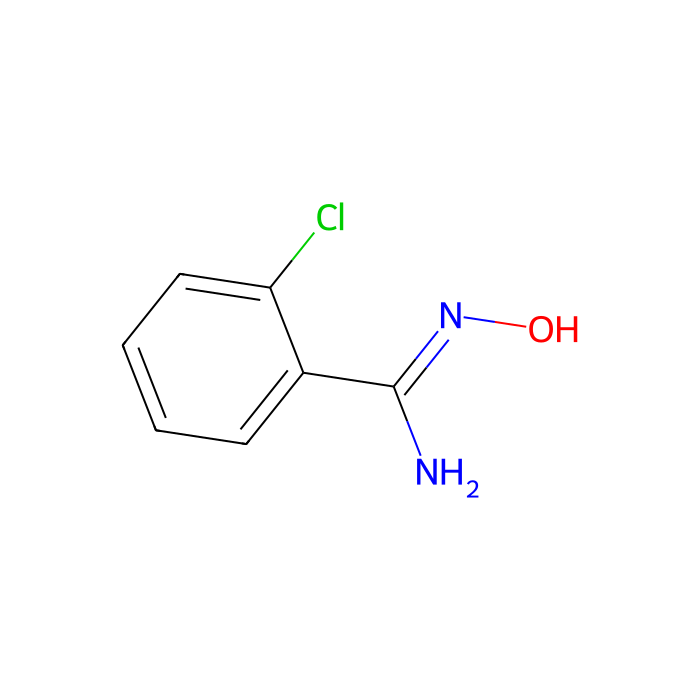
SKU: C589511; Product name: 2-Chloro-N-hydroxybenzimidamide (commonly referred to as 2-chlorobenzamidoxime).
Item-specific identifiers (from Product Data):
CAS: 56935-60-5
CID: 9634122
InChIKey: 305902 (as provided)
Molecular formula: Not specified for this item; refer to CoA/Spec Sheet.
Molecular weight: Not specified for this item; refer to CoA/Spec Sheet.
SMILES: Not specified for this item; refer to CoA/Spec Sheet.
Structural features (general description based on the chemical name; literature/structure rationale):
Core aromatic ring: A monosubstituted benzene ring bearing two ortho-related substituents.
Substitution pattern: An ortho chloro substituent (2-chloro) and a benzimidamide N-hydroxy moiety (amidoxime) directly attached to the aromatic carbonyl position (formally the benzonitrile-derived C of an amidoxime, i.e., –C(=NOH)–NH2 or resonance equivalent –C(=NO)–NH–).
Functional groups: Aromatic chloride (Ar–Cl) and an amidoxime functionality containing adjacent imine oxide (C=N–OH) and amide-like NH, capable of tautomerism (syn/anti around C=N and N–O).
Hydrogen-bonding: One N–H donor and one O–H donor; multiple heteroatoms enable strong intra-/intermolecular H-bonding.
2D structure in words: A benzene ring with a chlorine at the ortho position relative to an amidoxime carbon substituent; the benzylic carbon is doubly bonded to nitrogen (C=N) bearing an oxo-hydroxyl (–NOH) and singly bonded to an amino (–NH2/–NH–) fragment, consistent with an N-hydroxybenzimidamide.
Stereochemistry: No stereogenic centers; E/Z imine geometry may exist as rotamers/tautomers (literature/general).
Synthetic Utility
Functional group leverage:
Amidoxime (–C(=N–OH)–NH–) offers complementary nucleophilicity at O and N and undergoes selective transformations: O-acylation/alkylation, N–O bond reduction to amidines, and cyclodehydrations to 1,2,4-oxadiazoles.
Ortho-aryl chloride provides a versatile electrophile for cross-coupling, enabling rapid library expansion.
Strategic applications (literature/general):
Retrosynthesis to amidines: Install amidoxime early from nitrile, carry through synthetic steps (enhanced stability vs amidines), then unveil amidine late via reduction.
Heterocycle synthesis: Couple with carboxylic acids (EDC/DMAP or CDI) followed by cyclization to 1,2,4-oxadiazoles; ortho-chloro enables subsequent intramolecular cyclizations or intermolecular couplings for fused systems.
Umpolung at the imidamide carbon: O-activation (e.g., O-alkyl) can redirect reactivity, enabling rearrangements to N-substituted amidines under base or heat.
Selectivity control:
Base and counterion dictate O- vs N-functionalization: K2CO3/Cs2CO3 in polar aprotics favor O-alkylation; strong bases or phase-transfer conditions can increase N-alkylation.
Ligand choice for aryl chloride coupling: BrettPhos/XPhos for Buchwald–Hartwig amination; SPhos/XPhos for Suzuki with boronic acids at moderate temperatures.
Downstream diversification:
After amidine formation, ortho-chloro allows C–N/C–C formation to tune basicity, lipophilicity, and steric environment in medicinal chemistry campaigns.
Target Specificity
Not applicable. This product is a small-molecule chemical building block, not a biological macromolecule (e.g., antibody, enzyme, ligand with defined protein target specificity). No target, clone, isotype, or species reactivity information is associated with this item in the Product Data.
Wir verwenden Cookies, um die ordnungsgemäße Funktion der Website sicherzustellen und, soweit zulässig, Ihr Nutzererlebnis zu verbessern. Sie können Ihre Einstellungen jederzeit unter „Einstellungen“ verwalten. Weitere Informationen finden Sie in unserer Cookie-Richtlinie.
Shall we send you a message when we have discounts available?
Remind me later
Thank you! Please check your email inbox to confirm.
Products are supplied to verified businesses, institutions, and qualified professionals for research and development use only. Not for use in humans, animals, diagnosis, or therapy.

 K2302399